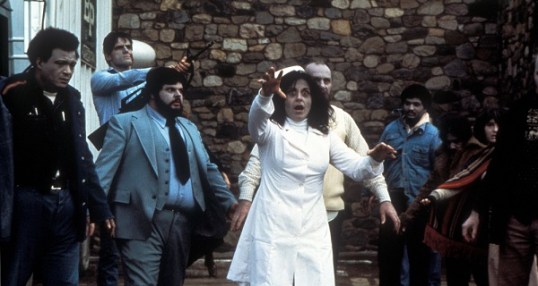
Dawn of the Dead (1978, dir by George Romero, DP: Michael Gornick)
Dario Argento not only produced and edited the European cut for 1978’s Dawn of the Dead, he also introduced George Romero to Goblin. The Italian band, famous for their horror movie soundtracks, provided the classic score to Dawn of the Dead.
(Admittedly, the score is is used far more prominently in Argento’s cut of the film than in Romero’s.)
For today’s horror song of the day, here is Goblin’s Main Theme From Dawn of the Dead.
This October, I’m going to be doing something a little bit different with my contribution to 4 Shots From 4 Films. I’m going to be taking a little chronological tour of the history of horror cinema, moving from decade to decade.
Originally broadcast in 1985, Into Thin Air is a made-for-TV movie that is based on a true story. It’s film that brings to life the horror of every family’s nightmare. Brian Walker (Tate Donavon) is an intelligent, soft-spoken, and somewhat naive college student in Ottawa. He’s been accepted into a summer writing program in Colorado. As he gets in the van that he will be driving to Colorado, he promises his mother, Joan (Ellen Burstyn), that he’ll call her when he reaches Nebraska and again when he reaches Colorado.
Brian drives away and that’s the last time that Joan ever sees her son. Brian calls from Nebraska and talks to his brother, Stephen (Sam Robards). Joan arrives home just as Stephen is saying goodbye. Brian never calls from Colorado. He has vanished, seemingly into thin air.
Joan, Stephen, and Joan’s ex-husband, Larry (played the great character actor Nicholas Pryor) travel to America to search for him. At one point, Stephen thinks that he’s spotted Brian’s van on the road and chase after it, just to discover that it’s a different van. Joan talks to cops in Nebraska and Colorado and discovers that different jurisdictions don’t work together or share information. As the days pass, Joan keeps hoping that Brian is somehow still alive….
I was about ten minutes into this film when I started sobbing. I pretty much cried through the entire film. Some of that was because I knew that they were never going to see Brian again. Some of that was because of the powerful, heartfelt performances of Ellen Burstyn, Nicholas Pryor, and Sam Robards. Most of it was because this film did such a good job of capturing the feeling of hopelessness and the dread that comes with not knowing what has happened to someone who you love. I found myself crying for Brian’s lost potential. He was a writer and he was engaging in a time-honored writing tradition. He was taking a road trip and he was discovering the world. He deserved better than whatever happened to him. He deserved see his novel sitting in a bookstore. Instead, he ran into the wrong people.
It’s the little details that really got to me. Stephen flies into a rage when he sees his younger brother wearing one of Brain’s sweaters. Joan momentarily gets her hopes up when she discovers that Brian reported some lost traveler’s checks, just to have that hope shot down when she’s told that the bank can’t reveal where Brian called them from unless Brian himself gives permission. When the van eventually turn up in Maine, it’s been totally trashed by whoever took it from Brian.
Eventually, Joan hires a private detective and Robert Prosky is well-cast as Jim Conway, a seemingly cynical ex-cop who dedicates himself to trying to provide closure for the Walkers. The scene where he finally discovers what happened to Brian is one of the strongest in the film and one of the most upsetting. So many people could have saved Brian if they only had the courage to speak up.
Into Thin Air is a powerful film. No one should ever be forgotten.
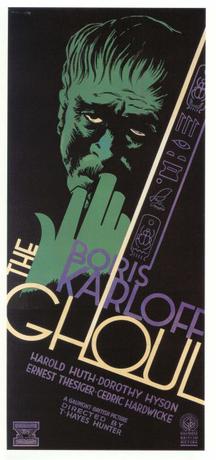
Some actors can make just about anything worth watching. That’s certainly the case with Boris Karloff and 1933’s The Ghoul.
In The Ghoul, Karloff plays Prof. Henry Moriant. The professor is an Egyptologist, a world-renowned expert on the dead. Moriant is now facing death himself, sick in bed and ranting about how he wants to be treated after he passes. Nigel Hartley (Ralph Richardson) stops by the mansion while pretending to be a vicar and offers to comfort Prof. Moriant in his last moments. The butler, Laing (Ernest Thesiger), explains that Moriant has never had much use for traditional religion. Instead, Moriant believes in the Gods of Egypt.
In death, Moriant wants to be buried with an Egyptian jewel in his hands. He believes that, after he dies, he will exchange the jewel with the Egyptian God Anubis and he will be reborn with amazing powers. However, when Moriant passes, Laing keeps the jewel for himself and attempts to hide it from the countess number of people who show up at the mansion, all seeking either the jewel or just information about Moriant’s estate. Moriant may not have been loved in life but everyone clearly loves his money.
Boris Karloff is not actually in that much of The Ghoul. He dominates the start of the film, ranting from his deathbed. And then, towards the end of the film, he rises from the dead and attacks those who he thinks have betrayed him and stolen the jewel. He’s only onscreen for a few minutes but he dominates those minutes. Karloff’s screen presence is undeniable. When he’s in a scene, he’s the only person that you watch. When he’s not in a scene, you find yourself wondering how long it’s going to take for Karloff to return.
That’s not to say that the other actors in The Ghoul aren’t good. The cast is full of distinguished names. Along with Richardson and Thesiger, Cedric Hardwicke, Anthony Bushnell, Dorothy Hyson, and Kathleen Harrison all wander through the mansion and try to avoid getting caught up in Karloff’s vengeance. Harrison provides the film’s comic relief and I actually enjoyed her flighty performance. The film itself is so darkly lit and full of so many greedy characters that it was nice to have someone on a totally different wavelength thrown into the mix. That said, the majority of the actors are stuck with paper-thin characters and aren’t really allowed the time to make much of an impression. This is Karloff’s film, from the beginning to end. And while the film itself is definitely a bit creaky, Karloff is always enjoyable to watch.
The Ghoul was made at a time when Karloff, having become a star with Frankenstein, was frustrated with the roles that he was being offered in America. He returned to his native UK and promptly discovered that he was just as typecast over there as he was in the United States. For a long time, The Ghoul was believed to be a lost film. However, in 1968, a copy was discovered in Egypt of all places. It’s unfortunate that the film itself isn’t better but there’s no denying the power of Karloff the performer.
1982’s Pink Floyd — The Wall is a film that I have mixed feelings about.
Some of that is due to my feelings about Pink Floyd. On the one hand, I can’t deny their talent and I do like quite a few of their songs, if they do all tend to be a bit on the portentous side. On the other hand …. Roger Waters! Bleh, Roger Waters. Waters was one of the founders of Pink Floyd and, for a while, the band’s de facto leader. He’s also a rabid anti-Semite and a defender of Vladimir Putin’s. That said, I’ve discovered that I can justify listening to Pink Floyd by remembering that the rest of the band hates Roger Waters as well and that Waters himself eventually left Pink Floyd. Waters’s bandmate, David Gilmour, has flat-out called Roger Waters an anti-Semite. Last year, when we had a total eclipse of the sun, I was happy to be able to play the last two tracks of Dark Side of the Moon while enjoying the early and temporary evening. It just felt appropriate.
Outside of Dark Side of the Moon, The Wall is probably Pink Floyd’s best-known work. (When I was younger, I can remember my Dad playing it whenever he was driving across the country.) A concept album about how much it sucks to be a wealthy Englishman, The Wall is one of those albums and films that are beloved by people who consider themselves to be alienated. Even more so than the average Pink Floyd album, The Wall was the brainchild of Roger Waters and, when the movie version was made in 1982, Waters wrote the screenplay. That said, I think you can argue that, much as with Tommy, The Wall was ultimately more about the vision of the film’s director than that of the man who wrote the songs.
The Wall is definitely an Alan Parker production. It’s big. It embraces the sordid. It’s stylish almost to the point of parody. Every image has been carefully constructed by a director who got his start doing commercials and whose main goal was to get an immediate audience reaction. Much like Parker’s Midnight Express or Evita, it’s a film that grabs your attention while you’re watching it and only afterwards do you stop consider that there really wasn’t much going on underneath the surface.
Pink (Bob Geldof) is a self-loathing rockstar who is haunted by his childhood in post-WWII Britain and whose marriage is failing. He’s building a wall, brick-by-brick, to keep himself separated from pain but the price of becoming comfortably numb is to be so alienated that you imagine becoming a neo-Nazi who orders his followers to follow the Worm. The imagery is powerful. The animated sequences by Gerald Scarfe still make quite an impression, especially the marching hammers. The score features songs like Another Brick In The Wall, Comfortably Numb, and Run Like Hell. The film is relentless, full of downbeat imagery that is often excessive but which Parker understood would appeal to the film’s target audience. Indeed, it’s such an overwhelming film that it’s easy to overlook the fact that, even before he transformed into a fascist, Pink is a drab character and his main problem seems to be that he can’t seem to find anything good to watch on television.
That said, I have to admit that, despite myself, I do like The Wall. It’s just so shameless that it’s hard not to enjoy the silliness of it all. Add to that, Comfortably Numb is a great song. (Another Brick In The Wall is also a great song though perhaps not for the reasons that Waters thought it was.) The Wall is a monument to the joys of cinematic excess.
There’s one rule in life that should never be forgotten.
Any movie that opens with Susan Lucci casting a hex that causes a man’s head to explode is going to be worth watching.
That’s certainly the case with Invitation to Hell, a 1984 made-for-TV movie that was directed by Wes Craven and which casts Lucci as Jessica Jones, an insurance agent who lives and works in an upper class suburb in Southern California. Jessica not only sells insurance but she also runs the ultra-exclusive Steaming Springs Country Club! Anyone who is anyone in town is a member of Steaming Springs! That include Matt Winslow (Robert Urich) and his family. Matt soon comes to suspect that something strange might be happening at the club. Fortunately, Matt’s spacesuit comes with a flame thrower, a laser, and a built-in computer that can determine whether or not someone is actually a human being. (Wearing the space helmet means viewing the world like you’re the Terminator.) Soon, it’s science vs. magic as Matt dons the suit and tries to rescue his family from country club living!
Totally ludicrous and a lot of fun, this is a film that has a little bit for everyone — familiar television actors, flamethrowers, space suits, demonic possession, exploding cars, and even a little bit of social satire as the film suggests that living in the suburbs is a terror even without weird country clubs and chic spell casters.
“There are horrors beyond life’s edge that we do not suspect, and once in a while man’s evil prying calls them just within our range.” The Thing on the Doorstep (H.P. Lovecraft)
As some of our regular readers undoubtedly know, I am involved in hosting a few weekly live tweets on twitter and occasionally Mastodon. I host #FridayNightFlix every Friday, I co-host #ScarySocial on Saturday, and I am one of the five hosts of Mastodon’s #MondayActionMovie! Every week, we get together. We watch a movie. We snark our way through it.
Tonight, for #MondayActionMovie, the film will be 1984’s Children of the Corn!
If you want to join this watch party, just hop onto Mastodon, pull up Children of the Corn on YouTube or Tubi, start the movie at 8 pm et, and use the #MondayActionMovie hashtag!




 Through the Shattered Lens