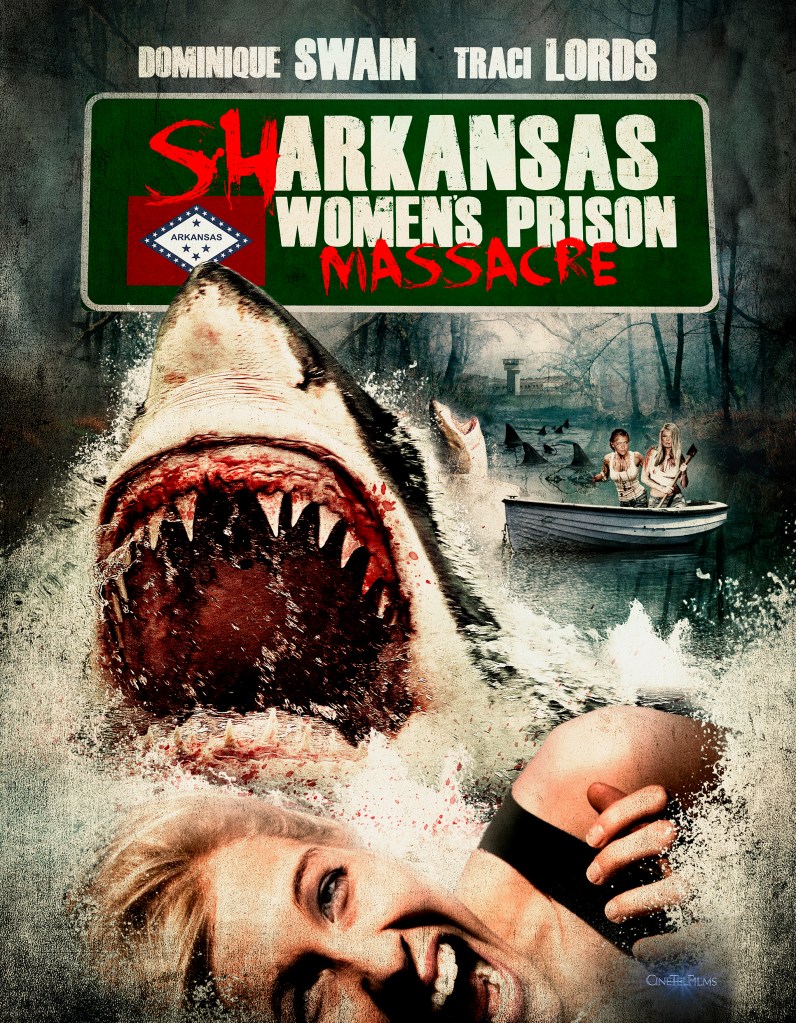
Brad reviews SHARKANSAS WOMEN’S PRISON MASSACRE (2015)! 


The exploitively titled SHARKANSAS WOMEN’S PRISON MASSACRE opens up with employees of an “Arkansas Fracking” company causing such a disturbance underground that spiky, ancient sharks wake up and start swimming in our swamps and eating whoever they happen to come across. As a lifelong Arkansan, I’m guessing this would have to be set near the Louisiana line, but I don’t think it’s ever made clear. It doesn’t really matter because the movie is actually shot in the state of Florida. This shark awakening just happens to coincide with a group of hot, womens’ prison inmates, including Christine Nguyen and Cindy Lucas, getting into a van to go clear some stumps in that same shark swamp that’s just outside of the walls of the penitentiary that they’re currently residing in. We also meet Detective Kendra Patterson (Traci Lords) and her partner, who are looking for a group of criminals, led by Honey (Dominique Swain), who may have escaped into that same swamp that now contains our ancient, spiky sharks and our sexy Arkansas inmates! Before you know it, the trials and tribulations of every person involved will be put on the back burner as they try not to become the next victim of the Sharkansas Women’s Prison Massacre. 

SHARKANSAS WOMEN’S PRISON MASSACRE is pretty much the exact film that you’d expect it to be. It’s cheap, with terribly cheesy special effects, bad acting and some super-sexy women. It was made for the SyFy channel so it doesn’t really have graphic gore or nudity, which I’m sure is disappointing for those hoping for more bosoms and blood. I did enjoy a scene early in the film when the ladies are extremely warm from a tough day of clearing stumps so they start spilling water on their white T-shirts, while their faces contort in unbridled pleasures. The film is directed by Jim Wynorski who’s known for his low budget exploitation movies such as CHOPPING MALL (1986), BIG BAD MAMA II (1987), NOT OF THIS EARTH (1988), BODY CHEMISTRY 4: FULL EXPOSURE (1995), ALABAMA JONES AND THE BUSTY CRUSADE (2005), and COBRAGATOR (2015). For the director’s fans, this movie has much more in common with his classic PIRANHACONDA (2012) than it does his BUSTY WIVES (2007) series. 

The cast of SHARKANSAS WOMEN’S PRISON MASSACRE is pretty much top notch for a film like this. I can honestly say that I’ve never seen Traci Lords in one of her porn films, but I’ve always thought she was pretty good looking, and she is here. I did have Cinemax for a number of years as a young man so I’ve definitely seen some of Christine Nguyen’s work. I would come across titles like TARZEENA: JIGGLE OF THE JUNGLE (2008) starring Christine, and the man in me couldn’t help but stop and check out the story. Finally, as a huge fan of director John Woo’s FACE/OFF (1997), I remember liking Dominique Swain as Sean Archer’s rebellious young daughter in the film. In this film, she’s the queen of overacting as a lesbian outlaw who’s out to bust her lover out of jail when she finds herself in a life or death battle with deadly, ancient land sharks. It’s not exactly the performance of a lifetime, but it’s still kind of fun if you’re in the right frame of mind. 

At the end of the day, you’re either the kind of person who likes a movie like SHARKANSAS WOMEN’S PRISON MASSACRE or you’re not. There’s not a lot of in between. It’s personally not my favorite kind of film, but I’ll pretty much watch anything with an Arkansas connection, even though this one is “in title only.” For fans of the director, the film DINOCROC VS. SUPERGATOR, or some of the beautiful cast members, this film may be just what your looking for this October!

Horror On TV: Hammer House Of Horror Episode #1: Witching Time (dir by Don Leaver)


Hammer House of Horror was a British anthology series that ran for 13 episodes in 1980.  As you can tell by the title, the show was produced by Hammer Films.  Each episode dealt with a different type of horror and featured some of the best actors working in British film and television.

The first episode aired on September 13th, 1980.  Lucinda Jessup (Patricia Quinn), a 17th century witch, escapes from a pack of witch hunters by traveling into the future.  Discovering that her former home is now occupied by a film composer (Jon Finch) and his wife (Prunella Gee) and that the marriage is not a happy one, Lucinda puts her mark  on the composer.  Can the man’s unfaithful wife save him from the witch?  The husband isn’t all that sympathetic and I think that many viewers will probably feel that it might be for the best to just let the witch have him but this is still a well-acted and atmospheric episode.  Keep an eye for Ian McCulloch of Zombi 2 fame as the wife’s lover.

This episode also features some brief nudity so don’t watch it at work.


The TSL Horror Grindhouse: Maniac (dir by William Lustig)


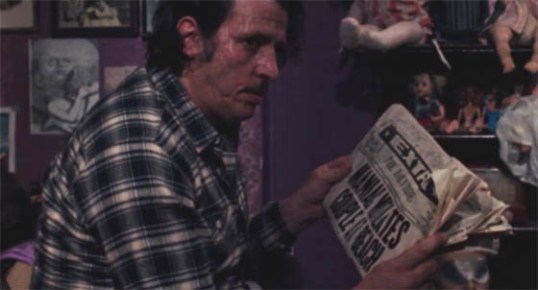
 First released in 1980, Maniac stars Joe Spinell as Frank Zito.

Frank lives in a run-down New York apartment.  The grimy walls are covered with pictures that appear to have been cut out of magazines.  The sheets on the bed look like they haven’t been washed in over a year and, for that matter, the sweaty and greasy Frank Zito looks like he could definitely use a shower as well.  Frank lives alone but he has several blood-stained mannequins.  He talks to the mannequins, cooing about how he just wants them to be nice to him and to stop abusing him.  Just looking at the apartment, one can imagine the nauseating odor of sweet, blood, and who knows what else that seeps out whenever Frank Zito opens his door.

Frank Zito is also a murderer.  The majority of the film is taken up with scenes of him stalking his victims.  One extended sequences features him stalking a nurse through a subway station.  Another scene features a rather nightmarish moment in which Frank, in slow motion, jumps on the hood of a car and shoots a man point blank with a shotgun.  (The man is played by Tom Savini, who was also responsible for the film’s gore effects.)  An innocent model is killed after Frank breaks into her apartment.  “I just want to talk to you,” he says and maybe he actually believes that at first.

Frank has a chance meeting with a glamorous and beautiful photographer named Anna (Caroline Munro, playing a role that was rejected by Daria Nicolodi).  Somewhat improbably, Anna is charmed by the socially awkward Frank and even agrees to go out with him.  She’s touched when Frank shows up at the funeral of the model that he killed.  “She didn’t have many friends,” Anna tells Frank.

Meanwhile, at the cemetery, Frank’s fate awaits….

Maniac is one of the most infamous and controversial grindhouse films ever made.  The film’s atmosphere and the bleak visuals are the equivalent of being forced to look at New York while wearing glasses that somebody found floating in the sewer.  The deaths are drawn out and Savini’s gore effects are disturbingly convincing.  It’s a nearly plotless film about a man who hates women and what makes it scary as opposed to just exploitive is the fact that there are men like Frank Zito out there.  Joe Spinell, who was one of the great character actors of the 70s, appeared in everything from The Godfather to Taxi Driver to Rocky but, in the end, it’s his performance as Frank Zito that he seems to be destined to be most-remembered for.  Spinell is frightening, convincing, and disturbing as Frank Zito.  Spinell was planning on doing a sequel before his untimely death, at the age of 52, in 1989.

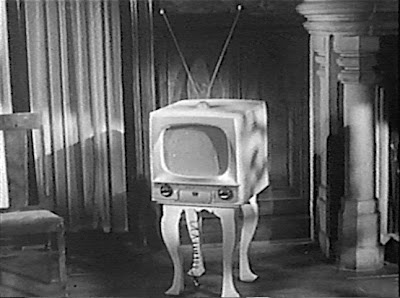
(Spinell was a hemophiliac who bled to death after slipping in the shower.  According to Maniac director William Lustig, when the police entered Spinell’s apartment, the first thing they saw was a huge amount of blood.  The second thing they saw was a life-like replica of Spinell’s head sitting on top of the television.  The head was a prop from Maniac and so convincing that the police originally assumed someone had broken into the apartment and decapitated him.  Spinell’s death not only prevented him from playing Frank Zito for a second time but also kept him from reprising his role as Willie Cicci in The Godfather Part III.)

Maniac is not an easy film to defend but, if I had to, I would point out that Frank Zito is portrayed as being an unsympathetic loser throughout the entire film.  He’s not some evil genius like Hannibal Lecter.  He’s not a nonstop quip machine like Freddy Krueger.  He’s not even enigmatic or superhuman like Michael Myers or Jason Voorhees.  Instead, he’s a pathetic loser who can’t even win an argument with the voices in his head.  Horror films all too often glorify or make excuses for serial killers.  (Just look at all of the Ted Bundy films.)  Maniac does not present Frank Zito as being anything other than a pathetic and twisted man and, as such, it’s probably one of the most realistic portrayals of a serial killer to be found on film.  Frank Zito is not meant to be glorified, though I’m sure that went over the heads of more than a few people who saw this film when it first opened.  It’s an ugly film but it’s about an ugly subject.  It’s exploitive but ultimately it’s on the side of Zito’s victims.

The film was an early directorial credit of William Lustig, who worked as a production assistant on Dario Argento’s Inferno in order to see how Argento deal with shooting on location in New York.  It was while working on Inferno that Lustig met Daria Nicolodi and offered her the part of Anna in Maniac.  (Anna’s last name is D’Antoni, a clear nod to Nicolodi’s Italian roots.)  Nicolodi was disgusted by the script and turned it down.  (Caroline Munro accepted the role and was reunited with her Starcrash co-star, Joe Spinnell.  Interestingly enough, even after all of the controversy created by Maniac, Munro and Spinell went on to co-star in The Last Horror Movie.)  Lustig based his serial killer on David “Son of Sam” Berkowitz and named him after director Joe Zito, who would go on to direct Friday the 13th — The Final Chapter.

For all the controversy that has dogged Maniac over the years, it’s easy to forget that the film itself is surprisingly well-directed and acted.  Caroline Munro bring some much needed class to the proceedings, even if the script requires her character to make some truly dumb decisions.  And Joe Spinell was simply horrifying as Frank Zito.  It’s not a pleasant film and if you ever find yourself in a home where the owner has a Maniac poster on the wall, I would suggest leaving immediately.  It is, however, a landmark of grindhouse filmmaking.
(Be sure to read Arleigh’s thoughts on Maniac here!)

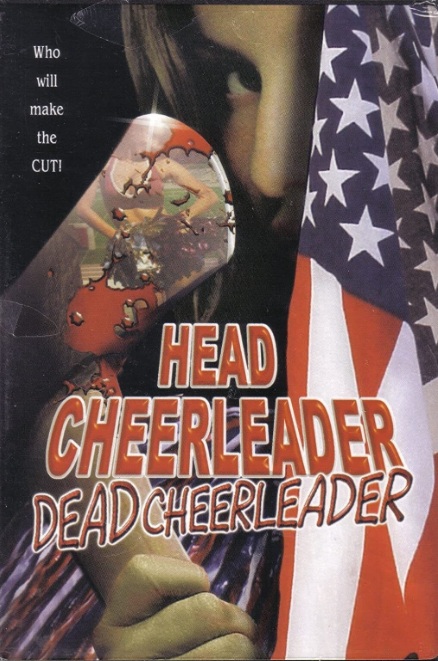
October Hacks: Tourist Trap (dir by David Schmoeller)


1979’s Tourist Trap opens in the same way that many slasher films have opened.  A group of friends — young, attractive, and not particularly bright — are driving through a secluded, rural area when they have car trouble.

Now, I have to say that, if I was driving through a rural secluded area or even if I was just a passenger in the vehicle, I would totally freak out if the car broke down.  I mean, seriously, you’re in the middle of nowhere.  You have no idea who or what might be hiding behind those trees.  Even if you don’t get attacked by a bunch of inbred hillbilly cousins, you might get eaten by a bear or, even worse, you might get mauled by a deer and end up with Lyme Disease.  Or you might just end up with a bunch of flies buzzing around your face, which is really even worse than getting attacked by a wild animal.

(Pro-tip: One way to deal with flies is to combine the open flame of a lighter with a can of hairspray.)

I’ve seen enough slasher films to know that bad things happen when you get lost in the woods.  However, up until everything started getting all self-referential in the 1990s, old school slasher films were infamous for featuring characters who had apparently never seen a slasher film or really any other type of movie before.

Your car broke down in the woods?  One member of your party has already disappeared while looking for a gas station?  You have no way of letting anyone know where you are?  Sure, why not go skinny dipping?  For that matter, why not check out Slausen’s Lost Oasis, a run-down shack that is the home of a lot of wax figures and which is owned by the shotgun-toting Mr. Slausen (Chuck Connors).  Mr. Slausen is pretty bitter about the new freeway.  It took away all of his business.

Of course, it turns out that there’s more to this tourist trap than meets the eyes.  For one thing, the mannequins often seem to randomly come to life and murder anyone who spends too much time alone with them.  Secondly, things in the tourist trap often move on their own, as if someone has psychic powers.  And then there the enigmatic man who wears a wax mask and likes to take people hostage before transforming them into wax figures….

Tourist Trap has a totally ludicrous plot but Slausen’s Oasis is such a creepy location and Chuck Connors plays his role with such unnerving intensity that it doesn’t matter that things don’t always make sense.  At its best, Tourist Trap plays out like a filmed nightmare, one in which the rules of normal physics often don’t seem to apply.  The victims are interchangeable (though I did like Tanya Roberts’s energetic performance as Becky) but the kills are imaginative and memorable gruesome.  Researching the film, I was surprised to discover that Tourist Trap was given a PG-rating, despite the skinny dipping and the blood and all of the terrifying wax figures.  Don’t let that rating fool you.  This is genuinely scary slasher film and one that everyone should see before going on an impulsive road trip to the middle of nowhere.

On-Stage With The Lens: Medea (dir by Mark Cullingham)


In 431 BC, the Greek playwright Euripides premiered his latest play, Medea.  The story of a woman scorned who deals with her anger by murdering her ex-husband’s soon-to-be wife, future father-in-law, and finally her own children, Medea has lived on as one of Euripides’s most-performed plays.  Three actresses have won Tony awards for playing Medea on Broadway, setting the record for the most Tonys won for playing the same role.

Medea is a play that is open to a lot of interpretations.  Quite a few stagings of the play present Medea as being a sympathetic character, a victim of a misogynistic culture who was driven to extremes by the men around her.  I can see that argument and it is true that the play does emphasize that all the men in Medea’s life treat her terribly.  Creon plots to send Medea into exile so that his daughter can marry her husband.  Medea’s smarmy husband, Jason, says that he has no choice but to marry a princess because Medea is only a “barbarian,” fit to be his mistress but not his wife.  In many ways, Medea is a sympathetic character.  But, for me, all of that sympathy goes out the window as soon as she murders her children.  The fact that, in most stage versions of the play, the Gods then help her to escape makes her even less sympathetic in my eyes.  (Needless to say, it certainly doesn’t do much for the reputation of the Greek Gods.  Then again, one gets the feeling that even the ancient Gods didn’t particularly like their Gods.)

In 1983, Zoe Caldwell won a Tony for playing Medea.  (Interestingly enough, in this production, the Nurse was played by Judith Anderson, who also won a Tony for playing Medea, in 1947.)  A performance at the Kennedy Center was filmed for PBS.  The production, with its minimalist sets and atmosphere of growing dread, captures the nightmarish intensity of the story.  Zoe Caldwell gives a riveting performance as Medea, alternating between wild-eyed madness and subtle manipulation.

As the most horrific of the Greek plays, Medea is a production that just feels right for the Halloween season.  Here is Zoe Caldwell in 1983’s Medea.

Doctor Who — The Time Meddler (1965, directed by Douglas Camfield)


Today, everyone knows the origins of the Doctor.  We know that the Doctor is a Time Lord and a native of the planet Gallifrey.  We know that the Time Lords had a policy of not interfering with other civilizations.  They could travel through time but they were never to change history.  We know that the Doctor, even after stealing the TARDIS, remained true to that belief while other renegade Time Lords did not.

It wasn’t always like that.  During the show’s early years, the Doctor was meant to be a very mysterious figure and it was implied that he himself had invented (rather than stolen) his TARDIS.  It wasn’t until nearly two years into the show’s original run that we met anyone else from the Doctor’s home planet and that we finally got to see a TARDIS that could actually change shape.

All of that happened in The Time Meddler, a four-episode serial the originally aired from July 3rd, 1965 to July 24th.  In this episode, the Doctor’s TARDIS materializes in Northumbria in 1066.  With Ian and Barbara having recently returned to their own time, the Doctor (William Hartnell) is now traveling with Vicki (Maureen O’Brien) and Steven Taylor (Peter Purves), both of whom come from the future and who are much less argumentative than either Ian or Barbara.  Finally, the Doctor has companions who are not only happy to be there but who are willing to do whatever he says.  Though the Doctor tells Vicki that he will miss Ian and Barbara, he does seem much more relaxed in this serial than in previous ones.

The Doctor’s arrival is observed by The Monk (Peter Butterworth), a mysterious figure who doesn’t seem to be surprised at all to see a blue police call box materialize in 1066.  A time meddler who it is implied has met the Doctor before, the Monk is plotting on changing the course of history by wiping out King Harald Hardrada’s Viking invasion fleet, therefore leaving Harold Godwinson and his troops fresh and fully armed so that they can then defeat William The Conqueror at the Battle of Hastings.  The Doctor is captured early on by the Monk, leaving Steven and Vicki to deal with the suspicious locals.

The Meddling Monk was truly a great creation.  As played by Peter Butterworth, he wasn’t so much an evil-doer as he was just someone who thought it would be fun to change history.  (I’ve always disliked the theory that the Meddling Monk was an early incarnation of The Master.  The Master was always evil while the Monk was basically a prankster.)  Peter Butterworth gives an amusing and energetic performance as the Monk and the highlights of the serial are the scenes between him and Hartnell.  They both bring out the best in each other and Hartnell, who could often seem testy while acting opposite the younger actors who played his companions, truly seems to enjoy playing opposite an actor who was basically his equal in both skill and experience.

This episode is best-known for being the first episode to introduce another member of The Doctor and Susan’s race.  It was also the first episode to feature a TARDIS other than the Doctor’s.  (The Monk’s TARDIS works, which reminds the viewer of just how broken-down the Doctor’s vehicle actually is.)  It is often overlooked that it was also one of the better “historical” episodes.  Doctor Who was originally envisioned as a show that would teach younger viewers about history.  Unfortunately, the purely historical episodes were often dry and uninvolving.  This episode teaches about the Battle of Normandy but it also livens things up by giving the Doctor a worthy adversary.

It can be difficult to judge Hartnell’s time as the Doctor, just because so many of his serials are either incomplete or totally missing.  For viewers who are used to a younger and friendlier Doctor, Hartnell’s Doctor can seem rather grouchy.  The Time Meddler, though, features William Hartnell at his best and is one of the highlights of Doctor Who‘s early years.

The Barbarians (1987, directed by Ruggero Deodato)


In a magical land of dragons and fierce warriors, the evil sorcerer Kadar (Richard Lynch) attacks a peaceful group of traveling entertainers, slaughtering the majority of them and kidnapping their queen, Canary (Virginia Bryant).  Canary has a magical ruby that Kadar hopes will increase his power.  Canary also has two sons who are each sold separately into slavery.  Years later, these muscle-bound twins, Kutchek (Peter Paul) and Gore (David Paul), will be reunited and will team up to save their mother, fight a dragon, and free the kingdom from Kadar.

An Italian-American co-production that was directed by Ruggero Deodato and distributed by Cannon, The Barbarians was a starring vehicle for the so-called Barbarian Brothers.  Peter and David Paul were twin bodybuilders who appeared in a handful of films and who are today best-known for getting cut out of Oliver Stone’s Natural Born Killers.  (In his director’s commentary, when explaining why their scene didn’t work, Stone said, “It was my fault.”)  Peter and David Paul were not natural-born actors.  They’re both pretty stiff in The Barbarians but their natural chemistry as brothers made up for a lot.  They spend most of their screentime in The Barbarians bickering and yelling at each other and you get the feeling that was something they had a lot of experience with.

The Barbarians starts slow.  It takes a while to get going and the plot has the ramshackle feel of many Cannon productions.  Richard Lynch, as always, is a great villain and familiar faces like Michael Berryman and George Eastman have small roles.  Trying to keep track of who is betraying who can require keeping a scorecard while watching the movie but The Barbarians does a good job of creating its fantasy world (and it looks really good for a film that was probably not made for much money) and once the action finally does get started, there’s enough of it to keep things entertaining.  The Barbarians battle not only Kadar’s sorcery but a dragon as well and they do it all while trash talking each other.  The film feels like a cross between Dungeons and Dragons and a regional wrestling production.  It’s entertainingly dumb.

Horror Scenes That I Love: Dr. Loomis Explains Michael Myers in the original Halloween


We’ve talked a bit about Donald Pleasence today.  Pleasence is one of my favorite actors, an intense performer with an eccentric screen presence who always gave it his all, even in films that didn’t always seem like they deserved the effort.  Pleasence was a character actor at heart and he appeared in a wide variety of films.  He’s absolutely heart-breaking in The Great Escape, for instance.  However, it seems that Pleasence is destined to be best-remembered for his horror roles.  For many, he will always be Dr. Sam Loomis, the oracle of doom from the original Halloween films.

In this scene from the original Halloween, Dr. Loomis (Donald Pleasence) attempts, as best he can, to explain the unexplainable.  I’ve always felt that Pleasence’s performance in the first film is extremely underrated.  People always tend to concentrate on the scenes where he gets angry and yells or the later films where an obviously fragile Pleasence was clearly doing the best he could with poorly written material.  But, to me, the heart of Pleasence’s performance (and the film itself) is to be found in this beautifully delivered and haunting monologue.

In this scene, we see that Dr. Loomis is himself a victim of Michael Myers.  Spending the last fifteen years with Michael has left Loomis shaken and obviously doubting everything that he once believed.  Whenever I watch both Halloween and its sequel, I always feel very bad for Dr. Loomis.  Not only did he have to spend 15 years with a soulless psychopath but, once Michael escapes, he has to deal with everyone blaming him for it.  Dr. Loomis was literally the only person who saw Michael for what he was.

Incidentally, Donald Pleasence nearly turned down the role of Sam Loomis.  He didn’t think there was much to the character.  (The role had already been offered to Christopher Lee and Peter Cushing, neither of whom were interested.)  It was his daughter, Angela Pleasence, who persuaded Donald to take the role.  At that year’s Cannes Film Festival, Angela saw John Carpenter’s Assault on Precinct 13 and she assured her father that Carpenter was a talented filmmaker.  Taking his daughter’s advice, Donald Pleasence accepted the role and, by all accounts, was a complete gentleman and a professional on set.  After making horror history as Dr. Sam Loomis, Pleasence would go on to appear in two more Carpenter films, Escape from New York and Prince of Darkness.

Horror Novel Review: My Secret Admireir by Carol Ellis


First published in 1989, My Secret Admirer tells the story of Jenny.

Jenny is a teenager who has lived in four different town over the past six years.  Her dad’s job requires him to move from town to town and her mother doesn’t like the idea getting tied down anywhere.  I have to admit that I could relate to Jenny because my family used to move all over the place.  By the time I was 12 years old, I had lived in Texas, Oklahoma, Arkansas, New Mexico, Colorado, and Louisiana.  Frequently moving meant that I had to continually get used to new towns, new schools, new teachers, and new friends.  Years later, I realized that spending my childhood on the go left me with massive trust and abandonment issues.  In other words, it really sucked.  My heart went out to Jenny.

When the book opens, Jenny has only been in her new home for a few days.  She’s still nervous about the house and the town.  She’s scared of the hills that are near her home and the rocky bluffs that sit behind the hills.  She worries about wild animals.  She doesn’t know anyone in town and school doesn’t start for another few days.

So, of course, her parents decide to abandon her.

When they are informed that their old house has been sold, Jenny’s parents buy plane tickets so that they can fly back to their former home and collect the rest of their belongings.  Jenny is left behind so that she can deal with the painters (who are scheduled to show up in three days).  Parents in YA book — especially YA horror books — are usually not that great but I have to say that Jenny’s parents take selfish parenting to a whole other level.

Fortunately, Jenny meets her neighbor, the very talkative Sally.  Sally ropes Jenny into taking part in a big scavenger hunt.  During the hunt, Jenny meets Dave and his bitchy girlfriend, Diana.  Diana and Dave are having a fight so Dave teams up with Jenny for the scavenger hunt and, within an hour or so, Jenny and Dave are in love.  Unfortunately, the scavenger hunt does not go as well for Diana.  A day after a sudden storm brings the hunt to a close, Diana is found at the bottom of the cliff.  With Diana in a coma, Jenny wonders if it’s possible that Dave pushed her.

Meanwhile, Jenny seems to have a secret admirer, someone who calls the house and leaves messages on her answering machine.  It’s all good and well until someone leaves a present on her porch.  When Jenny opens the package, she discovers the head of a rattlesnake!

This novel was fairly ridiculous.  Between Jenny’s parents basically abandoning her in a town and house that she barely knew to Jenny falling in love with Dave after spending 30 minutes with him, this book was all about people making bad decisions.  Unfortunately, despite all of the silly plot developments, the book never quite becomes the sort of over-the-top, melodramatic spectacle that one might hope it would become.  That said, I could relate to how Jenny felt about always being the new girl and it was a quick read.  For that matter, I don’t like heights either.

In the end, the book’s message was one to which I could relate:

No, not that!  Instead, if you believe in yourself, you can get a boyfriend and you can survive being stuck in a scary old house!  That’s an important lesson to learn!


October True Crime: Dr. Crippen (dir by Robert Lynn)


Dr. Hawley Harvey Crippen

In 1910, a homeopath named Dr. Hawley Harvey Crippen was executed by hanging in the UK.

An American by birth, Dr. Crippen had come to London in 1897 with his second wife.  (His first wife died of a stroke and Crippen sent his only son to live with his grandparents.)  Cora Crippen was a former music hall singer who hope to continue her career in London and who did manage to make friends with several prominent members of the city’s theatrical community.  Dr. Crippen was widely regarded as a meek man who was dominated by his rage-prone wife.  Crippen struggled to hold down a regular job and eventually ended up as a manager at the Druet Institute for the Deaf.  By at least 1905, Dr. Crippen was having an affair with a young typist named Ethel Le Neve.

Cora disappeared in early 1910.  When her friends stopped by the house to ask for her, Dr. Crippen said that his wife had left him for another man and had returned to America.  Later, he claimed that Cora had subsequently died in California.  When Ethel was spotted wearing Cora’s jewelry, the London police launched their own investigation into Cora’s disappearance.  After Crippen was interviewed by the police, he and Ethel fled to Brussels and then boarded an ocean liner heading for Canada.  After Crippen and Ethel disappeared, the police searched Crippen’s home and found a torso buried in the basement.  It was assumed that the torso was all that was left of Cora.

(As some have pointed out, it didn’t seem to make much sense for Crippen to dispose of Cora’s head, legs, and arms but to keep her torso.  Apparently, at that time, it was common for human torsos to show up in the Thames, the result of people jumping in the river and then having their body split apart by the current.  As such, the Thames also became a popular place to dump murder victims.  One wonders why Crippen wouldn’t have done the same.)

Meanwhile, on the ocean liner heading to Canada, the captain noticed that one passengers looked like a freshly shaven Dr. Crippen and that the “boy” he was traveling with was obviously a young woman in disguise.  The captain sent a wireless telegram to London.  Chief Inspector Walter Dew boarded a faster liner and actually managed to reach Canada before Crippen.  When Crippen and Ethel arrived in Canada, Walter Dew was waiting for them.

Fate simply wasn’t on Crippen’s side.  If Crippen had bought third class tickets instead of sailing first class, it’s probable the captain would have never seen him during the voyage.  If Crippen had taken a boat to his native United States instead of Canada (which was then still a British dominion), Dew would not have been able to take him back to the UK without an extradition hearing and it’s entirely possible that the evidence would have been ruled insufficient.  Instead, Crippen was promptly returned to London and put on trial for murdering his wife.

During the heavily-covered four-day trial, Crippen’s defense was that Cora had returned to America and that there was no way to prove that the torso was Cora’s.  Though the jury found Crippen guilty in just 22 minutes and he was hanged a month later, there were many who felt that Crippen was innocent or, at the very least, that his guilt had not been proven.  I imagine that one reason why so many people doubted Dr. Crippen’s guilt was because he just didn’t look or act like a murderer.  He wasn’t Jack the Ripper, a shadowy figure moving through the night.  Instead, he was a short, balding, and rather owlish looking man who wore glasses and who, in most photographs, has a quizzical expression on his face.

In short, Dr. Crippen seems as if he was literally destined to eventually be played by Donald Pleasence.

The 1963 film, Dr. Crippen, takes a rather straight-forward approach to telling the story of the doctor.  It opens with Crippen (Donald Pleasence, naturally) on trial for the murder of his wife and it largely tells the story through flashbacks.  Cora (Coral Browne) is portrayed as being a no-talent narcissist who regularly cuckolds her husband while Ethel Le Neve (Samantha Eggar) is portrayed as being a naive young woman who truly loves Dr. Crippen.  The film leaves open the question of whether or not Crippen killed his wife, though it seems to strongly suggest that Crippen was innocent of the crime and the only reason he fled London was because he wanted to be with Ethel.  Donald Pleasence is excellent as Dr. Crippen, playing him with just enough ambiguity that the viewer is left to wonder whether he did it or not.  Pleasence turns Crippen into a sympathetic figure while still holding back just enough to suggest that emotional darkness that could have led even the meek Dr. Crippen to becoming a murderer.  Nicolas Roeg’s black-and-white cinematography captures both the harshness of Crippen’s life in prison and the fleeting romance of his brief time with Ethel.

As for the real life Crippen, both his guilt and his subsequent execution continue to be controversial, with some claiming that DNA testing proved that the torso did not belong to Cora.  (Other have quite reasonably pointed out that the sample used had degraded quite a bit over a hundred years.)  There have been many attempts to win Dr. Crippen a posthumous pardon but all have failed and will probably continue to fail unless Cora’s remains are somehow discovered in a grave somewhere in California.

Shortly before his execution, in his final letter to Ethel Le Neve, Crippen wrote, “Face to face with God, I believe that facts will be forthcoming to prove my innocence.”  After Crippen was hung, Ethel spent three years in Canada before returning to London.  She changed her name, worked as a typist, and eventually married and had two children.  She died in 1967, fifty-seven years after Dr. Crippen.