Horror Film Review: The Pit (dir by Lew Lehman)


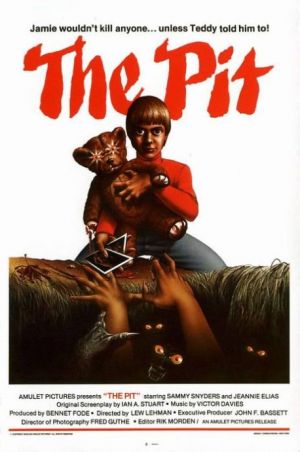
The 1981 Canadian film, The Pit, tells the story of a creepy little jerk named Jamie Benjamin (Sammy Snyders).

Now, admittedly, Jamie is only twelve years old and, usually, I make allowances for bad behavior from people who aren’t old or mature enough to know better.  But there’s just something off about Jamie.  He comes across as creepy from the first minute he shows up, with his intense stare and his blonde bowl cut.  He spends a lot of time in the woods, where he has discovered a hole in the ground.  The hole is full of hungry creates that Jamie calls Trogs.  Jamie regularly takes raw meat to the hole and tosses it in.  Unlike all of the kids at school and his own parents, the Trogs are always happy to see Jamie.

It may sound like a bad idea to give meat to a bunch of monsters that you just happened to find in the woods but Teddy thinks it’s a good idea.  Teddy is Jamie’s teddy bear.  Teddy talks.  Teddy has all sorts of ideas for how Jamie can get back at everyone who has ever made fun of him or left him feeling insecure.  Why not just toss them into the pit?  Is Teddy real or is he just in Jamie’s mind?  The film tries go for some ambiguity.  That said, the Trogs are definitely real so it’s not that difficult to go from accepting the idea of carnivorous monsters to buying into a talking teddy bear.

Jamie is entering puberty and his hormones are going crazy.  When his parents leave for a trip, they hire a psychology student named Sandy O’Reilly (Jeannie Elias) to keep an eye on Jamie.  Jamie develops a crush and soon becomes obsessed with Sandy.  Jamie is the type of kid who pretends to drop something just so he can look up Sandy’s skirt.  (Bad Jamie!)  Despite Jamie’s crush on Sandy, he still steals money from her so that he can buy raw meat for the Trogs.  When he can’t get any more meat, he starts tempting real people out to the woods and pushing them in.  When he tells Sandy about the Trogs, she doesn’t believe him.  He takes her to the pit and that’s when things really start to get bad….

The Pit is an odd little film, one that never quite settles on a tone.  In the original script, the Trogs and Teddy’s advice were all meant to be in Jamie’s head and Jamie himself was only meant to be 9 years old.  The horror elements were meant to be products of Jamie’s disturbed imagination and one can still see elements of that in the completed film.  However, director Lew Lehman decided to make Jamie older, to leave no doubt that the Trogs were real, and to add a small amount of humor.  As such, The Pit is a film that veers from being a horror film to being a somewhat depressing coming-of-age film to a somewhat mean-spirited comedy.  Sammy’s behavior, which might have been understandable for a 9 year old, becomes even more creepy now that he’s a twelve year-old who still takes orders from a teddy bear.

It’s a confused film but Sammy Snyders gives one of the best creepy kid performances of all time and there’s something undeniably satisfying about the ending.  As Jamie discovers, he’s not the only kid with a pit and teddy bear can only protect him for so long.

Horror Film Review: Frankenstein Meets The Space Monster (dir by Robert Gaffney)


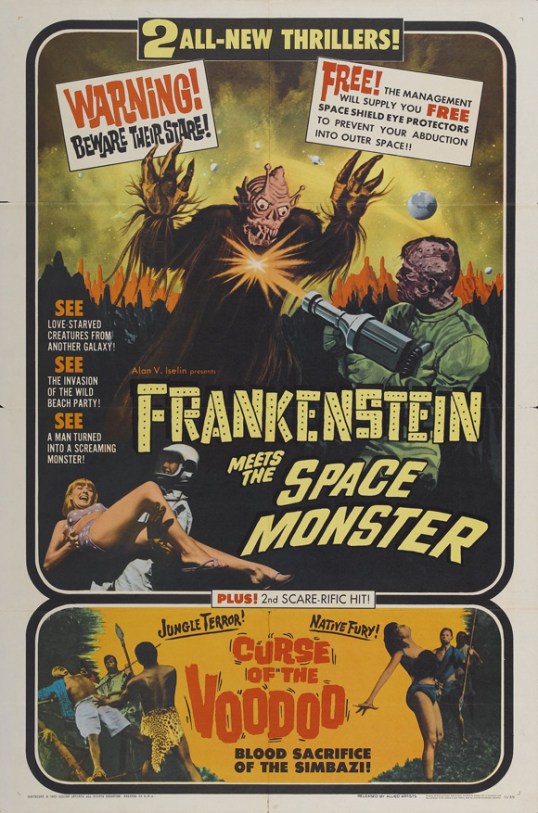
Despite the title, 1965’s Frankenstein Meets The Space Monster is not actually about Frankenstein or his monster.

Instead, the Frankenstein of the title is Frank Saunders (Robert Reilly), an astronaut who happens to be an android.  Frank was created by Dr. Adam Steele (James Karen, in one of his first film roles).  Frank is designed so that he can go into space without making any of the mistakes that a human astronaut might make.  He’s the next stage in the space program!  With Frank sitting in a rocket, America will have rightfully conquered the Moon in no-time flat!

(Don’t waste my time with any of the international treaty crap.  I don’t care how many other countries go to the Moon, it belongs to America because we landed their first.  It’s the 51st State and someday, we’ll probably end up moving the federal government to the moon.  Hopefully, we’ll just leave it there.)

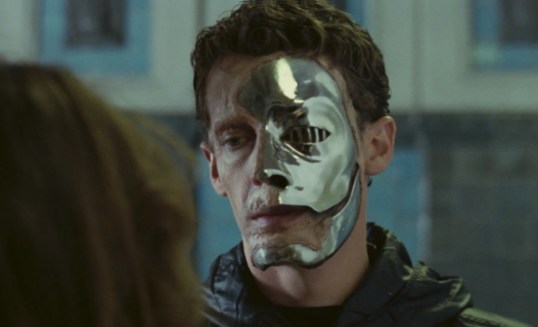
Unfortunately, no sooner has Frank gone into space then he gets shot down by the Martians.  Frank crashes in Puerto Rico and, with his face horrifically disfigured, starts to malfunction,  Soon, he’s creating chaos all over the island and it’s up to Dr. Adam Steele — what a name! — to put a stop to it.  However, before Frank is deactivated, he needs to meet the Space Monster (a mutant named Mull) and defeat the Martians.

Why are the Martians on Earth?  According to a short, pointy-eared dwarf Martian named Dr. Nadir (Lou Cutell), an atomic war has led to the death of all the women on Mars.  Personally, I think Dr. Nadir is lying because he came to Earth with a Martian woman named Princess Marcuzan (Marilyn Hanold).  I think it’s more a case of almost all of the Martian women faking their own deaths so that they could get out of having to talk to Dr. Nadir.  Seriously, Dr. Nadir is a little creep.  Add to that, his Martian name actually sounds like an insult in English.  Personally, I think he should come up with a new name if he wants people to listen to him.  I would suggest calling himself Adam Steele but that name is already taken.

Soon, Martians are abducting bikini-clad women off of beaches in Puerto Rico.  Can the Martians be stopped?  Can Frank be restored?  Will James Karen go on to have a distinguished career as a beloved character actor?  Spoiler alert: the answer to the third question is yes.  Indeed, one of the joys of this film is getting to see James Karen in a rare leading role.  He commits to giving as good performance, even though the film itself is pretty silly.

Another joy of this film is the soundtrack, which is surprisingly good for a film of this budget and caliber.  Just try to get That’s The Way It’s Got To Be out of your head!  (In the film, this song plays as Frank prepares to go into space.)

That’s the way it’s got to be!

As for Frankenstein Meets The Space Monster …. I just can’t help it.  I like the damn thing.  It’s just so ludicrous and silly that it’s impossible for me not to enjoy.  The film’s producers decided that they didn’t just want a robot terrorizing an island.  They also wanted Martians and a mutant, as well!  And we’re all better off for it.


Get In The Mood For Halloween With These Horrifying Comic Covers!


Once upon  a time, horror comics were all the rage.  In the 1950s, impressionable young readers were told scary stories by hosts with names like The Cryptkeeper and The Old Witch, and the Vault-Keeper.  That all changed when Congress got involved and held a series of hearing on whether or not horror comics were leading to juvenile crime.  All of the horror comics were canceled and the comic book industry agreed to tone things down with the Comics Code.

Trying to suppress horror comics only made them even more popular amongst readers and collectors.  Who could have seen that coming?  Teachers and juvenile court officers may have hated them in the 50s but now, they’re some of those most valuable comics around.  Here are a few classic covers from the 50s horror comic era.

Horror On The Lens; Robot Monster (dir by Phil Tucker)


Oh my God, I love this movie!

In this 1953 film, a gorilla wearing a diving helmet uses the Calcinator Death Ray to wipe out almost all human life on Earth.  Only 8 people survive, among them a professor, his family, and Roy (future Eurospy star, George Nader).  Ro-Man (George Barrows) is hounded by his superior to track down and destroy the survivors.  Ro-Man does his best, though the humans prove to be …. well, they’re not really that resourceful.  In fact, they’re pretty dumb.  But Ro-Man is pretty dumb himself.

Regularly (and incorrectly) cited as being one of the worst films ever made, Robot Monster is an enjoyably absurd hybrid of horror and science fiction.  Earth is destroyed through a combination of bad lighting effects and stock footage and the arguments between Ro-Man and his superior have to be heard to be believed.  Robot Monster is actually a bit more self-aware than a lot of people realize.  This is a low-budget Z-movie that realizes that it’s a low-budget Z-movie and which cheerfully embraces its identity.  Robot Monster is a personal favorite and it’s a bit of Halloween tradition around these parts.

And now, enjoy Robot Monster in all of its black-and-white glory!


October Hacks: Blood Legacy (dir by Carl Monson)


a.k.a. Blood Legacy

In this 1971 film, John Carradine briefly plays Christopher Dean, a wealthy man who hated his family and his servants.  He dies before the film actually begins but we do get to see him in flashbacks and we also hear his voice at the reading of his will.  Dean leaves a fortune to his children and his servants, but he does so only on the condition that they spend a week at Dean’s estate.  If anyone dies or leaves the estate, they will lose their inheritance and the money will be split amongst those who stayed and/or survived.  You can see where this is leading, right?

This is actually a promising premise and it’s easy to imagine how it could have inspired an American version of Mario Bava’s Bay of Blood, where one person is killed by another just for that killer to then be killed by someone else until eventually, there’s no one left.  Unfortunately, while the characters are all unpleasant and greedy, none of them are as memorable as anyone in Bava’s classic shocker.  They’re all generic jerks and, as such, it’s hard to have much of a reaction when they start dying.  The film does feature several familiar B-movie stars.  Jeff Morrow and Faith Domergue (both of whom were in This Island Earth) appear as brother and sister.  Richard Davalos (who played James Dean’s brother in East of Eden) has an eccentric role.  Western character actor Rodolfo Acosta plays the sheriff who eventually takes an axe to the forehead.  B-movie veteran Buck Kartalian plays Igor, the butler.  (His name is actually Igor!)  Some of the members of the cast were good actors but few of them are particularly good in this film.  I did appreciate the weird energy of Buck Kartalian.  John Carradine doesn’t do much but he does deliver his lines with the proper amount of contempt.

The film does have a few vaguely interesting kills.  Bees are used as a weapon at one point.  A head is found in a refrigerator and Richard Davlos says, “This is just like a horror movie.”  Wow, Richard, thanks for sharing!  There’s a big twist ending but it really not that impressive of a twist.

Probably the most interesting thing about Blood Legacy is that it’s essentially a remake of Andy Milligan’s The Ghastly Ones. (Director Carl Monson had a habit of ripping off other films.  In 1973, he remade Roger Corman’s Little Shop of Horrors.  Monson called his remake Please Don’t Eat My Mother.  The film starred Buck Kartalian.)  Blood Legacy was originally released under the title Legacy of Blood but Milligan was so annoyed at being ripped-off that he later made his own remake of The Ghastly Ones and decided to give it the same title as Carl Monson’s rip-off.  Monson changed his film’s title and distributed it under the names Will To Die and Blood Legacy so that it wouldn’t be confused with Andy Milligan’s Legacy of Blood.  It makes sense.  Why would anyone want their Andy Milligan rip-off to be confused with an actual Andy Milligan film?

Horror On TV: Hammer House of Horror #6: Charlie Boy (dir by Robert Young)


The next episode of Hammer House of Horror is The House That Bled To Death but I’ve decided not to share it for this Halloween because it features the death of a kitty and I’m kind of tired of pets dying in horror films.  It’s an effective and scary episode, though.  It’s on YouTube so if you want to watch it, feel free.  

Moving right along, tonight’s episode is Charlie Boy.  Graham (Leigh Lawson) and his wife Sarah (Angela Bruce) inherit an statue that they don’t realize also doubles as a really big voodoo doll.  After stabbing the statue a bit too many times, Graham comes to realize that he’s accidentally condemned almost everyone he knows to death, including both him and his wife.  Thanks to the fast-paced director of Robert Young and the committed performances of the cast, this is an entertainingly macabre episode.  It originally aired on October 18th, 1980.


The TSL Horror Grindhouse: Mary, Mary, Bloody Mary (dir by Juan López Moctezuma)


In 1975’s Mary, Mary, Bloody Mary, Cristina Ferrare plays Mary, an American painter who lives and works in Mexico.

Mary seems to be living her ideal life.  She paints.  She travels.  Her work is popular.  She has glamorous and wealthy friends.  She has her independence.  Even when she starts a relationship with a young American diplomat named Ben (David Young), he seems like a genuinely nice guy who respects her need to have a space of her own.

However, Mary has a secret.

Mary is a vampire.  She doesn’t have fangs, she doesn’t sleep in a coffin, and she can go out in the daylight.  But she has an obsessive need to drink blood.  Whenever she can get away from Ben, she’ll pull out a knife and slit the nearest throat.  On the beach, a pushy, middle-aged man falls victim to her.  Back in the city, she kills her former lover (Helena Rojo), who is not happy that Mary is now dating a man.  Mary does her best to hide her murderous inclinations from Ben, even as she finds herself tempted to taste his blood.

However, someone else has recently arrived in Mexico and he appears to be looking for Mary.  The Man (John Carradine) dresses in black and wears a mask over his face.  The Man also carries a blade and, like Mary, he drinks the blood of his victims.  When Mary reads a newspaper story about a murder that she didn’t commit, she realizes that she’s not the only vampire in Mexico.  At the film progresses, we learn that Mary and the Man share a very close connection and Mary is forced to confront whether or not she can be both in love and a vampire.

One thing that I appreciated about Mary, Mary Bloody Mary is that it didn’t leave much ambiguity as to whether or not Mary was actually a vampire.  At first, it seemed like the movie was going to play the “Is-she-or-isn’t-she” game and maybe suggest that Mary was just mentally disturbed,  But instead, the film makes it clear that Mary is dependent upon drinking the blood of others.  It’s suggested that vampirism is something that was passed down to her, much like how I inherited my red hair from my father’s side of the family.  But, in the end, there’s no doubt that Mary actually is a vampire.  Cristina Ferrare occasionally seems miscast as a ruthless killer but, ultimately, she brings the right amount of sophistication to the role and John Carradine is, as always, a nice addition to the cast.

Unfortunately, the majority of Mary, Mary, Bloody Mary is very slowly paced.  I can appreciate a film that takes it time but the first 45 minutes of Mary, Mary, Bloody Mary really does sometimes feel like an endurance test.  Once The Man shows up, the film’s pace starts to pick up and Mary is very quickly forced to confront the truth of her cursed existence.  At times, I got the feeling that the director was trying too hard to convince me that there was more to Mary, Mary, Bloody Mary than there actually was.  The film is littered with scenes that suggest the story was meant to be a statement on the human condition but …. nah.  Ultimately, it’s just a film about a woman who drinks blood.

Doctor Who — The Daemons (1971, directed by Christopher Barry)


When I was growing up and watching Doctor Who on PBS, I had a friend whose mother forbid him from watching the show because she thought that it promoted Satanism.

Her opinion was almost totally based on the cover of the novelization of one of the Third Doctor’s most popular adventures.

She took one look at that cover and decided that both the book and the show were promoting Satan.  I warned him that would happen when he first bought the book but, back in the day, it was nearly impossible to resist the temptation of the shelf of Doctor Who novels at Walden Books.  It was almost as if the books had been put there by you know who.

If my friend’s mother had read the book or even watched the serial when it eventually aired on PBS, she would have discovered that The Daemons did not feature the Devil.  Instead, it features Azal (Stephen Thorne), an evil horned alien who had spent centuries experimenting on humans and who had inspired many ancient myths and religions.  If my friend’s mother had watched the show, she would have seen that, rather than celebrate Satan, the show instead suggested that there was no Satan and that all of mankind’s Gods were actually visiting aliens.  She would have also seen that while The Master (played by Roger Delgado) disguised himself as a vicar, it fell to a local white witch to warn everyone in a quaint British village that the local archeological dig was a mistake.  Because of the Master’s religious disguise, everyone followed him when they should have been listening to the pagan…

In hindsight, it’s probably a good thing my friend’s mother never watched the show.

The Daemons has a reputation for being one of the best of the Third Doctor’s adventures and I’m inclined to agree.  The Doctor (Jon Pertwee) and his latest companion, Jo Grant (Katy Manning), try to stop the dig and instead find themselves trapped by a heat shield that has suddenly sprung  up over the village.  One of the defining images of this episode was a helicopter busting into flame when it hit the invisible barrier.  With the Brigadier and the majority of UNIT outside of the village, The Doctor, Jo, Sgt. Benton (John Levene), and Captain Yates (Richard Franklin) try to stop the plans of The Master and Azal.  Unfortunately, the villagers themselves have fallen under the sway of evil and are planning a special maypole sacrifice.


So many different actors have played The Master (and the character has become so overused) that it is easy to forget just how good Roger Delgado, the first Master, was in the role.  Delgado played the Master as being incredibly evil but he also played him as having a sense of humor and style about his evil, which is something that subsequent Masters have often failed to do.  Delgado’s Master appeared in every serial of the eighth series and he proved to be more than a worthy opponent for Pertwee’s Doctor.  Off-screen, Pertwee and Delgado were close friends and Pertwee later said that Delgado’s death in a traffic accident was one of the factors in Petwee’s decision to step away from the show.  The Daemons featured Delgado at his best as the Master did his worst and tried to claim the powers of someone who humans considered to be Satan.

The Daemons is also remembered for one of the best lines in the history of Doctor Who.  When confronted by Azal’s gargoyle servant, the Brigadier calls over a UNIT solider and orders, “Chap with wings there, five rounds rapid.”  I can only imagine how tired Nicholas Courtney got of having that line repeated to him over the years but his delivery of it is perfect.  The Brigadier was such a uniquely English character, imbued with the unflappable attitude of a country that had survived the collapse of an Empire, the Blitz, and the Suez Crisis.  Nicholas Courtney took a line that sounds like something Graham Chapman would have said on Monty Python and instead made it into an iconic piece of dialogue that reminded those of us American watching on PBS that, in Doctor Who, the entire universe was British.

Though it led to the show being forever banned in my friend’s house, The Daemons is a Doctor Who classic.