The 1995 YA thriller, Final Girl, tells the story of Lily. Lily is about to graduate high school and she is determined that she is going to beat out Graham for valedictorian. After all, Graham is just a rich boy who owns a green Porsche while Lily is working two jobs to help support her mother, who has had a stroke. Plus, both of Lily’s older sisters were valedictorians so of course Lily is going to continue the family tradition!
(At this point, let me just say that I’m glad that the only family-related high school pressure that I had came from people who wanted me to become a cheerleader like my sister. If I had people pressuring me to also do well in school, I don’t think I could have handled it. Don’t get me wrong, I did pretty well in school. But there was never any risk of me becoming valedictorian, not as long as I was required to take Algebra classes. I was very happy with academically being in the upper half but not at the top of my class.)
Anyway, Lily is determined to give the big speech at graduation but one of her teachers, Mr. Reiner, has given her a B on what Lily clearly feels was an A paper. When Reiner refuses to reconsider the grade, Lily says that she could kill him. Shortly afterwards, Mr. Reiner dies in a freak accident! AGCK!
Even with Mr. Reiner out of the way, it still seems like Graham might beat her to the top. But then Graham turns up dead, push head first into a — I’m being totally a serious here — printing press! Mr. Reiner’s death may have been a tragic accident but Graham was definitely murdered! And guess who everyone suspects!
Can Lily prove her innocence while maintaining her grade point average? And who is responsible for the latest deaths on Fear Street?
You’ll have to read the book to find out. If I told you any more details about the plot, you’d probably guess who the murderer is. It’s really not a shock at all. But still, Stine has some fun with the way this killer reacts to the truth beingd discovered. This is one Stine book where the killer is even more creepy than usual. Lily’s a bit difficult to sympathize with (because, seriously, it’s not like being the 2nd best student at the school is going to force her to settle for a fast food job or something) but the supporting cast is likable and the the whole printing press death is just strange enough to make the book a bit more memorable than the average Stine thriller.
I guess my grad for Final Grade would be a much deserved B+. There’s nothing wrong with a good, strong B.
In this twine game, a friend invites you to visit his home. He says that you can come over and you can ever sleep over but that it’s important that you follow the rules. What are the rules? He gives you four pages of notes, detailing all the rules for the different times of day.
Some of the rules make sense. When you arrive at the front door, knock twice. If you enter the kitchen and his mother is making something to eat, do not make eye contact with her. Do not bother his father if the old man is watching television.
Other rules make less sense. If you find yourself standing in front of a portrait of a woman, do not move until the portrait blinks at you. If you hear a scream in the middle of the night, pull your covers over your head and do not get out of bed. If you’re taking a shower and hear a sound, do not leave the shower. If you see your friend at certain times of the day, do not approach him because he won’t actually be your friend.
These rules would be enough to make most people stay home but you go anyways. Can you follow the rules and survive the house? It’s not as easy as it sounds because there are a lot rules to remember and there are also a lot of ghosts looking for a reason to kill you. Only knocking once before entering the house is as good a reason to take you out as any. Don’t worry, though. Each time you die, new ghosts and new quests are unlocked and you find yourself standing in front of the house again.
It’s fun for Halloween and a good horror game, with none of the clunkiness that you sometimes find in other big Twine games. The house is great location and very well-described. You can survive by following the rules but it’s more fun to intentionally break the rules and discover all the different ways that you can die. There’s a lot of them!
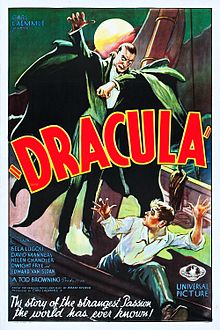
Seeing as how today is Bela Lugosi’ birthday, it only seems appropriate that today’s scene that I love should honor him. This is one Bela’s best scenes from 1931’s Dracula. Because his performance has been so widely imitated (and Bela himself appeared in a few films that poked fun at it), it’s often forgotten just how could Lugosi was in the role.
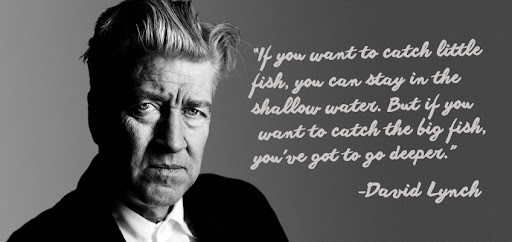
First published in 2007, Catching The Big Fish is a 177-book full of very short chapters in which David Lynch writes things that feel very David Lynchian.
The back of the book describes Catching The Big Fish as being the story of where David Lynch gets his ideas from. And it is true that, in a few chapters, Lynch does describe how a certain sight or sound inspired some of the scenes in his films. (For instance, he describes how he came to cast Frank Silva as KILLER BOB in Twin Peaks. It’s a story that you’ve probably heard before but, as with most things, it’s more charming when you read it in Lynch’s words.) Lynch describes capturing an idea as being like catching a big fish. It’s not easy and it requires you to heard for what Lynch calls the “deeper water” but you feel proud of yourself when you do it. (Or, at least, I assume that’s the case. I don’t actually fish myself.) Along with discussing his ideas, Lynch mentions the pain of Dune’s failure, his love of the French, his fascination with textures and Bob’s Big Boy, and the importance of not doing anything that could possibly compromise one’s creativity, whether it be therapy or drugs.
That said, the majority of the book is Lynch discussing meditation. Lynch is a notably apolitical filmmaker but he’s always been outspoken in his support of meditation to find peace and inspiration so it’s not surprising that a book about where he gets his ideas would center on meditation. Most of Lynch’s big ideas seem to come from catching details that others are too busy to spot and Lynch credits meditation with giving him the peace of mind and the insight necessary to do that.
So, it would seem that Lynch’s main lesson here would be that it’s a good idea to pay attention to what’s going on around you and to always take a closer look at things than the people around you. To be honest, it’s kind of an obvious lesson but again, the book is written by Lynch and the most obvious of things are more charming when Lynch points them out. As you might expect, Lynch comes across as being in his own world but he also seems like he genuinely hopes that you get something worthwhile out of the book. In the final chapter, he wishes you “peace” and you have no doubt that he means it.
To be honest, I’m not really into meditation. It works for some but it usually just makes me more anxious. But I do really like David Lynch and, if you’re a Lynch fan, you’ll find this book interesting. It’s enigmatic but earnest, much like Lynch’s best films.
This 1982 Spanish-produced slasher film was advertised, at least in the United States, with the brilliant tag line: “You don’t have to go to Texas for a chainsaw massacre.” And indeed, Pieces takes place in Boston, Massachusetts. And yet, it’s a Boston that has little relation to the Boston of the real world. (Some of that may be because, while a few scenes were filmed in Boston, the majority of the film was shot in Spain.) Indeed, one can argue that Pieces takes place in an alternate reality, one that was created with bits of giallo suspense, slasher gore, and scenes randomly borrowed from every other exploitation film ever made.
In the 1950s, a little boy wears a bowtie and plays with a pornographic jigsaw puzzle. His mother takes the puzzle away from him, which he doesn’t appreciate at all. It leads, as things usually do, to an axe murder.
In the 1980s, a college student tries to roller skate down a sidewalk, just to suddenly lose control. As she helplessly rolls down the street, two workman carrying a sheet of glass just happen to step out in front of her. Pieces of blood-stained glass fly everywhere. As is typical of Pieces, this actually has nothing to do with the larger plot of the film. We never learn the girl’s name. We never hear learn if she survived nor do we hear much else about the accident. Instead, it’s just a random incident, tossed in to illustrate that the world is going mad.
On campus, a chainsaw killer is killing students and teachers. He’s the boy with the bowtie, all grown up. He takes body parts home with him so that he can stitch them together, recreating the jigsaw puzzle that was stolen from him years before. Oddly enough, he never makes much of an effort to hide his chainsaw. He casually gets on an elevator with one of his victims. She notices that he’s carrying a chainsaw but she doesn’t say anything about it until he actually turns it on.
Dean Foley (played by Eurohorror veteran Edmund Purdom) is upset that students keep getting dismembered on campus, as well he should be. Lt. Bracken (Christopher George, barking out his lines with the same annoyed energy that he brought to Graduation Day) is also upset because he’s supposed to arrest criminals and stuff. Unfortunately, all of Bracken’s cops are incredibly incompetent. Bracken is forced to rely on the help of Kendall James (Ian Sera). Despite being kind of scrawny and unappealing, Kendall is the most popular student on campus. Kendall also knows every victim and discovers the majority of them. You would think that Kendall would be the obvious suspect but instead, Kendall somehow ends up directing the entire investigation. Kendall’s not a cop but he’s soon ordering around the veteran detectives and everyone’s okay with that. (One detective even mentions that Kendall might as well be a part of the force.)
Lt. Backen decides that the best way to solve the case is to send in Mary Riggs (Linda Day George), who is not only an undercover cop but also a top-ranked tennis player! There’s a lot of tennis in Pieces, as Mary works on her game in between working with Kendall to solve the murders. Kendall and Mary aren’t very effective though. After discovering that one victim was chopped in half in the showers while Kendall and Mary were trying to find the source of some loud marching band music, Mary lets the killer know exactly what she thinks of him.
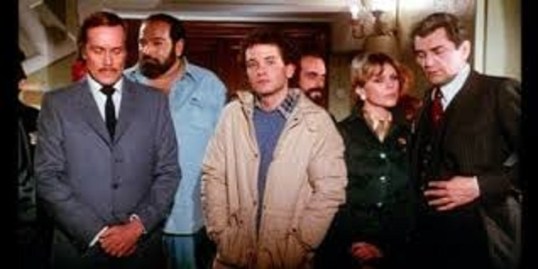
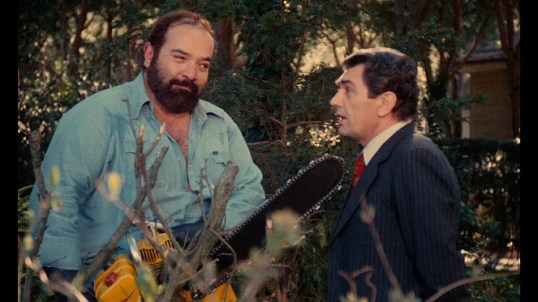
But who is the killer? Because Pieces was as inspired by the giallo genre as the slasher genre, there are several suspects. Kendall seems like the obvious one but, for whatever reason, no one makes that connection. Instead, we’re left to wonder if maybe it could be the Dean. Or how about Prof. Brown (Jack Taylor), the somewhat odd professor who seems to be a bit repressed? Or maybe it’s the handyman, Willard (Paul L. Smith)? Willard is creepy and he works with a chainsaw! There are a lot of suspects and helpfully, after a murder at the pool, every single one of them shows up at the scene of the crime. At one point, they all even gather in the same corner and look straight at the camera. You half expect Kendall to announce, “Well, I can’t possibly solve this one! Can you?”
But that’s not all! When Kendall and Mary aren’t solving murders, they’re having to deal with all of the other weird things that happen on campus. At one point, Mary is randomly attacked by the school’s karate instructor. After Kendall shows up and explains who the man in, they all laugh it off as being the result of “bad chop suey.” Later, Kendall walks Mary back to her place and, after she rejects his attempts at romance, Kendall turns around to be confronted by another student who taunts him by yelling, “Casanova!” Meanwhile, other students are still walking around campus in the middle of the night and making plans to meet up in a room that contain the height of campus luxury, a waterbed!
(Yes, a murder does occur on the waterbed. Yes, water goes everywhere. It’s Chekhov’s waterbed. You can’t introduce it without including a scene where it gets punctured.)
Many things happen, none of which make sense. The entire film is so over-the-top in its combination of gore, overacting, and general absurdity that it becomes strangely fascinating. From today’s perspective, it’s easy to imagine that the film was actually meant to be a parody but director J. Piquer Simon has said that it was meant to be viewed as a serious thriller, regardless of how the film was subsequently advertised in the United States. Even the film’s ending, in which someone who is not the killer is randomly castrated just because, was meant to be taken seriously. Every weird moment was included to give the audience what they wanted. Audiences loved Bruce Lee so, of course, a random karate fight was tossed in. People love chainsaws so, of course …. well, you get the idea.
On the one hand, Pieces is a really heavy-handed and mean-spirited film, one in which the victims are almost exclusively women and where sex and violence are too often connected. Mary may be an absurd character but you’re happy when she shows up because she’s the one woman in the film not presented as being a passive victim. On the other hand, Pieces is just so over-the-top and absurd that it’s hard not to watch the film all the way through. Perhaps the only thing that keeps the film from being incredibly offensive is that, regardless of what the director has claimed, it is so obviously not meant to be taking place in the real world. When that plate glass was shattered, it obviously opened a vortex that sucked the campus into a world where every slasher and giallo trope has been adapted to the point of absurdity. This is one of those films that just gets more and more strange with each passing minute. You watch it and you find yourself continually thinking, “This movie can’t get any weirder” and then it manages to do just that. Watching the movie is like stepping through a portal into some sort of strange alternate reality. Just try to look away.
4 Shots From 4 Films is just what it says it is, 4 shots from 4 of our favorite films. As opposed to the reviews and recaps that we usually post, 4 Shots From 4 Films lets the visuals do the talking.
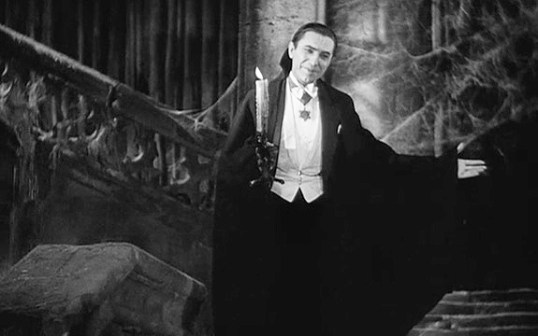
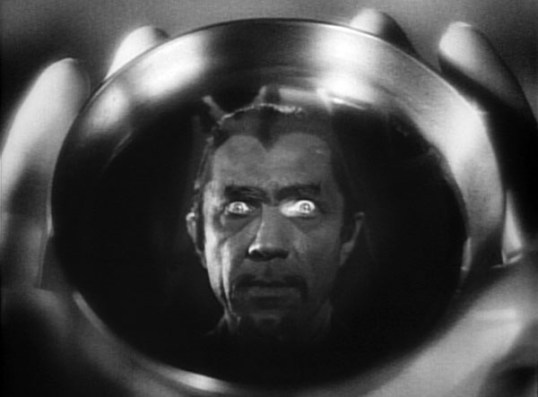
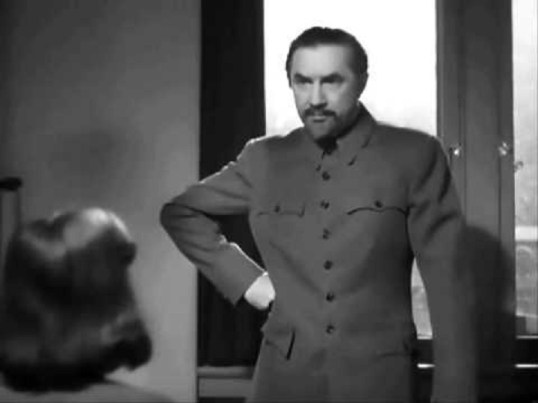
139 years ago on this date, Bela Lugosi was born in Hungary. Today, we honor his memory with….
4 Shots From 4 Bela Lugosi Films
Dracula (1931, dir by Tod Browning, DP; Karl Freund)
White Zombie (1932, dir by Vincent Halperin, DP: Arthur Martinelli)
Ninotchka (1939, dir by Ernst Lubitsch, DP: William H. Daniels)
Bride of The Monster (1955, dir by Ed Wood, DP: Ted Allan and William H. Thompson)
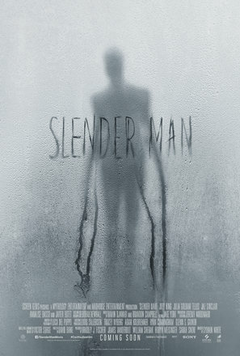
Slender Man is a 2018 horror film about the Slender Man, the mysterious supernatural being who appears in online photographs and videos and who …. well, I’m not sure what it is that he does exactly. Apparently, he targets children and teenagers and he uses his long arms to either abduct them or drive them crazy or maybe take them to a different realm of existence. Who knows? That’s actually probably a part of the appeal of Slender Man. He can pretty much be whoever or whatever anyone wants him to be.
In this Massachusetts-set film, four teenage girl decided to summon the Slender Man. Their ceremony works but it turns out that summoning a demonic figure who hunts children is not as good an idea as the girls originally assumed. Who would have guessed it, right? After one of the girls disappear, the other three try to figure out how to deal with Slender Man. It all leads to death, insanity. and panic. Yay!
Slender Man is one of those films where nearly every scene is severely underlit and it’s often difficult to actually tell what’s happening in each scene. This has become a very popular technique in recent years, one that some directors have embraced almost to the point of absolute absurdity. (Watch any horror-themed program on Netflix and you’ll see what I’m talking about.) I imagine the idea is to create a creepy and shadowy atmosphere and to keep you wondering about what might be lurking in the darkness. There’s nothing wrong with that, if the film itself is genuinely scary. However, in a film like Slender Man, the underlit look feels rather lazy. It’s as if the director and the cinematographer realized that the film’s story was never going to make sense so they specifically turned off the light to try to keep us from noticing. Instead of trying to improve the script or maybe come up with something interesting for Slender Man to do, they instead did the cinematic equivalent of shoving the audience into a dark room, locking the door, and then shouting boo in the vain hope of tricking them into being scared.
Of course, a huge part of the problem with Slender Man is that real life is often scarier than anything that will ever appear in a movie. In 2014, two teenage girls really did stab one of their friends and they did attempt to blame their crime on Slender Man, whom they claimed they were tying to impress. This led to a moral panic, one in which parents worried that internet memes were turning children into sociopaths. My own personal opinion is that if your child is stabbing one of their friends, they have problems that go far beyond anything they may have seen online. Moral panics are a lot like Slender Man, in that they can be whatever the participants want them to be. In this case, the panic over internet memes allowed parents the luxury of not reflecting on whether or not their own bad parenting has anything to do with the actions of their children. “No,” parents could say, “it wasn’t that we raised a sociopath! It’s that some anonymous user posted a silly picture of Slender Man peaking out from behind a tree!” It is much easier to demand that a website be taken down or censored than to actually ask yourself why your children would be 1) stupid enough to believe in Slender Man in the first place and 2) eager to impress him.
Though Sony Pictures always denied it, it’s obvious that the Slender Man movie was made to capitalize on the publicity surrounding the Slender Man trial. Unfortunately, the film itself just isn’t scary. It’s poorly paced, poorly acted, and way too dark. No wonder Slender Man hasn’t been seen in a while….
Watching The Creeping Terror is an October tradition here at the Shattered Lens. How could anyone resist a film about a killer carpet, especially one that features a random dance party? This film was directed by an enigmatic figure named Vic Savage. No one is really sure who he actually was. No one is sure what happened to him after The Creeping Terror was finally released. But what we do know is that he made a film unlike any other.
This is from 1976. Did you know that minotaurs can breathe fire? I like the half-naked couple that just happens to be at the front of the crowd. This movie knew how to appeal to an audience.
Tonight, for our horror on the lens, we have the third episode of the 2nd season of Friday the 13th: The Series!
Kate Trotter plays a psychiatrist who, due to a cursed radio, is capable of helping even the most troubled of her patients! Unfortunately, for everyone that she helps, someone else has to die!
This episode originally aired on October 14th, 1988.






 Through the Shattered Lens