In this episode of HBO’s horror anthology, Tales From The Crypt, Joe Pesci plays a con artist who tries to swindle twin sisters, just to discover that the sisters have a secret of their own. Pesci is at his best here, poking fun at his own screen persona while playing a character who discovers that he’s not quite as clever as he thought he was.
The episode originally aired on August 26th, 1992.
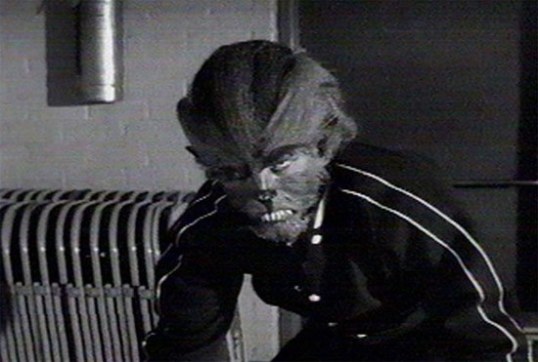
Tony Rivers (Michael Landon), the lead character in 1957’s I Was A Teenage Werewolf, is a teenager. You probably already guessed that from the film’s title but, as we all know, titles can be misleading. Teenagers were very popular in the 50s, after all.
But no, Tony is actually a teenager. In fact, he’s one of those troubled teenagers that were all the rage in the late 50s. He lives for kicks and spends too much combing his hair. He skips school. He stays out late. He gets into fights with other teenagers. He’s not dumb, mind you. He has plenty of friends and a girlfriend (Yvonne Lime) who only wants the best for him. He just has a hard time controlling his temper and his father (Malcolm Atterbury) isn’t sure what to do with him.
However, Detective Donavon (Barry Phillips) has a possible solution! After the police are called to break up one of Tony’s fights, Donavon suggests that maybe Tony should seek professional counseling. In fact, maybe he could go see Dr. Brandon (Whit Bissell)! Dr. Brandon is a widely respected hypnotherapist and he has an office right next to the local airplane factory. Only the best therapists are allowed to practice next to the airplane factory. Everyone knows that.
Even though he doesn’t want to, Tony finally agrees to see Dr. Brandon. Even if he doesn’t say it, you can tell that Tony is thinking, “This is totally squaresville. Really melvin, maaaaaan….” the whole time. But Brandon gets results!
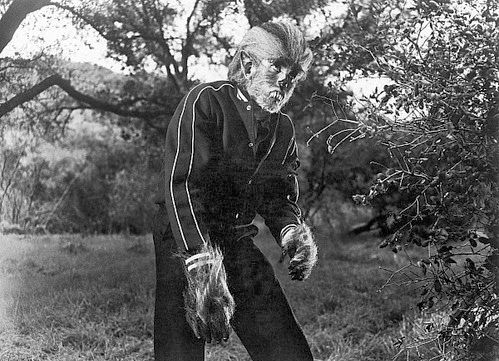
In fact, you could argue that he gets too many results. After twice hypnotizing Tony and telling him to think of himself as being a wild animal, Tony becomes just that! That’s right, Tony turns into a werewolf and he’s soon running around town — in his letterman jacket! — and killing anyone that he comes across.
Whenever Tony transforms back into a human, he regrets what he’s done. Unfortunately, it turns out that almost anything can cause Tony to turn back into a wolfman. Most werewolves need a full moon. All Tony needs is to hear the sound of the school bell….
To be honest, I imagine that most people who watch this film do so because they want to see a werewolf creating chaos while wearing a high school letterman jacket. Considering that this was a low-budget film made to play as half of a double feature, the werewolf makeup is actually fairly impressive and that letterman jacket adds just the right touch of weirdness to the whole affair.
Make no mistake, it’s an entertaining and deeply silly film but, at the same time, it does have an interesting subtext. One could argue that Tony’s transformation into a werewolf serves as a metaphor for his struggle to grow up. Neither werewolves nor juvenile delinquents can control themselves and Michael Landon gives a performance that’s just sensitive enough to justify calling this one Werewolf Without A Cause.
That said, the main appeal of this film is definitely the chance to see a werewolf in a letterman jacket.
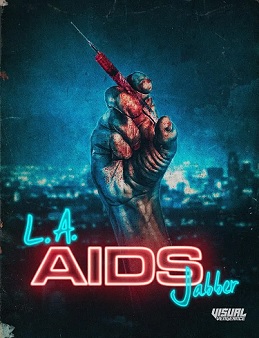
Jeff (Jason Majik) is an angry young man who is seeing a therapist because he has issues with women. He worked in a furniture warehouse, where he has issues with his boss. Jeff has issues with everyone but soon, he has an even bigger concern. Because of a nagging stomachache, Jeff goes to see a doctor. The doctor does some bloodwork. He runs the results twice just to be sure. Then he informs Jeff that he has tested positive for AIDS. Jeff snaps. He fills a huge hypodermic needle with his own blood and then goes on a rampage, jabbing people across Los Angeles.
The two detectives who have been assigned to the jabber case (and who appear to investigate every other homicide in Los Angeles as well) do not want the story to get into the press. Unfortunately, a stolen boombox that belongs to the boyfriend of a local news reporter (Joy Yurada) picks up the sound of the detectives talking on their secure line. Refusing to be intimidated, the reporter reveals the details of the investigation on the nightly news. Jeff decides to make the reporter his newest target.
Again, this is a real movie and that is the real title.
L.A. AIDS Jabber is a shot-on-video film that was based on the urban legend about someone with AIDS going to the clubs in New York and Los Angeles and randomly pricking people with a needle. The movie itself is pretty dire, full of bad performances and subplots that don’t lead anywhere. To me, the most interesting thing about the movie was how little it actually seemed to know about AIDS or how it was transmitted. For instance, no one — not even the doctor who tells Jeff that he’s tested positive — uses the term “HIV.” The doctor tells Jeff that he has “tested positive for AIDS” and then just sends him home. I get that this film was made in 1994 when people were still learning about this virus but the doctor could have at least informed Jeff that it can take several years for HIV to develop into AIDS. As a last minute twist reveals at the end of the film, that’s not the only way that the doctor has failed his patient.
As for the rest of the movie, it’s all bad performances, bad acting, bad jokes, and a bad script. Jason Majik does have one good scene where he starts punching a wall but that’s pretty much it. This jabber’s not worth getting stuck with.
That is pretty much the plot of this short Twine game. You are given the option of deciding what type of vampire you are (Are you a Nosferatu or a Twilight or a Gothic Vampire?) and you’re also allowed to decide just how exactly you want to spend your evening. Do you want to hit the clubs or would you rather spend your night singing karaoke? It’s up to you.
This game feels like it may have been abandoned why it was still being developed but what there is of it is enjoyable. The game at least has a sense of humor. There’s even an ending where the game says that you’re obviously looking for something darker than this game is prepared to offer up. Not much happens in this game but a few of the jokes did make me laugh. After you’ve played as many overlong, overly serious Twine games as I have, it’s hard not to appreciate something as unpretentious as Europop Vampire.
4 Or More Shots From 4 Or More Films is just what it says it is, 4 shots from 4 of our favorite films. As opposed to the reviews and recaps that we usually post, 4 Shots From 4 Films lets the visuals do the talking!
This October, I’m going to be doing something a little bit different with my contribution to 4 (or more) Shots From 4 (or more) Films. I’m going to be taking a little chronological tour of the history of horror cinema, moving from decade to decade.
Today, we take a look at 2013 and 2014!
6 Shots From 6 Films: 2013 — 2014
Only Lovers Left Alive (2013, dir by Jim Jarmusch, DP: Yorick Le Saux)
Under the Skin (2013, dir by Jonathan Glazer, DP: Daniel Landin)
The Conjuring (2013, dir by James Wan, DP: John R. Leonetti)
The Babadook (2014, dir by Jennifer Kent, DP: Radek Ładczuk)
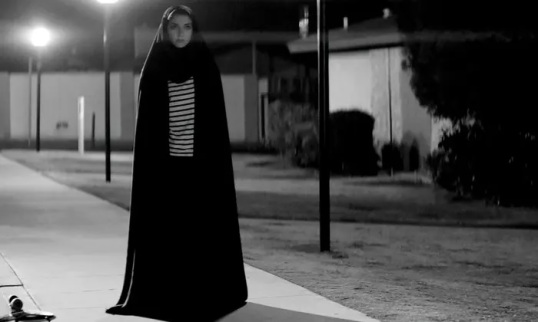
A Girl Walks Home Alone At Night (2014, dir by Ana Lily Amirpour, DP: Lyle Vincent)
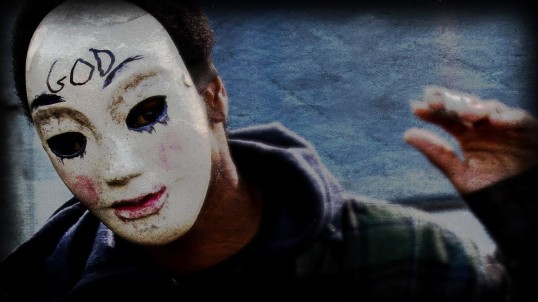
The Purge: Anarchy (2014, dir by James DeMonaco, DP: Jacques Jouffret)
First released way back in 1979, Prophecy is one of those films where a big evil corporation is selfishly polluting the environment and a group of noble Native Americans is convinced that a vengeful spirit of the forest has been awakened as a result.
We’re told that the vengeful spirit is named Katahdin and that it’s “as large as a dragon and has the eyes of a cat.” We’re also told, by someone who claims to have actually seen it, that the Katahdin is a combination of several different creatures, “a part of everything that is God’s creation.”
Sound pretty scary, right?
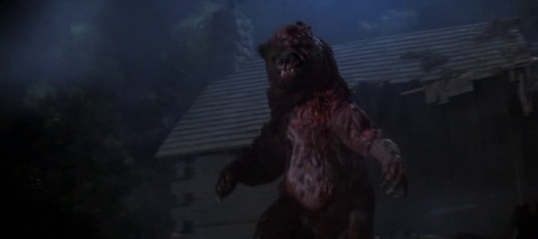
Well, it is until the bear itself actually shows up on screen. That’s when we find ourselves confronted with this:
I mean, don’t get me wrong. He certainly is ugly. But he just looks so silly and …. well, fake.
The lesson here, and it’s an important one, is that you should never put your monster onscreen unless it can actually live up to all the hype. Take a lesson from Spielberg. When it became obvious that the shark in Jaws looked like a tin model, Spielberg made the decision to not show the shark. Instead, he gave us a lot of point of view shots and, by the time the shark did appear, audiences were so frightened that it didn’t matter whether it looked convincing or not. Prophecy makes the mistake of having its monster all over the place and it just doesn’t work.
Of course, once the EPA’s Dr. Robert Verne (Robert Foxworth) shows up with his pregnant wife (Talia Shire, who somehow went from The Godfather and Rocky to this), he discovers that one reason why the Katahdinh doesn’t live up to all the hype is because it’s just a mutant bear. It turns out that all that pollution led to some crazy results and now every logger, Native American activist, and camper in the area is in danger! Can Dr. Verne and a team of disposable, forgettable characters end the threat of Katahdinh!?
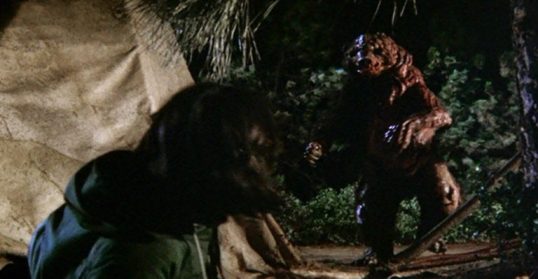
Prophecy is a big, dumb movie that’s never as much fun as you want it to be. There is one early scene that features a camper trying to hop away from Katahdinah while zipped up in a sleeping bag. That scene — which ends with one ruined sleeping back and lot of feathers floating around — is just demented enough to be kind of fun:
Otherwise, the entire film is slow-moving and rather dull. Part of the problem is that it was directed by John Frankenheimer, a major and important filmmaker who had entirely the wrong sensibility for this film. Frankenheimer was a legitimately great director (among his good credits: The Manchurian Candidate, Birdman of Alcatraz, Ronin, Seconds) but he takes the material too seriously. He spends so much time trying to sell the film’s environmental message that he forgets that the majority of the audience for a film like this isn’t watching because they want to become a better person. They’re watching for mutant bear mayhem! This is the type of film that needed to be directed by someone from the Roger Corman school of quick thrills and shameless shlock.
So, here are the twin lessons of Prophecy: know your audience and make sure your monster can live up to its reputation! Otherwise, you’ll just be known for that one scene with the exploding sleeping bag.
(I originally shared this film back in 2011 and 2019 — can you believe we’ve been doing this for that long? — but the YouTube vid was taken down both times! So, I’m resharing it today!)
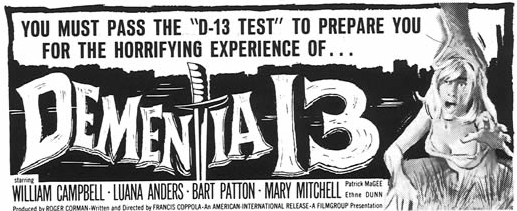
For today’s excursion into the world of public domain horror, I offer up the film debut of Francis Ford Coppola. Before Coppola directed the Godfather and Apocalypse Now, he directed a low-budget, black-and-white thriller that was called Dementia 13. (Though, in a sign of things to come, producer Roger Corman and Coppola ended up disagreeing on the film’s final cut and Corman reportedly brought in director Jack Hill to film and, in some cases, re-film additional scenes.)
Regardless of whether the credit should go to Coppola, Corman, or Hill, Dementia 13 is a brutally effective little film that is full of moody photography and which clearly served as an influence on the slasher films that would follow it in the future. Speaking of influence,Dementia 13 itself is obviously influenced by the Italian giallo films that, in 1963, were just now starting to make their way into the drive-ins and grindhouses of America.
In the cast, keep an eye out for Patrick Magee, who later appeared as Mr. Alexander in A Clockwork Orange as well as giving a memorable performance in Lucio Fulci’s The Black Cat. Luana Anders, who plays the duplicitous wife in this film, showed up in just about every other exploitation film made in the 60s and yes, the scene where she’s swimming freaks me out to no end.




 Through the Shattered Lens