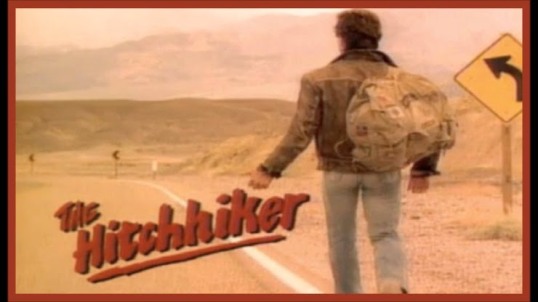
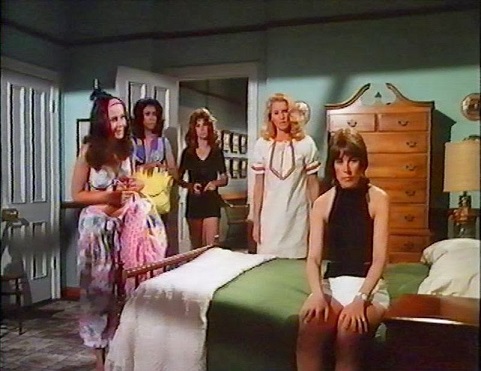
Horror on TV: The Hitchhiker 5.1 “The Martyr” (dir by Phillip Noyce)


Tonight’s episode of The Hitchhiker is a stylish homage to noir, starring Meg Foster as a femme fatale who is not quite as blind as she pretends to be.  This episode was directed by Phillip Noyce, who was also responsible for a film about an actual blind person, Blind Fury.  Interestingly enough, that film also featured Meg Foster, though in a very different role than the one that she plays here.

This episode originally aired on April 22nd, 1989.

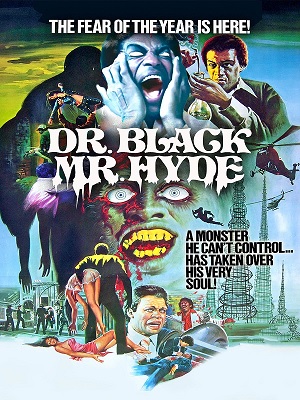
The TSL Horror Grindhouse: Dr. Black, Mr. Hyde (dir by William Crain)


1976’s Dr. Black, My Hyde tells the story of Dr. Henry Pride (Bernie Casey).

Dr. Pride is a respected doctor, the head of a free clinic in the Watts district of Los Angeles.  He has a big house.  He has a fancy car.  With Dr. Billie Worth (Rosalind Cash), he is researching a serum that will help people with cirrhosis to regenerate the tissue of their liver.  Of course, Dr. Pride wasn’t always rich.  In his own words, he and his mother grew up in the guest house of a brothel.  But now that he is rich and successful, some people claim that he’s lost touch with his community.  As a prostitute named Linda (Marie O’Henry) tells him, “You talk white, you think white, you probably drive a white car.”

In a scene that is designed to bring to mind the horrors of the Tuskegee syphilis experiments, Dr. Pride considers the ethics of injecting his serum into his patients without warning them that there might be consequences.  Billie warns him that what he’s thinking about doing would be not only unethical but illegal.  Dr. Pride questions whether ethics matter when dealing with something that could potentially save lives in the future.  After Dr. Pride injects an elderly black woman with the serum, she turns into a white-skinned monster who attempts to strangle a nurse before promptly dying.  Despite this, Dr. Pride continues to develop the serum and eventually, he tries it on himself.

Under the effects of the serum, Dr. Pride becomes a white-skinned madman.  (Bernie Casey wears a white makeup whenever he plays this film’s version of Mr. Hyde.)  Under the influence of the serum, Pride rampages through Watts, killing prostitutes and pimps before transforming back into the Dr. Pride.  The police are investigating the murders but they’re searching for a white man.  Meanwhile, Dr. Pride continues to obsess on trying to work out the kinks of her serum.  He wants Linda to be his latest test subject.

Dr. Black, Mr. Hyde is a blaxploitation take on Dr. Jekyll and Mr. Hyde and, as with many blaxploitation films, the subtext is frequently more interesting than what actually happens on screen.  Dr. Pride, after continually being accused of acting white, takes his serum and soon literally becomes white and sets out to kill the prostitutes and the pimps who remind him of his life before he became a doctor.  And while it’s easy to see this as an example of the serum turning a good man into an evil monster (the classic Jekyll and Hyde formula), it’s also true that, even before his transformation, Dr. Pride views his patients as being potential test subjects.  For all of his talk about helping people, Dr. Pride maintains his distance from the members of his own community.  Is the serum turning Dr. Pride into a monster or is it just revealing who Dr. Pride truly wishes to be?  Given the film was directed by William Crain, who also did Blacula and who, unlike a lot of Blaxploitation directors, actually was black, it’s easy to believe that the subtext was intentional.

Of course, subtext aside, Dr. Black, Mr. Hyde is a cheap-looking and haphazardly edited film.  Much of the acting is amateurish but Bernie Casey gives a strong performance as both the repressed black doctor and his violent, white alter ego.  Cheapness aside, Dr. Black, Mr. Hyde is a frequently intriguing film.

The McPherson Tape (1989, directed by Dean Alioto)


A found footage film, The McPherson Tape (which is also known as UFO Abduction) opens with a title crawl that tells the viewer that what they are about to see is both and also the most compelling evidence to date that aliens are visiting Earth.

On October 8th, the Van Heese family gathers to celebrate the fifth birthday of Michelle.  Michael, the youngest of the Van Heese brothers, is home from college and he’s brought his new video camera with him, which he uses to film the party.  At first, his brothers give him a hard time about both his new beard and his camera but soon, everyone has bigger things to worry about.  When the power suddenly goes out, Michael and his brothers go outside to investigate.  While doing so, they stumble across what appears to be a spaceship and three humanoid aliens standing outside of it.  The brothers run back to the house and, eventually, the aliens follow.

The McPherson Tape was one of the first found footage films and it stays true to the rules of the genre to an extent that more recent examples have not.  That means that the 66-minute film plays out in real time.  There’s no background music.  The sound quality is poor.  The footage is grainy and sometimes out of focus.  This is one found footage film that actually looks like found footage, with the only thing giving the game away being the rubber alien masks worn by the actors playing the invaders.  Just as in real life, it’s not always exciting.  There are moments of dead space where both the audience and the McPhersons are waiting to see what happens next.  But because the film feels authentic and it features a cast of unknowns who do a good job of acting scared and confused, it’s much more effective than some of the slicker examples of the genre that have come out in recent years.

Director  Dean Alioto later remade The McPherson Tape with a bigger budget professional actors.  In 1998, the remake aired on the UPN under the title Alien Abduction: Incident In Lake County and supposedly caused a panic when some viewers though it was an actual documentary.  For my money, though, the original is still the best.

Retro Television Reviews: Five Desperate Women (dir by Ted Post)


Welcome to Retro Television Reviews, a feature where we review some of our favorite and least favorite shows of the past!  On Sundays, I will be reviewing the made-for-television movies that used to be a primetime mainstay.  Today’s film is 1971’s Five Desperate Women!  It  can be viewed on YouTube!

Five women, who all went to college together, reunite for the first time in five years.  They’re planning on spending a weekend at a cabin on a private island.  Lucy (Anjanette Comer) is the alcoholic who talks too much.  Dorian (Joan Hackett) is the pill popper who lies about having a handsome husband and two beautiful children.  Joy (Denise Nicholas) is the former activist turned trashy model.  Gloria (Stefanie Powers) is bitchy and self-centered.  And Mary Grace (Julie Sommars) is the one with the mentally ill mother who refuses to speak to her.  Upon reuniting on the dock, the five women all immediately gather in a circle sing an old sorority song.  It’s going to be one of those weekends!

The private island is lovely and the women believe that they have it to themselves, with the exception of the two men who are also on the island.  Wylie (Robert Conrad) is the caretaker and he seems to be a trustworthy gentleman and exactly the type of guy who you would want to be stranded on an island with.  And then there’s Meeker (Bradford Dillman), who drove the boat to the island and who is the type of overbearing jerk who has to be specifically told not to bother the women.  While the women stay in the main house, the men stay in the nearby caretaker’s cottage.

From the start, it proves to be a stressful weekend.  All of the women have secrets and long-buried resentments that come out at the slightest provocation.  Not helping the fact is that there’s a murderer on the island, one that goes from killing a dog to strangling Dorian while the rest of the women are at the beach.  The woman, figuring that the murderer has to be either Meeker or Wylie, lock themselves into their house for the night but it turns out that it’s going to take more than a locked door to defeat a killer.

Five Desperate Women has an intriguing premise but it also has an extremely short running time.  With only 70 minutes to tell its story and 7 major characters to deal with, the film doesn’t leave much room for character development and, as a result, each woman is only given one personality trait and each actress ends up portraying that trait as broadly as possible.  As a result, it doesn’t take long for the movie to go from being Five Desperate Women to Five Annoying Women.  As for Robert Conrad and Bradford Dillman, the two of them give effective performances but anyone with a hint of genre savvy will be able to guess who the killer is going to turn out to be.  There is one unintentionally funny moment where the desperate women attempt to fight off the killer by throwing rocks at him and none of the rocks come close to reaching their target but otherwise, Five Desperate Women is not particularly memorable.

Horror Scenes That I Love: Peter Cushing in Horror of Dracula


Peter Cushing was a horror mainstay who played both heroes and villains, often appearing opposite Christopher Lee.  By most accounts, Cushing was a kind and old-fashioned British gentleman, one who was beloved by both his colleagues and his fans.  Christopher Lee described him as being his best friend and reportedly, never fully recovered from his sadness over Cushing’s death in 1994.

(Cushing’s long screen collaboration actually first started in 1948’s Hamlet, in which Cushing played Osric and Christopher Lee had an uncredited role as a spear carrier.)

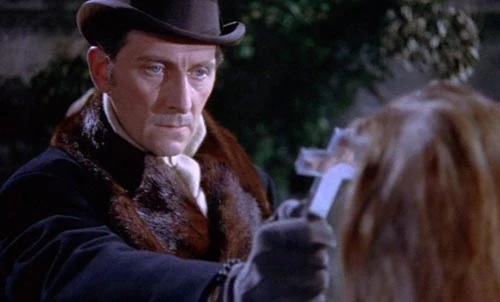
Though Hammer Films often cast Cushing as the mad Baron Van Frankenstein, I preferred his work as the stern but kindly Dr. Van Helsing.  This scene from 1958’s Horror of Dracula, in which Van Helsing drives a stake through Lucy and ends her eternal suffering, features Cushing at his best.  In this scene, we see both Van Helsing’s determination and also some hints of the kindness that Cushing brought to the role.

October True Crime: Confessions of a Serial Killer (dir by Mark Blair)


The 1985 film, Confessions of a Serial Killer, is based on the confessions of Henry Lee Lucas.  Lucas was a one-eyed Michigan-born drifter who was arrested for murder in Texas in 1983.  Once in custody, Lucas started confessing to murder after murder.  At one point, it was estimated that Lucas had claimed to have killed around 600 people, sometimes by himself and other times with the help of his friend and sometimes lover, Ottis Toole.  (Lucas “married” Toole’s 12 year-old niece, Becky, and then later chopped her up in a field.)

Of course, eventually, someone actually looked at Lucas’s confessions and came to realize that they didn’t really add up.  Lucas had confessed to so many murders that, in order to believe him, you would have to be willing to accept that he could commit a murder in Florida in the afternoon and then somehow commit a second murder in upstate New York that night.  (And that’s not even getting into the fact that Lucas confessed to killing Jimmy Hoffa and claimed that the CIA sent him to Cuba to take out Fidel Castro.)  In the end, it was determined that Lucas was simply telling the police what they wanted to hear and that, sometimes deliberately and sometimes accidentally, the police were feeding him information about unsolved crimes in order to make his confessions more credible.  Today, it’s generally agreed that Lucas may have killed 11 people.  It’s also possible that he only killed two.  (On the other hand, Ottis Toole really was the degenerate serial killer that Lucas claimed her was.)

Still, the national coverage of Lucas’s confessions inspired two independent films that were made in the mid-80s.  One of those two films (and the better known of the two) was John McNaughton’s Henry: Portrait of a Serial Killer, in which Lucas was played by Michael Rooker and most of the action took place in Chicago.  The other film was Confessions of a Serial Killer, which was filmed in Texas.

In Confessions of a Serial Killer, Henry Lee Lucas is re-imagined as Daniel Ray Hawkins (Robert A. Burns), a polite and mild-mannered redneck whose short stature, glasses, and somewhat quizzical expression all hide the fact that he is actually a vicious serial killer.  Having recently been arrested, Hawkins nonchalantly confesses his crimes to Sheriff Will Gaines (Berkeley Garrett).  Hawkins obviously enjoys telling his stories and he also appreciates that, whenever he and the sheriff go out to a crime scene together, he gets a hamburger and a chocolate milkshake.  (“If these policemen weren’t here,” Hawkins tells one waitress, “you’d be mine.”)  Hawkins talks about his childhood, growing up as the son of the town prostitute and a shellshocked father.  He claims that his first victim was a sex worker in Scranton.  Though flashbacks, we see Hawkins’s friendship with the moronic and equally bloodthirsty Moon Lewton (Dennis Hill).  Hawkins eventually marries Moon’s sister, Molly (Sidney Brammer), who turns out to be just as sociopathic as her brother and her new husband.

Though it never escapes from Henry’s shadow, Confessions of a Serial Killer is an effective and disquieting film.  The low budget works to the film’s advantage, especially in the scenes in which Hawkins wanders across the Texas countryside.  Watching these grainy, documentary-style scenes, the viewer can literally feel the humidity and see the bugs buzzing around the tall grass.  Though the cast is made up of unknowns, they all bring an authenticity to their roles.  Anyone who has ever spent any time in small town Texas will automatically recognize the stoic but fair-minded sheriff played by Berkeley Garrett and the humble and religious doctor played by Ollie Handley.  That said, the film is dominated by Robert A. Burns and his effectively low-key performance as Daniel Ray Hawkins.  Burns himself was a set designer who got his start designing the house of horrors from The Texas Chainsaw Massacre.  Burns plays Hawkins as being someone who has figured out how to come across as harmless but who also can’t help but seem off-center.  His flat delivery of Hawkins’s lines captures the fact that, on the inside, Hawkins is empty.  Even when he kills someone to whom he was close, he can only blandly say, “I was sorry about that.”  True feelings are unknown to him.

Confessions of a Serial Killer is a film that stick with you.  It’s a film that reminds you that you never know who might be watching you.  Is that polite man just looking to be helpful or is he another Daniel Ray Hawkins?

4 Shots From 4 Films: Special Tod Browning Edition


4 Shots From 4 Films is just what it says it is, 4 shots from 4 of our favorite films. As opposed to the reviews and recaps that we usually post, 4 Shots From 4 Films is all about letting the visuals do the talking.

This October, I am going to be using our 4 Shots From 4 Films feature to pay tribute to some of my favorite horror directors, in alphabetical order!  That’s right, we’re going from Argento to Zombie in one month!

Today’s director is Tod Browning, who started his career during the silent era, ended it in the sound era, and was responsible for some of the most important horror and suspense films of both eras!

4 Shots From 4 Tod Browning Films

West of Zanzibar (1928, dir by Tod Browning, DP: Percy Hilburn)

Dracula (1931, dir by Tod Browning. DP: Karl Freund)

Freaks (1932, dir by Tod Browning, DP: Merritt Gerstad)

The Devil-Doll (1936, dir by Tod Browning, DP: Leonard Smith)

Moments #9: Visiting Another Cemetery


A few blocks from my house, there is a historic cemetery, one that is over 150 years old.  It is surrounded by a fence.  Behind it, there is a bus station.  Across the street from it, there is a gymnastics center and several warehouses.  Other than the fence and the gravestones, there are no markings and I think most people drive by without ever noticing it.

I first noticed it one day while I was driving to the library.  I came back later with my camera and I took some pictures.  At first, it was difficult to concentrate with the sound of traffic in the background but the longer I spent standing outside the gates of the cemetery, the less I heard of the traffic.

Later, I learned that the people buried in this cemetery were among the first to build a town on this land.  Without these people, who came from across the country, these roads and warehouses and the new gymnastics center would have never had a place to be built.


As I left, I saw an American flag raising over a nearby used car lot.  I made sure to get a picture before I went home.

Previous Moments:

  1. My Dolphin by Case Wright
  2. His Name Was Zac by Lisa Marie Bowman
  3. The Neighborhood, This Morning by Erin Nicole
  4. The Neighborhood, This Afternoon by Erin Nicole
  5. Walking In The Rain by Erin Nicole
  6. The Abandoned RV by Erin Nicole
  7. A Visit To The Cemetery by Erin Nicole
  8. The Woman In The Hallway by Lisa Marie Bowman

Horror Film Review: The Astral Factor (dir by John Florea)


Filmed in 1978 but not released until 1984, The Astral Factor tells the story of Roger Sands (Frank Ashmore).

Known as the Celebrity Killer, Roger is a serial killer who murdered women who reminded him of his famous mother.  It may seem like Roger is destined to spend the rest of his life in prison but what the legal system didn’t consider is that Roger has the ability to not only move things with his mind but to also turn himself invisible.  How did Roger get those powers?  Who knows?  At one point, Roger’s psychiatrist mentions that Roger was a student of the paranormal.  Later, it’s revealed that he had several books about the supernatural in his bedroom.  Apparently, Roger figured out how to do it himself.

Anyway, Roger is now invisible and soon, he has escaped from prison.  He is determined to kill the five women who testified against him at his trial, both because they remind him of his mother and also because he blames them for sending him to prison.  Roger strangles his victims, which in this case means that the actresses playing them have to pretend like they’re struggling with someone who can’t be seen.  In fact, Roger spends almost the entire film in a state of invisibility.

How do you catch a killer who can’t be seen?  It’s a fair question but police Lt. Charles Barnett (Robert Foxworth) might have the answer.  Barnett’s solution involves grabbing a gun and keep firing it until you hit something.  That’s a straight-forward solution but The Astral Factor is a pretty straight forward film.  The film begins with Roger turning invisible and, to its credit, it doesn’t spend too much time trying to justify or explain Roger’s magical powers.  The film understands that all the audience really needs to know is that Roger can’t be seen and that it’s up to Lt. Burnett to find a way to stop his killing spree.

The Astral Factor is a low-budget film, one that is full of formerly prominent performers who obviously showed up to get a quick paycheck.  Sue Lyon, Marianne Hill, Leslie Parrish, and Elke Sommer all play potential victims and all of them look like they would rather be doing anything other than appearing in The Astral Factor.  Robert Foxworth, to his credit, does his best to give a convincing performance as a level-headed cop who is forced to accept the reality of the paranormal.  Not only is he having to investigate a series of murders but he’s having to do it on his birthday.  Stefanie Powers plays his girlfriend, Candy.  Candy often refers to herself in the third person whenever she’s having a conversation with her boyfriend.  I tend to do the same thing so at least there was a character in this movie to whom I could relate.  Knowing the rules of the genre, I spent the entire movie expecting Candy to be put in danger and I was actually impressed when my expectations were subverted and that didn’t happen.

With the exception of a few atmospheric scenes and an entertainingly garish and tacky dance number, the film itself has the rather flat look of a made-for-TV movie, though the occasional hint of nudity indicates that it was meant to be a theatrical release.  As I mentioned at the start of this review, The Astral Factor was originally filmed in 1978 but it sat on the shelf until 1984.  That’s when a slightly shortened version was released under the title The Invisible Strangler.  Today, the film is available in countless Mill Creek Box Sets, under its original title and with its original run time restored.

Horror on the Lens: The Boogie Man Will Get You (dir by Lew Landers)


Today’s horror on the lens is a short horror comedy from 1942.  In The Boogie Man Will Get You, Winnie Slade (Miss Jeff Donnell) buys an old house from Prof. Billings (Boris Karloff) with plans to covert it into a hotel.  However, one of the conditions of the sale is that Prof. Billings and his servants be allowed to live on the property.  What Winnie doesn’t know is that Prof. Billings had been conducting experiments on traveling salesman.  He hopes to turn them into supermen who, much like Captain America, can then be sent overseas to fight the Nazis.  However, his experiments have yet to be successful and have mostly just resulted into a lot of salesman being buried out in the rose garden.

However, things start to look up for Prof. Billings when he meets Dr. Lorencz (Peter Lorre), who is not only a doctor but also a mayor, sheriff, and dog catcher.  Seriously, Dr. Lorencz can do it all!

The Boogie Man Will Get You is a fun little time capsule of the time in which it was made.  For horror fans, it is mostly interesting because it features both Boris Karloff and Peter Lorre.  Both Karloff and Lorre appear to be having a lot of fun parodying their usual screen images.

Enjoy!