The TSL Horror Grindhouse: Things (dir by Andrew Jordan)


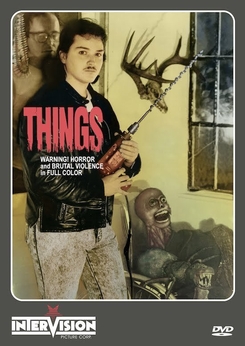
Things is a low-budget, independently-made horror film from 1989.

Things tells the story of Don (Barry J. Gillis) and Fred (Bruce Roach), two gentlemen with mullets who decide to drop by the house of Don’s brother, Doug (Doug Bunston).  When they arrives at the house, they’re surprised to find that Doug is nowhere to be seen.

“Doug, are you here?” Don asks, “Doug, are you alive?”

Don and Fred decide to raid the refrigerator in search of beer.  Inside the refrigerator, they find a book by Aleister Crowley and a tape recorder.  They decide to listen to the tape, which was a huge mistake because, when you’re starring in a crappy horror film, the last thing you want to do is remind the viewer of a different, better horror film.  As they played the tape, I thought to myself, “Don’t mention Evil Dead, don’t mention Evil Dead….”

“Hey,” Don said, “this is like that movie where those weird things happened….”

Anyway, Doug finally makes an appearance and orders them to stop making so much noise.  His wife is trying to sleep.  She’s been exhausted because she and Doug have been working with the mad Doctor Lucas (Jan W. Pachul) in an attempt to conceive a child.  Unfortunately, Lucas’s experiments have led to Susan giving birth to several insect-like monsters, which promptly attempt to eat Doug, Don, and Fred.

Things is such a Canadian film that I actually had to pause the movie after about ten minutes so that I could put on one of Jeff’s hockey jerseys and watch the film in proper style.  Don and Fred are just two regular guys who want to show off their guts and drink some beer.  Indeed, it’s debatable whether or not Don and Fred are as upset about the killer monsters as they are about the fact that Doug doesn’t have much beer left in the refrigerator.  For his part, Don sports both a formidable mullet and truck driver mustache.  He looks like he can’t wait to head back to Toronto as soon as the problem with all of the killer monsters are taken care of.

Things has a reputation for being one of the worst horror films ever made and …. well, it’s certainly not a good film.  The film takes a few stabs at Robocop-style social commentary by casting porn star Amber Lynn as a news reader who appears at random moments and announces that there’s been a power failure in New York and that George Romero is heading to the Supreme Court in his attempt to establish his ownership of Night of the Living Dead.  We’re also promised a story about the presidency of George H.W. Bush and the growing possibility of nuclear war.  Unfortunately, these scenes don’t add much to the film but they do provide a diversion from listening to Don and Fred attempt to have an articulate conversation.  Even if one can accept the bad acting (and sometimes, when it comes to indie horror films, you have to be ready to accept a few awkwardly delivered lines), the film itself is so poorly lit that it’s often difficult to tell what’s actually happening on screen.  Perhaps Things’s biggest problem is that, unless you really enjoy listening to two grown men argue about whether or not there’s any beer left, Things is just a boring movie.  It’s developed a cult reputation, largely due to being riffed on by the Rifftraxx crew, but I would be shocked to find anyone who has actually watched the film more than once.  Things is not The Room.  It’s not even Birdemic.

That said, the film did end with the suggestion that the whole thing might have just been a dream and I appreciated that.  It was a solution that made about as much sense as anything else in the film.
The Devil’s Mistress (1965, directed by Orville Wanzer)


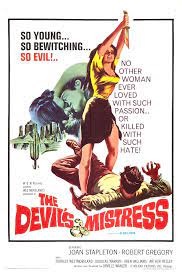
In the Old West, four outlaws are trying to keep one step ahead of the posse when they comes across an isolated cabin sitting the middle of nowhere.  The oldest of the outlaws say that they should stay away from the cabin because it is too far away from civilization and whoever lives there is trying to hide something.  He is outvoted by the other outlaws, who are hungry and hoping the cabin will have some food.

It turns out that cabin belongs to a bearded man who claims to be a pilgrim of some sort.  He lives with his mute wife.  He welcomes the men and gives them food.  Two of the outlaws repay him by murdering him and then raping his wife.  They decide to take the wife with them as they make their way to Mexico.  The wife silently follows but the men soon start to die, one-by-one.  Are the men unlucky or is the woman they kidnapped somehow causing it all to happen?  Given the film’s title, it’s not hard to guess.

The Devil’s Mistress is a mico-budget, independently-produced mix of the western and horror genres.  The film looks cheap and the actors playing the outlaws are all pretty inexpressive but Joan Stapleton’s otherworldly beauty is perfect for the role of the abducted woman who turns out to be far more clever and dangerous than the outlaws assumed.  With a good deal of philosophical dialogue about life, death, and guilt, the film has a lot more on its mind than the average indie western, with each outlaw forced to confront their own mortality as they are punished for their sins.

Horror Scenes That I Love: Godzilla in Godzilla vs. Megalon


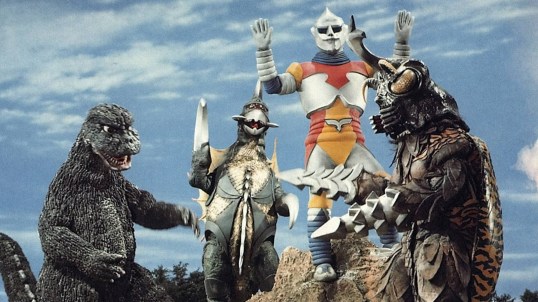
For today’s Horror Scene That I Love, let’s take a minute or two to show some respect to one of the world’s greatest (and longest-lived) film stars, Godzilla!  Whether he’s attacking humanity as the literal representation of atomic age anxiety or if he’s saving Earth from a bunch of aliens, Godzilla has always been a superstar.

In this scene from 1973’s Godzilla vs. Megalon, Godzilla shows just how much of a star he is by taking a stand against bullying and saving his friend, Jet Jaguar.  In this scene, Godzilla shows that he was an anti-bullying activist even before it was cool.  Megalon and his friend thought they could just taunt poor old Jet Jaguar.  Not as long as Godzilla’s around!

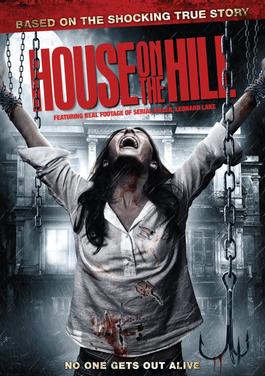
October True Crime: House on The Hill (dir by Jeffrey Frentzen)


2012’s House on the Hill is loosely based on the true story of Leonard Lake and Charles Ng, two of the worst serial killers to ever haunt California.

Two former Marines who met after Ng placed an advertisement in a survivalist magazine, Lake and Ng lived together on an isolated tract of land.  Underneath their cabin, they constructed a dungeon.  Over the next year, they murdered a countless number of people in their dungeon and buried their remains.  Lake and Ng killed anyone they came across, including several people who had previously been friends of Lake’s.  (Ng apparently didn’t have any friends to kill.)  Though they were officially accused of committing eleven murders, it’s felt that the number was probably much higher.  The two of them videotaped their crimes.  Ng kept a detailed and graphic journal in which he gloated about all of the people who he had killed.  Lake made videos in which he explained his philosophy and expounded on why he felt that he deserved a slave.  Eventually, Lake committed suicide after he was arrested on a shop lifting charge.  Ng fled to Canada but was eventually sent back to the United States.  He currently sits on California’s inactive death row.

In the film, Sonia (Naidra Dawn Thompson) is visited at her home by Paul (Kevin McCloskey), a detective.  Paul explains that he knows that Sonia was the only survivor of Ng and Lake’s rampage.  She survived by being the slave that Leonard Lake desired, filming Ng and Lake’s crimes.  Paul wants to know if Sonia remembers one of Lake and Ng’s victims, a woman named Karianna (Shannon Leade).  Paul says that his clients want to know the circumstances that led to Karianna’s death.  After some hesitation, Sonia tells Paul about her experiences as Lake and Ng’s prisoner.  The film is a mix of black-and-white scenes involving Paul and Sonia and color flashbacks to the crimes of Lake (Stephen A.F. Day) and Ng (Sam Leung).  While Sonia and Karianna are both fictional, the audience is shown footage of the real Leonard Lake, talking about his “philosophy” of life.

At first, it feels a bit tasteless to include the actual footage of the real Leonard Lake but, by the end of the film, I was glad that it had been included because, physically, the real-life Leonard Lake and Charles Ng were both considerably less attractive than the actors who played them in the film.  This is especially true of Charles Ng.  The real life Ng was pudgy and nerdy.  Sam Leung, on the other hand, is undeniably handsome and muscular.  Meanwhile, Stephen A.F. Day has the looks and manner of a friendly social worker so it was good to have actual footage of Lake so that the audience could see that, in real life, Leonard Lake was an overweight, loser incel whose spoke like someone who was desperately trying to convince the listener that he was smarter than he actually was.  (Leonard Lake was the type to stumble over any word that had more than one syllable.)  Probably the best thing that a serial killer film can do is remind the audience that most killers are not erudite and clever.  They’re not Hannibal Lecter.  Instead, they’re losers who are striking out at a world in which they have no hope of succeeding.

As for the film itself, it does capture the horror of being trapped but it’s hard not to feel that it made a mistake by focusing on the fictional Sonia and her conversation with Paul.  Indeed, by having the film narrated by a fictional character who managed to escape, the film does a disservice to to the real victims who weren’t so lucky.  With all of the flashbacks and flashforwards, the narrative itself feels too jumbled to really tell us anything about how or why Lake and Ng not only committed their crimes but how they managed to get away with it for over a year.  In the end, the scariest thing about Lake and Ng is that, if not for that one shoplifting incident, their reign of terror could have continued uninterrupted for even longer than it did.

4 Shots From 4 Films: Special Roger Corman Edition


4 Shots From 4 Films is just what it says it is, 4 shots from 4 of our favorite films. As opposed to the reviews and recaps that we usually post, 4 Shots From 4 Films is all about letting the visuals do the talking.

This October, I am going to be using our 4 Shots From 4 Films feature to pay tribute to some of my favorite horror directors, in alphabetical order!  That’s right, we’re going from Argento to Zombie in one month!

Today’s director is one of the most influential figures in American film history, the one and only Roger Corman!

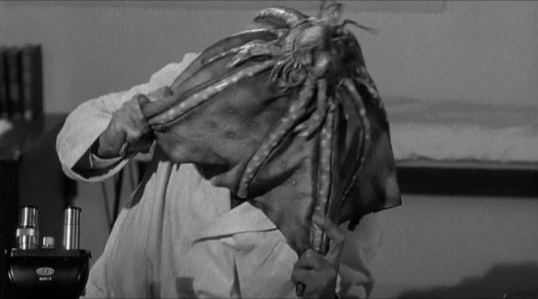
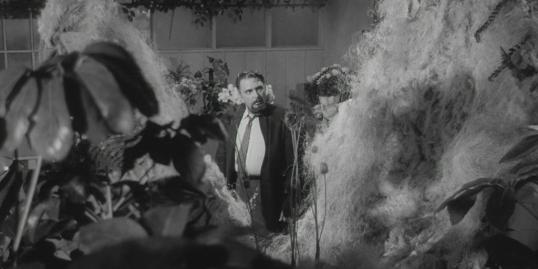
4 Shots From 4 Roger Corman Films

Not of this Earth (1957, dir by Roger Corman, DP: John Mescall)

The Little Shop of Horrors (1960, dir by Roger Corman, DP: Archie R. Dalzell)

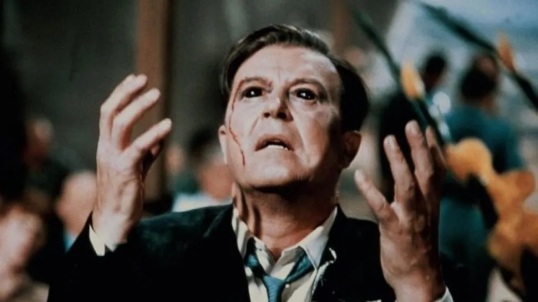
X: The Man With The X-Ray Eyes (1963, dir by Roger Corman, DP: Floyd Crosby)

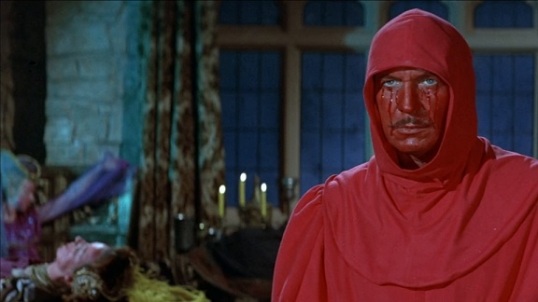
The Masque of Red Death (1964, dir by Roger Corman, DP: Nicolas Roeg)

Horror Film Review: Hounded (dir by Tommy Boulding)


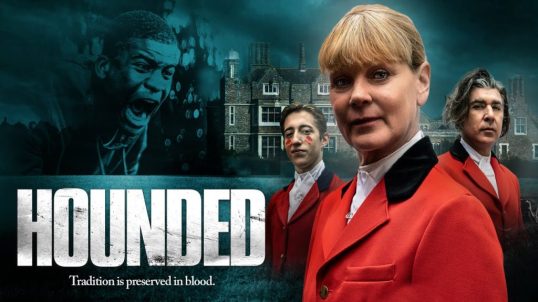
In this British film from 2022, Leon (Nobuse Junior) is the head of a crew of thieves.  Yes, he spends his time breaking into people’s houses and stealing their stuff but the film insists that he’s not that bad.  He’s just trying to raise the money to send his younger brother, Chaz (Malachi Pullar-Latchman) to a university.  Working with the two brothers are the perpetually angry Vix (Hannah Traylen) and the perpetually religious Todd (Ross Coles).  To be honest, none of the really seem like they should be hanging out together but I guess crime makes for unexpected partnerships.  Still, you really do have to wonder in what world would Vix and Todd even say “hi” to one another, let alone work together as a part of a burglary crew?

An antique dealer (Larry Lamb) hires the crew to beak into the estate of the Katherine Redwick (Samantha Bond, best-known for playing Ms. Moneypenny in the Timothy Dalton Bond films) and steal a valuable ceremonial knife.  Unfortunately, it turns out that it’s all a set up and soon, the four thieves are being chased across the estate by Katherine and her family.  If the thieves can make it back to civilization, they’ll be safe.  If they can’t, then they’ll have to face the ceremonial knife.  Yes, they’re playing a most dangerous game, with Count Zaroff’s isolated island being replaced by a posh British country estate.  The film is called Hounded because, just as in a fox hunt, the Redwicks use dogs to chase down their prey.  The dogs are cute and fear not, no harm comes to them.  This is a 2022 film and everyone knows better than to harm a dog.  The humans on the other hand….

There’s a lot of class struggle commentary to be found in Hounded.  The thieves are all working class and angry about not being given the same opportunities as the rich.  The Redwicks are so posh and refined that they basically come across as Monty Python-style caricatures.  They may be hunting people for sport but they’re very polite and proper about it and Katharine spends a lot of time talking about how the Redwicks always hunt with honor.  Unfortunately, while Samantha Bond is entertaining as the main villain, the rest of the characters are not particularly memorable and some of the actors playing the thieves give performances are downright embarrassing.  As such, you never really care much about whether the thieves are going to escape or if the Renwicks are going to face justice.  All you care about is whether or not the dogs are going to be okay.  If your film is going to feature a lot of scare scenes featuring dogs, try not to cast cute Dalmatians.  Seriously, I found myself rooting for the dogs because I knew that, no matter what they did, they would be adorable while doing it.

For the most part, Hounded is a predictable film.  It’s short but it seems much longer.  The version of The Most Dangerous Game just isn’t dangerous enough.

Horror on the Lens: Mesa of Lost Women (dir by Herbert Tevos and Ron Ormond)


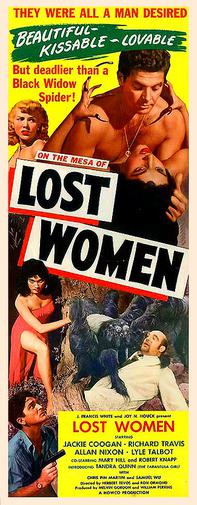
Today’s Horror on the Lens is the infamous 1953 film, Mesa of Lost Women.  Off in the middle of the desert, Dr. Aranya (Jackie Coogan) is conducting dangerous experiments that are resulting not only in giant spiders but also a master race of superwomen who Aranya is planning to use to conquer the world or something.

Mesa of Lost Women is a bit of a disjointed film.  It was originally filmed by a German director named Herbert Tevos, who claimed to be an associate of Erich Von Stroheim’s and a former collaborator of Marlene Dietrich’s.  However, despite his claims of being well-connected, no one was particularly impressed with Tevos’s first cut of the film so Ron Ormond was brought in to film additional scenes, the majority of them featuring Jackie Coogan as the insane Dr. Aranya.  Jackie Coogan was, at the time, still best-known for playing The Kid in the Charlie Chaplin film of the same name.  After Mesa, he would go on to play Uncle Fester on the original Addams Family.

Anyway, Mesa of Lost Women is one of those B-movies that simply has to be seen and heard to be believed.  (Lyle Talbot provides the narration, which is judgmental even by the standards of the 1950s.)  Enjoy Mesa of Lost Women!

Music Video of the Day: Preacher Man by Fields of Nephilim (1987, directed by Richard Stanley)


A cemetery, an atomic wasteland, a chainsaw, a preacher with a bunch of mutant worshippers, it doesn’t get more 80s gothic than this.

Director Richard Stanley directed several gothic music videos but he’s best-known for his feature films, including Hardware and Dust Devil.  (In many ways, the video for Preacher Man feels like a dry run for both Hardware and Dust Devil.)  He was also the original director of the infamous The Island of Dr. Moreau until his conflicts with both the studios and actors Marlon Brando and Val Kilmer led to him being replaced by John Frankenheimer.

Enjoy!

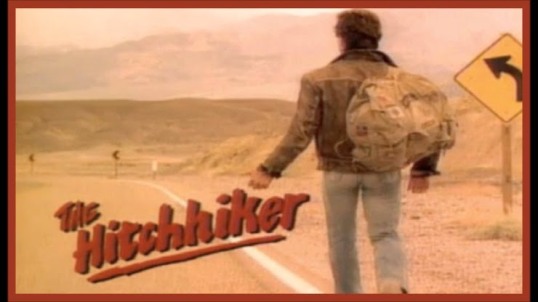
Horror on TV: The Hitchhiker 5.3 “Dark Wishes” (dir by John Liang)


On tonight’s episode of The Hitchhiker, a nurse (Tammy Lauren) decides that the best way to win the husband of her patient is to indulge in a little black magic.  Needless to say, things don’t go quite as planned.  And yes, The Hitchhiker definitely has something to say about it!

Seriously, I would so freak out if I ever saw The Hitchhiker commenting on anything that I’ve ever done in my life.  “Lisa Marie Bowman thought she could escape real-life horror by writing about fictional horror.  But sometimes, that which we think is fiction, turns out to be real….”  AGCK!

This episode originally aired on July 1st, 1989.