Italian Horror Showcase: Witchery (dir by Fabrizio Laurenti)


Like many Italian horror films, Witchery is a film that is known by many names.

When it was originally released in Italy, it was called La Casa 4 and it was sold as being a sequel to Sam Raimi’s Evil Dead films.  (In Italy, Evil Dead was called La Casa.)  In countries where Umberto Lenzi’s Ghosthouse was a hit, this film was entitled Ghosthouse 2.  (Adding to the confusion, Ghosthouse was called La Casa 3 in Italy, even though it had nothing to do with the Evil Dead films.)  In countries where neither Ghosthouse nor La Casa were hits, this film was sometimes called Witchcraft and sometimes called Witchery.  For the purposes of this review, I’m going with Witchery, just because Witchcraft is kind of a bland title.

Anyway, the main lesson to be learned from Witchery is that David Hasselhoff will never be anyone other than David Hasselhoff.  In this film, he plays a character named Gary but, from the minute you see him and he starts talking, it’s impossible to think of him as being anyone other than David Hasselhoff.  You spend the film thinking, “Uh-oh, David Hasselhoff’s getting sexually frustrated.  Uh-oh, that witch is coming for David Hasselhoff.  Did they just throw David Hasselhoff through a window?”

David Hasselhoff and his friend Leslie (Leslie Cumming) are in Massachusetts, staying at an abandoned hotel.  It’s rumored that, living nearby, there’s a reculsive actress, known as the Woman in Black (Hildegard Knef), who decades ago made some sort of deal with the devil or a witch or something like that and the hotel is now some sort of portal to Hell.  Leslie is determined to discover whether the rumors are true but all David Hasselhoff cares about is the fact that Leslie is still a virgin.  “It’s not normal,” he tells her, with a look in his eye that suggests that he’s willing to help her out.  Somehow, Leslie manages to resist Hasselhoff.

Before Hasselhoff can continue to make his case, both he and Leslie have to hide in the hotel because a group of people show up.  It turns out that the Brooks family is interested in buying the hotel so that they can renovate it and hopefully make some money!  Now, they’ve arrived and they’re looking to inspect the property.  There’s Jane (Linda Blair), who is pregnant.  There’s Jane’s obnoxious stepmother, Rose (Annie Ross), who won’t stop complaining.  There’s two real estate agents, Linda (Catherine Hickland) and Jerry (Rick Farnsworth).  And then there’s a little kid who has a Sesame Street cassette player with him.  Have you ever wanted to hear a demonic chant come out of a bulky box decorated with Big Bird and Oscar the Grouch?  Well, this is the film for you!

Anyway, the Brooks family ends up getting stranded at the hotel for a night, which gives the Woman In Black several chances to pop up and send people to Hell.  It turns out that the hotel is crawling with all sorts of demonic creatures and not even David Hasselhoff can scare them off.  One person gets their lips sewn together and is hung in a fireplace.  Someone else gets crucified upside down.  Someone else gets impaled on a marlin.  Because she’s played by Linda Blair, Jane gets possessed….

It’s a real mess of a film and not one that ever makes much sense.  You keep wondering just what exactly the Woman In Black is hoping to accomplish but then you realize that the film itself has no idea so you stop worrying about it.  Witchery may not be a good film but it’s such a strange film that it’s a little bit hard to resist.  I mean, how many other films combine demonic chants with Big Bird?  How many other films feature David Hasselhoff playing himself and getting into a fight with Linda Blair?  Watching the film, you get the feeling that everyone involved just kinda made it up as they went along.

I’m not exactly recommending Witchery but it is one of those films that’s weird enough to justify viewing it at least once.

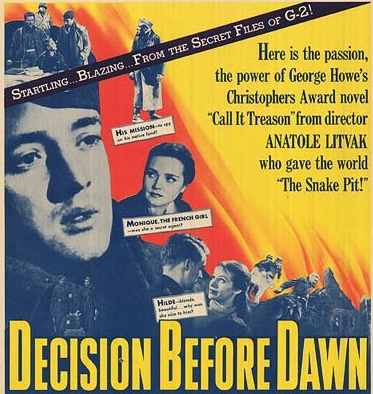
Cleaning Out The DVR, Again #14: Decision Before Dawn (dir by Anatole Litvak)


MPW-55716

So, I’m currently in the process of cleaning out my DVR by watching the 40 films that I recorded from March to June of this year.  Yesterday, I watched the 14th film on my DVR, the 1951 film Decision Before Dawn.  

Decision Before Dawn aired on April 9th on FXM and I specifically recorded it because it was nominated for best picture.  It only received one other nomination (for editing) and it’s one of those nominees that often seems to be dismissed by Oscar historians.  Whenever Decision Before Dawn is mentioned, it’s usually because it’s being unfavorably compared to the other nominees: A Place In The Sun, A Streetcar Named Desire, and An American In Paris.  I went into Decision Before Dawn with very low expectations but you know what?

Decision Before Dawn is not a bad film.  In fact, I would even go as far as to say that it’s actually a damn good film.  If you’re into war films — and, admittedly, I am not — you will love Decision Before Dawn.  If, like me, you’re a history nerd, you’ll be fascinated by the fact that, since this film was shot on location, Decision Before Dawn offers a chance to see what Europe looked like in the years immediately following the destruction of World War II.

As I mentioned, I’m not really into war movies but fortunately, Decision Before Dawn takes place during World War II.  World War II is one of the few wars where there’s no real ambiguity about whether or not the war needed to be fought.  When it comes to picking a villain that everyone can hate, Adolf Hitler and his followers are petty much the perfect villains to go with.

In Decision Before Dawn, Oskar Werner plays Karl Maurer, a German soldier who deserts after his best friend is executed for insubordination.  Though Karl loves his home country, he hates the Nazis who have taken it over.  Karl surrenders to the Americans and volunteers to return to Germany to act as a spy.  Karl finds himself in a strange situation.  Though he’s fighting against the Nazis, he is also mistrusted by the Allies.  He is literally a man without a country.

When word comes down that a German general is willing to surrender, Karl and another German soldier-turned-spy, the greedy and cowardly Sgt. Barth (Hans Christian Bleth), are sent into Germany to both find out if the information is true and to find out where another division of German soldiers is located.  Accompanying the two Germans is a bitter American, Lt. Dick Rennick (Richard Basehart).  Rennick doesn’t trust either of the Germans.

While Rennick and Barth track down the surrendering General, Karl is sent to track down the other division.  Along the way, Karl visits many bombed out German towns and meets Germans of every political persuasion.  Some of them still vainly cling to hope for victory over the Allies but the majority of them are like Hilde (Hildegard Knef), a young war widow who just desperately wants the fighting to end.  Thanks to the deeply empathetic performances of Werner and Knef, the scenes between Hilde and Karl elevate the entire film.  In those scenes, Decision Before Dawn becomes more than just a war film.  It becomes a portrait of men and women trapped by circumstances that they cannot control.

Decision Before Dawn is an exciting and well-acted thriller, one that starts slow but then builds up to a truly thrilling conclusion.  Anatole Litvak directs the film almost as if it were a film noir, filling the entire screen with menacing shadows and moody set pieces.  Decision Before Dawn is a war film that does not celebrate war but instead mourns the evil that men do and argues that sometimes the most patriotic thing that one can do is defy his or her government.  It may be one of the more obscure best picture nominees but it’s still one that deserves to be rediscovered.

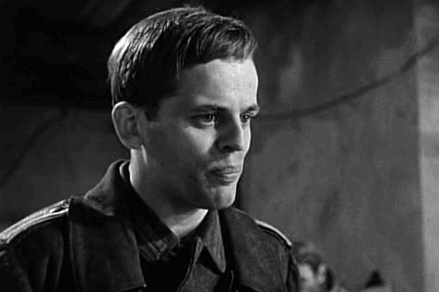
By the way, if you do watch Decision Before Dawn, be sure to keep an eye out for Klaus Kinski.  He only appears for a minute or two and he’s not even credited but you’ll recognize him as soon as you see him.  The eyes give him away as soon as he shows up.

DBD_Kinski