Horror Film Review: Don’t Look Now (dir by Nicolas Roeg)


Donald Sutherland and Julie Christie in Don’t Look Now (1973)

I have to admit that I’m actually a bit embarrassed to say that Venice is my favorite city in Italy.

I mean, it’s such a cliché, isn’t it?  Tourists always fall in love with Venice, even though the majority of us really don’t know much about the city beyond the canals and the gondolas.  I spent a summer in Italy and Venice was definitely the city that had the most American visitors.  Sadly, the majority of them didn’t do a very good job representing the U.S. in Europe.  I’ll never forget the drunk frat boys who approached me one night, all wearing University of Texas t-shirts.  One of them asked, “Are you from Texas?”

“No,” I lied.

“You sound like you’re from Texas!” his friend said.

“No, ah’m not from Texas,” I said, “Sorry, y’all.”

I mean, that’s not something that would have happened in Florence or even Naples!  In Rome, handsome men on motor scooters gave me flowers.  In Venice, on the other hand, I had to deal with the same assholes that I dealt with back home!

That said, I still fell in love with Venice.  And yes, it did happen while riding in a gondola.  At that moment, I felt like I was living in a work of art.  I can still remember looking over the side of the gondola and watching as a small crab ran across someone’s front porch.  That’s when I realize that, by its very existence, Venice proved that anything was possible.

I’ve often heard that Venice is slowly sinking.  That Venice has a reputation as being a dying city would probably have come to a surprise to the drunk Americans who were just looking for a girl from Texas that summer.  And yet, Venice has always been associated with death.  Just consider Thomas Mann’s Death in Venice and the subsequent film adaptation from Luchino Visconti.  Consider the controversial Giallo in Venice.  And, of course, you can’t forget about the 1973 film, Don’t Look Now.

Oh my God, Don’t Look Now is a creepy movie.  It’s probably best known for two things: the lengthy sex scene between Julie Christie and Donald Sutherland (which was apparently quite controversial back in 1973 but which seems rather tame when viewed today) and the film’s shock ending.  It’s one of the best and most disturbing endings in the history of horror and I’m not going to spoil it in this review.  The first time I saw the movie, the ending caught me totally off guard and gave me nightmares.  Admittedly, it’s not hard to give me nightmares but what’s remarkable is that, upon subsequent viewings, the ending is still just as frightening and disturbing.  In fact, knowing what’s going to happen makes the film even more chilling.

The film’s story is actually a rather simple one.  After their daughter, Christine, accidentally drowns, John (Donald Sutherland) and Laura Baxter (Julie Christie) take a trip to Venice.  Though they’re in Venice so that John can restore an ancient church, both John and Laura are mostly trying to escape their grief.  Laura meets a blind woman, Heather (Hilary Mason), who claims to not only be a psychic but who also says that she can see Christine in the afterlife.  Laura believes Heather and is concerned when Heather says that Christine wants them to leave Venice.  John, on the other hand, believes that Heather is a fake.

When the Baxters get a phone call informing them that their son has taken ill, Laura flies back to the UK.  Or does she?  One day, John spots his wife riding on a boat with Heather and her sister.  Has Heather abducted or brainwashed his wife?  When John goes to the police, they are as skeptical of him as he was of Heather.  In fact, they start to suspect that John may have something to do with a recent rash of murders.

Confused, John searches Venice for his wife but, instead of finding her, he spots a figure in the distance.  It appears to be a young child, one who is wearing the same red coat that Christine was wearing when she drowned….

It’s a simple story but it’s told in a very complex fashion.  Director Nicolas Roeg is best known for his fragmented narrative style.  Roeg often mashes together scenes from the past, present, and future and leaves it up to the viewer to put it all together.  (For instance, in Don’t Look Now, scenes of John and Laura making love are intercut with scenes of them getting dressed afterward.)  Roeg’s style that can often come across as being pretentious but, in Don’t Look Now, it works perfectly.  The audience is kept off-balance and is always aware that that’s more than one possible interpretation for everything that is seen.  Is Laura in the UK or is she on a boat in Venice?  Is Heather seeing Christine or is she just trying to con a grieving mother?  Is John chasing the figure in the red coat or is she actually the one pursuing him?  Is John chasing the figure because he believes that she’s his daughter or because he wants to prove, once and for all, that Christine is gone and never coming back?  Roeg keeps you guessing.

Death seems to permeate every frame of Don’t Look Now, whether it’s Heather’s cheery descriptions of the afterlife or the sight of a bloated corpse being pulled out of the canal.  Even when John is working in the church, he still nearly slips off a scaffolding.  While John restores ancient buildings to the vibrant glories of the past, the present seems to grow more and more ominous and menacing.  John and Laura may have traveled to Venice to escape their grief but their grief follows them.  How they deal with that grief — both as a couple and as individuals — is what determines their fate.  For a film that is full of mysteries, none is as enigmatic as Julie Christie’s smile when she’s on the boat.

I’m probably making Don’t Look Now sound like an incredibly grim film and, to a certain extent, it is.  After all, early 70s cinema is not known for its happy endings.  And yet, as dark and disturbing as this film may be, it’s impossible to look away from.  Roeg does a fantastic job capturing both the beauty and the decay of Venice while Donald Sutherland and Julie Christie are so sympathetic as John and Laura that you find yourself rewatching and hoping that somehow, they don’t end up making the same mistakes that they made the last time that you watched.

Don’t Look Now is an essential horror film and one that’s as timeless as the sight of a crab running across someone’s front porch.

The TSL’s Horror Grindhouse: I Don’t Want To Be Born (dir by Peter Sasdy)


“I don’t want to be born!”

“That’s too bad, kid!  YOU’RE COMING OUT!”

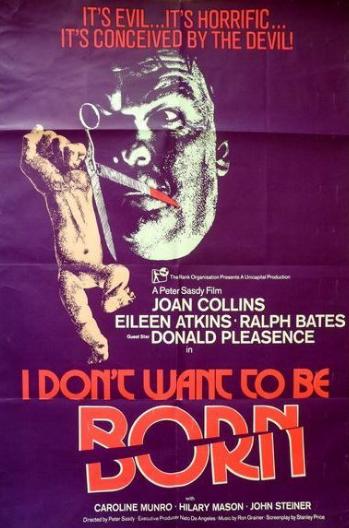
Now, admittedly, that dialogue is never heard in the 1975 British horror film, I Don’t Want To Be Born.  However, if I had heard that particularly exchange in this film, I would not have been surprised.  That’s just the type of movie that I Don’t Want To Be Born is.  It’s a thoroughly ludicrous, totally ridiculous movie and what makes it all the more memorable is that it doesn’t seem to realize how silly it all is.  This is a batshit crazy movie that tells its story in the most serious way possible.  This damn film is almost somber, it’s so serious.

Lucy (played by Joan Collins) is a stripper who performs her act with a perverted dwarf named Hercules (George Claydon).  When Hercules tries to force himself on Lucy, he is tossed out of the club by Tommy (who is played by John Steiner, a good actor who somehow always turned up in movies like this one.)  After she and Tommy make love, Lucy is confronted by Hercules who curses her, telling her that she will have a baby “as big as I am small and possessed by the devil himself!”

Oh, Hercules, you weirdo.

9 months later, Lucy’s life has somehow completely changed.  She’s no longer a dancer.  Now, she’s married to a rich Italian named Gino (played by Ralph Bates, speaking in a bizarre accent).  When Lucy has her baby, it’s a long and difficult delivery.  The baby is huge!  Not only is he huge, but he also has a bad temper and unnaturally sharp nails.  The first time that Lucy holds him, he attacks her.  Whenever the baby is introduced to anyone new, he responds by biting them.  When Tommy drops by to take a look at the baby that might be his son, he ends up with a bloody nose!

But that’s not all this baby can do!  Anytime he’s left alone in a room, the room ends up getting destroyed.  Eventually, he apparently figures out how to climb trees and how efficiently slip a noose around the neck of anyone who walks underneath him.  And don’t think that you can escape this baby simply because you’re taller and faster.  One unfortunate person is decapitated, even though he’s standing at the time.  How did the baby reach his neck?  Who knows?

Does this baby need an exorcism?  Lucy’s sister-in-law, Sister Albana (Eileen Atkins), certainly believes that it does!  As Lucy thinks about whether the baby’s behavior is in any way odd, she glances over at the baby and — OH MY GOD!  The baby has Hercules’s face!

And it just keeps going from there.  Again, I feel the need to repeat that this film is meant to be taken very seriously.  The script may be full of awkward and clichéd dialogue but most of the cast attempts to act the Hell out of it.  Speaking of the cast, there’s a lot of familiar horror people in this one.  Along with John Steiner, there’s also Caroline Munro and Donald Pleasence.  Those three give performances that somehow manage to remain credible, perhaps because they had the experience necessary to understand what type of movie they were in.  But the rest of the cast … you feel bad for them because they’re just trying  so hard.

It’s a terrible movie but it’s so weird that I have to recommend that everyone see it once.  If for nothing else, see it for the scene where Hercules responds to an attempt to exorcise the baby by swaying drunkenly on the stage.  It’s weird and it’s hard for mere words to do it justice.

“No wonder this baby didn’t want to be born!”

That line is also nowhere to be found in this movie.  It’d be nice if it was, though.

Guilty (Horror) Pleasure #23: Meridian (dir by Charles Band)


You know how there are certain films that you just know you shouldn’t like but yet, you do?  These are the films that you know you should reject but yet, right when you’re on the verge of condemning them, you suddenly realize that you’d rather watch them for a second or a third time.

For me, Meridian is one of those films.

meridian (1)

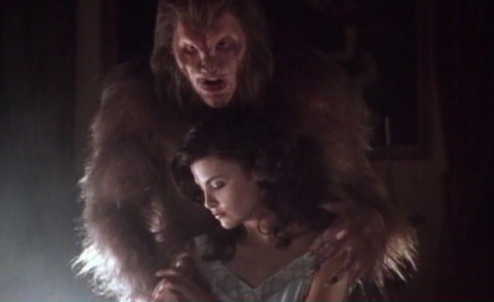
Meridian presents a twisted take on the Beauty and the Beast fairy tale.  Catherine (Sherilyn Fenn) and Gina (played by an actress who is credited simply as being “Charlie”) are recent art school graduates who have moved to Italy.  Gina has come to Italy to work in art restoration while Catherine has inherited her father’s castle!  That right — Catherine owns her very own castle!

I wish I owned a castle in Italy.  In fact, the first person to buy me a castle in Italy (preferably one in Southern Italy) will get a special shout out from me on this site.  Get to it!

Anyway, Catherine is pretty happy to be living in her very own castle.  Not only does she have a lot of servants but one of them happens to be her childhood nanny (Hilary Mason) who, for reasons that don’t become clear until late in the film, is still very protective of Catherine.  Catherine was a little apprehensive about moving into the castle because, when she was little, she used to see the ghost of a dead girl wandering about.  However, with her nanny there to protect her and Gina visiting for the weekend, what is there to worry about?

However, one morning, Catherine and Gina discover that a traveling circus has been set up near the castle.  Catherine finds herself intrigued by the leader of the circus, the mysterious Lawrence (Malcolm Jamieson).  She invites Lawrence and all the performers to have dinner at the castle.  With the help of magic, wine, and drugs, the dinner turns into an orgy with a nearly unconscious Catherine being taken by Lawrence’s twin brother, Oliver (Jamieson again).  While atop of Catherine, Oliver reverts to his true form, as seen above…

Naturally, it all has to do with family curses and ghosts and all the rest.  The morning after, Catherine wakes up with little memory of what happened.  The performers are gone and Gina soon leaves the castle.  Left with only her servants, Catherine starts to see the ghost of that dead girl again.  And, of course, both Oliver and Lawrence show up once again.  At no point does the plot make any sense but, then again, life is usually kinda messy so why should movies be any different?

Meridian


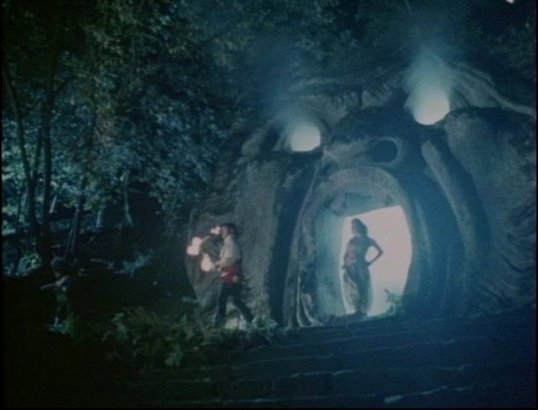
So, look — there’s a lot of negative things that I could say about Meridian.  Catherine is not a strong heroine, the film’s overly complicated plot is full of holes, and some of the acting is inconsistent.  But yet, oddly enough, those flaws ultimately work to Meridian‘s advantage.  It really is one of the most dream-like films that I’ve ever seen and often times it truly does come across like not only a fantasy but a fantasy that you might not want the world to know about.  (Which, I think, would make it the epitome of a guilty pleasure…hmmm…)  Working with what was undoubtedly a small budget, Charles Band tells his story with a lot of atmosphere and haunting imagery.  Taking place in a beautiful country and featuring a beautiful cast, Meridian is a lot better than one might otherwise expect.

Meridian was first released in 1990.  The version I saw was included as part The Midnight Horror DVD Collection, along with the original Prom Night and 6 other films, none of which were as good as either Meridian or Prom Night.

http://www.youtube.com/watch?v=IXL08qyhSxM

Previous Guilty Pleasures:

  1. Half-Baked
  2. Save The Last Dance
  3. Every Rose Has Its Thorns
  4. The Jeremy Kyle Show
  5. Invasion USA
  6. The Golden Child
  7. Final Destination 2
  8. Paparazzi
  9. The Principal
  10. The Substitute
  11. Terror In The Family
  12. Pandorum
  13. Lambada
  14. Fear
  15. Cocktail
  16. Keep Off The Grass
  17. Girls, Girls, Girls
  18. Class
  19. Tart
  20. King Kong vs. Godzilla
  21. Hawk the Slayer
  22. Battle Beyond The Stars