
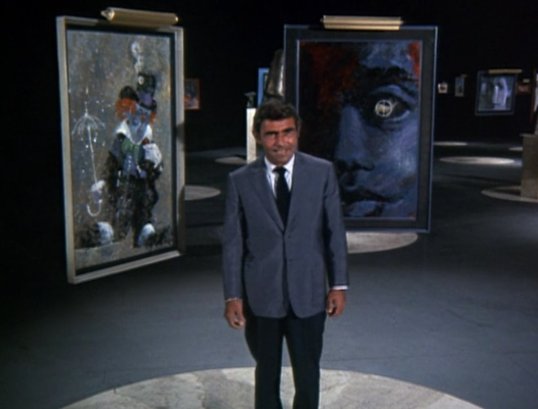
The fourth episode of Night Gallery originally aired on January 6th, 1971. It was the first episode of the new year and it continued to open with Rod Serling walking through a most curious museum, inviting us to take a look at the macabre paintings on display and consider the stories behind them.
This episode featured two stories.
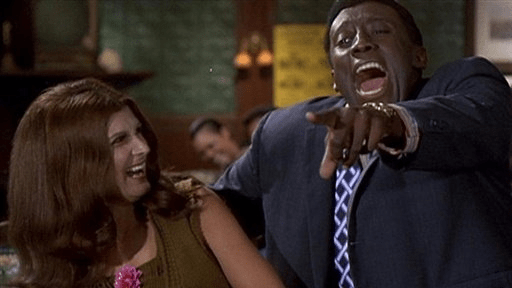
Make Me Laugh (dir. by Steven Spielberg, written by Rod Serling)
Jackie Slater (Godfrey Cambridge) is a comedian who can’t make anyone laugh. He’s just been fired from his latest job and even his loyal agent (Tom Bosley) is suggesting that it might be time to throw in the proverbial towel. While Jackie drowns his sorrows at a bar, he’s approached by a man named Catterje (Jackie Vernon). Chatterje explains that he can cast miracles but, because he’s not very good at his job, the miracles often have unintended consequences. “I don’t care!” Jackie says, “I’ll take the risk!” Jackie wants people to laugh at him. Jackie gets his wish but it turns out that he should have listened to Chatterje’s warning.
This segment was directed by Steven Spielberg, back when he was just starting his career and he was largely working in television. Spielberg also directed Eyes, which was a highlight of the Night Gallery pilot. Unfortunately, his direction of Make Me Laugh is a bit less successful than his work on Eyes. Spielberg’s direction features none of the inspired touches that made Eyes so successful. Part of the problem may be that this story takes place in the word of comedy and comedy has never been a topic for which Spielberg has shown much affinity.
Make Me Laugh does feature a good lead performance from Godfrey Cambridge. Otherwise, this segment is largely forgettable.
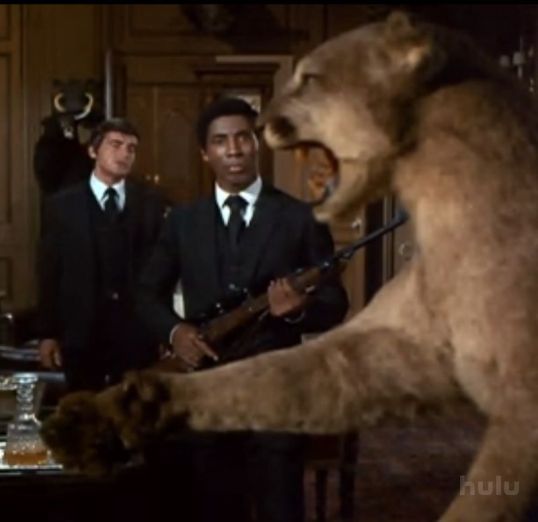
Cleans Kills And Other Trophies (dir by Walter Doniger, written by Rod Serling)
Raymond Massey plays Col. Archie Dittman, a wealthy racist who is obsessed with hunting and killing. He even has a study full of the mounted heads of all of the animals that he’s killed. Archie’s son, Archie, Jr. (Barry Brown), has just graduated from college and has no interest in hunting. Col. Dittman demands that his son go on a hunt or risk being disinherited. What the colonel fails to take into consideration is that both his bloodlust and his racism has offended his butler (Herbert Jefferson, Jr.) and that his butler has a magic-related revenge in mind.
Clean Kills and Other Trophies is hardly subtle but it does create and maintain a properly ominous atmopshere. Raymond Massey gives a wonderfully villainous performance and it’s hard not to be amused by the fact that his son is wearing a peace signal prominently on his lapel, as if the segment’s director took one look at it and said, “What’s one thing that we can do to make the themes of this segment even more heavy-handed?” The segment ends on a note that is so entertainingly over-the-top that it’s hard not to love it.
This episode was uneven. Make Me Laugh does’t quite work but Cleans Kills and other Trophies is good enough to make up for the disappointing segment that precedes it.
Previous Night Gallery Reviews:
 Through the Shattered Lens