Retro Television Review: Coming to America 1.1 “Pilot”


Welcome to Retro Television Reviews, a feature where we review some of our favorite and least favorite shows of the past!  On Thursdays, I will be reviewing Coming to America, which aired on CBS in 1989.  Almost the entire show is currently streaming on YouTube!
Fresh off the success of the film Coming To America, Eddie Murphy served as executive producer of a series based on the film.  How did that work out?  Read on to find out!

Episode 1.1 “Pilot”

(Dir by Tony Singletary, originally aired on July 4th, 1989)

The pilot for Coming to America begins with the story already in progress.  We get an overhead shot of New York while Prince Tariq (Tommy Davidson, speaking with an unconvincing accent) explains that he and his minder, Omar (Paul Bates), have been sent to America so that Tariq can attend college.  (Tariq is established as being the younger brother of the character that Eddie Murphy played in the original film.)  Tariq and Omar have rented a room from diner owner Carl Mackey (John Hancock).  Carl is a curmudgeon.  Tariq expects everyone to treat him like royalty.  Carl grumbles about not getting to eat unhealthy food before a doctor’s visit.  Tariq does an extended Stevie Wonder impersonation.

Uh-oh, Tariq’s out of money!  In just nine months, he spends all of his money on movies and clothes.  What can Tariq do?  Maybe he and Omar can work in Carl’s diner!  Uh-oh, Tariq’s started a dance party in the diner and he orders Omar to join the fun!  Carl shows up at an inopportune time and Omar is fired.  Can Tariq take responsibility for his actions?

“I’m a Beverly Hills Cop, you’re a Beverly Hills cop too and in 48 hours, we’re Trading Places.” Tariq says at one point and seriously, you have to wonder why they didn’t toss a reference to The Golden Child in there.  Tariq is royalty so it certainly would have made more sense for him to refer to himself as being a Golden Child as opposed to being a Beverly Hills Cop.  That’s the type of show this is, though.  The humor is heavy-handed but it also misses way too many opportunities.

My friend from Australia, Mark, sent me the link for this pilot (it’s on YouTube) and he dared me to see how much I could watch before turning it off in disgust.  I managed to get through the entire thing but it wasn’t easy.  To be honest, I nearly stopped this thing as soon as Tariq’s opening narration began.  When that much exposition is stuffed into the opening narration, you know that you’re about watch a disjointed mess of a program.  Indeed, one could argue that calling this program disjointed is a case of me being charitable.  In the end, the main problem is that, after all the build-up of Tariq being a prince, the plot itself could just as easily been the plot of a thousand other mediocre sitcoms.  How many times did Lisa and Kelly have to take jobs at the Max in Saved By The Bell?  Both Malibu CA and One World suggested that working at a restaurant was the best — perhaps the only! — way to learn responsibility.  The Coming to America diner looks almost exactly like the City Guys diner.  How is this not a Peter Engel production?

Coming to America aired once.  There was never a second episode.  Hence, today, we’ve started and ended a series!  Next week, something new will premiere in this time slot.  Hopefully, it will be better than both Malibu CA and Coming to America.
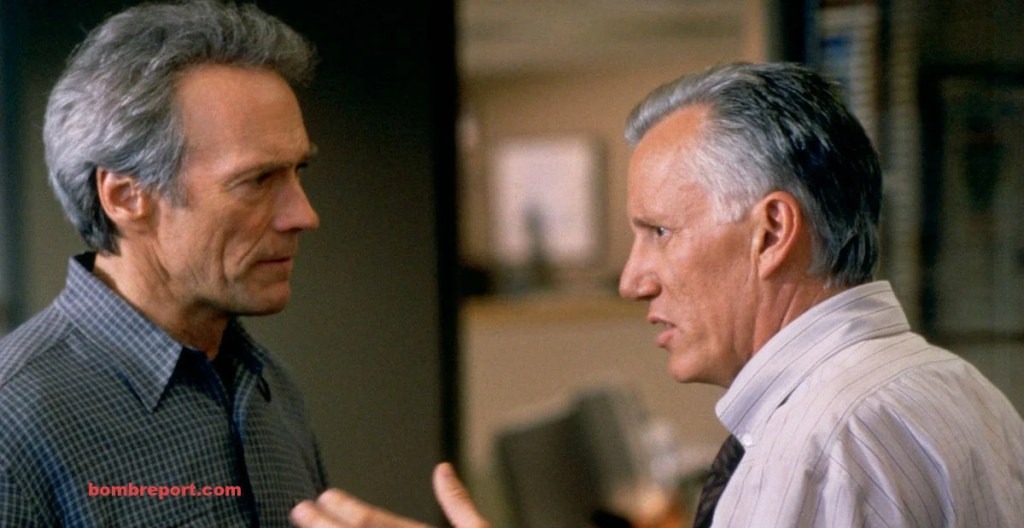
I review TRUE CRIME (1999) – starring Clint Eastwood and James Woods!


Here at The Shattered Lens, we’re celebrating Clint Eastwood’s birthday on May 31st. I decided to revisit his 1999 film, TRUE CRIME. 

Clint Eastwood directs and stars as ace journalist, Steve Everett, who also happens to be a bad friend, a terrible dad, and an even worse husband. Literally the only thing that he’s got going for him is his “nose,” his ability to sniff out a story where no one else can. Even that has begun to fail him, mostly due to his recents bouts with alcoholism, which he seems to somewhat have a handle on at the time of this story. When a young, beautiful colleague tragically passes away in an auto accident, Steve is given her previous assignment to cover the execution of convicted murderer Frank Beechum (Isaiah Washington). Not the kind to write a human interest “puff piece” like the Oakland Tribune is wanting, Everett begins digging into the past and pretty soon that nose of his starts telling him that Beechum is a victim of circumstantial evidence. Despite his editor Bob Findley’s (Denis Leary) objections, he’s able to convince his newspaper boss Alan Mann (James Woods) to let him dig deeper into the story. As he tries to juggle his myriad personal problems with his growing belief in Beechum’s innocence, Everett is also facing a clock that is ticking down to the midnight execution. Will he be able to find the crucial piece of evidence that will set Beechum free?

TRUE CRIME appears to be somewhat of a forgotten Clint Eastwood film. I saw it at the theater when it came out in 1999, but it was not financially successful, only bringing in $16 Million at the box office. Regardless of that, I still love the film. It’s certainly not perfect. It’s probably too long, Beechum is probably too angelic after being “born again,” and the resolution may be a little unrealistic, but I still enjoyed every second of it. One of the coolest things about Clint Eastwood is his willingness to play such flawed men on screen, yet we still love him. He’s great in this film! Anyone who’s read much of my work knows that my love of actor James Woods goes back to being in junior high and renting his movies BEST SELLER and COP. It’s such a treat seeing the legendary pair on screen together even if Woods’ role is sort of a glorified cameo. Woods is hilarious in his limited screen time. My last shout out is to Isaiah Washington as the innocent man who’s about to be put to death. After all these years and appeals, he’s accepted his fate, but the scene where he tells Everett his story and Everett tells him that he believes he’s innocent is so powerful. Add to that Washington’s scenes with his wife and daughter, and I was very much emotionally invested in this film. Washington’s performance was key to the film working, and he’s great!

Overall, TRUE CRIME is a film that takes its sweet time, but it ultimately tells a tense, engrossing story that ratchets up the tension to 10 prior to its last second resolution. I consider it very underrated and highly recommend it. I’ve included the trailer below:

Film Review: Jackie Brown (dir by Quentin Tarantino)


It took me a while to really appreciated Jackie Brown.

I was nineteen and in college when I first watched the movie.  A friend rented it and we watched it with the expectation that it would be another Tarantino film that would be full of violence, fast music, and stylish characterizations.  And, of course, Jackie Brown did have all three of those.  But it was also a far more melancholy film than what we were expecting and compared to something like Kill Bill, Jackie Brown definitely moved at its own deliberate pace.  That’s a polite way of saying that, at times, the film seemed slow.  It seemed like it took forever for the story to get going and, even once it became clear that Jackie Brown (Pam Grier) and Max Cherry (Robert Forster) were going to steal from Ordell Robbie (Samuel L. Jackson), it still felt like an oddly laid back heist.  Robert de Niro, the film’s biggest star, played a guy who seemed to be brain dead.  Bridget Fonda brought an interesting chaotic energy to the film but her character was disposed of in an almost off-hand manner.  The whole thing just felt off.  I appreciated the performances.  I appreciated the music on the soundtrack.  But I felt like it was one of Tarantino’s weaker films.

As I’ve gotten older, I’ve come to better appreciate Jackie Brown.  First released in 1997 and adapted from a novel by Elmore Leonard, Jackie Brown finds Quentin Tarantino at his most contemplative.  Indeed, Tarantino wouldn’t direct anything quite as humanistic until he did Once Upon A Time In Hollywood.  If the heist seemed rather laid back, that’s because Jackie Brown really isn’t a heist film.  It’s a film about aging, starring two icons of 70s exploitation.  Robert Forster was 56 when he played bail bondman Max Cherry while Pam Grier was 48 when she was cast as Jackie Brown, the flight attendant turned smuggler.  Jackie and Max two middle-aged people faced with a world that doesn’t really make much sense to them anymore.  (Obviously, it’s easier for me to understand them now than it was when I was nineteen and I felt like the future was unlimited.)  Max bails people out of jail and it’s obvious that he still has a shred of idealism within him.  He actually does care about the people he gets out of jail and he’s disgusted by Ordell’s callous attitude towards the people who work for him.  Jackie is a flight attendant who, when we first see her, looks like she could have just stepped out of a 1970s airline commercial.  Ripping off Ordell isn’t just something that she’s doing for revenge or to protect herself, though there’s certainly an element of both those motivations in her actions.  This is also her chance to finally have something for her.  Jackie and Max are two lost souls who find each other and wonder where the time is gone.  All of those critics who have wondered, over the years, when Quentin Tarantino would make a mature movie about real people with real problems need to rewatch Jackie Brown.

Of course, it’s still a Quentin Tarantino film.  And that means we get a lot of scenes of Samuel L. Jackson talking.  This is one of Jackson’s best performances.  Ordell is definitely a bad guy and most viewers will be eager to see him get his comeuppance but, as played by Jackson, he’s also frequently very funny and definitely charismatic.  One can understand how Ordell lures people into his trap.  Jackson loves to watch video tapes of women shooting guns.  He allows De Niro’s Louis to crash at his place and the scene where Ordell realizes that Louis is thoroughly incompetent is brilliantly acted by both men.  And then you have Bridget Fonda, as a force of pure sunny chaos.  Jackson, De Niro, and Fonda are definitely a watchable trio, even if the film rightly belongs to Pam Grier and Robert Forster.

The older I get, the more I appreciate Jackie Brown.  This is the film where Tarantino revealed that there was more to his artistic vision than just movie references and comic book jokes.  This film takes Tarantino’s style and puts it in the real world.  It’s Tarantino at his most human.