Spring Break on the Lens: You Get Me (dir by Brent Bonacorso)


Ah, the beach.

The beach is a beautiful and fun place and the perfect location to celebrate a spring or summer break.  But beware of getting carried away with your youthful revelries because it can lead to complications that will follow you into the fall.  And those complications can be deadly….

BLEH!

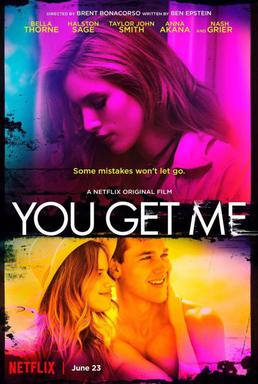
Okay, sorry for all the drama.  I’m just trying to make myself feel some sort of enthusiasm for reviewing the 2017 Netflix film, You Get Me.  You Get Me is technically not a spring break movie but it does take place on the beach and it does feature a moderate amount of drinking, drug-taking, and partying so, it’s close enough.  It also features a cast of 20-something actors cast as high school students.  Some are more believable than others.

Basically, dumb and dull teenager Tyler (Taylor John Smith) is having the best summer of his life because he has a girlfriend named Ali (Halston Sage), who he is totally in love with.  (Ali could probably do better but whatever.  Everyone makes mistakes in high school.)  Tyler is also frustrated because Ali wants to wait before having sex with him and she also doesn’t understand why Tyler has been so hesitant to introduce her to his dysfunctional family.  When Tyler goes to a party and runs into a guy from Ali’s past, he learns that Ali used to be much wilder.  Angry that Ali hasn’t been honest with him, big dumb Tyler gets drunk and runs off with Holly (Bella Throne), a girl who he has only known for an hour.  They go dancing.  Holly offers Tyler a pill.  Tyler isn’t sure he’s ready for that.  “You swallow, I swallow,” Holly tells him.  Tyler and Holly spend a passionate weekend together but, afterwards, Tyler and Ali get back together, with Ali promising that she’ll tell Tyler everything about her past.  “No more secrets,” Tyler agrees, despite the fact that he’s now keeping a secret of his own.

Fortunately, Holly was only visiting for the summer and it’s not like Tyler will ever see her again so …. OH MY GOODNESS, LOOK WHO JUST SHOWED UP AT TYLER’S HIGH SCHOOL!  Holly now goes to the same school as Tyler and her new best friend is Ali!  Tyler asks Holly not to tell Ali anything about their weekend together.  Holly, however, has stopped taking her meds (seriously, that’s a plot point) and has decided that if she can’t have Tyler, no one will.  Soon, Holly is claiming to be pregnant and serving peanut-laced smoothies to people with food allergies.  Have you ever noticed how people in movies like this always have a best friend who suffers from a food allergy?

I’m probably making You Get Me sound more fun than it actually is.  It’s actually an extremely bland movie and a surprisingly tame one.  At her best, Bella Thorne is less an actress and more an agent of chaos.  She gets a few opportunities to be enjoyably evil in You Get Me but the script, for whatever reason, often seems to be more concerned with boring old Tyler.  Perhaps if Taylor John Smith and Halston Sage had at least a little bit of romantic chemistry, we would care about what happens to Tyler and Ali but they don’t.  Since they don’t really seem to be that into each other, it’s a little bit hard to get upset when Holly comes between them.

The beach, I will say, looked lovely.  And I really liked Holly’s house.  And, as I mentioned earlier, there were a few moments when Bella Thorne’s demented performance brought some life to the anemic proceedings.  But, for the most part, You Get Me is forgettable.  It did not get me.
Catching Up With The Films of 2019: Late Night (dir by Nisha Ganatra)


Molly Patel (Mindy Kaling) has just gotten a new job.  A struggling comedienne who, up until now, has been forced to test out her best material on her coworkers at a chemical plant, Molly is hired to join the writing staff of late night talk show host, Katherine Newbury (Emma Thompson).  Even though Molly knows that she was largely hired so that the show could claim to have a diverse writing staff (all of the other writers are white males), she is still thrilled to be working for Katherine.  Why wouldn’t she be?  Katherine is a notoriously difficult boss who can’t even be bothered to learn the names of most of the people working for her but Katherine is also a legend, one of the first women to ever host her own late night talk show.

Of course, all legends have to come to an end and Katherine’s career as a late night talk show host appears to be in its final days.  Katherine’s rating have been in a steep decline for several years and her nonthreatening monologues and habit of booking guests like Doris Kearns Goodwin are not doing much to reverse the trend.  Safely hidden away in her mansion and continually worried about the health of her Parkinson’s-stricken husband, Walter (John Lithgrow), Katherine has grown out of touch.  Making matters even worse, the president of the network (played by Mindy Kaling’s Office co-star, Amy Ryan) hates Katherine and is eager to replace her with an obnoxious, Dane Cook-style comedian named Daniel Tennant (Ike Barinholtz).

Molly’s new job is a struggle at first.  The other writers dismiss Molly as merely being a “diversity hire” while Katherine often seems to be put off by Molly’s cheerful earnestness.  Over time, Molly proves herself and soon, she’s inspiring Katherine to refuse to leave her show without a fight.  Gone are bland monologues and boring presidential historians, replaced by politically charged humor and YouTube stars.

Late Night, as you may remember, was a huge hit at Sundance back in January.  Amazon Studios paid 13 million for the distribution rights.  The film was released in June to generally positive reviews and …. well, it made very little money.  Despite an extensive advertising campaign and a deluge of think pieces that literally begged audiences to see the film, Late Night flopped at the box office and it is estimated that, taking into account the film’s ad campaign, Amazon lost about 40 million dollars on the film.

Why wasn’t Late Night a bigger success at the box office?  At the time, the popular answer was misogyny.  While one should never discount that, I think that the film’s failure had more to do with the fact that the ad campaign made Late Night look more like the latest Netflix series than an actual cinematic experience.  Like a lot of movies about TV, Late Night was a film that seemed like it could wait for television.  I mean, I am the film’s target audience and even I waited to watch the film on Prime.

As for the film itself, it’s flawed but likable.  Along with co-starring in the film, Mindy Kaling wrote the script and the dialogue is consistently witty, even if the plot occasionally struggles to keep up.  At its best, this is a fun movie to listen to.  Visually, the film’s a bit flat and there’s a big third act development that feels a bit forced but, for the most part, the film works.  Not surprisingly, Emma Thompson is perfectly cast as Katherine and she delivers her razor sharp lines with the right mix of scorn and pathos.  Mindy Kaling effortlessly holds her own opposite Thompson and even John Lithgow, who can usually be counted upon to chew every piece of scenery available to him, is effective in his small but important role.  In the end, it’s kind of a sweet film and there’s something touchingly naive about the film’s steadfast belief that a late night talk show can actually be worth all the trouble.

Late Night is available on Prime so check it out.


Film Review: Before I Fall (dir by Ry Russo-Young)


One of my favorite films of 2017 was Before I Fall, which was kind of a combination of Mean Girls, Groudhog Day, and Happy Death Day.  Two years later, it remains one of my favorite movies, even if I do end up crying whenever I watch it.

The film begins with an ordinary teenager named Samantha Kingston (Zooey Deutsch) waking up on February 12th.  We follow her throughout her day and watch her deal with family, friends, teachers, and all the drama that goes along with all of that.  We meet her boyfriend, Rob (Kian Lawley) and we automatically know that she needs to dump his jock ass.  (Whenever we hear him glibly say, “Love ya,” it’s like nails on a chalkboard.)  We all know that Sam should be with Kent (Logan Miller), who is sweet and sensitive and gives her a white rose for Cupid’s Day.  We also meet and get to know her friends, Allie (Cynthia Wu), Elody (Medalion Rahimi), and especially Lindsay (Halston Sage).  While being a close friend to Sam, Lindsay is still the stereotypical popular, mean girl, the one who decides who is accepted and who is destined to forever to be an outsider.  Sam, on the other hand, is not a mean girl (or, at the very least, she’s a not-as-mean girl).  Instead, she’s the girl who simply goes along with what everyone else is doing.  She may not instigate any bullying but she doesn’t do anything to stop it either.

February 12th was the night that Sam had been planning on losing her virginity to Rob but Rob pretty much ruins that by getting drunk and acting like an asshole.  Instead, at a party at Kent’s house, Sam watches as Lindsay humiliates an outsider named Juliet (Elena Kampouris).  After leaving the party, Sam, Lindsay, Elody, and Allie drive down a dark road.  They listen to music.  They talk about how stupid everyone at the party was.  And, eventually, the car crashes and….

Suddenly, Sam’s waking up in her bedroom!  And it’s February 12th all over again!  That’s right, Sam is in a time loop, destined to continually relive the final day of her life until she makes things right.  In the 2010 novel that this film is based on, author Lindsay Olivier makes it pretty clear that each time Sam relives her day, she’s going through another stage of grief, moving from denial to acceptance.  While the film doesn’t make that point quite as clearly as the book, it does do a good job of showing us how, each time that Sam is forced to relive that day, she comes out of it as a changed person.  She discovers that Rob wasn’t worthy of her love and that Kent was.  She discovers that her family wasn’t as terrible as she assumed.  And, perhaps most importantly, she learns that being a friend does not mean excusing casual cruelty.

Watching Before I Fall is always an emotional experience for me.  A lot of it is because I can relate to Sam.  In many ways, back in high school, I was Sam.  But, even beyond that, the theme of Before I Fall is universal.  It doesn’t matter how old you are or what your background may be.  It doesn’t matter if you were popular in high school or if you were one of the outsiders.  Everyone — every single one of us — has done something that they regret.  All of us have one day that we wish we could travel back to and do things differently.

Well-directed by Ry Russo-Young and featuring a lot of beautiful Canadian scenery (the film was shot in British Columbia and Vancouver), Before I Fall is a poignant and touching film.  Zooey Deutch, Halston Sage, Cynthia Wu, and Medalion Rahimi are all believable as longtime friends and, to the film’s credit, no one — not even Lindsay — can be reduced to a mere stereotype.  Before I Fall is a film about regret, denial, anger, acceptance, and finally, peace.  No wonder it makes me cry.

Back to School Part II #50: Paper Towns (dir by Jake Schreier)


(For the past three weeks, Lisa Marie has been in the process of reviewing 56 back to school films!  She’s promised the rest of the TSL staff that this project will finally wrap up by the end of Monday, so that she can devote her time to helping to prepare the site for its annual October horror month!  Will she make it or will she fail, lose her administrator privileges, and end up writing listicles for Buzzfeed?  Keep reading the site to find out!)

paper-towns

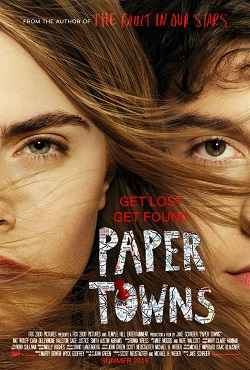
Looking at the film poster above, you could be forgiven for immediately thinking of The Fault In Our Stars.  Of course, some of that is because it says, “From the author of The Fault In Our Stars” and because it features half of Nat Wolff’s face.  (Wolff had a key supporting role in Fault.)  Beyond that, though, the poster feels as if it could have just as easily been used for The Fault In Our Stars.  Check out the intensity of the stares.  Though we may only see half of their faces, both of the pictured characters appear to be daring the viewer to dismiss their concerns as being mere “teen drama.”

When Paper Towns was released in 2015, it was repeatedly advertised as being the next Fault In Our Stars.  Paper Towns does share Fault‘s unapologetic earnestness and, in a few scenes, its sense of inescapable melancholy.  (As people get older, they tend to sentimentalize the years that came before and, as a result, they often forget how coming-of-age and intense regret often go hand-in-hand.)  But ultimately, though they’re both based on novels by John Green and feature Nat Wolff, Paper Towns tells a very different story from The Fault In Our Stars.

Nat Wolff stars as Quintin, who is better known as Q.  Quintin is a student at Jefferson Park High School in Orlando.  He’s the epitome of a good kid.  He’s shy, he’s polite, and, somewhat inevitably when you consider what is currently valued in American society, he’s not particularly popular at school.  He spends most of his time hanging out with his friends, Ben (Austin Abrams) and Radar (Justice Smith).  And when he’s not hanging out with them, he’s pining for the most popular girl in school, Margo (Cara Delivingne).

Margo and Quintin have been neighbors since they were children.  When Margo’s family first moved in, she and Quintin became close friends but that friendship ended after they came across the body of a man who had committed suicide.  Traumatized, Margo drifted away from Quintin.  Now, nine years later, they are both seniors in high school.  Quintin silently loves Margo.  Margo rarely acknowledges his existence…

Or, that is, she doesn’t until the night that she suddenly climbs through Quintin’s bedroom window.  She explains that her boyfriend has been cheating on her.  She wants revenge on him and all of her friends, none of whom bothered to tell her what was going on.  A night of gleeful vandalism follows, ending with a romantic dance.

The next morning, Margo is gone.  She’s vanished and no one knows where she has gone.  However, Quintin is determined to find her and he is also convinced that she has left him a trail of clues that will lead him to her.  When he concludes that she’s gone to upstate New York, he recruits his friends (and one of Margo’s former friends) to go on a road trip with him.  Quintin is convinced that Margo will be waiting for him but, as always, the truth is a bit more complex…

While the plot description might make Paper Towns sound like a YA version of Gone Girl, it’s actually an achingly sincere and incredibly likable little film.  The entire cast has a good chemistry and their dialogue is clever without sounding artificial.  The best thing about Paper Towns is that it serves as a wonderful showcase for Nat Wolff, who is one of the best and most underrated young actors working today.  If you watch this film directly after watching Wolff convincingly play a self-destructive sociopath in Palo Alto, you’ll get a hint of Wolff’s range.

Paper Towns won’t make you cry like The Fault In Our Stars did but it’s still a pretty decent film.