Dan Stanton (Edmund Cobb) and Condon (Tom Quinn) are planning to run a bunch of ranchers off their land by cutting off their water supply. Once the ranchers leave, Stanton and Condon will be able to sell their land to the railroads. After the bad guys murder a rancher named Jennings (George Morell), the rancher’s daughter (Lynne Carver) sends a message to U.S. Marshals Nevada Jack McKenzie (Johnny Mack Brown) and Sandy Hopkins (Raymond Hatton). Old friends of the murdered rancher, Sandy and Nevada come to town to rally the ranchers against Stanton and his men and to free up the water that’s been dammed up.
This was a pretty standard Johnny Mack Brown western. Johnny Mack Brown and Raymond Hatton always made for a good team but the story here is pretty predictable. After you watch enough B-westerns, you start to wonder if there were any made that weren’t about outlaws trying to run ranchers off their land. It’s interesting that these movies almost always center, in some way, around the coming of the railroad. The railroad is opening up the frontier and bringing America together but it also brings out the worst in the local miscreants.
As with a lot of B-westerns, the main pleasure comes from spotting the familiar faces in the cast. Charles King and Herman Hack play bad guys. Tex Driscoll plays a rancher. Horace B. Carpenter has a small role. These movies were made and remade with the same cast so often that that watching them feels like watching a repertory company trying out their greatest hits.
Because today would have been Bela Lugosi’s birthday, it seems appropriate to showcase him in a bonus horror on the lens!
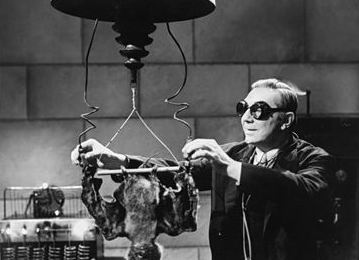
In the 1940 film, The Devil Bat, the owners of a company in the small town of Heathville are super-excited because they’re going to be given their head chemist, Dr. Paul Carruthers (Bela Lugosi), a bonus check of $5,000. However, since Carruthers’s inventions have made millions for the company, he is offended by the small check and decides that the best way to handle this would be to sue in court and demand fair compensation …. just kidding! Instead, Dr. Carruthers sends his army of giant bats to kill the families of his employers.
The Devil Bat was produced by Production Releasing Corporation, a poverty row studio that specialized in shooting quickly and cheaply. Going from Universal to PRC was technically a step down for Lugosi but The Devil Bat is actually an excellent showcase for Lugosi and he gives one of his better non-Dracula performances as the embittered Dr. Carruthers. Indeed, one can imagine that Lugosi, who played such a big role in putting Universal on the map, could relate to Carruthers and his bitterness over not being fairly rewarded for the work he did to make others wealthy.
Enjoy The Devil Bat, starring the great Bela Lugosi!
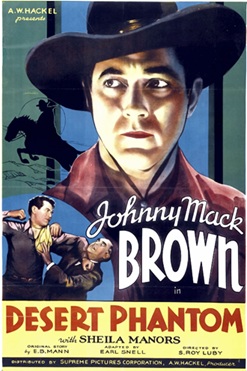
In a frontier town, rancher Jean Halloran (Sheila Bromley) has a big problem. Someone is shooting and killing all of her ranch hands and sending her notes in which he tells her to give up her ranch and leave town. When an ammunition salesman and trick shooter named Billy Donavon (Johnny Mack Brown), Jean hires him to serve as a bodyguard and to track down the mysterious Phantom. Billy, however, has a secret of his own.
DesertPhantom is a remake of an old Harry Carey film. I don’t know why Poverty Row did remakes since all of their films pretty much had the same plot regardless. A stranger comes into town and gets involved with a female rancher and a bad guy who is trying to hide his actual identity. In this one, Nelson McDowell gets to supply the comic relief as a befuddled veterinarian while familiar faces like Ted Adams and Karl Hackett are there to keep us guessing about how the Phantom could actually be. If you’ve watched enough of these movies, though, you’ll always be able to guess who the bad guy is.
This isn’t the best of Johnny Mack Brown’s movies. The Phantom’s story seems like it could have been interesting but that would have meant taking more risks than most of the Poverty Row studios were willing to do. Johnny Mack Brown is as convincing a cowboy as always and is the film’s saving grace. Brown was a western star precisely because he could make even something like DesertPhantom watchable.
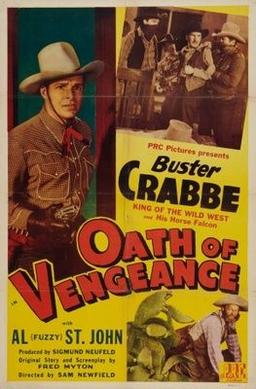
In a small frontier town, the ranchers and the farmers are nearly at war with each other. Cattle are being rustled. The head of the farmers (Karl Hackett) is accused of killing a ranch hand. Store owner Fuzzy Q. Jones (Al St. John) suspects that it’s all a set-up and he’s not going to stand for it. If the farmers kill all the ranchers and the ranchers kill all the farmers, there won’t be anyone left to shop at his store. Fuzzy calls in his friend, Billy Carson (Buster Crabbe).
Buster Crabbe may have gotten his start in the westerns by playing Billy the Kid but the producers of his films eventually realized that there was only so long that Buster could play a character known as “the Kid” and Billy the Kid’s reputation as an outlaw was actually not helpful at the box office because parents didn’t want to send their kids to a matinee that might teach them the wrong lessons. After a handful of “Billy the Kid” films, Buster’s western hero suddenly had a new name. Billy Carson was a standard western do-gooder, called in whenever a town needed to be cleaned up or his old sidekick Fuzzy needed some help around the store. Crabbe was a convincing hero no matter what but the Billy Carson films lacked the thing that made the Billy the Kid films interesting. Usually, no one was trying to arrest Billy Carson.
OathofVengeance isn’t bad, at least not by the standards of Poverty Row westerns. There’s plenty of fights and Crabbe, being a former Olympian, looks convincing with he throws a punch. The plot is a pretty standard B-western plot but Crabbe’s natural likability carries the day. Fans of the genre will be happy to see Charles King and Kermit Maynard, playing bad guys. Frank Ellis plays the ranch hand whose murder sets off the story. It’s always good to see the old gang back together again.
In the 1940 film, The Devil Bat, the owners of a company in the small town of Heathville are super-excited because they’re going to be given their head chemist, Dr. Paul Carruthers (Bela Lugosi), a bonus check of $5,000. However, since Carruthers’s inventions have made millions for the company, he is offended by the small check and decides that the best way to handle this would be to sue in court and demand fair compensation …. just kidding! Instead, Dr. Carruthers sends his army of giant bats to kill the families of his employers.
The Devil Bat was produced by Production Releasing Corporation, a poverty row studio that specialized in shooting quickly and cheaply. Going from Universal to PRC was technically a step down for Lugosi but The Devil Bat is actually an excellent showcase for Lugosi and he gives one of his better non-Dracula performances as the embittered Dr. Carruthers. Indeed, one can imagine that Lugosi, who played such a big role in putting Universal on the map, could relate to Carruthers and his bitterness over not being fairly rewarded for the work he did to make others wealthy.
Enjoy The Devil Bat, starring the great Bela Lugosi!
The 37th film in Mill Creek’s Fabulous Forties box set was 1940’s The Devil Bat, which Gary Loggins reviewed on this site back in October. Since, for the most part, I agree with Gary’s review, I’m going to recommend that you go read it and then I’ll just add a few thoughts of my own.
The Devil Bat is usually described as being one of the films that Bela Lugosi made during his decline, even though he made it just a year after appearing in a supporting role in the Oscar-nominated Ninotchka. Lugosi plays Dr. Paul Carruthers, a small-town chemist who uses radiation to create a gigantic bat that he unleashes on everyone who he feels has wronged him. The bat targets anyone who makes the mistake of wearing an aftershave lotion that Carruthers has created.
I would argue that there is a hint of genius to be found within The Devil Bat.
First off, there’s the fact that the giant bat is so clearly fake that it actually becomes rather charming. Wisely, the film makes no effort to convince you that the bat is real. Whenever that big, fake bat is lowered in on a bunch of often-visible wires, it works as almost a Brechtian alienation device. In much the same way that Godard used jump cuts in Breathless, Devil Bat uses that big, fake bat to remind the audience that they are watching a film. As a result, the audience has no choice but to think about the conventions of the horror genre and how their own world view has been shaped by watching movies like Devil Bat.
The other hint of genius is the satirical masterstroke of casting Bela Lugosi as a small town chemist. Lugosi remains Lugosi, regardless of what role he plays. When the film’s characters accept, without even a second glance, that Bela Lugosi, with his thick accent and his theatrical acting style, is a humble suburbanite, the film becomes a perhaps inadvertent satire of American conformity.
Needless to say, Lugosi was always a far better actor than he has ever been given credit for being. In The Devil Bat, he plays Dr. Carruthers with a weary sense of resignation. Carruthers never becomes a standard evil villain. Instead, he’s a man who has been so beaten down by life that he now see no other option beyond using a giant bat to kill those who he feels has betrayed him. Much as he would in Ed Wood’s Bride of the Monster, Lugosi brings an almost redemptive sadness to his mad scientist.
The end result is that poor, misunderstood and underestimated Bela elevates the entire film.
About a month ago, for reasons that I’m sure made sense at the time, I decided it would be fun to watch and review all 50 of the films included in Mill Creek’s Fabulous Forties box set. If you know anything Mill Creek box sets, then you won’t be surprised to learn that the majority of these 50 films are public domain B-movies. A few of them have been good, a few of them have been bad, and a few of them have been forgettable.
I have to admit that, as much as I love watching old movies, there’s a part of me that’s more than ready to move onto the next Mill Creek box set, the Nifty Fifties. But, before I do that, I have to finish up the Forties. Fortunately, I just watched the 25th film included in the Fabulous Forties and I am happy to say that I am now halfway done with this project! Yay!
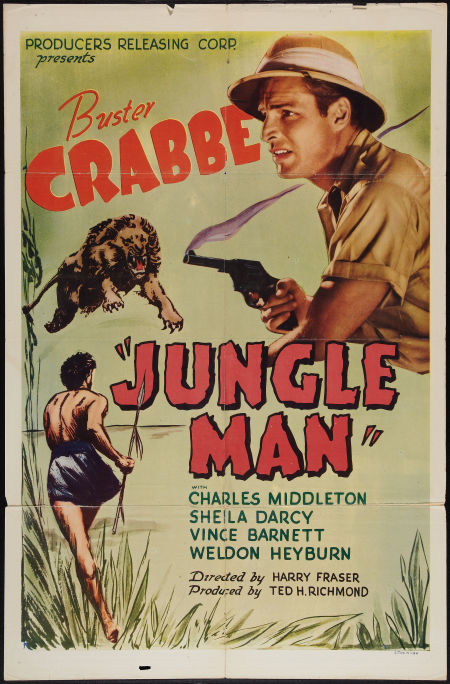
As for the film itself, it’s a 63-minute film from 1941. Though it was later retitled Drums of Africa, it was originally called Jungle Man.
As for what Jungle Man is about … well, it’s mostly about stock footage.
There is kind of a plot. Wealthy Bruce (Weldon Heyburn) and his friend Alex (Robert Carson) want to go to Africa so that they can see the legendary City of the Dead. Bruce’s fiancée, Betty (Sheila Darcy), decides to accompany them because she wants to visit her brother (Charles Middleton), a missionary. Once they get to Africa, they also meet a doctor (Buster Crabbe) who is trying to find a cure for a fever that is wiping out the native population.
But really, the plot is mostly just an excuse for stock footage. We watch as our explorers walk down a jungle trail. Someone says, “Look up in that tree!” We cut to grainy footage of a monkey in a tree. Cut back to everyone looking upward. Cut back to that monkey in the tree. Suddenly, we hear a roar on the soundtrack. Cut to slightly less grainy footage of a tiger running through a field. Cut back to the explorers saying, “Look out, tiger!” Cut back to the monkey climbing up higher in the tree.
(Of course, tigers don’t live in Africa but that’s just the type of film this is!)
Even when our heroes finally reach the City of the Dead, we don’t actually see them walking around the city. Instead, we see them staring into the distance and then immediately cut to some still shots of what Wikipedia identifies as being Cambodia’s Angkor Wat. Of course, no attempt is really made to match any of the shots. If Jungle Man was made today, they could just CGI the Hell out of it. But since it was made in 1941, audiences had to suspend their disbelief and accept shots that didn’t particularly match up with any other shots and a storyline that was pretty much determined by whatever stock footage the producers had available.
On the plus side, it’s only 60 minutes long and some of the stock footage is fun, particularly if you like cute monkeys or fierce tigers. For the most part, it’s silly but inoffensive.
And you can watch it below!
(I should admit that, as I watched it, I kept thinking about those GEICO commercials where Jane and Tarzan are lost in the jungle and Tarzan refuses to ask for directions. “Tarzan know where Tarzan go.” “No, Tarzan does not know where Tarzan go. Excuse me, do you know where the waterfall is? The waterfall?”)
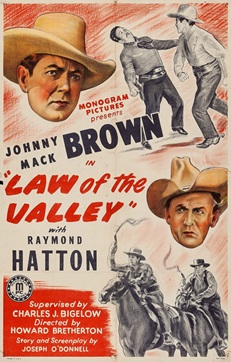 Dan Stanton (Edmund Cobb) and Condon (Tom Quinn) are planning to run a bunch of ranchers off their land by cutting off their water supply. Once the ranchers leave, Stanton and Condon will be able to sell their land to the railroads. After the bad guys murder a rancher named Jennings (George Morell), the rancher’s daughter (Lynne Carver) sends a message to U.S. Marshals Nevada Jack McKenzie (Johnny Mack Brown) and Sandy Hopkins (Raymond Hatton). Old friends of the murdered rancher, Sandy and Nevada come to town to rally the ranchers against Stanton and his men and to free up the water that’s been dammed up.



 Through the Shattered Lens