4 Or More Shots From 4 Or More Films is just what it says it is, 4 shots from 4 of our favorite films. As opposed to the reviews and recaps that we usually post, 4 Shots From 4 Films lets the visuals do the talking!
Today, the Shattered Lens celebrates what would have been the 96th birthday of Hal Ashby, one of the most important (and, sadly, one of the most overlooked) directors of the 1970s. It’s time for….
4 Shots From 4 Hal Ashby Films
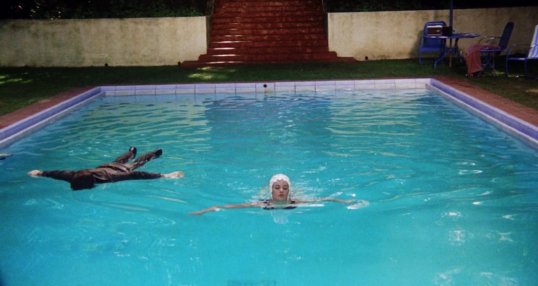
Harold and Maude (1971, dir by Hal Ashby, DP: John A. Alonzo)
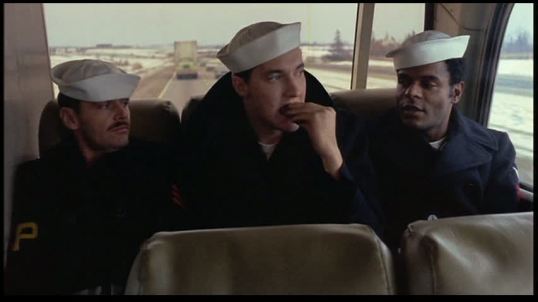
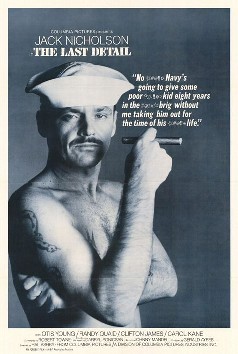
The Last Detail (1973, dir by Hal Ashby, DP: Michael Chapman)
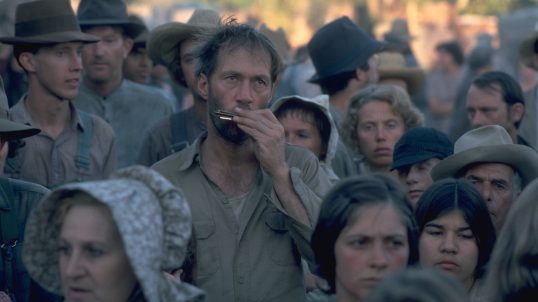
Bound for Glory (1976, dir by Hal Ashby, DP: Haskell Wexler)
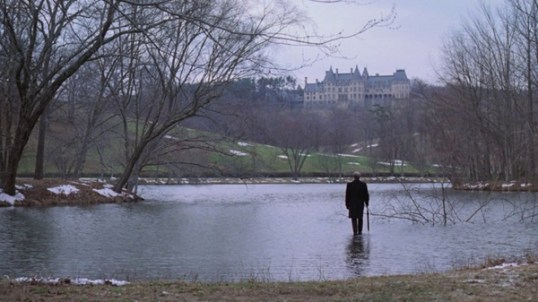
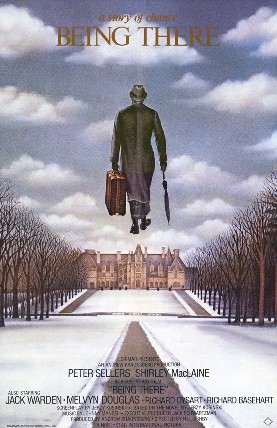
Being There (1979, dir by Hal Ashby, DP: Caleb Deschanel)
Billy “Badass” Buddusky (Jack Nicholson) and Richard Mulhall (Otis Young) are two Navy lifers stationed in Virginia. On shore patrol, they’ve been assigned to transport a 18 year-old seaman to a Naval prison in Maine. The kid has been dishonorably discharged and sentenced to eight years in the brig for trying to steal $40 from a charity box. (The charity was a favorite of the wife of his commanding officer.) Buddusky and Mulhall are expecting to find a hardened punk but instead, they end up escorting Larry Meadows (Randy Quaid), a timid teenager who suffers from kleptomania and who doesn’t seem to understand just how bad things are going to be for him for the rest of his life. Not only is he going to do eight years in the brig, surrounded by hardened criminals, but his dishonorable discharge is going to follow him for the rest of his life.
Resenting having to take Meadows to prison and also feeling that he’s getting a raw deal, Buddusky and Mulhall decide to make a few stops on their way to Maine, so that Larry can enjoy what little time he has left and hopefully lose his virginity before being locked up. In between brawling with Marines, visiting a brothel (where a young Carol Kane plays one of the prostitutes), and hanging out with a group of hippies (one of whom is played by Gilda Radner), Meadows comes to think of Buddusky and Mulhall as being his best friends. Unfortunately, for Meadows, both Buddusky and Mulhall have their job to do.
Hal Ashby’s road picture is a character study of three men who are all lifers, even if they don’t realize that. Both Buddusky and Mulhall hate the Navy but they also can’t relate to anyone who isn’t a member of the service. Meadows’s entire future has been pre-determined because he tried to steal $40 but he doesn’t realize it until its too late. When the film came out, it was controversial due to its “colorful” language. In an interview, screenwriter Robert Towne defended the frequent profanity because, as he put it, when you’re in a situation you hate, “that’s what you do. You bitch.” Hal Ashby’s loose direction captures the road trip feel as the three leads reluctantly head to their ultimate destination.
The Last Detail features one of Jack Nicholson’s best performances. Buddusky is cynical and doesn’t trust anyone other than Mulhall but even he knows that Larry Meadows deserves better than to spend eight years in the brig. Along with lending his star power to the film and standing by director Hal Ashby when Ashby was arrested for marijuana possession, Nicholson also played a big role in the casting of Randy Quaid as Larry Meadows. (The other final contender for the role was John Travolta but Nicholson insisted on Quaid). The 6’5 Quaid towers of Nicholson and Young, making him look as if he could escape any time that he wants. But Larry is so naive that he doesn’t want to make any trouble for his “friends.” Though this wasn’t his first film, The Last Detail is the film that made Quaid one of the busiest character actors of the 70s and 80s and it also, at least temporarily, made him a part of the Jack Nicholson stock company.
Both sad and funny, The Last Detail is one of the best films of the 70s and features Jack Nicholson at his most unforgettable.
4 Or More Shots From 4 Or More Films is just what it says it is, 4 shots from 4 of our favorite films. As opposed to the reviews and recaps that we usually post, 4 Shots From 4 Films lets the visuals do the talking!
Today, the Shattered Lens celebrates what would have been the 95th birthday of Hal Ashby, one of the most important (and, sadly, one of the most overlooked) directors of the 1970s. It’s time for….
4 Shots From 4 Hal Ashby Films
Harold and Maude (1971, dir by Hal Ashby, DP: John A. Alonzo)
The Last Detail (1973, dir by Hal Ashby, DP: Michael Chapman)
Bound for Glory (1976, dir by Hal Ashby, DP: Haskell Wexler)
Being There (1979, dir by Hal Ashby, DP: Caleb Deschanel)
Darryl Palmer (Michael O’Keefe) is an outfielder for the Atlanta Braves who is in a hitting slump until he meets a singer named Debby (Rebecca De Mornay). Debby agrees to go on a date with Darryl if he can manage to hit two home runs in his next game. Darryl does it and soon, he and Debby are married. Debby becomes Darryl’s good luck charm. When she comes to his games and when he’s confident that she loves him, Darryl hits home run after home run. When Debby tries to pursue her music career and have a life of her own, Darryl gets into a slump. After Debby gets tired of Darryl’s possessiveness and leaves him, his manager and his teammates decide that the key to winning the pennant is for Darryl to get laid.
(Are you listening, Rangers?)
Because it mixed baseball and romance, I thought I would like The Slugger’s Wife but actually I couldn’t stand it. Darryl’s such an insecure and possessive jerk that his behavior is often abusive. By the end of the movie, I didn’t care if the Braves won the Pennant. I just wanted Debby to come to her senses and get as far away from Darryl as possible. Darryl’s so unlikable that I couldn’t take any pleasure in him threating to break Roger Maris’s homerun record. He didn’t deserve the success and he certainly didn’t deserve Debby.
The one thing that the movie got right is how superstitious baseball can make someone. A few seasons ago, I noticed that the Rangers always seemed to win whenever I didn’t watch the game so I decided the key to finally returning to the World Series would be for me to just not watch the games at all. I spent the whole season just reading about the games after they ended. It was difficult because I love to watch baseball. But I also really wanted the Rangers to have a winning season so I refused to watch a single game.
“The story here is the miracle that we ever found that track. I was convinced – and I think Mick was – that it was definitely a reggae song. And we did it in 38 takes – ‘Start me up. Yeah, man, cool. You know, you know, Jah Rastafari.’ And it didn’t make it. And somewhere in the middle of a break, just to break the tension, Charlie and I hit the rock and roll version. And right after that we went straight back to reggae. And we forgot totally about this one little burst in the middle, until about five years later when somebody sifted all the way through these reggae takes. After doing about 70 takes of ‘Start Me Up’ he found that one in the middle. It was just buried in there. Suddenly I had it. Nobody remembered cutting it. But we leapt on it again. We did a few overdubs on it, and it was like a gift, you know? One of the great luxuries of The Stones is we have an enormous, great big can of stuff. I mean what anybody hears is just the tip of an iceberg, you know. And down there is vaults of stuff. But you have to have the patience and the time to actually sift through it.”
— Keith Richards on Start Me Up
Since today is Oscar Sunday, let’s start the day with a video that was directed by an Oscar winner.
Hal Ashby got his start as an editor and a favorite collaborator of director Norman Jewison. Ashby won his only Oscar for editing the 1967 best picture winner, In the Heat of the Night. Ashby then went on to become a director himself and, in that role, he was responsible for some of the most important films of the 1970s. Check out this list of credits: Harold and Maude, The Last Detail, Shampoo, Bound for Glory, Coming Home, Being There, and Let’s Spend the Night Together. All of these films were directed by Hal Ashby.
Let’s Spend The Night Together was a Rolling Stones concert film and I imagine that his work on that film is probably what led to Ashby directing this music video. Like a lot of the great 70s directors, his career struggled as people like Don Simpson took over Hollywood and the industry’s focus shifted away from empowering directors to keeping studio executives happy. While Ashby found himself practically unemployable in Hollywood, he was still able to make a living with work like this video and directing television episodes.
Hal Ashby died in 1988 of pancreatic cancer. Bruce Dern famously said that the way Ashby was treated in Hollywood was the “most disgusting thing” that he had ever seen over the course of his long career. Fortunately, movies are forever and Ashby’s work has since been rediscovered and continues to influence aspiring filmmakers all over. Richard Linklater is a huge fan and paid homage to Ashby with Last Flag Flying.
The 1967 film, In the Heat of the Night, tells the story of two very different men.
Chief Gillespie (Rod Steiger) is the police chief of the small town of Sparta, Mississippi. In many ways, Gillespie appears to the epitome of the bigoted Southern cop. He’s overweight. He loses his temper easily. He chews a lot of gum. He knows everyone in town and automatically distrusts anyone who he hasn’t seen before, especially if that person happens to be a black man or from the north.
Virgil Tibbs (Sidney Poitier) is a black man from the north. He’s a detective with the Philadelphia Police Department and he’s as cool and controlled as Gillespie is temperamental and uncouth. Tibbs has no patience for the casual racism that is epitomized by lawmen like Chief Gillespie. When Gillespie says that Virgil is a “fancy name” for a black and asks what people call Virgil in Philadelphia, Virgil declares, “They call me Mister Tibbs!,” with an authority that leaves no doubt that he expects Gillespie to do the same.
Together …. THEY SOLVE CRIMES!
For once, that old joke is correct. When a Chicago industrialist named Phillip Colbert is discover murdered in Sparta, Chief Gillespie heads up the investigation and, assuming that the murderer must be an outsider, orders Deputy Wood (Warren Oates) to check out the train station for any suspicious characters. When Wood arrives at the station, he discovers Virgil standing on the platform. Virgil is simply waiting for his train so that he can get back home to Philadelphia. However, Wood promptly arrests him. Gilespie accuses him of murdering Colbert, just to discover that Virgil’s a police detective from Philadelphia.
Though neither wants to work with the other, that’s exactly what Gillespie and Virgil are forced to do as they investigate Colbert’s murder. Colbert was planning on building a factory in Sparta and his wife (Lee Grant) makes it clear that, if Sparta wants the factory and the money that comes with it, Virgil must be kept on the case. Over the course of the investigation, Gillespie and Virgil come to a weary understanding as both of them are forced to confront their own preconceived notions about both the murder and life in Sparta. In the end, if it’s impossible for them to truly become friends, they do develop a weary respect for each other. That is perhaps the best that one could have hoped for in 1967.
I have to admit that it took me a few viewings before I really appreciated In the Heat of the Night. Though this film won the Oscar for Best Picture of 1967, it’s always suffered when compared to some of the films that it beat. One can certainly see that the film was superior to Doctor Dolittle and Guess Who’s Coming to Dinner. But was it a better film than The Graduate or Bonnie and Clyde? Did Rod Steiger really deserve to win Best Actor over Dustin Hoffman and Warren Beatty? (Amazingly, Poitier wasn’t even nominated.)
To be honest, I still feel that In The Heat of the Night was probably the 3rd best of the 5 films nominated that year, superior to the condescending Guess Who’s Coming To Dinner but nowhere near as groundbreaking as Bonnie and Clyde or The Graduate. The first time I watched In the Heat of the Night, I thought Steiger blustered a bit too much and the film’s central mystery didn’t really hold together and, to a large extent, I still feel like that.
But, at the same time, there’s a lot to appreciate about In the Heat of the Night. On subsequent viewings, I came to better appreciate the way that director Norman Jewison, editor Hal Ashby, and cinematographer Haskwell Wexler created and maintained an atmosphere that was so thick that you can literally feel the Mississippi humidity while watching the film. I came to appreciate the supporting cast, especially Warren Oates, Lee Grant, Scott Wilson, Anthony James, and Larry Gates. (Gates especially makes an impression in his one scene, playing an outwardly genteel racist who nearly cries when Tibbs reacts to his slap by slapping him back.) I also came to appreciate the fact that, while the white cop/black cop partnership has subsequently become a bit of a cliche, it was new and even controversial concept in 1967.
And finally, I came to better appreciate Sidney Poitier’s performance as Virgil. Poitier underplays Virgil, giving a performance of tightly controlled rage. While Steiger yells his way through the film, Poitier emphasizes that Virgil is always thinking. As in the same year’s Guess Who’s Coming To Dinner, Poitier plays a dignified character but, here, that dignity is Virgil’s way of defying the demands and expectations of men like Gillespie. When Virgil does strike back, it’s a cathartic moment because we understand how many times he’s had to hold back.
In the Heat of the Night may not have been the best film of 1967 but it’s still one worth watching.
Well, here we are! It’s January 1st. In just a few days, the Oscar nominations will be announced and then, on February 9th, the winners will be revealed! From now until the day of the ceremony, I will be taking a look at some of the films that were nominated for and won Oscars in the past. As of this writing, 556 films have been nominated for best picture. I hope that, some day, I will be able to say that I have seen and reviewed every single one of them.
Let’s start things off with the 1978 Best Picture nominee, Coming Home!
Coming Home takes place in California in 1968. While hippies stand on street corners and flash peace signs, teenagers are being drafted and career military men are leaving for Vietnam and people continue to tell themselves that America is doing the right thing in Indochina, even though no one’s really sure just what exactly it is that’s going on over there. At the local VA hospital, the wounded and the bitter try to recover from their wartime experiences while struggling with an often heartless bureaucracy and feelings of having been abandoned by their country.
When Marine Corps. Capt. Bob Hyde (Bruce Dern) is deployed to Vietnam, he leaves behind his wife, Sally (Jane Fonda). Told that she can no longer live on the base while her husband is overseas, Sally gets an apartment, a new car, and eventually a new hairdo. She also gets a new friend, Vi Munson (Penelope Milford). Vi smokes weed and is critical of the war in Vietnam. It doesn’t take long for Sally to start to enjoy the idea of being free and not having to cater to Bob’s every whim. Sally even ends up volunteering at the local VA hospital.
That’s where she meets Luke (Jon Voight, looking youngish and incredibly sexy), a bitter but sensitive vet who, having gone to Vietnam and returned to the U.S. as a paraplegic, is now outspoken in his opposition to the war. Luke is also friends with Billy (Robert Carradine), who is Vi’s shell-shocked brother. When Luke and Sally first meet, they collide in a hallway and Sally gets a bag full of urine spilled on her. It’s only later that Luke and Sally realize that they knew each other in high school and soon, they’re having an affair. Luke, who is as gentle a lover as Bob is brutish, brings Sally to her first orgasm in a sensitively-directed scene that should be studied by any and all aspiring filmmakers.
Unfortunately, the problem with having an affair while your husband is away is that, eventually, your husband’s going to come back. Bob returns from Vietnam and he’s no longer the confident and gung ho officer that he was at the start of the film. He now walks with a pronounced limp and, like Luke, he’s angry. However, whereas Luke has channeled his anger in to activism, Bob tries to keep his emotions bottled up. (He does take the time to give the finger to a few protesters and, considering how obnoxious most of the protesters in this film are, you can’t help but feel that Bob may have had a point.) When Bob discovers that Luke and Sally have been having an affair, he snaps….
Meanwhile, Billy is having a hard time readjusting to life, Vi is getting picked up by sleazy men in bars, and there’s a ventriloquist who shows up a few times. There’s a lot going on in Coming Home and, at times, it feels like the film’s trying to cram in too much. The film often seems a bit disjointed, with semi-documentary footage of Voight hanging out with real paraplegic vets awkwardly mixed in with didactic scenes of Sally turning against the war.
That the love story between Sally and Luke is so effective has far more to do with the performances of Jane Fonda and especially Jon Voight, than it does with anything in the film’s script. Indeed, the script itself doesn’t seem to be too concerned with who Luke and Sally were before they collided in that hallway and it also doesn’t seem to be all that interested in who they’ll be after the end credits role. As written, they’re just plot devices, specifically created and manipulated to express the film’s antiwar message. But then you see Jon Voight’s haunted eyes while he’s listening to a group of vets discuss their experience or you hear the pain in his voice while he talks to a bunch of high school students and it’s those little moments and details that tell you who Luke is. By that same token, Jane Fonda does a good job of showing each stage in Sally’s liberation, even if you can’t help but feel that the main reason Sally becomes an anti-war feminist is because she’s played by Jane Fonda.
Of course, in the end, the entire film is stolen by Bruce Dern. You actually end up feeling very sorry for Bob Hyde (and, to the film’s credit, you’re meant to). It would have been very easy to just portray Bob as being a close-minded pig but the film respects his pain just as much as it respects Luke’s anti-war activism and Sally’s need to be free. In the end, you actually feel worse for Bob than you do for either Luke or Sally. Bob is as much a victim of the war as anyone else in the film.
Coming Home was one of the first films about Vietnam to ever be nominated for best picture. Jane Fonda and Jon Voight both won Oscars but the film itself lost to a far different look at the war in Vietnam, The Deer Hunter.
One of my favorite online film reviewers is Mitch Lovell of the Video Vacuum. The thing I like about Mitch is that he doesn’t worry about how many Oscars a film has been nominated for or whether or not a film’s politics are currently in fashion. Unlike a lot of online reviewers, he doesn’t worry about whether or not he’s going against the “accepted” views of the critical establishment. Instead, he’ll watch a film and tell you exactly how he felt about it.
For example, Mitch Lovell’s review of the otherwise critically acclaimed 1976 best picture nominee Bound for Glory can be summed up in three words: “boring as fuck.” Every other online review that I’ve found for Bound for Glory offers up polite but rarely inspiring praise for this rather lengthy film about the folk singer Woody Guthrie. Most of those reviews do acknowledge that the film moves at its own pace but we are told that we will be rewarded for being patient. If the review was written after 2010, you can be sure that the reviewer will be sure to say that Bound for Glory reminds us of why labor unions are still important and need to be protected from the Tea Party. (The idea apparently being that, if a film has the right politics, it doesn’t have to actually be all that interesting.) It’s all rather predictable and that’s why we’re lucky to have reviewers like Mitch Lovell around. Whether you agree with him or not, it’s good to have a reviewer who will go against the conventional wisdom.
I recently watched Bound for Glory as a part of TCM’s 31 Days of Oscars and, to a large extent, I have to agree with Mitch Lovell’s review. This is a movie that is not only long but which moves slowly as well. It’s not that the film has a deliberate pace. It’s just slow! (If you want to see a film that makes good use of a deliberate pace, check out Barry Lyndon.) David Carradine plays Woody Guthrie, a sign painter who, during the Great Depression, abandons his family in Texas and, by hopping trains, makes his way to California. He works with fruit pickers. He tries to convince his fellow workers to form a union. He gets beat up a lot.
And he plays his guitar.
If there’s anything that remains consistent about Bound for Glory, it’s that Woody is always playing his guitar and that every time he starts to play, something terrible either has happened or does happen. There’s a huge dust storm. Woody plays his guitar. A fight breaks out at a union meeting. Woody plays his guitar. A bunch of hoboes on a train get beat up. Woody plays his guitar. Woody shows up at a textile mill and starts to play his guitar. He gets beaten up by a bunch of thugs. Woody impresses Pauline (Gail Strickland) by playing his guitar and soon, he’s cheating on his wife. Woody partners up with another folk singer, Ozark Blue (Ronny Cox), and they get their own radio show where Woody plays guitar. Woody promptly gets fired.
It quickly became apparent to me that Woody Guthrie’s guitar was cursed. Whenever he played it, poor people ended up getting oppressed.
In many ways, Bound for Glory is a prototypical example of what it means to be an acclaimed-at-its-time-but-subsequently-forgotten best picture nominee. It’s a big epic film that tells a fictionalized account of a real person’s life story. Woody Guthrie is best known for writing This Land Is Your Land, which is a song that I mostly associate with pretentious super bowl commercials. As Bound for Glory details, Woody was also a union organizer and political activist but what’s odd is that the film keeps the exact details of what he believed rather vague. We’re given the general idea of what Woody believed but we’re not given any specifics. As a result, Woody just comes across like another part-time social protestor as opposed to being a true political thinker (much less a revolutionary).
On a positive note, Bound for Glory is impressive to look at. The film’s cinematographer was the famous Haskell Wexler (who also directed Medium Cool, a film that was as upfront about its politics as Bound for Glory is vague) and Wexler captures some hauntingly beautiful images of the American wilderness. The scene where a gigantic wall of dust crashes down onto a small Texas town is especially memorable.
Otherwise, though, Bound for Glory is pretty much a snoozefest. It was nominated for best picture of 1976 and, when you compare it to fellow nominees like All The President’s Men, Network, Taxi Driver, and even Rocky — Bound for Glory does feel a bit out of place.
Then when you consider some of the other films that came out in ’76 — Carrie, Face to Face, The Front, God Told Me To, Logan’s Run, The Man Who Fell To Earth, Marathon Man, The Omen, The Outlaw Josey Wales, Lipstick, Robin and Marian, The Sailor Who Fell From Grace With The Sea, and The Town That Dreaded Sundown — the nomination of Bound for Glory feels like even more of a mistake.
As a general rule, I don’t watch the news. However, a few nights ago, I made an exception and I watched CNN. The reason was because it was snowing in New York City and apparently, CNN anchorman Don Lemon was broadcasting from something called the Blizzardmobile. I just had to see that!
Well, the Blizzardmobile turned out to be huge letdown. I was hoping for something like the Snowpiercer train but instead, it just turned out to be a SUV with a camera crew and a pompous anchorman who hilariously kept insisting that he was knee-deep in a blizzard when even a Texas girl like me could tell that the Blizzardmobile was only encountering a few snow flurries.
So, I flipped around to see if any of the other news stations had anyone in a blizzardmobile. What I discovered was that only CNN had a blizzardmobile but one thing that every news station did have was a panel of experts. An anchorperson would say something like, “What does the future look like?” and the panel of experts would tell us what the future looked like to them. What I found interesting was that I had no idea who these experts were but yet I was supposed to just believe that their opinions were worth considering.
I mean, for all I knew, those experts could have just been people who were spotted wandering around New York at night. But, because they were introduced as experts and looked directly at the camera whenever they spoke, they were suddenly authoritative voices.
Oddly enough, the very next night, I watched a movie from 1979 that dealt with the exact same issue.
Being There tells the story of Chance (Peter Sellers), a dignified, middle-aged man who lives in Washington, D.C. and works as a gardener for a wealthy older man. Chance cannot read. Chance cannot write. Chance goes through life with a blank smile on his face. Chance has never experienced the outside world. Instead, he spends all of his time working in the old man’s garden and obsessively watching TV. When the old man dies, Chance finds himself exiled from the house. Wandering around Washington D.C., Chance asks a random woman to make him dinner. He politely speaks with a drug dealer who pulls a knife on him. Finally, he finds himself entranced by a window display of televisions. Backing away from the window, Chance stumbles into the street and is struck by a car.
Though he’s not seriously injured, the owner of the car, Eve Rand (Shirley MacClaine), insists that Chance come back to her mansion with him so that he can be checked out by her private physician (Richard Dysart). As they drive back to the house, Eve asks Chance for his name.
“Chance the Gardner,” Chance replies.
“Chauncey Gardiner?” Eve asks.
Chance blankly nods.
Back the house, Chance meets Eve’s husband, Ben (Melvyn Douglas). Ben is a wealthy industrialist who is dying of leukemia. Ben takes an immediate liking to Chance. Because Chance is wearing the old man’s suits, everyone assumes that Chance is a wealthy businessman. When Chance says that he had to leave his home, they assume that his business must have failed due to government regulation. When Chance talks about his garden, everyone assumes that he’s speaking in metaphors.
Soon, Ben is introducing Chance to his friend, Bobby (Jack Warden). Bobby happens to be the President and when he quotes Chance in a speech, Chance the Gardner is suddenly the most famous man in the country. When he appears on a TV talk show, the audience mistakes his emotionless comments for dry wit. When he talks about how the garden reacts to different seasons, they assume that he’s an economic genius. By the end of the film, Bobby has become so threatened by Chance’s popularity that he’s been rendered impotent while wealthy, rich men plot to make Chance the next President of the United States.
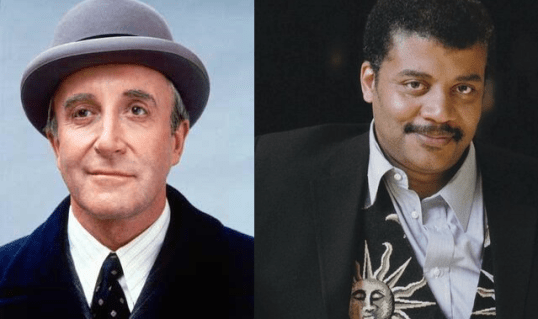
In many ways, Chauncey Gardiner was the Neil deGrasse Tyson of his era.
Being There is a one joke film and the idea of someone having no emotional skills beyond what he’s seen on television was probably a lot more mind-blowing back in 1979 than it is in 2015. But I still enjoyed the film. Peter Sellers gave a great performance as Chance, never sentimentalizing the character. As well, the film’s point is still relevant. If Being There were made today, Chance would be the subject of clickbait articles and Facebook memes. (Chauncey Gardiner listed his ten top movies and number 8 will surprise you! Or maybe This boy asked Chauncey Gardiner about his garden and his response was perfect.)
At its best, Being There is a film that will encourage you to question every expert you may see. Especially if he’s just stepped out of a blizzardmobile…


 Through the Shattered Lens