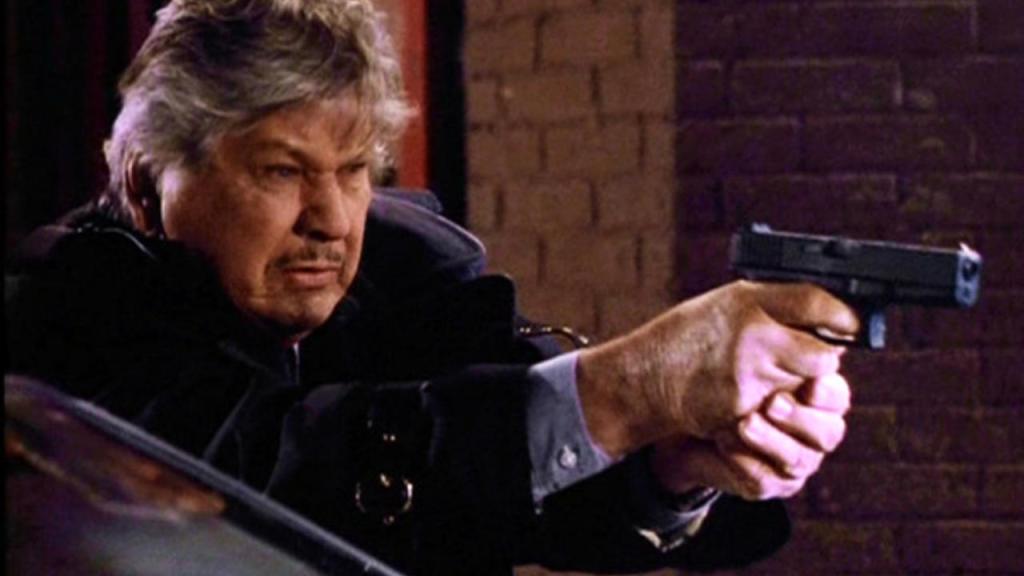
Brad reviews FAMILY OF COPS III: UNDER SUSPICION (1999) – Charles Bronson’s final film! 


Legendary actor Charles Bronson ended his five-decade career by starring in a series of made-for-TV movies, FAMILY OF COPS (1995), BREACH OF FAITH: A FAMILY OF COPS II (1997), and FAMILY OF COPS III: UNDER SUSPICION (1999). I was in my mid-twenties as this series played out, and I enjoyed each of the installments. Today, I’m going to take a look at the final film in the series, and the final film in Charles Bronson’s career.

FAMILY OF COPS III: UNDER SUSPICION opens with Milwaukee Police Inspector Paul Fein (Charles Bronson) and his detective son, Ben Fein (Joe Penny), investigating the double murder of a wealthy banker, Phillip Chandler, and his wife. Their initial suspect, the couple’s son Evan Chandler (Greg Spottiswood), is later found murdered, so they have to keep digging. They eventually uncover a money laundering scandal involving the current Chief of Police (Sean McCann) that may go all the way up to the Mayor (Art Hindle)! As usual, this series includes additional storylines involving other members of the family. One of the subplots involves Paul’s youngest son Eddie (Sebastian Spence), who’s racked with guilt over a S.W.A.T. raid gone wrong. Unable to open the warehouse door at the appropriate time, Eddie blames himself for the deaths of two cops. The other primary subplot involves Paul’s oldest daughter Kate (Barbara Williams), who finds herself pregnant with the child of her social worker boyfriend. Determined to have the baby whether her boyfriend hangs around or not, Kate must navigate their relationship and all the family drama while preparing for the possibility of being a single mother. 

As far as I’m concerned, the fact that this is Charles Bronson’s final film should make it a must watch for any person who considers themselves to be a fan of the icon. Making his debut in 1951 in the Gary Cooper film YOU’RE IN THE NAVY NOW, because he could “belch on cue,” Bronson’s final film would debut on CBS on January 10th, 1999, when he was 77 years old. At such an advanced age, Bronson still commanded the screen even though he was at the end of his career, and as time would tell, near the end of his life. He would be diagnosed in 2001 with Alzheimer’s disease and would pass away on August 30th, 2003. I savor every moment of this film, and while it makes me sad in some ways, in other ways I consider it my favorite of the series. Joe Penny steps up and takes a co-lead role in the film. He’s tough and sensitive, which adds another layer of depth to the foundation that Bronson had established in the first two movies. The series wouldn’t get another movie without Bronson, but I would have definitely been down for a Joe Penny led follow-up! This movie has a stronger sense of humor than we’ve seen in the earlier films, and I also like the main story as Paul Fein and his son take on systemic corruption in Milwaukee. While it’s still formulaic, I found the primary storyline to be more interesting than the generic crime stories in the first two installments. The subplots involving Eddie and Kate add some depth to the Fein family dynamics, but other than the fact that Kate is determined to keep her baby with or without her boyfriend’s help, the subplots didn’t make much of an impact for me. Also, there is one major departure in this installment, as Angela Featherstone does not return as the youngest daughter, Jackie Fein. Nicole de Boer steps into the role, and while she’s cute as a button, the character isn’t given much to do.

Overall, while FAMILY OF COPS III: UNDER SUSPICION is not in the same league as the great films made during Charles Bronson’s prime, it’s still a respectable close to his iconic career. It features good, committed performances, especially from Bronson and Joe Penny. The final shots of Charles Bronson looking over his movie family and smiling as they enjoy each other and share a meal together is a fitting end to his movie career, and one final celluloid glimpse into the man underneath the legendary facade.

Late Night Retro Television Review: Friday the 13th: The Series 3.4 “Crippled Inside”


Welcome to Late Night Retro Television Reviews, a feature where we review some of our favorite and least favorite shows of the past! On Fridays, I will be reviewing Friday the 13th: The Series, a show which ran in syndication from 1987 to 1990. The entire series can be found on YouTube!

This week, it’s all up to Johnny Ventura!

By the way, it is true that these reviews usually run on Friday.  This week, however, all the cold weather caught up to me and I spent most of yesterday in bed.  As a result, this week’s review got preempted to tonight.  Now, let’s find out what’s been going on in the world of cursed antiques!

Episode 3.4 “Crippled Inside”

(Dir by Timothy Bond, originally aired on October 21st, 1989)

This week’s episode opens with teenager Rachel Horn (Stephanie Morgenstern) nearly getting gang-raped by a group of jocks.  Rachel manages to escape from them but, as she runs away, she’s hit by a car and left a quadriplegic.  Feeling that her life is over, things start to look up for Rachel when an old man (John Gilbert) gives her his antique wheelchair, which he suggests will help her regain the ability to move.  When Rachel sits in the antique wheelchair, she can send out her astral form.  Each time she uses the wheelchair, her body heals just a little bit more.  The only catch is that the wheelchair only works if Rachel kills people while in her astral form.  Hey, I can think of at least four guys that Rachel might want to kill….

With Jack and Micki in London, it falls to Johnny Ventura to try to get the wheelchair back.  I have to admit that I was a bit skeptical when I saw this episode was going to be a solo effort on Johnny’s part.  I was like, “Johnny’s only been a regular for two episodes and he’s already working alone?”  (I have to admit that my feelings towards the Johnny Ventura character are very much influenced by how much I liked Ryan.)  But I have to say that this was a good episode and a lot of that was because Johnny was working alone.  Not understanding the true danger of the cursed antiques, Johnny was torn about whether or not to take the wheelchair away from Rachel.  Rachel was a very sympathetic character and the people she was targeting truly were terrible.  Johnny, not understanding that Rachel was losing her soul to the devil, actually gave the wheelchair back at one point.  By the end of the episode, he realized he had made a mistake.  Steve Monarque did a wonderful job portraying Johnny’s growing realization that there are no good curses.

This was a good episode.  I still miss Ryan but Johnny held his own.  The story was emotionally effective and the ending left me feeling genuinely unsettled.  Johnny learned the truth about curses and I learned that, even during its final season, Friday the 13th: The Series was capable of producing intelligent and memorable horror.

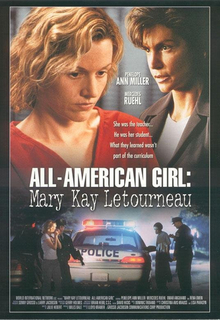
Retro Television Review: All-American Girl: The Mary Kay Letourneau Story (dir by Lloyd Kramer)


Welcome to Retro Television Reviews, a feature where we review some of our favorite and least favorite shows of the past!  On Sundays, I will be reviewing the made-for-television movies that used to be a primetime mainstay.  Today’s film is 2000’s All-American Girl: The Mary Kay Letourneau Story!  It  can be viewed on YouTube.

In 1996, a 34 year-old teacher named Mary Kay Letourneau decided that she had fallen in love with someone who was not her husband.

A 34 year-old deciding that they are no longer happy in their marriage and subsequently deciding that that they’ve found love with someone else is hardly an unusual or even surprising occurrence.  What made Mary Kay Letourneau’s case a national scandal was that the person that she decided that she was in love with was a 12 year-old student named Vili Fualaau.  Mary Kay started her affair with Vili when she was his sixth grade teacher.  When she was arrested and charged with two counts of second-degree rape of a child, Letourneau was pregnant with Vili’s child.  Even after being arrested, Letourneau insisted that she and Vili were soulmates.  After giving birth to Vili’s child, Letourneau was sentenced to six months of prison and somehow managed to avoid having to register as a sex offender.  After serving her sentence, Letourneau was promptly arrested again with Vili and was sent back to jail, where she gave birth to Vili’s second child.

All-American Girl opens with Mary Kay Letourneau (Penelope Ann Miller) in jail, insisting that everything that happened between her and Vili was consensual and that their love is real.  The majority of the film is shown in flashbacks.  Some of those flashbacks deal with Mary Kay, her husband (Greg Spottiswood), and Vili (Omar Anguiano).  Watching the flashbacks, I couldn’t help but notice that the film really did seem to be on Mary Kay’s side, to an almost ludicrous extent.  Her husband is portrayed as being a soulless sociopath, even before Mary Kay starts sneaking around with Vili.  As for Vili, he is presented as being the one who initiated his relationship with Mary Kay, flirting with her in class and comforting her when she starts crying in a school hallway.  The actor playing Vili looked, acted, and sounded considerably older than just 12 years old.  At times, he appeared to be nearly as old as Penelope Ann Miller.  And I’ll admit that it’s totally possible that Vili could have looked older than his age and maybe he did have a surprisingly mature vocabulary.  But still …. he was 12 years old!  Apparently, Letourneau cooperated with the film’s producers and that’s pretty obvious from the first minute we see Vili giving Letourneau a wolfish smile in the 6th grade.

The flashbacks dealing with Letourneau’s childhood are a bit more interesting, if just because Letourneau was the daughter of a congressman who ran for president in 1972.  (One of her brothers served in the first Bush White House.  Another served as an advisor to the 2016 Trump campaign.)  At one point, she taunts a group of protestors that have gathered outside of her family’s home and her father praises her courage.  The film hints that it was the twin traumas of her brother’s death and the discovery that her beloved father had fathered two children with a mistress that led to Letourneau’s subsequent instability.  Perhaps that’s true, though I think the film is a bit too eager to accept that as an all-purpose explanation.

You may have guessed that I had mixed feelings about this film.  Penelope Ann Miller gave an excellent performance as Mary Kay but the film’s attempts to portray May Kay as being even more of a victim that Vili were undeniably icky.  

As for the real Mary Kay, she married Vili four years after being released from prison.  They separated a year before Mary Kay died in 2020.  Their relationship inspired several films, most recently May/December.

Horror on TV: The Hitchhiker 5.23 “Dying Generation” (dir by Timothy Bond)


Tonight’s episode of The Hitchhiker features Roberta Maxwell as a fortune teller who, for five bucks, gives her clients a vision of the future and, as we all know, no one gets a happy ending.  Maybe that’s why so many of her teenage clients end up committing suicide.  Greg Spottiswood and Cynthia Preston play the two teens who decide to investigate how the fortune teller is involved in their friends death.  This is an intriguing episode, featuring a good performance from Roberta Maxwell.

This episode originally aired on November 24th, 1989.