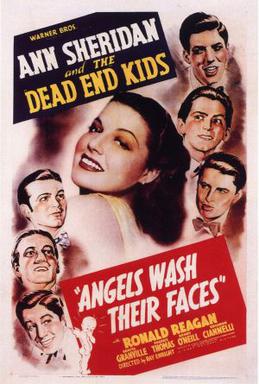
Angels Wash Their Faces (1939, directed by Ray Enright)


Gangster William Kroner (Bernard Nedell) and his henchman Martino (Eduardo Ciannelli) frame teenager Gabe Ryan (Frankie Thomas) for setting several buildings on fire.  Because Gabe has just gotten out of reform school and is a member of a local neighborhood gang, they know that no one will believe him or his sister, Joy (Ann Sheridan).

What Kroner and Martino did not count on were the Dead End Kids (Billy Halop, Bobby Jordan, Leo Gorcey, Gabriel Dell, Huntz Hall, and Benard Punsley).  They’re not going to sit by while the adults send their friend to jail.  Plus, one of their friends was killed in one of the fires.  The kids are out for revenge and sympathetic district attorney Pat Remsen (Ronald Reagan) is on their side.

As a publicity stunt, the city is holding an election for “Kid Mayor.”  The Kid Mayor gets to run the city for a week.  What could go wrong?  Billy Halop decides to run for Kid Mayor so that he can order the arrest of Kroner and then beat a confession out of him.

Angels Wash Their Faces was one of the last of the studio-made Dead End Kid films.  After this one, they would be sent down to Poverty Row and their films would be more obviously comedic.  Angels Wash Their Faces starts out as a juvenile delinquent drama, with Gabe struggling to rebuild his life and keep on the right track.  Then it becomes a goofy comedy, with Billy Halop running for mayor and unleashing vigilante justice on the bad guys.  I’m not sure that any city would actually give the “kid mayor” the power to lock people up.  Whoever came up with the idea of a kid mayor should be run out of politics.

On the positive side, Ann Sheridan is beautiful.  Future president Reagan is his usual friendly self.  On the negative side, the movie, overall, lacks the edge that made the first few Dead End Kids films memorable and the Dead End Kids themselves seem to be pretty much interchangeable.  Huntz Hall would have made a better mayor.


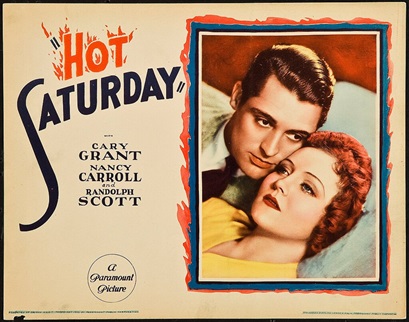
Love On The Shattered Lens: Hot Saturday (dir by William A. Seiter)


First released in 1932 and featuring Cary Grant in his first leading role, Hot Saturday is a film about gossip and love.

Ruth Brock (Nancy Carroll) is a young bank teller living in a small town.  It’s the type of town where everyone knows everyone else.  For instance, everyone knows that every man in town wants to date Ruth but that Ruth, for her part, is not in any hurry to settle down and get married.  She’s having too much fun going to dances, drinking with her friends, and enjoying life.  Everyone knows that playboy Romer Sheffield (Cary Grant) is interested in Ruth but then again, Romer appears to be interested in everyone.  Romer has scandalized the town by allowing a woman named Camille (Rita LaRoy) to live at his mansion.

Ruth has a date with one of her coworkers, Conny Billop (Edward Woods), but, when Conny refuses to take no for an answer, she gets away from him and ends up at Romer’s estate.  Ruth and Romer spend the night together, just talking.  Still, thanks to Conny and Eva (Lillian Bond), the daughter of Ruth’s boss, the whole town is soon convinced that Ruth is Romer’s lover.  The town is so scandalized that Ruth even loses her job.

Fortunately, Bill Fadden (Randolph Scott) has returned to town.  Bill is a geologist.  He grew up in town, with Ruth.  He’s spent the last seven years on a surveying expedition but now he’s back and he wants to marry Ruth.  How lucky is Ruth?  She not only has two good men in love with her but one of them looks like Cary Grant and the other one looks like Randolph Scott!  However, when Bill hears the rumors, will he continue to love her or will he be yet another person who gives in to the curse of small town gossip?

Hot Saturday is a film that truly took me by surprise.  It’s a pre-code film and it’s one that has all of the usual tropes that one usually associates with the pre-code era.  Everyone’s obsessed with sex.  There’s a lot of kissing.  There’s a lot of drinking.  There’s an emphasis on legs and lingerie.  There’s even a scene where Ruth gets into a wrestling match with her younger sister when she discovers that her sister has taken her new panties.  I’m one of four sisters so I could certainly relate but it’s still not the sort of thing that one necessarily expects to find in a film from the 1930s.  But that’s one reason why I love the Pre-Code era.  Allowed to police itself, pre-code Hollywood made films that were more realistic and open about their subject matter than the films made under the production code but which also still had their own unique innocence to them.  Hot Saturday has an ending that would have never been allowed during the Code era, one that is, dare I say it, rather empowering.

But, beyond all that, Hot Saturday is an intelligently written film that strikes a good balance between drama and character-driven comedy.  Nancy Carroll is beautiful and likable in the lead role.  Cary Grant and Randolph Scott are both as handsome and charming as can be.  Hot Saturday is both a look at the reality and dangers of small town gossip and a touching love story.  I enjoyed it.

Lisa Marie Reviews An Oscar Nominee: Alice Adams (dir by George Stevens)


Katharine Hepburn was famous for both her relationship with Spencer Tracy and the films that she made with him.  They were such frequent co-stars and so associated with each other that “Hepburn-Tracy” became a film genre in and of itself, one that promised a bit of comedy, a bit of drama, and some sharp-witted romance.  That said, I have to admit that one of my favorite of Katharine Hepburn’s film is one that she made not with Spencer Tracy but instead with Fred MacMurray.  Alice Adams is a Tracy-Hepburn film without Tracy.

First released in 1935 and based on a novel by Booth Tarkington (who was quite a big deal back in the day even if, like Arrowsmith‘s Sinclair Lewis, he’s somewhat forgotten today), Alice Adams stars Hepburn as the title character.  Alice is the daughter of Virgil Adams (Fred Stone) and his wife, who is only referred to as being Mrs. Adams (Anne Shoemaker).  Virgil is a sickly man who has worked as a clerk at a glue factory for several years.  Despite living in a rather large house and having a maid named Malena (Hatti McDaniel), the Adams family is not wealthy.  However, Mrs. Adams desperately wants the family to be rich and Alice carries herself with the airs of a wealthy woman, despite the fact that everyone in town knows that she’s not.  Alice love her family and is loyal to them, even if her younger brother (Frank Albertson, who later played Sam “Hee Haw” Wainwright in It’s A Wonderful Life) appears to be addicted to gambling and her mother is constantly browbeating her father for not being more ambitious.  Her family may embarrass her but we know she wouldn’t trade them for all the money in the world.  That’s why we like Alice, even if she does sometimes act like a snob.

However, when Alice meets and falls for the wealthy Arthur Russell (Fred MacMurray), she lies about her social background and tries to present herself as being just as rich as him.  When she invites Arthur and his parents to her house for a dinner party, she frantically tries to keep up the charade of being wealthy.  Meanwhile, Virgil finds himself wrongly accused of stealing from his boss (Charley Grapewin) and, as a result, the family’s financial future is put in jeopardy.

Alice Adams is a mix of screwball comedy and social drama.  On the one hand, Alice’s desperate attempts to throw the perfect party are frequently very funny.  Katharine Hepburn was always at her best when she played a flighty character and the contrast between Alice’s sophisticated airs and Alice’s actual personality makes me laugh every time that I watch the film.  At the same time, there’s a definite undercurrent of melancholy to the film.  Alice and her mother are both so desperate to be rich that they’ve both been blinded to just how wonderful their lives really are.  Alice may like Arthur and Arthur definitely likes Alice but one never forgets that a part of Alice’s attraction to Arthur is that Arthur can give her the life to which she aspires.

Alice Adams features one of Hepburn’s best performances and it’s a rare Hepburn performance to which anyone watching should be able to relate.  At some point in our lives, we’ve all felt like Alice.  We’ve all been Alice, even if we don’t want to admit it.  Fred MacMurray’s natural likability serves him well as Arthur.  He comes across like a genuinely nice guy and we definitely want him and Alice to end up together.

Alice Adams was nominated for Best Picture but it lost to a much bigger production, Mutiny on the Bounty.  Bette Davis beat Katharine Hepburn for Best Actress.  Davis later said that she felt Hepburn should have won.

The Fabulous Forties #39: My Man Godfrey (dir by Gregory La Cava)


My_man_godfrey

The 38th film in Mill Creek’s Fabulous Forties box set was My Man Godfrey, which is strange considering that My Man Godfrey is not a 40s film.  The back of the box insists that My Man Godfrey was made in 1946 but it was actually made in 1936.  Errors like this aren’t uncommon when it comes to Mill Creek but, even beyond that simple mistake, My Man Godfrey is clearly not a product of the earnest and pro-American 1940s.  My Man Godfrey may be a screwball comedy but it’s a comedy that is very much a product of the far more cynical 1930s.  It’s a comedy that could only have come out during the Great Depression, at a time when FDR was promoting his New Deal and yet many Americans were still out-of-work and struggling to make ends meet, forgotten by a country determined to buy into a feel good narrative regardless of any evidence to the contrary.

But no matter!  My Man Godfrey might not technically belong in the Fabulous Forties box set but I’m still glad that it was there because it is an absolutely fantastic film.

The Godfrey of the title is played by the always charming and always funny William Powell.  When we first see him, he’s living in a garbage dump with several other men who have lost their money, homes, and family.  These are men who spend their time wondering when and if things are ever going to get better.  While the rest of the country insists that happy days are here again, these men know it’s simply not true.  They are truly the forgotten men.

Fortunately, there’s also a scavenger hunt going on!

For charity, a group of rich people are running around the city and collecting various oddities.  And among those oddities — “a forgotten man!”  When wealthy and snobbish Cornelia Bullock (Gail Patrick) stops off at the dump, she offers Godfrey five dollars to come with her and be her “forgotten man.”  Offended, Godfrey reprimands her and a shocked Cornelia stumbles back and falls into an ash pile.  Cornelia’s younger sister, the flighty Irene (Carole Lombard), sees this and laughs.  Mostly to get back at Cornelia, Godfrey agrees to be Irene’s forgotten man.

When Irene takes Godfrey to the Waldorf-Astoria Hotel so that the game’s organizers can declare him to be an authentic forgotten man, Godfrey is disgusted by the silly and wealthy people that he sees around him.  After he is authenticated, Godfrey proceeds to loudly denounce everyone in the hotel.  Every one is scandalized, except for Irene.  Irene asks Godfrey if he would like to come home with her and be her family’s new butler.  Reluctant but broke, Godfrey agrees.
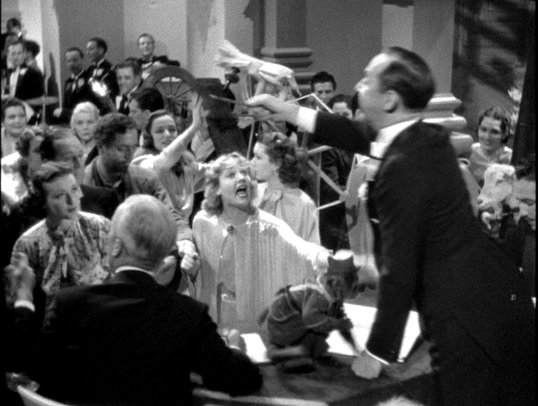
One of the joys of this scene is seeing the other things people found during the scavenger hunt. Love the monkey.

One of the joys of this scene is seeing the other things people found during the scavenger hunt. Love the monkey.

Godfrey, however, is far less amused.

Godfrey, however, is far less amused.

The next morning finds Godfrey in the Bullock mansion, prepared to start his duties as a butler.  He turns out to be a surprisingly adept butler but there’s only one problem.  It turns out that everyone was drunk last night and, as a result, nobody remembers Irene hiring Godfrey.  As Godfrey reintroduced himself to the family, he gets to once again know the Bullocks.

For instance, patriarch Alexander Bullock (Eugene Pallette) is a well-meaning man but he’s incapable of controlling his eccentric family or their excessive spending.  He faces each day with the weary resignation that his household is a disorganized mess and that he’s on the verge of losing his business.

Alexander’s wife, Angelica (Alice Brady), lives in her own world and confronts every problem with nonstop and delusional positivity.  She is very excited to have taken on a protegé, an artist named Carlo (Mischa Auer, who was justifiably nominated for an Oscar for his wonderfully odd performance).  Carlo is often surly and spoiled but he does do a pretty good impersonation of a gorilla.  Whenever the often dramatic Irene is declaring herself to be the most miserable rich girl in the world, Angelica insists that Carlo cheer everyone up by grunting and jumping around the room.
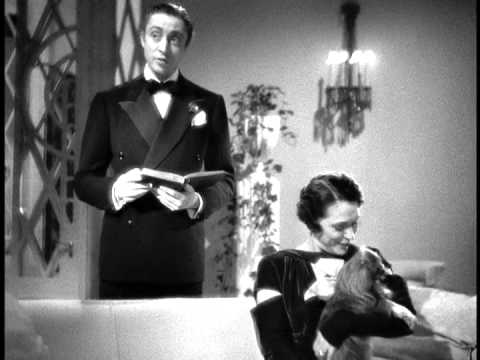
Mischa Auer as Carlo
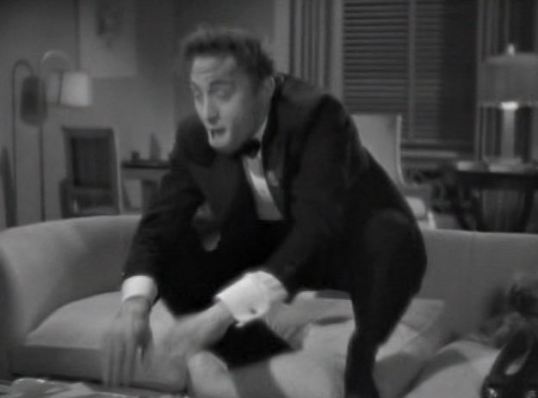
Mischa Auer as Carlo

Mischa Auer as a gorilla

Mischa Auer as a gorilla

(Apparently, the gorilla impersonation was something that Auer used to do at Hollywood parties.  The role of Carlo was specifically created with the idea of capturing Auer’s act on film.  As a result, Auer was one of the first actors to ever be nominated for Best Supporting Actor and he started a new career as a comedic character actor.)

Cornelia is selfish and materialistic.  Though she may not remember much about the scavenger hunt, she does remember Godfrey humiliating her.  From the minute she discovers that Godfrey is the new butler, she starts to conspire against him.  When her necklace disappears, everyone is sure that she hid it herself just to frame Godfrey.  The truth, of course, is a little bit more complicated.

And finally, there’s Irene.  Irene is spoiled but she’s not selfish.  She’s also not as ditzy as everyone assumes.  It’s just that she sees the world in her own unique way.  Almost as soon as Irene remembers that she hired Godrey, she decides that she’s in love with him.  She also decides that Godfrey is her protegé.  After all, if her mother can have a protegé, why can’t she!?
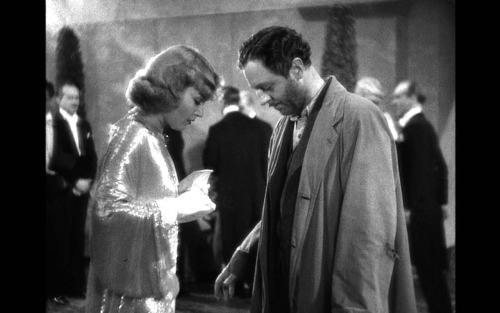
Carole Lombard and William Powell

Carole Lombard and William Powell

Carole Lombard was a masterful comedienne whose career was tragically cut short when she was killed in a plane crash in 1942.  Lombard is absolutely adorable in the role of Irene, a character to whom I very much related.

Of course, there is more to Godfrey and his past than he actually let on.   And, even after he becomes the new butler, Godfrey doesn’t forget where he was living just a few days before.  My Man Godfrey is a hilarious comedy but it’s also a comedy with a social conscience.
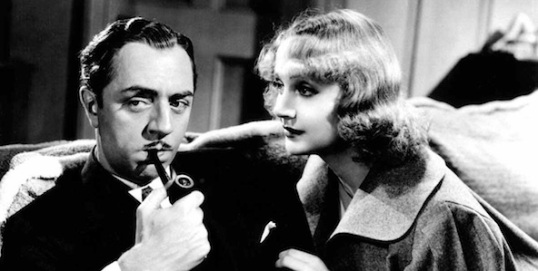
my-man-godfrey_592x299

I love this film.  It’s a screwball comedy in the best sense of the term, a film where all of the characters are eccentric while also remaining human.  William Powell and Carole Lombard were briefly married before they teamed up in My Man Godfrey and their chemistry is delightful to watch.  Finally, the supporting cast is memorable in the way that only a collection of great 1930s character actors can be.

My Man Godfrey is a great film.  It may not be from the 1940s but I’m glad it was included.
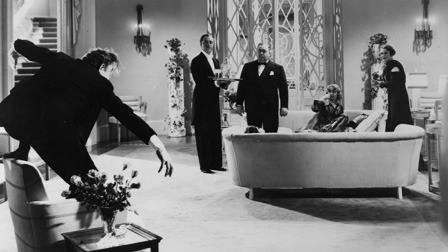
Godfreyw_bw_original

(By the way, just between you and me — I had a lot of fun watching this movie and writing this review.  It kind of reminded me why I started writing about movies in the first place.)
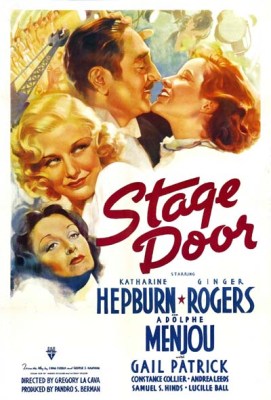
Cleaning Out The DVR #35: Stage Door (dir by Gregory La Cava)


(For those following at home, Lisa is attempting to clean out her DVR by watching and reviewing 38 films by the end of today!!!!!  Will she make it?  Keep following the site to find out!)

Stage_Door_(1937)

The 1937 film Stage Door is a great example of a unique genre of American film, the Katharine Hepburn Gets Humbled genre.

In the 1930s, Katharine Hepburn went through a period of time where she was considered to be “box office poison.”  She was undeniably talented but it was obvious that the studios weren’t sure how to showcase that talent.  They put her in high-brow films that often did not have much appeal to audiences.  As well, the press hated her.  Katharine Hepburn was outspoken, she was confident, she was a nonconformist, and, too many, her refusal to do interviews and sign autographs marked her as a snob.  Very few people wanted to see a movie starring Katharine Hepburn and therefore, very few people were willing to make a movie starring Katharine Hepburn.

(Interestingly enough, as I sit here typing this, another KH — Katharine Heigl — is pretty much in the exact same situation, with the main difference being that Hepburn was a far more interesting actress.)

Fortunately, Katharine Hepburn was smart enough to recognize the problem and she started to appear in films like Stage Door.  In Stage Door, she essentially played a character who mirrored the public’s perception of her.  Terry Randall is a snobbish and pretentious aspiring actress who comes to New York to pursue her career and moves into a theatrical rooming house.  At first, her attitude makes her unpopular with the other actresses living in the house.  But, as the film progresses, Terry slowly starts to let down her defenses and reveals that she’s just as insecure, neurotic, and vulnerable as everyone else.  She also proves herself to be willing to stand up to manipulative producers and condescending directors.  When she’s cast in her first Broadway show, it turns out that the show is being financed by her father and his hope is that she’ll do such a bad job and be so humiliated that she’ll give up acting.  And, at first, it appears that Terry will be terrible.  During rehearsals, she is stiff and mannered.  (Hepburn was actually quite brave to portray Terry as being such a believably bad actress.)

Of course, Terry isn’t the only actress at the rooming house who has issues to deal with.  For instance, Judy Canfield (Lucille Ball) has to choose between pursuing her career or getting married and starting a family.  Kay (Andrea Leeds) is a once successful actress who is now struggling to find roles, can’t pay her bills, and has become suicidal as a result.  And then there’s Jean (Ginger Rogers), Terry’s cynical roommate and frequent enemy and occasional friend.  Jean is falling in love with Anthony Powell (Adolphe Menjou), the lecherous producer of Terry’s play.

Stage Door is a wonderfully entertaining mix of melodrama and comedy.  You’ll laugh, you’ll cry, and you’ll really find yourself hoping that all of the actresses at the rooming house will have their dreams come true.  While the film is dominated by Hepburn and Rogers, it truly is an ensemble piece.  Not only does the cast include Eve Arden, Lucille Ball and Andrea Leeds (giving the film’s best and most poignant performance) but the great dancer Ann Miller appears as Jean’s equally cynical best friend.  Stage Door may be 79 years old but it’s aged wonderfully.

At the box office, Stage Door was a modest success and it directly led to Hepburn being cast in the classic screwball comedy, Bringing Up Baby.  Stage Door was nominated for best picture but it lost to The Life of Emile Zola.

Back to School #22: Rock ‘n’ Roll High School (dir by Allan Arkush)


Originally, when I started this series of Back to School reviews, I was planning on reviewing Grease.  After all, everyone has seen that film.  It’s on TV all the time.  (Looking in your direction, AMC.)  It’s a musical, which is a genre that I love but one which I also rarely seem to review.  The movie features a good performance from Stockard Channing.  It also has a lot of dancing and you know how much I love that.  And speaking of love, a lot of people seem to absolutely love Grease.

But, the more I thought about it, the more I realized that while others may love Grease, I don’t.  Oddly enough, I always seem to fool myself into thinking that it’s a fun movie but then I make the mistake of watching it whenever it pops up on AMC and every time, I am surprised to discover just how boring Grease really is.  The majority of the cast play their roles as if they’re still on a Broadway stage and projecting to the back of the house.  Olivia Newton-John is miscast.  John Travolta appears to be acting on auto pilot.  Both the songs and even Stockard Channing are never as good as I remembered.  Worst of all, the dance numbers are so ineptly staged and filmed that, half-the-time, you can’t even see what anyone’s doing with their feet.

While I certainly don’t have any problem writing a negative review (and check out my thoughts on Avatar if you doubt me), I wanted to end the 70s on a positive note.  So, instead of telling you that Grease isn’t good as many people seem to think, I want to recommend another film that, like Grease, features a lot of singing and dancing but which also happens to be a lot of more fun.

That film, of course, is the 1979 cult classic Rock ‘n’ Roll High School.

screen-shot-2010-04-27-at-1-34-11-am

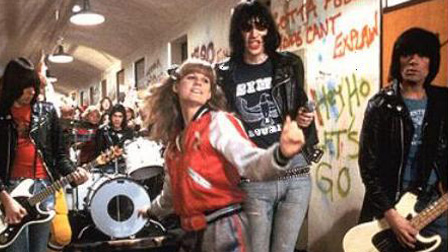
Things are amiss at Vince Lombardi High School.  The students are so obsessed with rock and roll (and the music of the Ramones, in particular) that they have caused several principals to quit.  The hallways are a disorganized mess.  Student Riff Randall (P.J. Soles) spends all of her time having fantasies about the way that Joey Ramone eats pizza.  A strange students named Eaglebauer (Clint Howard) runs a shadowy company known as Eaglebauer Enterprises out of a smoke-filled boy’s restroom.  (He’s even got an administrative assistant to schedule meetings for him.)  Handsome jock Tom Roberts (Vincent Van Patten) can’t get a date, largely because he’s obsessed with Riff who is obsessed with the Ramones.  Little does Tom realize that Riff’s best friend, the sweet and intelligent Kate Rambeau (Dey Young), has a crush on him.

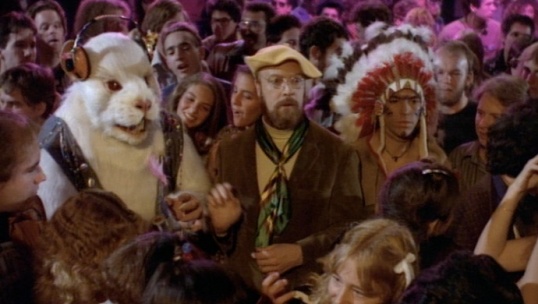
The school board hires a new principal to bring some peace to the high school.  Ms. Togar (Mary Woronov) is a strict and mentally unbalanced disciplinarian who, with the help of two apparently subhuman hall monitors, is determined to suppress any sort of fun, rebellion, or free thought.  Togar hates loud music, mostly because it causes white mice to spontaneously explode.  (When, late in the film, a human-sized white mouse — or he could have just been a very strange man wearing a white mouse costume, the film is ambiguous on this point — attempts to enter a Ramones concert, he’s turned away for his own good.  Until, of course, he reveals that he’s brought along headphones for his own protection…)

rat


In the end, it all comes down to this: Togar and her allies want to burn records.  Riff and the Ramones want to stop her.  And maybe blow up the school.  (David from Massacre at Central High would have been a fan of the Ramones.)

Rock ‘n’ Roll High School is an intentionally over-the-top film that both celebrates youthful rebellion while satirizing traditional high school films.  The jokes (which are a good combination of the silly and the genuinely clever) come non-stop, the actors all bring a lot of energy to their roles, and the entire film is just a lot of fun. As played by P.J. Soles, Riff Randall really is the ideal best friend and I imagine that a lot of boys in 1979 probably walked out of the theater with a huge crush on both P.J. Soles and Dey Young.  And finally, Mary Woronov gives a wonderfully demented performance as Ms. Togar.

rock-n-roll-high-school-1979


Rock ‘n’ Roll High School seems like the perfect film to end the 70s with.  Tomorrow, Back to School continues with the 80s!  So, if you’ve never seen Rock ‘n’ Roll High School before, watch it below!

http://www.youtube.com/watch?v=gKUHFI1dnKo