The TSL Grindhouse: Caligula: The Ultimate Cut (dir by Tinto Brass)


How many cuts do we need of a bad movie?

Caligula is a film with a long and storied history.  In the mid-1970s, Penthouse publisher Bob Guccione wanted to follow the lead of his rival, Hugh Hefner, and get into the movie business.  His plan was to make an explicit adult film with high production values, one that could be sold as a mainstream feature film.  He decided that the infamously decadent Roman Emperor Caligula would be the subject of his film.  In order to give the project some gravitas, he accepted scripts from both Lina Wertmuller and Gore Vidal.  Ultimately, he chose to go with Vidal’s script because Vidal’s name had more cultural cachet than Wertmuller’s.  It certainly wasn’t because he liked Vidal’s script, which Vidal later said featured a lot of gay sex but only one scene of heterosexual coupling.

With the promise that Caligula would be a classy production that would push the boundaries of cinematic sex without actually being pornographic, Guccione was able to bring together a truly impressive cast of actors.  Malcolm McDowell agreed to play Caligula.  Helen Mirren was cast as Caligula’s wife, Caesonia.  John Gielgud took on the role of Nerva the philosopher while Peter O’Toole was cast as the diseased Emperor Tiberius.  Guccione offered directing duties to John Huston and Lina Wertmuller.  In the end, no matter how much money he was willing to spend or how distinguished a cast he had assembled, Guccione could not find a prominent, mainstream director who was willing to work with him.  Guccione ended up hiring a director he knew little about, an Italian arthouse filmmaker named Tinto Brass.

Brass proceeded to rewrite Vidal’s script.  Brass’s version of the film featured more sex and less politics.  Guccione was happy about that until he discovered that Brass’s plan was to direct the sex scenes to be grotesque and disturbing.  To his horror, Guccione discovered that Brass was essentially parodying the type of film that Guccione wanted him to direct.  Even when Guccione insisted that the latest “Penthouse pets” be cast in the film, Brass tried to keep them in the background.  As Guccione’s demands grew, Brass responded by refusing to emphasize the ornate and very expensive sets that Guccione had paid to have created.  A working ship was built but Brass reportedly chose to put it in a small warehouse so that there would never be room to get a full shot of it.  Guccione responded by taking the film away in post-production and inserting several hardcore sex scenes, which upset the members of the cast who did not sign on to appear in a pornographic film.

As for the film itself, it must be said that Caligula is probably one of the most historically accurate portrayals of ancient Rome.  The city was said to be a mix of dirty streets and ornate palaces and Caligula certainly captured the mix of beauty and sordid decadence that was the Roman Empire.  The film’s plot actually sticks very closely to what was written about Caligula by Roman historians like Suetonius.  Helen Mirren and Malcolm McDowell both give strong performances, even if McDowell later claimed the film ruined his career by typecasting him as a perverse villain.  Peter O’Toole is memorably grotesque as Tiberius.  Exploitation vets John Steiner and Teresa Ann Savoy also make an impression in their roles and one gets the feeling that they both understood what type of film they were appearing in, even if the bigger names in the cast did not.  There are moments of shocking grandeur and visual beauty to be found in Caligula and also moments of such total ugliness that they are difficult to watch.  In many ways, Caligula is what Guccione wanted.  It’s a big, expensive film that tests boundaries and features explicit sex.

But, Good God, is it ever boring!  Seriously, the scene where Caligula visits Tiberius in Capri goes on forever.  Despite McDowell’s strong performance, Caligula is not a particularly compelling character.  He becomes emperor and then he goes mad.  For over two hours, Caligula does one terrible thing after another and there’s only so long that you can watch it before you just want someone to hurry up and kill him.  The film suggests that Caligula was rebelling against the Roman establishment but, in the end, who cares?  He kills his friends.  He has sex with his sister.  In the film’s most disturbing scene, he rapes a bride and then fists the groom.  It just goes on and on and it gets old pretty quickly.

Still, there’s always been a lot of debate over whether or not it would be possible to make Caligula into a good film.  Bob Guccione claimed that he saved the film.  Tinto Brass disagreed and his director’s cut, which takes out Guccione’s hardcore inserts, is considerably better-paced than the Guccione version but the nonstop ugliness still gets rather boring.

That brings us to the latest version of Caligula, the Ultimate Cut.  Assembled without the input of Tinto Brass or the deceased Bob Guccione, Caligula: The Ultimate Cut played at Cannes in 2023 and was given a limited release by Drafthouse Films in 2024.  It was largely assembled out of unused footage and alternate takes.  I’ve read that not a single fame from the original version of Caligula is in The Ultimate Cut but I don’t think that’s quite true.  (The scene with the giant beheading machine appears to be the same footage that appeared in the original version.)  Caligula: The Ultimate Cut removes all of Guccione’s hardcore footage but it also downplays a lot of Brass’s directorial flourishes as well.  Instead, The Ultimate Cut is said to much more closely follow Gore Vidal’s vision of the film.

Is the Ultimate Cut any good?  It definitely looks better than the previous version of Caligula.  The restoration makes Rome into a very colorful city.  There’s a bit more humor to McDowell’s performance in the Ultimate Cut.  While his version of Caligula still becomes a monster (and the wedding rape is still included in the film), he starts out as a clown whose mission is to humiliate the Roman establishment in much the same way that Tiberius used to humiliate him.  In The Ultimate Cut, Caligula is much more of an anarchist.  At the same time, the Ultimate Cut features a bit less of John Steiner as the duplicitous Longinus and that’s a shame because Steiner’s performance was one of the best in the original version.  As well, Helen Mirren’s performance is stronger in the original version than in The Ultimate Cut.  The alternate takes that were used in The Ultimate Cut often seem to favor McDowell over Mirren.

That said, The Ultimate Cut is still a bit of an endurance test.  Caligula’s meeting with Tiberius still goes on forever and the nonstop evil of his reign still gets a bit dull after a while.  It turns out that Caligula the Anarchist is no more compelling than Caligula the Madman.  Brass and even Guccione may have had a point with the original version of CaligulaCaligula is a film that requires a truly sordid and shameless sensibility to be interesting.

In the end, it’s hard not to feel that all of this could have been avoided if Gemellus had been named emperor.
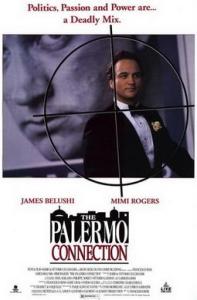
A Movie A Day #80: The Palermo Connection (1990, directed by Francesco Rosi)


Carmine Bonavia (James Belushi) is an idealistic New York City councilman who wants to be mayor.  Despite an easily understood slogan — “Make A Difference!” — his reform campaign is running behind in the polls.  Having nothing to lose, Carmine announces that he supports the legalization of drugs.  By taking out the profit motive, the Sicilian Mafia will no longer have any incentive to sell drugs in the inner city.  Carmine shoots to top of the polls.  Now leading by 11%, Carmine marries his campaign manager (Mimi Rogers) and returns to his ancestral home of Sicily for a combination honeymoon and fact-finding tour.  The Mafia, realizing that Carmine is serious about legalizing drugs, conspires to frame him for the murder of a flower boy.  If that doesn’t work, they are willing to resort to other, more permanent, methods to prevent Carmine from ever becoming mayor.

The Palermo Connection is an unfairly overlooked film from Francesco Rosi, an Italian director who specialized in political controversy.  Though The Palermo Connection was sold as a thriller, Rosi was more interested in showing how organized crime, big business, government corruption, the war on drugs, and the poverty of the inner cities are all intricately connected.  When Carmine arrives in Palermo, Rosi contrasts the outer beauty of Sicily with the desperate lives of the junkies living there.  The pace may be too slow for action movie fans but Rosi gives the audience much to think about.  This is probably the last film you would ever expect to star James Belushi but he gives a strong and committed performance as Carmine.

The Palermo Connection, which was co-written by Gore Vidal, is a good film that predates The Wire in its examination of how greed, drugs, poverty, and racism all come together to victimize the most marginalized members of society.

Shattered Politics #20: The Best Man (dir by Franklin J. Schaffner)


Best_man22234

“Does The Best Man Always Get To The White House?” asks the poster for the 1964 film, The Best Man.

Of course, nowadays, that question seems incredibly naive.  Of course the best man doesn’t always get to the White House!  Some of my friends are Republicans and some of my friends are Democrats and a lot of my friends are Libertarians but they all have one thing in common: the belief that at least half of the past 4 elections were won by the wrong man.

But, as anyone who has done their research can tell you, 1964 was a far different time from 2015.  In general, people had greater faith in both government and their elected leaders.  Ineffective leaders and corrupt authority figures were viewed as being the exception as opposed to the rule.  We’re a lot more cynical now and, when we see political movies from the early 60s, all of that optimism and idealism often make them feel very dated.

Another big difference between the middle of the 20th Century and today is that, when it came to presidential nominating conventions, there was actually the potential for some suspense regarding who would win the nomination.  Occasionally, it took more than one ballot for a candidate to be nominated.  Last minute deals often had to be made and convention delegates were actually selecting an ideology along with a candidate.  Political conventions were contests and not coronations.

Again, it’s obvious that times have changed and, as a result, a film like The Best Man, which may have seemed very provocative and shocking in 1964, feels a bit like an antique today.  That doesn’t mean that it’s a bad film.  In fact, The Best Man is an interesting time capsule of the way things used to be.

The Best Man takes place at a presidential nominating convention.  The party is not specified but it feels like a Democratic convention.  There are several candidates competing for the nomination but the two front-runners are former Secretary of State William Russell (Henry Fonda) and Senator Joe Cantwell (Cliff Robertson).

Much like the character that Fonda played in Advise & Consent, Russell is an intellectual, a calm and rational liberal. Much like Spencer Tracy in State of the Union, Russell is separated from his wife (Margaret Leighton) but the two of them are pretending to be a happy couple for the sake of the campaign.

Meanwhile, Joe Cantwell is a paranoid and ruthless opportunist, a former war hero who will do anything to win.  The only person more ruthless than Joe Cantwell is his brother and campaign manager, Don (Gene Raymond).

(For those who enjoy history, it’s interesting to note that John F. Kennedy was a war hero-turned-senator who had a ruthless brother who doubled as his campaign manager.)

Both Cantwell and Russell come to the convention hoping to get the endorsement of former President Art Hockstader (Lee Tracy).  While the pragmatic Hockstader cannot stand Cantwell personally, he also views Russell as being weak and indecisive.

However, both Russell and Cantwell have secrets of their own.  When Cantwell discovers Russell’s secret and threatens to leak it, Russell has to decide whether or not to reveal Cantwell’s secret.

The Best Man was based on a stage play by Gore Vidal and the actual film never quite escapes its theatrical origins.  And, in many ways, it feels undeniably dated.  But it’s still a well-acted film, one that will probably be best enjoyed by political junkies and students of history.  Before watching the movie, be sure to read up on the 1960 presidential election and then see if you can guess who everyone is supposed to be.

What Lisa Marie Watched Last Night: Myra Breckinridge (dir. by Michael Sarne)


Last night, as I struggled to get some sleep, I ended up turning on the television to HBO and watching a truly infamous film — 1970’s Myra Breckenridge.  Based on a novel by Gore Vidal (a writer that I generally have little use for), Myra Breckinridge is infamous for being one of two X-rated film released by 20th Century Fox in 1970.  (The other one was Russ Meyer’s Beyond The Valley of the Dolls.)

Why Was I Watching It?

Because I’ve read a lot of books devoted to “the worst films ever made.”  And all of them mention 1970’s Myra Breckinridge as being one of the worst ever made.  And having seen the film, I can say that they’re right.

What’s It About?

Well, that’s a good question.  Okay, there’s a bisexual film critic named Myron Breckinridge (played by an actual film critic named Red Reed).  Myron gets a sex change operation from a pot-smoking doctor played by John Carradine.  “It won’t grow back,” Carradine warns him.

Next thing you know, Myron is Myra and is now being played by Raquel Welch.  Pretending to be Myron’s window, Myra goes to the acting school that is run by Myron’s uncle Buck (John Huston) and ends up falling in love with an acting student (played, pretty badly in her film debut, by Farrah Fawcett).  Unfortunately, Fawcett’s in love with a cowboy from Oklahoma so Myra ends up anally raping the cowboy with a big dildo.

Oh, and a 70 year-old Mae West in the film for some reason.  She plays a talent agent. 

It all sounds a lot more interesting than it actually is.

What Worked?

Nothing.  Just in case I’m not being clear, allow me to clarify: Nothing.  Seriously, this may indeed be the worst movie I have ever actually sat through.  What’s said is that it didn’t even work on a “so-bad-its-good” level.  I love trashy film but Myra Breckinridge isn’t really interesting enough to be trashy.  It’s just an amazingly boring film that thinks it’s about sex. 

I’ve also read some who have claimed that this film, bad as it is, has a certain camp appeal.  And, if you’ve never actually seen a campy film, you might think that Myra Breckinridge is camp.  However, camp is not boring.  Myra Breckinridge is.

Actually, there is one scene that has an odd, “you’ve-got-to-see-this-crap” appeal to it and here it is.  Mae West sings “Hard to Handle.” 

What Doesn’t Work:

The entire freaking film.  Seriously.  I mean, I don’t even know where to begin or what specifically to point out because, if you simply take this film’s failings on a problem-by-problem basis, it creates the false impression that the film is somewhat watchable. 

Okay, here’s a few things that I simply will not be able to live with myself if I don’t take a few moments to be a bitch about:

1) There’s a lot of bad movies that are distinguished by interesting or, at the very least, watchable performances.  It’s as if the actors realize that they’re going to go down with the ship unless they bring something new to the film.  (Meanwhile, so-called great films feature some of the worst performances this side of Avatar…)  Unfortunately, Myra Breckinridge is not one of those films.  The cast alternates beyond going insanely overboard (like John Huston and Rex Reed) to delivering their lines with a dull contempt that seems to be directed as much at us as at themselves (like Raquel Welch.)

By the way, Raquel Welch is actually one of my favorite of the old school film stars.  For me, she’s a bit of a role model, a strong Latina who never felt the need to apologize for being both a sex symbol and an intelligent, succesful woman.  But Welch really does give a pretty bad performance here.  Then again, I would argue that she gives the material exactly the amount of effort it deserves.

2) As bad as the cast is, no one is as terrible as Mae West.  The 70 year-old West came out of retirement to play her role here.  Anyway, it’s hard to understand why she’s in this film.  At one point, when she meets a 6’7 actor, she says she’s only concerned with the seven inches.  Now, imagine this being said by your great-great-great-grandma and you have some idea what it’s like to watch her performance here.

3) This film was made in 1970 and it attempts to be all counter-cultural by having “hippies” wandering around in the background.  As well, we get a lot of hard-hitting political satire.  By that, I mean that various fat men in cowboy hats pop up and complain about “smut” and “nudity” in the movies.  I guess the audience is supposed to go, “Oh my God, they’re talking about movies like this!”  It’s for this reason that I think that Myra Breckinridge is actually secretly meant to be a piece of right-wing propaganda.

4) Finally, for no real reason, clips from old 20th Century Fox films are littered throughout the film, popping up randomly to…well, I was going to say “comment on the action,” but few of them manage to do that.  Basically, it works like this: you see Raquel Welch anally raping a man with a dildo.  And then you see a clip of Stan Laurel for a few seconds.  Then, you’re back to Raquel anally raping the man.  Suddenly, there’s a clip of Claudette Colbert smiling.  Suddenly, Raquel’s back and she’s still anally raping the man.  And by the way, I’m not just making this up so I’ll have an example.  This is what actually happens in the film. 

5) And again, allow me to clarify that this film — which features Raquel Welch using a dildo to anally rape a man — is still one of the most boring things ever made.

6) “Okay,” you’re saying, “if you hated it so much then why did you sit through the entire freaking movie, Lisa?”  I did it because, once I start watching a movie, I can’t stop watching until it ends.  That’s my addiction.  That’s my curse.  That’s a duty that I’ve proudly accepted as a film lover.  And not even Myra Breckenridge is going to keep me from doing my duty.

“Oh my God!  Just like me!” Moments:

Yes, I know that this is where I traditionally offer up some sort of teasingly vague comment about my first year at college or where I admit that I’m scared of dogs, heights, swimming, and the area directly behind the television.  And you would be justified in thinking that a film that claims to celebrate sexual freedom and bisexuality would give me the perfect excuse to be all sorts of TMI.

But you know what?  There were absolutely no “Oh my God!  Just like me!” TMI moments in Myra Breckenridge because there was not one single moment that, in any way, rang true or seemed to possess any sort of insight about…well, about anything.  For an X-rated film that was specifically about sexuality, Myra Breckinridge left me as dry as the Sahara.

So, sorry — for the first time, I can say that I watched something that had absolutely no “OMG!  Just like me!” moments.

Lessons Learned:

I will watch anything.

Now Playing: The Disco Love Theme From Caligula


When the infamous epic Caligula was first released back in 1979, a disco version of Caligula’s love theme — We Are One — was also released as a promotional gimmick.  If you’ve sat through the behind-the-scenes footage on the Caligula Imperial Edition DVD, this song has probably been forever branded on your brain.

And that’s not necessarily a bad thing.

This song is so over-the-top, so blatantly exploitive, so insidiously catchy, and so totally inappropriate for the film it was written for that it simply cannot be ignored.  To me, this song represents everything that makes the Grindhouse great. 

(As well, I hope whoever was playing bass got paid extra…)

While we’re on the subject, I’m also going to include the opening credits of Caligula because I’ve always liked the use of Profokiev’s Romeo and Juliet.

(I also love the fact that the screenplay is credited as being adapted from a script by Gore Vidal yet no one is given credit for doing the adapting, the editing is credited to “the production,” and director Tinto Brass is credited with “principal photography.”)