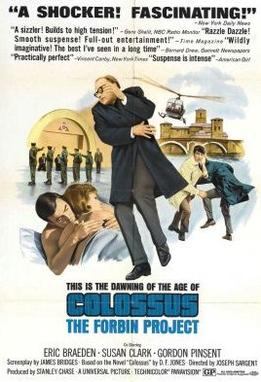
Colossus: The Forbin Project (1970, directed by Joseph Sargent)


Deep in a complex that is hidden away in the Rocky Mountains, Dr. Charles Forbin (Eric Braeden) has put together and programmed a computer called Colossus.  A super computer, Colossus has been designed to control the nuclear arsenal of the United States and its allies.  Colossus will not only keep America safe but it was also remove the chance of human error or human hesitation.  No longer will two men sitting in a silo with a key have to make the decision whether to obey the orders coming from the commander in chief.  No longer will people have to make the split-second decision that could plunge the world into war.

To Forbin’s surprise, the Soviet Union has developed their own super computer, called Guardian.  Colossus asks to be “linked” to Guardian and the Russians agree to allow it as a gesture of good will.  What no one realizes is that both computer systems have become sentient and that they soon decide that humans cannot be trusted to not destroy themselves and the planet.  To Forbin’s horror, Colossus starts to take over the world.

Based on a novel by Dennis Feltham Jones, Colossus was originally filmed in 1968 but it wasn’t released until 1970.  The film looks dated with its gigantic computer but it feels prophetic with its storyline about an AI taking over the world and deciding that it knows better than its makers.  Director Joseph Sargent adroitly mixes science fiction with Bond-style intrigue as Charles Forbin tries to reason with his creation and both the CIA and the KGB try to take down the computers.  The film even tosses a bit of 70s-style paranoia, with both the American and the Soviet governments trying to keep the public from discovering that the supercomputers are trying to take over the world.

Colossus: The Forbin Project is an intelligently written and thought-provoking science fiction film.  Eric Braeden does a great job as Charles Forbin, the engineer who goes from being arrogant and cocky to desperate to finally defiant as his creation slips out of his control.  William Schallert, so often cast as a nice father figure, turns in a good performance as the head of the CIA as does Susan Clark, cast as a colleague who has to pretend to be Forbin’s mistress just so she and Forbin can talk and plot without being monitored by Colossus.

Colossus is a smart sci-fi film that is more relevant than ever.

Late Night Retro Television Review: Friday the 13th: The Series 3.9 “Femme Fatale”


Welcome to Late Night Retro Television Reviews, a feature where we review some of our favorite and least favorite shows of the past! On Fridays, I will be reviewing Friday the 13th: The Series, a show which ran in syndication from 1987 to 1990. The entire series can be found on YouTube!

This week, Micki finds herself trapped in a movie!

Episode 3.9 “Femme Fatale”

(Dir by Francis Delia, originally aired on November 20th, 1989)

In an isolated mansion, former film director Desmond Williams (Gordon Pinsent) lives with retired actress Lili Lita (Kate Reid).  Lili is sick and bed-ridden now but, when she was younger, she starred in all of Desmond’s noir melodramas.  Desmond still enjoys watching their old films, particularly one in which Lili played a doomed femme fatale named Glenda.

Unfortunately, Desmond’s copy of the film is cursed.  Whenever he watches it, he has to watch with a young woman who will suddenly find herself switching places with Glenda.  Glenda is allowed to live in the real world until her unfortunate replacement is killed in the film.  Desmond is overjoyed to have Glenda come into his world.  Glenda, however, is more than little frustrated by the fact that she always has to return to the movie.

When Micki shows up to try to retrieve the cursed film, she ends up trapped in the movie.  Micki, however, is a bit more creative than Desmond’s other victims and continually tries to change the script, just to discover that the black-and-white characters around her are always going to do the same thing no matter what.

Meanwhile, Jack and Johnny show up and try to rescue Micki.  While Glena explores the real world and even drops in on a showing of one of her old movies, Lili ends up shooting Desmond and then willfully taking Micki’s place in the movie.  Micki returns to the real world.  Lili dies in the film.  Gloria burns up into nothingness.  With Desmond dead, Gloria is now forever trapped in the film.

This was a good episode.  When it started, I thought Desmond was going to turn out to be one of the quasi-sympathetic villains who was using a cursed object in an effort to help someone else.  But, as the episode progressed, it becomes obvious that Desmond didn’t really love Lili.  Instead, he loved the character that he created for her to be.  He loved the imaginary femme fatale but not the real-life woman who played her.  As well, the scenes inside the film were handled with a lot of wit and style.  I enjoyed watching Micki trying to disrupt the film’s story.  As much as I miss John D. LeMay’s Ryan, his absence really allowed Robey to come into her own during the third season.

Friday the 13th could be an uneven show but this episode was definitely a triumph.

Retro Television Reviews: Quarantined (dir by Leo Penn)


Welcome to Retro Television Reviews, a feature where we review some of our favorite and least favorite shows of the past! On Sundays, I will be reviewing the made-for-television movies that used to be a primetime mainstay. Today’s film is 1970’s Quarantined! It can be viewed on YouTube!

The John C. Bedford Clinic sits atop a cliff overlooking the ocean.  Though it may be a small hospital, it’s also widely respected.  The clinic was started by John Bedford (John Dehner) and the majority of its employees are related to him.  His three sons — Larry (Gary Collins), Bud (Gordon Pinset), and Tom (Dan Ferrone) — are all doctors and they all work at the clinic.  Bud’s wife, Margaret (Susan Howard), is a psychologist and she also works at the clinic, encouraging the older patients not to give up hope in their twilight years.  John Bedford is a stern taskmaster and his youngest son, Tom, resents always having his father and his older brothers staring over his shoulder.  John and Larry explain that they are simply treating Tom the way that they would treat any new doctor.  Tom isn’t so sure.

When the Bedfords aren’t hanging out in the tasteful ranch house that sits next to the clinic, they’re checking on their patients.  As Quarantined opens, they’ve got quite a few to deal with.  The most famous is Ginny Pepper (Sharon Farrell), a film star who has come to the clinic because she’s been suffering from back pain.  Larry quickly diagnoses her as suffering from kidney failure and announces that she’s going to need to get an immediate transplant.  Ginny is not happy to hear that and spends most of her time trying to make both Larry and Nurse Nelson (Virginia Gregg) miserable.  Of course, it eventually turns out that Ginny’s not so bad.

Meanwhile, Margaret attempts to cheer up a dying old man named Mr. Berryman (Sam Jaffe) and an eccentric man named Wilbur Mott (Wally Cox) hangs out in the hospital hallway.  Martha (Terry Moore) and Lloyd Atkinson (Madison Arnold) are at the hospital to visit their son, Jimmy (Mitch Vogel).  Unfortunately, while in Jimmy’s hospital room, Lloyd suddenly collapses and subsequently dies.  John takes one look at Lloyd and announces that Lloyd might have Cholera and, as a result, no one can leave or enter the hospital until the test results come back.

In other words, the John C. Bedford Clinic is …. QUARANTINED!

If you’re thinking this sounds a little bit dull …. well, you’re not wrong.  Quarantined has a 73-minute running time and a large cast but it really does just feel like an episode of a not particularly interesting medical drama.  It wouldn’t surprise me to discover that this movie was actually meant to serve as a pilot for a show that would have followed day-to-day life at the clinic.  Each member of the Bedford family is given a hint of characterization, just enough to suggest what type of situations they would get involved in on a weekly basis.  Larry was the straight shooter who was dedicated to saving lives.  Bud was the well-meaning middle child while Margaret was the one who encouraged the men to talk about their feelings.  Tom was the idealistic but impulsive youngest child.  John was the wise patriarch.  They’re all kind of boring.

The same can be said of Quarantined as a movie.  As directed by Leo “Father of Sean” Penn, the movie promises a lot of drama but it never really delivers and there’s something rather annoying about how casually John announces that no one is allowed to leave the clinic.  He even calls the police and has them set up road blocks around the clinic.  On the one hand, John is doing the right thing.  No one wants a cholera epidemic.  On the other hand, everyone’s so quick to accept that idea of John being a benign dictator that …. well, one can only imagine what a pain in the ass the Bedfords would have been during the COVID era.

As far as I know, there was never a TV show about the Bedford family and their clinic on a cliff.  Personally, I’m okay with that.  

A Movie A Day #21: A Case of Libel (1983, directed by Eric Till)


a-case-for-libelIn the 1950s, at the height of the McCarthy era, no one is more feared than Boyd Bendix (Daniel J. Travanti), an acerbic, right-wing gossip columnist.  Anyone who crosses Bendix the wrong way runs the risk of being accused of everything from sexual deviancy to communism.  Bendix’s latest victim is prominent journalist named Dennis Corcoran (Gordon Pinset).  Unlike everyone else who has been bullied by Bendix, Corcoran refuses to quietly submit.  Working with a gruff but brilliant attorney, Robert Sloane (Ed Asner), Corcoran takes Bendix to court.

A Case of Libel was made for Showtime and it is very much the type of movie that was made for teachers to show in classrooms full of aspiring Clarence Darrows.  Adapted from a Broadway play, A Case of Libel is also based on the true story of a successful lawsuit that was brought against columnist Westbrook Pegler in 1955.  A Case of Libel is basically a filmed play but is memorable for the performances of Ed Asner and especially Daniel J. Travanti.

A Case of Libel is a movie that I used to rent, on VHS, from my local video store when I was just starting to get interested in politics.  Because it was a cheap production on a cheap tape, the picture always looked terrible but I still enjoyed it.  Despite what the picture above claims, it’s never gotten an official DVD release and it probably never will be since there’s not a huge demand for old Ed Asner/Daniel J. Travanti courtroom dramas.  If it ever does come out on DVD, I’ll buy it.

Film Review: Chandler (1971, directed by Paul Magwood)


C1971chandler1handler (Warren Oates) is a former private investigator who quits his job as a security guard and gets back into the detective game.  An old friend of his, Bernie Oakman (Charles McGraw), hires Chandler to follow and protect a woman named Katherine Creighton (Leslie Caron).  Katherine is scheduled to testify against gangster John Melchior (Gordon Pinset) and Oakman tells Chandler that he believes Melchior may be planning on murdering her.  What Chandler does not know is that Oakman is being manipulated by a corrupt federal agent, Ross Carmady (Alex Dreier), who is planning on duping Chandler into killing Melchior so that Carmady can take over Melchior’s racket.  Though Chandler tries not to get emotionally involved in his cases, he ends up falling for Katherine.

In case you are keeping count, Chandler is the sixth Warren Oates film that I’ve reviewed this week.  Some of that is because TCM devoted all of Monday to showing his films but it’s also because Warren Oates was a really cool actor who died too soon and never got as much credit as he deserved.  Warren Oates combined the talent of a leading man with the face of a character actor and, as a result, he played some of the most memorable supporting roles of the 60s and 70s.  He was the tough guy who could talk a mile a minute and his upturned grin always showed up at the most unexpected of times.  Warren Oates brought humanity to outcasts and sympathy to villains.

Chandler is one of Warren Oates’s few leading roles.  Unfortunately, it’s not much of a showcase.  Director Paul Magwood and producer Michael Laughlin felt that the then-head of MGM, James Thomas Aubrey, interfered with the production of the film.  After the film’s release, Magwood and Laughlin took out a full-page, black-bordered ad in Variety that read:

Regarding what was our film Chandler, let’s give credit where credit is due. We sadly acknowledge that all editing, post-production as well as additional scenes were executed by James T. Aubrey Jr. We are sorry.

Chandler is a strange film to watch.  The plot is complicated but nothing really happens until the downbeat ending.  Much like Robert Altman’s far more successful The Long GoodbyeChandler tries to contrast the title character’s old-fashioned 1940s style and moral code with the 70s.  Chandler, who always wears a suit and drives an old car, is meant to be a man out of time.  Warren Oates does a good job, giving a Humphrey Bogart-style performance.  But since Chandler doesn’t seem to be sure what it is trying to say about either the 40s or the 70s, it’s all for naught.

Chandler is a forgettable film, one that is only worth watching for the rare chance to see Warren Oates as a leading man.

Warren Oates in Chandler

Warren Oates as Chandler