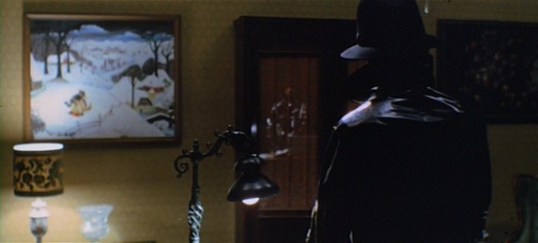
The TSL’s Horror Grindhouse: Spasmo (dir by Umberto Lenzi)


http://www.youtube.com/watch?v=uY3AIPR-Mhs

Yesterday, Italian horror fans were saddened to hear of the passing of director Umberto Lenzi.

Over the course of his long career, Lenzi worked in almost every possible genre of Italian film.  He directed spy films.  He directed westerns.  He did a few comedies.  He directed two movies about Robin Hood.  In the wake of the international success of The French Connection, he was one of the leading directors of Italian crime films.  Among fans of Italian horror, he is best known for his cannibal films and his work in the giallo genre.  He even directed the first fast-zombie film, Nightmare City, a film that very well may have served as an inspiration for 28 Days Later.  According the imdb, Lenzi is credited with directing 65 films.  Some of them were good.  Many of them, if we’re to be honest, were rather forgettable.

But none were as strange as 1974’s Spasmo.

Attempting to detail the plot of Spasmo is a challenge.   Even by the twisty standards of the giallo genre, the mystery at the heart of Spasmo is a complicated one. According to Troy Howarth’s So Deadly, So Perverse Volume Two, even Lenzi admitted that Spasmo‘s storyline made no sense.  Add to that, Spasmo features so many twists and turns that it’s difficult to judge just how much of the movie’s plot you can safely describe before you start spoiling the film.

Spasmo tells the story of a man named Christian (Robert Hoffman).  While Christian is out walking on the beach with his girlfriend, they come across a woman lying face down in the surf.  The woman is named Barbara (Suzy Kendall) and, though she declines to explain why she was lying in the middle of the beach, Christian still becomes obsessed with her.  Barbara runs off but then he just happens to run into her at a party that’s being held on a boat.  Christian may be with his girlfriend and Barbara may be with her boyfriend but they end up leaving together.  Barbara says she will make love to Christian but only if he shaves his beard.

Meanwhile, lingerie-clad mannequins are being found on the beach.

Christian ends up getting attacked by a man named Tatum.  Christian shoots Tatum but then the body disappears.  Christian and Barbara hide out at a lighthouse.  There’s another couple at the lighthouse and where they came from is never quite clear.  They say that a dead body has recently been discovered but, when Christian demands to know what they mean, they say that they’re just joking.  Later, Christian thinks that he sees Tatum walking around but, just as suddenly, Tatum’s gone.

Christian is convinced that his brother, Fritz (Ivan Rassimov) can help him.  Barbara says that there is no hope.  We know better than to trust Fritz because he’s played by Ivan Rassimov.  Possessing the best hair in Italian horror, Ivan Rassimov almost always played the heel…

Meanwhile, mannequins continue to be found on the beach.

That may sound like I’ve described a lot of plot but I’ve actually only begun to scratch the surface.  Even by the standards of Italian thrillers, Spasmo is chaotic.  The film may not make any sense but it’s never boring.  Between the mannequins and the murders, it’s pretty much impossible to follow the plot but who cares?  As directed by Lenzi, Spasmo plays out like a dream, full of surreal images and memorably weird performances.  Robert Hoffman and Suzy Kendall are ideally cast while Ivan Rassimov is wonderfully slick and enigmatic as Fritz.  Spasmo is a film that keeps you guessing.  Whether it keeps you guessing because the plot is clever or because the plot itself is deliberately designed (and filmed) to make no sense is something that viewers will have to determine for themselves.  Personally, I think it’s a little of both.

Lenzi may not have cared much for Spasmo but it’s one of his most memorable films.

4 Shots From 4 Films: Happy Birthday Mario Bava!


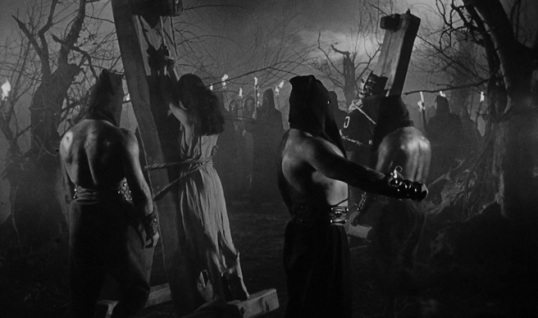
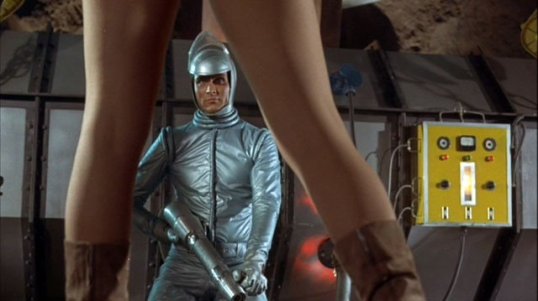
4 Shots from 4 Films is just what it says it is, 4 shots from 4 of our favorite films. As opposed to the reviews and recaps that we usually post, 4 Shots From 4 Films lets the visuals do the talking. Today is the birthday of Mario Bava (1914-1980), Italian maestro of the horror and giallo genres. Here are 4 Shots from some of my favorite Bava films:

                                                      Black Sunday (1960)

                                                          Black Sabbath (1963)

                                                          Danger: Diabolik (1968)

                                                       Lisa and the Devil (1972)

The TSL’s Grindhouse: Giallo in Venice (dir by Mario Landi)


(I know this is a boring poster but it’s literally one of the few Giallo in Venice graphics that I can post without running the risk of getting the site in trouble.)

So, I finally saw the infamous (and, in many countries, banned) 1979 film, Giallo in Venice.

Back when I first decided to learn about the history of Italian horror, Giallo in Venice was a title that I frequently came across in the course of my research.  Everyone — and I do mean everyone — seemed to agree on three points: 1) it was one of the most graphic and mean-spirited Italian thrillers of all time, 2) it had never been released on DVD or Blu-ray in the United States and, as such, it was not the easiest film to see, and 3) the film was really, really bad.

Now, I have to admit that I probably wouldn’t have had any desire to see Giallo in Venice if not for the fact that I repeatedly read that it would be next to impossible for me to do so.  I hate being told what I can and cannot do.  Don’t get me wrong.  Everything that I read about Giallo in Venice was overwhelmingly negative.  Critics, some of whom I actually respected, were nearly unanimous in their dismissal of the film.  Unlike my hope that I’ll someday see fully restored versions of Greed and London After Midnight, seeing Giallo in Venice was never a number one priority for me.  Instead, it was just something that I kept in the back of my mind.  If I ever had a chance to watch Giallo in Venice, I told myself, I would just so I could say that I had seen it.

Last week,I got that chance.  I discovered that Giallo in Venice had not only been uploaded on YouTube but it was also the uncut version.   (I’m not going to include a link because of the film’s graphic content.  I don’t want to get either this site or the people who uploaded the video in trouble.  If you go to YouTube and search for “Giallo in Venice,” it should be one of the first videos to come up.) The only problem was that, along with being copied from a faded VHS tape, it was the Russian language version.  Basically, whenever any of the film’s characters spoke, you would first hear the line in the original Italian and then a rather angry man would shout the same the line in Russian.  Unfortunately, I know very little Italian and absolutely no Russian.

Needless to say, this led to a rather odd viewing experience.  If Giallo in Venice had been directed by a visual stylist like Lucio Fulci, Dario Argento, Mario Bava, or even Ruggero Deodato, it might not have been a problem.  Those four directors are all rightly renowned for their ability to create mood and atmosphere.  (And, for that matter, the best giallo films are often more concerned with visuals than dialogue.)  Unfortunately, Giallo in Venice was directed by Mario Landi, an veteran television director whose style can best be described as “turn on the camera at the start of the scene, turn it off at the end.”

(Landi also directed Patrick Still Lives, which is a smidgen more interesting than Giallo in Venice.)

As for the film’s plot — well, it’s hard for me to say for sure.  Not to overemphasize this point but, quite literally, I COULD NOT UNDERSTAND A WORD THAT ANYONE WAS SAYING.

The film opens in Venice, with a man being stabbed to death while a woman drowns in a canal.  Inspector De Paul (Jeff Blynn) is assigned to solve the murders.  He has poofy hair that wouldn’t be out of place in a stage production of Boogie Nights and, for some reason, Inspector De Paul is constantly eating hard-boiled eggs.  In just about every scene in which he appears, he is eating an egg.  Though it was hard to judge his overall performance (though the Russian seemed to enjoy repeating De Paul’s dialogue), Jeff Blynn really got into eating those eggs.  It got rather sickening to watch after a while.  As far as I could tell, De Paul’s investigation amounted to talking to one witness and then talking to the dead woman’s roommate.

The roommate, incidentally, is played by Mariangela Giordano, who also appeared in Patrick Still Lives, Burial Ground, and Michele Soavi’s The Sect.  Any fan of Italian horror will not only recognize Giordano but will also immediately know that her Giallo in Venice character is destined meet an unlucky end.  Patrick Still Lives, Burial Ground, and Giallo in Venice were all produced by Giordano’s then-boyfriend and, in all three films, she played a character who was graphically and gruesomely killed onscreen.  In Patrick Still Lives, she was skewered by a fireplace poker.  In Burial Ground, she made the mistake of trying to breastfeed her zombiefied son.  And in Giallo in Venice, one of her legs is slowly sawed off.  Seriously, if my boyfriend insisted that I suffer a terrible death in every film that he produced, it would probably be an issue.  Just saying.

Anyway, while Inspector De Paul is investigating the murder, this young couple keeps popping up.  They’re young, rich, and fifty shades of fucked up.  Fabio (Gianni Dei) has apparently been rendered impotent by all the cocaine that he’s been snorting and the only way he can get off is by forcing Flavia (Leonara Favi) to play out all of his kinky fantasies.  I found myself wondering why the film kept switching back and forth, between the not-quite-loving couple and the murder investigation.  Was Fabio the murderer?  Then, suddenly, I realized that Fabio and Flavia were the same couple who were murdered at the start of the film.  The Fabio and Flavia scenes were flashbacks.  I’m assuming that my confusion was due to the Russian dialogue but it says something about Landi’s visual style that it was impossible to tell, just from watching, that the Flavia/Fabio scenes were meant to be flashbacks.

(As far as I can — and again, dialogue problems — the flashbacks weren’t triggered by anyone saying, “I remember one time…” or anything like that.  Add to that, most of the flashbacks only featured Fabio and Flavia so, logically, there’s no way anyone could have been telling Inspector De Paul what happened.  Instead, the flashbacks just felt like random scenes that were sprinkled in between the violence and the eating.)

Giallo in Venice is a mix of egg eating, sex, and sadism.  The graphic murders are probably what Giallo in Venice is best known for, though I have to admit that I found the constant egg eating to be almost as disgusting.  As for the film’s gore, it was just as graphic and extreme as I had previously read.  But, with the exception of what happens to poor Mariangela Giordano, the violence has no impact on the viewer.  Since Landi directs with no discernible style, there’s nothing behind the murders beyond the fact that, when you title a movie Giallo in Venice, you’re obligated to include a few deaths.  It’s violence for the sake of violence and therefore, rather boring.  Admittedly, I’m sure it was rather shocking in 1979 but, today, audiences are more used to that sort of thing.  After all, everyone’s seen that tutorial on how to be a zombie for Halloween.

While watching Giallo in Venice, it was hard not to compare it to Lucio Fulci’s The New York Ripper.  Both films are deeply unpleasant but, due to Fulci’s energetic and, at times, subversive direction, there’s at least always something going on underneath the blood-drenched surface of The New York Ripper.  You can debate whether or not he succeeded but it can’t be denied that Fulci was going for something more than just sadism when he made The New York Ripper.  (If you doubt me, read Stephen Thrower’s analysis in Beyond Terror: The Films of Lucio Fulci.)  Landi’s style, in Giallo in Venice, is so flat that there’s not only nothing going on underneath but the surface itself seems to be pretty barren too.

To give credit where credit is due, I did appreciate just how ugly Landi managed to make Venice look.  I’ve been to Venice and I absolutely love it.  I would never believe that a director could make Venice look like a dump but Mario Landi managed to do it.  I don’t know if that was intentional on his part but it actually worked for the film.  Since all of the characters actually lived in Venice, it made sense that they wouldn’t be standing around and admiring the city’s natural beauty.  Instead, they all live and operate in the parts of Venice that tourists don’t see.

Finally, Landi did manage to get one interesting shot, when the reflection of one of the victims is seen in the killer’s sunglasses.  Unfortunately, Landi was so impressed by that shot that he kept using it over and over again until, eventually, it became far less interesting.

One final note: Giallo in Venice had a very odd score.  It sounded like it was being played by a cocktail lounge jazz quartet.  The music, itself, was actually rather boring but it was so totally out-of-place that it became oddly charming.  I found myself craving a drink with a little umbrella in it.

Anyway, that’s Giallo in Venice.  It’s not good, it’s not memorable, but at least I can now say that I’ve seen it.

The Films of Dario Argento: Deep Red


I’ve been using this year’s horrorthon as an excuse to watch and review all (well, almost all) of Dario Argento’s films!  Today, I take a look at one of Argento’s best — 1975’s Deep Red!

profondo_rosso_poster

After the successful release of Four Flies on Grey Velvet in 1971, Dario Argento announced his retirement from the giallo genre.  His next film was 1973’s The Five Days of Milan, a historical comedy-drama with a political subtext.  The Five Days of Milan was a huge box office flop in Italy and, to the best of my knowledge, it was never even released in the United States.  To date, it is Argento’s most obscure film and one that is almost impossible to see.  In fact, it’s so obscure that, in two of my previous posts, I accidentally called the film The Four Days of Milan and apparently, no one noticed.

Forgotten Argento

Forgotten Argento

After the failure of Five Days, Argento returned to the giallo genre.  And while he was undoubtedly stunned by the failure of his previous film, Argento ended up directing one of the greatest Italian films of all time.  If The Bird With The Crystal Plumage and Four Flies on Grey Velvet were both great giallo films, Deep Red is a great film period.  It is Argento at his over the top best.

Now, before I go any further, I should point out that there are many different versions of Deep Red floating around.  For instance, it was released in the United States under the title The Hatchet Murders and with 26 minutes of footage cut from the film.  For this review, I watched the original 126-minute Italian version.  I’ve always preferred the original to the shorter version that was released in America.  Oddly enough, Argento has said that he prefers the shorter version.

hatchetmurders

Deep Red opens with a blast of music that both announces Argento’s return to the giallo genre and also provides some hints to his future as a filmmaker.  Whereas his previous films had all featured an excellent but rather serious score by Ennio Morricone, Deep Red was the first Argento film to be scored by Goblin.  There’s a gothic, almost operatic playfulness to Goblin’s work on the film.  (If the Phantom of the Opera had ended up working in Hollywood and writing film scores, the end result would have sounded a lot like Goblin.)  Goblin’s deafening score works as the perfect sonic companion to Argento’s constantly roving camera and vibrantly colorful images.  (The blood spilled in Deep Red is the reddest blood imaginable.)

deepred6511

Deep Red‘s protagonist is Marcus Daly (David Hemmings) and, like so many Argento protagonists, he’s both an artist and a man without a definite home.  At one point, he explains that he was born in England, grew up in America, and now lives in Italy.  He’s a jazz pianist but he supports himself by giving music lessons.  In a scene excised from the American cut, Marcus tells his students that, while classical music should be respected and appreciated, it’s also necessary to be willing to embrace art that some critics would dismiss as being “trashy.”  Marcus, of course, is talking about jazz but he could just as easily be Dario Argento, defending his decision to return to the giallo genre.

deepred4k3

While Marcus plays piano and tries to help his alcoholic friend, Carlo (Gabriele Lavia), a German psychic named Helga Ulmann (Macha Meril) is giving a lecture when she suddenly announces that someone in the audience is a murderer.  Later, Helga is brutally murdered by a gloved, hatchet-wielding attacker.

deep-red-hatchet

(Helga’s murder scene is always difficult for me to watch, even if Argento doesn’t — as Kim Newman pointed out in a review written for Monthly Film Bulletin — linger over the carnage in the way that certain other horror directors would have.  I have to admit that I also always find it interesting that Helga is played by the same actress who, that same year, would play the evil Lady On The Train in Aldo Lado’s The Night Train Murders.  Playing one of the Lady’s victims was Irene Miracle, who later co-starred in Argento’s Inferno.)

deepredscream1655_copy0_original

The only witness to Helga’s murder?  Marcus Daly, of course.  He’s standing out in the street, having just talked to Carlos, when he looks up and sees Helga being murdered in her apartment.  Marcus runs up to the apartment to help, arriving just too late.  And yet, Marcus is convinced that he saw something in the apartment that he can’t quite remember.  Deep Red is yet another Argento film that deals with not only the power of memory but the difficulties of perception.  Marcus knows that he saw something but what?

deep-red-12

Well, I’m not going to spoil it for you!  In this case, the mystery and its solution makes a bit more sense than the mysteries in Argento’s first three films.  Argento isn’t forced to resort to debunked science, like he did in both Cat o’Nine Tails and Four Flies on Grey Velvet.  One reason why Deep Red is so compulsively watchable is because, for perhaps the first time, Argento plays fair with the mystery.  After you watch the film the first time, go back and rewatch and you’ll discover that all the clues were there.  You just had to know where to look.

dr

That said, the way that Argento tells the story is still far more important than the story itself.  Argento’s first three films may have been stylish but Deep Red finds Argento fully unleashed.   The camera never stops moving, the visuals are never less than stunning with the screen often bathed in red, and Goblin’s propulsive score ties it all together.  This is one of those films from which you can’t look away.  It captures you from first scene and continues to hold you through the gory conclusion.  Deep Red is an undeniably fun thrill ride and, even today, you can easily see why Argento frequently refers to it as being his personal favorite of his many films.  In fact, Argento even owns a store in Rome that is called Profondo Rosso.

03_42

But you know why I really love Deep Red?

It’s all because of the relationship between David Hemmings and Daria Nicolodi.  Daria Nicolodi plays Gianna Brezzi, a reporter who helps Marcus with his investigation.  After three films that featured women as either victims or killers, Gianna is the first truly strong and independent woman to show up in an Argento film.  I know that some people have criticized the scenes between Hemmings and Nicolodi, feeling that they drag down the pace of the movie.  I could not disagree more.  Both Hemmings and Nicolodi give wonderful performances and their likable chemistry feels very real.

Gianna and Marcus arm westle. (Gianna wins. Twice.)

Gianna and Marcus arm westle. (Gianna wins. Twice.)

To me, that’s what sets Deep Red apart.  You care about Marcus and you care about Gianna.  Yes, the mystery is intriguing and the murder set pieces are brilliantly choreographed, and Deep Red is definitely Argento at his best.  But for me, the heart and soul of the film will always belong to the characters of Marcus and Gianna and the performers who brought them to life.

deep-red

deep-red-2

Deep Red was the start of Dario Argento and Daria Nicolodi’s long and often contentious relationship.  (Dario and Daria’s daughter, Asia Argento, was born around the same time that Deep Red was released and has directed two films, Scarlet Diva and Misunderstood, that deal with her often chaotic childhood.)  This relationship would play out over the course of six films and, as much as I love those six films, it’s always a little sad to consider that, when watched in order, the provide a portrait of a doomed and dying romance, one that did not particularly end well.  (It is possibly not a coincidence that, with the exception of Deep Red and Tenebrae, Daria Nicolodi suffered some type of terrible death in every film she made with Argento.)

But, regardless of what may or may not have been going on behind the scenes, Deep Red remains a triumph for both its director and its stars.

david-daria-dario

The Films of Dario Argento: Four Flies On Grey Velvet


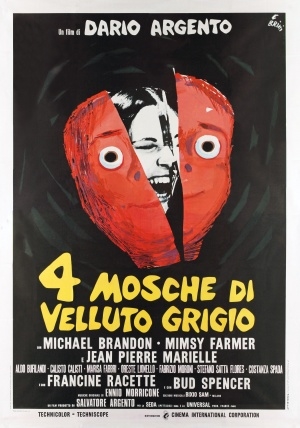
quattro_mosche

After the good but somewhat generic Cat o’Nine Tails, Dario Argento returned to form with his third film, 1971’s Four Flies on Grey Velvet.

It’s not particularly easy to describe the plot of Four Flies because, much like The Bird With The Crystal Plumage, the storyline is less important than the way that Argento tells it.  The film tells the story of Roberto Tobias (Michael Brandon), a drummer with an up-and-coming rock band in Rome.  In many ways, Roberto is a typical drummer.  He’s the guy who, even though he’s often obscured in the background, keeps things balanced.  He has a loving wife, Nina (Mimsy Farmer), a nice house, and worldly, politically woke friends who smoke weed and praise art.  Admittedly, one of those friends does tell a rather gruesome story about witnessing a beheading in Saudi Arabia which leads to Roberto having a reoccurring nightmare but otherwise, Roberto would appear to have a great life.

(Incidentally, Roberto’s nightmares are Argento at his best.)

So, why is this stable and easy-going guy suddenly being followed by a mysterious man in a suit?  And why, when Roberto confronts the man, does he discover that there’s yet another mysterious figure — this one wearing a mask — following him and taking pictures?

That’s the mystery that opens Four Flies on Grey Velvet but it’s not the only mystery to be found in the film.  In fact, this movie finds Argento at both his most macabre and his most playful.  At times, he literally seems to be seeing just how far he can push and how complicated he can make things before totally losing his audience.  The film may start with Roberto being followed and having nightmares but eventually, it comes to involve everything and everyone from Nina’s enigmatic cousin, Dalia (Francine Racette) to a beatnik named God (played by none other than spaghetti western mainstay, Bud Spencer) to a flamboyant private investigator (Jean-Pierre Marielle).  (By today’s standards, the portrayal of the gay detective has a few cringey moments but you have to remember that Four Flies On Grey Velvet was made in 1971.  It was nothing less than revolutionary for an Italian film of that era to portray an openly gay contemporary character in any type of positive light.)  To top it all off, the solution to the film’s main mystery is discovered through optography, the long-since discredited idea that an eye will “save” the last image seen before death.  It’s ludicrous but Argento pulls it off with a cheerfully over-the-top style that perfectly matches the film’s twisted plot.  After the toned down Cat o’Nine Tails, Four Flies was Argento’s way of reminding viewers of who he truly was as a filmmaker.

The film’s brilliant opening sets the tone for the entire film.  Watch it below and thank me later:

It’s rare that anyone every really discusses the acting in an Argento film.  Argento has himself admitted that he doesn’t worry much about actors and many of his films have been released in badly dubbed versions, which often makes it difficult to fairly judge any of the performances.  That said, Roberto Tobias is one of my favorite Argento protagonists and it’s all due to Michael Brandon’s performance.  Brandon makes Roberto into such a nice guy and does such a good job of capturing his descent into paranoia that it’s impossible not to get caught up in his story.  (I would even argue that the long-haired and politically concerned Roberto is almost an autobiographical stand-in for Argento himself.)  Though I can’t really explain why without running the risk of spoiling a major part of the movie, Mimsy Farmer is also excellent.  Reportedly, Argento originally wanted to cast Mia Farrow and you can imagine a post-Rosemary’s Baby pre-Woody Allen Farrow in the role.  But I’m glad that Argento couldn’t get her because Mimsy Farmer gives a close to perfect performance.

Four Flies was the third and final part of Argento’s “animal trailer,” and, at the time, Argento declared that Four Flies would also be his final giallo film.  He followed up Four Flies with The Four Days, a historical comedy that was considered to be such a failure that, after its release, Argento returned to the safety of the giallo genre and gave the world one of his greatest triumphs, Deep Red.  However, if The Four Days had been a success and Four Flies had been Argento’s final giallo film, it would have been a triumphant note to go out on.

Here’s the very misleading trailer that was used for Four Flies On Grey Velvet‘s American release.

http://www.youtube.com/watch?v=raTtFzQ1vNo

And here’s the even more obscure European trailer!

The Films of Dario Argento: The Cat o’Nine Tails


(I’m using this year’s horrorthon as an excuse to watch and review all of the films of Dario Argento.  Yesterday, I reviewed The Bird With The Crystal Plumage.  Today, I take a look at The Cat o’Nine Tails.)

gatto_a_nove_code

In 1971, Dario Argento followed up the massive success of The Bird With The Crystal Plumage with his second film as a director, The Cat o’Nine Tails.  While The Cat o’Nine Tails was another huge financial success, it’s never been as a critically acclaimed as Argento’s first film.  Argento, himself, regularly cites The Cat o’Nine Tails as being his least favorite of all of the films that he’s directed.

Much like The Bird With The Crystal Plumage, The Cat o’Nine Tails is a giallo that uses it’s rather complicated mystery as an excuse (a MacGuffin, to quote Hitchcock) for several suspenseful set pieces, the majority of which end with someone suffering some sort of terrible fate.  In this case, a series of murders are taking place around a mysterious medical complex, the Terzi Institute.  The murders are connected to some research being done at the institute.  I’m not going to spoil things by revealing what exactly is being researched but I will say that the key to the mystery is vaguely ludicrous, even by the typically flamboyant standards of the giallo genre.

But, then again, so what?  The fact that the genre’s mysteries are often overly complex and feature solutions that don’t always make sense is actually one of the appeals of the giallo film.  You don’t really watch a giallo for the mystery.  You watch it to see how the story will be told.  Perhaps more than any other genre, giallo requires a director with a strong vision.

And, if nothing else, Argento has always had a strong directorial vision.  Even when you may disagree with the choices that he makes (and I’m sure we all wonder why, in his later films, Argento grew so obsessed with telepathic insects), you can’t deny that they’re always uniquely Argento.  Though the film never reaches the delirious heights of The Bird With The Crystal Plumage, The Cat o’Nine Tails still has several strong set pieces.  There’s a sequence involving a poisoned glass of milk that I particularly appreciate.  And then there’s the long scene at the crypt, in which our two protagonists realize that they don’t really trust each other all that much.  And, of course, there’s the ending.  For a film that’s often dismissed as being lesser Argento, The Cat o’Nine Tails features one of Argento’s darkest endings.

The Cat o’Nine Tails is unique as being one of the only Argento films to regularly show up on TCM.  A lot of that is because The Cat o’Nine Tails is perhaps the least gory of all the films that Argento has made.  That doesn’t mean that there isn’t plenty of death and mayhem.  There is.  Blood is spilled but it never exactly flows.  The Cat o’Nine Tails is an Argento film that you could probably safely watch with an elderly relative.  That’s not necessarily meant as a complaint.  It’s just an observation that, when compared to the panty murder in The Bird With The Crystal Plumage or the skewering in The Mother of Tears, Cat o’Nine Tails is definitely a toned down Argento film.

The other reason why The Cat o’Nine Tails is popular on TCM is because it stars none other than that classic film mainstay, Karl Malden.  Continuing the Argento tradition of featuring protagonists who aren’t sure what they’ve witnessed, Malden plays a former newspaper reporter who is now blind.  He teams up with another reporter (played by James Franciscus, who may not have been a great actor but who did have perfect hair) to solve the murders.  Franciscus has the eyes.  Malden has the brains.  And Malden’s niece, Lori (Cinzia De Carolis), is largely present to provide the film with its final ironic twist.

Malden does a pretty good job in the role, too.  I’ve read some reviews that have complained that Malden overacts but actually, he gives the perfect performance for the material.  In fact, Malden’s unapologetically hammy performance contrasts nicely with the work of James Franciscus, which could  charitably be called subdued.  (Perhaps a better description would be dull…)

Cat o’Nine Tails may not be Argento’s best but I still like it.  If for no other reason, watch it for Malden and that wonderfully dark ending.


The Films of Dario Argento: The Bird With The Crystal Plumage


the-bird-with-the-crystal-plumage-2

Dario Argento.

The name inspires a lot of reactions.  Some people will tell you that Dario Argento is one of the greatest directors of all time.  Some people regularly cite him as being a prime example of an artist who hit his peak too early and who has spent the latter part of his career imitating his previous successes.  Some people will tell you that his films are dangerous.  He’s one of those directors whose films always seem to end up getting banned in certain communities.  Other cineastes will always praise him as a superior stylist whose influence is still felt to this very day.  Argento’s films have inspired thousands of horror filmmakers.  His films have also inspired a countless number of viewers to fall in love with horror.  Without the influence of Argento the horror genre would be not only less interesting but less profitable as well.

Myself, I’m a huge Argento fan.  Yes, I do love Suspiria but then again, everyone love Suspiria.  I have also made it a point to track down and watch the forgotten and/or critically reviled Argento films, like Trauma and The Phantom of the Opera.  My love of Argento is so strong that I usually even find myself enjoying his less acclaimed work as much as his acknowledged triumphs.  He is one of the masters of horror, a true maestro of Italian art.  For the longest time, I’ve been meaning to watch and review all 21 of Argento’s cinematic thrillers.  (Sadly, his one non-thriller, The Four Days, is notoriously difficult to see.)  With this being October, I figured why not now?

Dario Argento made his directorial debut in 1970 with The Bird With The Crystal Plumage.  Before directing his first movie, Argento had been a film critic and a screenwriter.  (Among other credits, he is listed as being one of the writers of Sergio Leone’s Once Upon A Time In The West.  Interestingly enough, his co-writer was another future director, Bernardo Bertolucci.)  With his very first film as a director, Argento established himself as a master of both suspense and horror.

I have seen some reviews that have identified The Bird With The Crystal Plumage as being the first giallo film.  That’s not at all true.  If anything, the credit for directing the first giallo should probably go to Mario Bava (who directed The Girl Who Knew Too Much in 1964) and some students of Italian cinema would even disagree with that.  However, The Bird With The Crystal Plumage undoubtedly did a lot to popularize the genre outside of Italy.

The film tells the story of Sam (Tony Musante) and his girlfriend, Julia (Suzy Kendall).  Sam is a writer and he’s living in Rome.  Argento is not traditionally known as an actor’s director but Musante and Kendall are both remarkably sympathetic in their roles and they seem to have a very real chemistry when they’re both on-screen together.  You actually do care about them as a couple and you find yourself hoping that nothing bad happens to them.  One thing that I liked was that their tiny apartment looked like it was someplace where a couple actually would live, love, and try to solve a murder.  Looking at Sam and Julia in that apartment (which is decorated with a picture of Albert Einstein and a poster reading “Black Power!”), you get the feeling that they have an existence outside of what you’re seeing during the film’s 94 minute running time.  They feel real.

Reportedly, Tony Musante and Argento did not have a great working relationship.  (Mustante was a character actor who wanted to talk about motivation.  Argento was more concerned with the technical aspects of shooting the film.)  Mustante may have been miserable but that actually works for his character.  When we first meet Sam, he’s frustrated because he’s suffering from writer’s block.  He’s so frustrated that he’s on the verge of moving back to the United States.  Sam’s frustration feels real and if that’s because Musante happened to be frustrated while shooting the film, so be it.  Whatever works.

One night, Sam goes for a walk and witnesses a stabbing in an art gallery.  Monica Ranieri (Eva Renzi) survives but it appears that her assailant has managed to escape.  The police suspect that Sam might be more than just a witness so they confiscate his passport.  Until the attacker is caught, Sam is stuck in Rome.

There’s a serial killer terrorizing Rome and both Sam and the police suspect that Monica nearly became the killer’s latest victim.  Some of the film’s most unnerving sequences are shot from the point-of-view of the killer, a technique that both leaves the killer’s identity a secret and also makes the audience complicit in the murders.  It’s as if Argento the film critic is daring the audience to consider why they’re watching what Argento the director is doing.

(And the murders in The Bird With The Crystal Plumage are brutal, even by the standards of Italian cinema.  The first murder that we actually witness — which is usually referred to as being “the panty murder,” for reasons that I’m not going to freak myself out by describing — is pure and total nightmare fuel.)

Everything that you might expect to find in a giallo is present in The Bird With The Crystal Plumage.  It may not have been the first but it’s definitely one of the prototypes for what the genre is usually considered to be.  Graphic violence, sexual perversion, point-of-view shots, a constantly roaming camera, a dramatic musical score, a killer who wears black gloves and carries a razor, a witness who has to prove his innocence, and a solution that’s revealed only when Sam reexamines what he thinks he saw; it’s all here.

What distinguishes The Bird With The Crystal Plumage is the style with which Argento tells his story.  Dario was 30 years old when he directed The Bird With The Crystal Plumage and there’s an infectious enthusiasm to the way he frames the mayhem.  Like many film critics directing their first film, Argento fills his debut with homages to earlier films.  You can tell he’s having a lot of fun while discovering just how far he can go without losing his audience.

46 years after it was first released, The Bird With The Crystal Plumage holds up surprisingly well.  It’s a nightmarish but compulsively watchable thrill ride and it remains one of Argento’s best.

Let’s Play With The Do-It-Yourself Giallo Kit!


Have I ever mentioned how much I enjoy playing with the Random Giallo Generator over at Braineater.com?  It’s a lot of fun — you just click on one link and you’re automatically given a randomly generated giallo film, complete with a properly evocative title and an intriguing plot description!  For lovers of Italian film, it’s a lot of fun.  And for writers, it can actually serve as a great way to come up with plots of your own.

I just spent a few minutes playing with the generator and here’s six of the results that I got!

Evidence of a Violent Struggle on a Frozen Landscape
Directed by
Alfredo Toretelloni

A surgeon who has been accused of a crime vanishes and is presumed dead for twenty years. A girl seems to know a little too much about the the disappearance; and after discovering an old painting, she kills the maniac in self-defense, but is mistakenly identified as the culprit and killed by a relative of the victim seeking revenge.

Three Dead on the Velvet Tapestry
Directed by
Stefano Stefani

A young nurse is found dead (presumably a suicide) in a train station. An English actor accidentally steps into the middle of the police investigation of the the murder. Despite several false leads, he must use supernatural assistance to determine the identity of the perpetrator.

Death is a Dark Figure with Teeth of Glass
Directed by
Umberto Umberti

A playwright who has been accused of a crime vanishes. A girl overhears a conversation about the disappearance. She kills the maniac in self-defense, but is mistakenly identified as the culprit and killed by a relative of the victim seeking revenge.

The Secret Lies Hidden in a Woman’s Hands
Directed by
Ruggero Ruggeri

A corrupt priest is butchered in the style of a killer who has been dead for many years. A young child believes he may have seen something that would explain the the crime. When another person is found murdered, he finds himself implicated deeper and deeper in the crime, with no apparent way out.

The Madman Screams Helplessly in a Silver Casket
Directed by
Stefano Giocomonte

An aging policewoman has her throat cut in the style of a killer who terrorized the neighborhood many years ago. Her best friend overhears a conversation about the crime; and despite several false leads, he is killed before he can solve the mystery; his mother then steps in to try to finish the investigation, only to find that the killer is in fact the policewoman, who wasn’t the real victim after all.

Your Heart is a Sphinx with One Red Eye
Directed by
Nanni Nonni

An American girl finds a human torso which has been hacked up in a church. Her father is accused of the crime. After several bloody murders, he is on the verge of solving the mystery when he is killed by the real culprits: a secret society made up of the people he most trusted.

Why not give the Do-It-Yourself Giallo Kit a try for yourself?

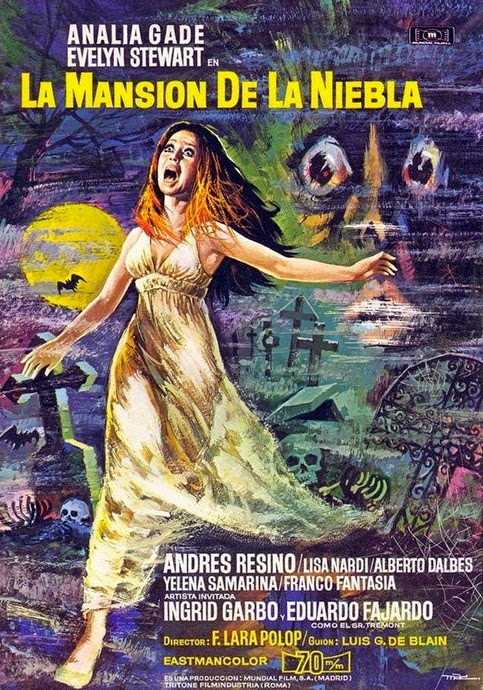
The Daily Horror Grindhouse: Murder Mansion (dir by Francisco Lara Polop)


Maniac Mansion Title

1972’s Murder Mansion (which is also known as Maniac Mansion) is an enjoyable Italian/Spanish co-production.  It’s been included in a few dozen Mill Creek box sets and it’s usually advertised as being a zombie film.  While I don’t want to give too much away about the film’s twisty plot, I do feel obligated to let our readers know that it is most definitely NOT a zombie film.  Instead, it’s an old-fashioned gothic giallo.

Murder Mansion opens with various people separately traveling across the countryside.  A few minutes is devoted to allowing us to get to know them and we quickly discover that they are all familiar giallo types.  There’s the cold businessman, the lecherous man with the beard and the driving gloves, and, of course, the free-spirited young lovers who have just met.  There’s also the emotionally unstable, Elsa (Analia Gade).

When a huge fog rolls in, Elsa is the first of the travelers to find herself stranded outside of a foreboding mansion.  She thinks she sees two shadowy figures in the fog — a woman and a hulking man dressed like a chauffeur — pursuing her.  As she runs through the fog, she runs into the young lovers, who are also similarly stranded.  They decide to seek refuge inside the mansion and … guess what?  It turns out that all the other travelers have decided to seek refuge there as well!

Well, it turns out that the mansion is looked after by a housekeeper named Martha (Ida Galli, a.k.a. Evelin Stewart).  Martha explains that the former owner of the mansion was killed years ago in an automobile accident, along with her chauffeur.  (Hmmm….)  Martha also goes on to explain that the village around the mansion is deserted because the villagers became convinced that the woman and her chauffeur were vampires.  Martha then invites everyone to spend the night.

As everyone prepares to turn in for the night, they can’t help but notice a few strange things.  First off, why is every bedroom decorated with a disturbing painting?  And why does the painting of the former, now deceased, owner of the house look so much like Martha?

As you probably already guessed, a mysterious figure soon starts to prowl around the house, killing the travelers one-by-one.  Meanwhile, Elsa continues to have her nervous breakdown and soon starts to have flashbacks to some unspeakable acts that were committed by her father…

Murder Mansion is an enjoyable little giallo, one that is full of creepy atmosphere, twisty plot developments, and memorably strange characters.  It’s actually a lot of fun to watch as our heroes creep around the mansion and try to put together all of the clues.  (It made me want to go out and solve mysteries!)  As far as blood, gore, and nudity are concerned, Murder Mansion is actually remarkably tame by the standards of Italian (and, for that matter, Spanish) thrillers, which makes it an appropriate introduction to the genre for people who may not have previously seen a lot of giallo films.

(Trust me.  I tried to introduce my aunt to giallo by showing her Mario Bava’s Bay of Blood and she made me stop the movie after the double impalement.  If I had been smart, I would have started with Murder Mansion and then worked my way up.)

All in all, Murder Mansion is a lot of fun and great Halloween treat!

Horror Film Review: Delirium (dir by Lamberto Bava)


Delirium1987

“I warn you, the hate of a woman can be very bad!” 

— Dialogue from Delirium (1987

The 1987 Italian film Delirium is an odd combination of soapy melodrama and giallo horror.  Someone is murdering models and taking pictures of their corpses.  Some other people are plotting to take over a magazine.  Obscene phone calls are received.  Recorded taunts are heard.  Oh, and one unlucky model is attacked by a swarm of bees.

That’s right — Delirium is the first and probably the only giallo to feature bees used as a deadly weapon.

Gioia (Serena Grande) is a former prostitute-turned-model-turned-men’s-magazine-publisher.  When we first meet Gioia, she’s sitting out at her pool and watching a photo shoot.  Her neighbor — a teenage boy who is confined to a wheel chair — calls her.

“You make my member hard with desire!” he tells her, “It wants to penetrate your flower and explode!”

Gioia calmly tells him to stop bothering her and then hangs up on him.  And really, this scene pretty much establishes everything that we need to know about Gioia.  She is a successful businesswoman who is just as comfortable dealing with the pervert next door as she is making high power deals.  You think Donald Trump’s ruthless?  Well, he’s got nothing on Gioia!

The other thing that you notice about Gioia is that she has an extremely voluptuous figure.  There’s not a single scene that isn’t shot to emphasize that fact and yet, the unapologetic pride that Gioia (and actress Serena Grande) took in her body was actually very empowering and one of the better aspects of the film.  Far too often, movies associate being busty with either being stupid or slutty and women are told that they have to hide their figure to be taken seriously.  (Traditionally, in horror films, it seems like the bigger an actress’s cup size, the less likely she is to survive until the end of the film.)  Speaking as someone who shares Gioia’s struggle, I was happy to see a woman with big boobs being portrayed as both an intelligent businesswoman and a tough, strong survivor.

Gioia has more than just the pervert next door to deal with.  There’s also the fact that her models are being murdered and she’s receiving photos of their dead bodies in the mail.  Who is killing Gioia’s employees?  Could it be a rival publisher (played by Capucine)?  Could it be Gioia’s neurotic assistant (played by Daria Nicolodi)?  Could it be George Eastman, who plays Gioia’s former lover?  Actually, it’s made pretty clear that it’s not George Eastman, which is odd when you consider how many movies have featured Eastman as a killer.  (Eastman and Grandi also co-starred in the infamous cannibal epic Anthropophagus, in which Eastman was the killer and Grandi was the center of one of the most infamous scenes in the history of Italian horror.)  Or could the killer by the pervert next door?

As is typical of films in the giallo genre, most of the murders are filmed from the killer’s point of view.  What’s interesting is that, when the killer looks at his victims, he literally sees them as twisted monsters.  It’s a neat little technique that leads to scenes like this:

Delirium-1

Delirium was directed by Lamberto Bava, who has never quite gotten the attention that he deserves.  Despite the fact that he directed such classics as the two Demons films and A Blade In the Dark, I’ve always felt that Lamberto is often overshadowed by the achievements of his father, Mario Bava.  However, Lamberto Bava’s films are almost always entertaining when taken on their own terms.  Delirium may not reach the heights of A Blade In The Dark or even Demons but it’s still an entertaining giallo.  It’s perhaps not the film to use to introduce a newcomer to the genre but, those of us who are familiar with giallo, Delirium is an enjoyably crazed offering.

fotodigioia7