Today, I present to you one of the most important films in horror history. Though it wasn’t appreciated when it was first released back in 1964, The Last Man On Earth was not only the 1st Italian horror film but George Romero has also acknowledged it as an influence on his own Night of the Living Dead.
It’s easy to be a little bit dismissive of The Last Man On Earth. After all, the low-budget is obvious in every scene, the dubbing is off even by the standards of Italian horror, and just the name “Vincent Price” in the credits leads one to suspect that this will be another campy, B-movie. Perhaps that’s why I’m always surprised to rediscover that, taking all things into consideration, this is actually a pretty effective film. Price does have a few over-the-top moments but, for the most part, he gives one of his better performances here and the black-and-white images have an isolated, desolate starkness to them that go a long way towards making this film’s apocalypse a convincing one. The mass cremation scene always leaves me feeling rather uneasy.
The film is based on Richard Matheson’s I Am Legend and no, it’s nowhere as good as the book. However, it’s still a worthy adaptation and one that stays true to the tone of the text, including the fact that Price’s main tormenter was also once his neighbor and best friend. This is one of those films that just hits differently in the wake of 2020’s COVID hysteria.
And now, it’s time for The Last Man On The Earth….
Kill, Baby…. Kill!, Mario Bava’s 1966 masterpiece, opens at the turn of the 20th Century.
In a small German village, a woman named Irena Hollander (Mirella Panfili) runs up a set of stairs at an abandoned church. From the bell tower, she either falls or deliberately jumps and crashes into the sharp spikes of the gate below. Agck! Falling from that high of a spot is bad enough without then landing on a gate and getting pierced by several sharp points at once. Making it even more disturbing is that it’s suggested that the spikes don’t instantly kill Irena. It’s a grotesque and disturbing image, shown to us in bright color. It’s death as pop art. It’s the sort of thing that only Mario Bava could have paid off.
Dr. Paul Eswai (Giacomo Rossi Stuart) is summoned to the village by Inspector Kruger (Piero Lulli). Kruger suspects that Irena may have been intentionally pushed and he wants Paul to conduct an autopsy. However, the superstitious townspeople say that her body must be buried immediately and Paul and Kruger actually have to rush out to the local cemetery to prevent the Irena from being buried. The gravediggers warn Paul and Kruger that they will be bringing a curse on themselves by not burying Irena. Paul and Kruger don’t listen. At the autopsy, a local medical student named Monica (Erika Blanc) is assigned to serve as the witness. Paul discovers that a silver coin has somehow been embedded in Irena’s heart.
Paul discovers that the villagers live in fear of the ghost a little girl. They claim that if you see the girl, that means you are cursed to die. Paul, being a man of science, is skeptical. When the daughter of the local innkeeper becomes horrified after saying that she has seen the little girl, Paul is critical of the treatment offered up by her superstitious parents. (That treatment include a chain of leeches — agck!) Meanwhile, Kruger goes to the estate of the mysterious Baroness Graps (Giovanna Galletti) and disappears! It soon becomes clear that the key to mystery lies in the estate of the Baroness and her past. Karl (Luciano Catenacci), the burgomaster, knows the secret of the Baroness but soon, he finds himself being targeted by the little girl.
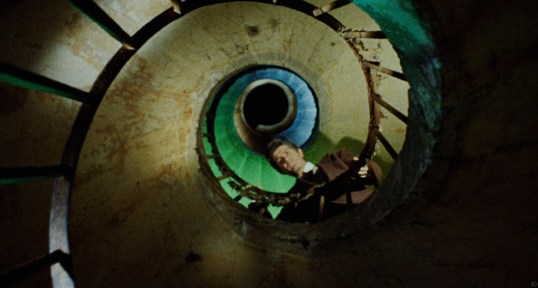
Maria Bava is a director who has been cited as an influence by everyone from David Lynch to Martin Scorsese and Kill, Baby…. Kill! is his masterpiece, a work of horrific pop art that is full of atmosphere, creative use of color, and an intentionally surreal style of plotting that makes the film less a standard story and more of a filmed nightmare. Towards the end, as Paul pursues the ghost of the little girl, an overhead view of a special staircase, lit in blues and greens, brings to mind Hitchock’s Vertigo while the village itself feels as if it could have been transported over from a Hammer horror film. Paul is a man of science and the villages are people of superstition and, in the end, both seem to be equally destructive. Paul is too quick to dismiss the old traditions while the villagers are too quick to put their faith in herbs and incantations. Bava creates an atmosphere in which everyone seems to be equally doomed.
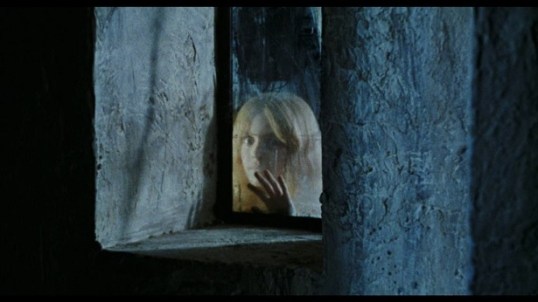
Of course, the main reason why Kill, Baby…. Kill! works is because that little girl (played by Valerio Vali, about whom little is known) is absolutely terrifying. When she suddenly shows up at a window and stares straight at her latest victim, it’s a true jump scare. She had an intense stare but, even worse, she seems to be so happy after she’s cursed someone. The true horror is that she can basically pop up anywhere. It doesn’t matter if you’re a good person or a rational person or someone who doesn’t even believe in ghosts. Fate cannot be escaped.
Kill, Baby…. Kill! is a both a story of nightmarish horror and a love letter to pure cinema.
Hi there and Happy October 8th! For today’s treat from the ranks of horror films that have fallen into the public domain, I present to you one of the most important films in horror history. Though it wasn’t appreciated when it was first released back in 1964, The Last Man On Earth was not only the 1st Italian horror film but George Romero has also acknowledged it as an influence on his own Night of the Living Dead.
It’s easy to be a little bit dismissive of The Last Man On Earth. After all, the low-budget is obvious in every scene, the dubbing is off even by the standards of Italian horror, and just the name “Vincent Price” in the credits leads one to suspect that this will be another campy, B-movie. Perhaps that’s why I’m always surprised to rediscover that, taking all things into consideration, this is actually a pretty effective film. Price does have a few over-the-top moments but, for the most part, he gives one of his better performances here and the black-and-white images have an isolated, desolate starkness to them that go a long way towards making this film’s apocalypse a convincing one. The mass cremation scene always leaves me feeling rather uneasy.
The film is based on Richard Matheson’s I Am Legend and no, it’s nowhere as good as the book. However, it’s still a worthy adaptation and one that stays true to the tone of the text, including the fact that Price’s main tormenter was also once his neighbor and best friend. This is one of those films that just hits differently in the wake of 2020’s COVID hysteria.
If you have 87 minutes to kill, please enjoy The Last Man On The Earth.
I think we all know the story of Sodom and Gomorrah.
As told in the book of Genesis, Sodom and Gomorrah were two of the wickedest cities in what was then the civilized world. God grew so sick of their wickedness that he decided to wipe both of the cities and all of their inhabitants out of existence. However, because Abraham’s son, Lot, was living in Sodom with his family, God sent two angels to Sodom to warn Lot. Lot tried to argue that, if he could find 10 good people in the city, Sodom should be spared. However, then the people of Sodom showed up and demanded to “know” the angels and that pretty much sealed their fate. Lot and his family were told to leave the city and to not look back while it was being destroyed. Unfortunately, Lot’s wife just couldn’t resist the temptation and she ended up turning into a pillar of salt.
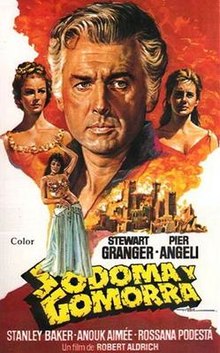
The 1962 film, Sodom and Gomorrah, recreates the Biblical story, though it takes a lot of liberties with the established narrative. Stewart Granger plays Lot. Anouk Aimee plays Bera, the decadent queen of Sodom who refuses to believe that the incoming destruction of her city is anything more than a dust storm. Pier Angeli plays Lot’s wife, who is imagined here as formerly being one of Bera’s slaves. Though she loves Lot, she loves her former life more and …. well, we all know the story. And then there’s several characters who were created specifically for the film. The most prominent of these is Astaroth (Stanley Baker), who is Bera’s scheming brother and who later is attracted to one of Lot’s daughters. The film was directed by Robert Aldrich. If you know anything about Aldrich’s filmography (Kiss Me Deadly, Twilight’s Last Gleaming, and Hustle among others), he’s not exactly the first name that comes to mind when you think of a director who you would expect to find directing a Biblical epic. And indeed, when compared to his other films, Aldrich often does seem to just be going through the motions when it comes to telling the film’s story.
Sodom and Gomorrah suffers from a problem that afflicted many Biblical epics. It takes forever to get to the good stuff. We’re all watching because we want to see the cities get destroyed and we want to watch Lot’s wife get transformed into a pillar of salt. However, this film — which has a running time of two and a half hours — takes forever to reach that point. First, we have to spend a lot of time listening to Astaroth plotting against his sister and scheming how to take over the Salt Trade, which is the source of the wealth of both of the cities. Then we spend an endless amount of time with Lot and his family wandering through the desert. There are a few good battle scenes but the film still feels dragged out. It takes forever to get to the destruction of Sodom and Gomorrah and it’s a bit of a let down when it finally does happen. The ground shakes, Dust fills the sky. Buildings start falling on people. Throughout it all, the Sodomites continue to behave wickedly, which leads to a few odd moments. (A man and a woman stop fleeing for a few minutes to make out against a wall. Naturally, the wall is the next thing to collapse.) After all of that build-up, the destruction scenes are maddeningly pedestrian.
Lot is probably one of the most interesting characters in Genesis, an imperfect man who tried to do the right thing but who often seemed to have terrible luck. Unfortunately, Stewart Granger is a bit of a stiff in the lead role and he’s never convincing as someone who could lead his people through the desert. He doesn’t have the innate authority that Charlton Heston had in The Ten Commandments. Far more successful are the performances of Stanley Baker and Anouk Aimee. Aimee, in particular, seems to being having a blast being bad. Or at least, she is until the walls come tumbling down.


 Through the Shattered Lens