That Richard Burton is today best-remembered for his tumultuous marriages to Elizabeth Taylor and for his performances in several less-than-worthy films is unfortunate as Burton was also one of the most highly regarded staged actors of his generation. In fact, late in his life, Burton often expressed regret that he had ever left the stage for films to begin with.
In 1964, Burton played Hamlet on Broadway, in a production that was directed by John Gielgud. (Gielgud also provided the voice of the Ghost.) This is a video-recording of both that production and Burton’s acclaimed performance. Burton brings an intense and almost divine madness to the role. Watching, one can see why Burton would have preferred to have been remembered for this instead of for playing Mark Antony.
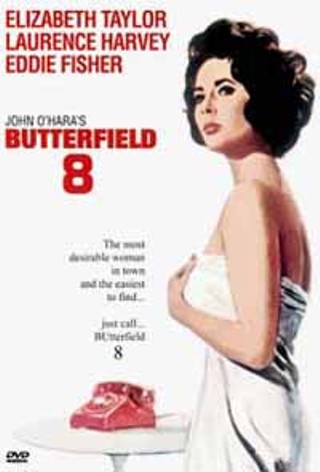
“Mama, face it,” Gloria Wandrous (Elizabeth Taylor) announces in the 1960 film, BUtterfield 8, “I was the slut of all time!”
Personally, I think Gloria is being a little bit too hard on herself. Certainly the film suggests, in its 1960 way, that she’s promiscuous and that she only sleeps with men for money but that doesn’t necessarily make her the slut of all time. For one thing, I would think that the slut of all time would have more options than just a wimpy pianist played by Eddie Fisher or a depressing, self-absorbed businessman played by Laurence Harvey.
“I still say it stinks,” Elizabeth Taylor said, almost immediately after winning her first Oscar for her performance in BUtterfield 8 and she’s kind of right. BUtterfield 8 is not a particularly good film, though not quite as bad as Taylor seemed to believe it to be.
Taylor won the Oscar after suffering a near fatal bout of pneumonia and having to undergo a tracheotomy. Along with saying that the film stunk, Taylor also often said that she only won her first Oscar because she nearly died. That may or may not be true but the thing is, Taylor’s the best thing in this overwritten and overheated mess of a movie. She certainly gives a better and more sympathetic performance than Laurence Harvey, who is cast as her married lover, Wilson Liggett. We’re meant to sympathize with Ligget but Harvey plays him as if he’s in a permanently sour mood and, after just a few minutes of listening to him bitch about every little thing, the viewer will get sick of him. It’s hard to really see what Gloria Wandrous sees in this whiny alcoholic.
Then again, the only other option that the film gives Gloria is Steve Carpenter, the pianist played by Eddie Fisher. Steve can’t decide if he’s in love with his boring girlfriend, Norma (Susan Oliver) or if he’s in love with Gloria. However, Steve has no problem letting Gloria borrow one of Norma’s dresses so that she can wear it when she goes home to visit her mother and I have to say that if I was Norma, Steve would be finding a new bed to sleep in after that. Gloria tells Steve that he needs to decide who he’s in love with but Steve jut can’t do it. Of course, in real life, Eddie Fisher left Debbie Reynolds so that he could marry Elizabeth Taylor. (A year or so later, Taylor left Fisher so that she could marry Richard Burton.)
BUtterfield 8 is one of those films that was undoubtedly considered to be daring when it was first released, seeing as how it acknowledged that people had sex without getting married first. (GASP!) Of course, though the film acknowledges that people have sex, it still makes sure to let us know that no one’s happy afterwards and that promiscuity eventually leads to death. (I mean, BUtterfield 8 may have taken risks but it still knew better than to defy the production code.) Seen today, the entire film is rather tame, talky, and slow but the star power of Elizabeth Taylor still comes through. The film opens with a lengthy sequence of Gloria getting ready for her day and, as you watch it and, more importantly, as you watch Elizabeth Taylor, you find yourself thinking that this is what a movie star is supposed to be. She dominates the film and she manages to credibly deliver even the most overheated pieces of dialogue. (Just try to imagine Jennifer Lawrence delivering the “slut of all time” line and you’ll immediately understand the difference between the movie stars of the past and the movie stars of the present. Of course, you could also say the same thing about trying to imagine a young Elizabeth Taylor in Silver Linings Playbook or The Hunger Games.) In fact, one could argue that Taylor’s performance is almost too good for the material. The film, in its 1960 way, suggests that Gloria would be better off if she just settled down but it’s impossible to imagine Taylor’s Gloria Wandrous settling for the stiffs played by Laurence Harvey and Eddie Fisher.
Though Elizabeth Taylor was correct about BUtterfield 8‘s overall quality, it’s still a good example of what star power can do for an otherwise mediocre film.
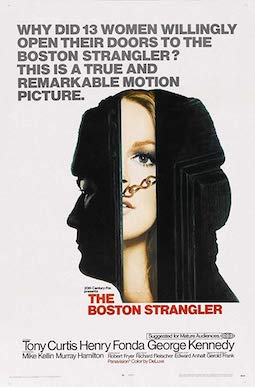
Between June 14, 1962 and January 4, 1964, 13 women between the ages of 19 and 85 were murdered in the Boston area. It was felt that they had all been killed by the same man, a monster known as The Boston Strangler. Though the police investigated many suspects, they never made an arrest. (One should remember that this was before the time of DNA testing or criminal profiling. The term “serial killer” had not even been coined. Today, sad to say, we take the existence of serial killers for granted. In the 60s, it was still an exotic concept.)
In October of 1964, a man named Albert DeSalvo was arrested and charged with being “the Green Man,” a serial rapist who pretended to be a maintenance man in order to gain access to single women’s apartments. After he was charged with rape, detectives were surprised when DeSalvo confessed to being the Boston Strangler. When confessing to the murders, DeSalvo got a few minor details wrong but he also consistently included other details that the police hadn’t released to the general public. Even when put under hypnosis, DeSalvo’s recalled those previously unreleased details. Because DeSalvo was already going to get a life sentence on the rape charges and because there wasn’t any physical evidence that, in those pre-DNA, could have conclusively linked DeSalvo to the crimes, he was never actually charged with any of the murders. Still, with his confessions, the cases were considered to be closed.
In 1966, before DeSalvo was even sentenced for the Green Man rapes, Gerold Frank wrote The Boston Strangler, a book about the murders, the investigations, and DeSalvo’s confessions. It was one of the first true crime books and, in 1968, it was adapted into one of the first true crime films.
Directed by Richard Fleischer (whose filmography somehow includes not only this film but also Dr. Dolittle, Fantastic Voyage, 20,000 Leagues Under the Sea, Conan The Destroyer, and Red Sonja), The Boston Strangler is really two films in one. The first half deals with the crimes and the police (represented by Henry Fonda, George Kennedy, Murray Hamilton, and James Brolin) investigation. This half of the film is pulpy and crudely effective, full of scenes of the cops rounding up every sex offender who they can find. There’s a scene where Henry Fonda talks to a prominent man in a gay bar that’s handled with about as much sensitivity as you could expect from a 1960s studio film. (On the one hand, the man is portrayed with respect and dignity and he’s even allowed to call out the patron saint of 1960s mainstream liberal piety, Henry Fonda, for being close-minded. On the other hand, everyone else in the bar is a stereotype and we’re meant to laugh at the idea that anyone could think that Henry Fonda could be gay.) Director Richard Fleischer makes good use of split screens, creating an effective atmosphere of paranoia. The scene where a woman tries to keep an obscene caller on the phone long enough for the police to trace his location made my skin crawl and served as a reminder that perverts predate social media. Another scene where a flamboyant psychic tries to help the police goes on for a bit too long but, at the same time, you’re happy for a little relief from crime scenes and terrified, elderly women discovering that their neighbors have been murdered.
The second half of the film features Tony Curtis as Albert DeSalvo. Curtis is effective as DeSalvo, playing him as being a self-loathing brute who is incapable of controlling his impulses. (Before committing one of his crimes, DeSalvo watches the funeral of John Kennedy, his face wracked with pain. Is the film suggesting that DeSalvo murdered to deal with the stress of life in America or is it suggesting that the hate that killed Kennedy was a symptom of the same sickness that drove DeSalvo? Or is the film just tossing in a then-recent event to get an easy emotional reaction from the audience?) As one might expect from a mainstream film made in 1968, The Boston Strangler takes something of a wishy washy approach to the question of whether DeSalvo’s crimes were due to sickness or evil. Yes, the film says, DeSalvo was bad but it’s still society’s fault for not realizing that he was bad. It’s the type of approach designed to keep both the law-and-order types and the criminal justice reformers happy but it ultimately feels a bit like a cop out. Still, the shots of DeSalvo isolated in his padding cell have an undeniable power and Curtis is both pathetic and frightening in the role. In its more effective moments, the second half of the film works as a profile of a man imprisoned both physically and mentally.
Watching the film today, it’s hard not to consider how different The Boston Strangler is from the serial killer films that would follow it. DeSalvo is not portrayed as being some sort of charming or interesting Hannibal Lecter or Dexter-type of killer. Instead, he’s a loser, a barely literate idiot who struggled to articulate even the simplest of thoughts. The cops aren’t rule-breakers or renegades. Instead, they’re doing their jobs the best that they can. Though the film ends with a title card saying that it’s important for society to make more of an effort to spot people like DeSalvo before they kill, The Boston Strangler has a surprising amount of faith in both the police and the law and it assumes that you feel the same way. It’s a film that takes it for granted the audience respects and trusts authority. It’s portrayal of the police is quite a contrast to the rebel cops who dominate pop culture today.
After the film came out, DeSalvo recanted his confessions and said that he had never killed anyone. He was subsequently murdered in prison in 1971, not due to his crimes but instead because he was independently selling drugs for prices cheaper than what had been agreed upon by the prison’s syndicate. After his death, many books were written proclaiming that DeSalvo was innocent and that the real Boston Strangler was still on the streets. Others theorized that the actual Strangler was DeSalvo’s cellmate and DeSalvo, knowing he was going to prison for life regardless, confessed in return for money being sent to his family. That said, in 2013, DNA evidence did appear to conclusively link DeSalvo to the murder of 19 year-old Mary Sullivan. Of course, that doesn’t mean that DeSalvo necessarily committed the other 12 murders. In fact, from what we’ve since learned about the pathology of serial killers, it would actually make more sense for the murders to have been committed by multiple killers as opposed to just one man.
Regardless of whether DeSalvo was guilty or not, The Boston Strangler is an uneven but ultimately effective journey into the heart of darkness.
Everyone already knows that the 1957 Best Picture nominee 12 Angry Men is a classic. We all know the film’s story — a teenage boy is on trial for murdering his family. 11 jurors want to convict. 1 juror doesn’t. Over the next few hours, that one juror tries to change 11 minds. Some of the jurors are prejudiced, some of them are bored, and some of them just want to go home. And, as the film reminds us, all 12 of them have a huge responsibility. You don’t need me to tell you that this is a great movie. Therefore, consider this to be less of a review and more of an appreciation of one of the best movies ever made.
1) The film is the feature debut of director Sidney Lumet. As any student of American film can tell you, Sidney Lumet was one of the most important directors in the history of cinema. After beginning his career in television, Lumet made his film directing debut with 12 Angry Men and he was rewarded with a much deserved Oscar nomination for best director.
2) The film’s story is actually a lot more complex than you might think. 12 Angry Men is such an influential film and its story has been imitated so many times that it’s easy to forget that the film’s plot is a lot more nuanced than you might think. Despite what many people seem to think, Juror Number 8 never argues that the defendant is innocent. Instead, he argues that the state has not proven its case beyond a reasonable doubt and, as a result, the defendant cannot be convicted. That’s an important lesson that is too often forgotten.
3) The movie celebrates the power of one person determined to do the right thing. Again, that’s a lesson that remains very relevant today.
4) As Juror Number Eight, Henry Fonda makes human decency believable.
5) As the angry and bullying Juror Number Three, Lee J. Cobb is the perfect antagonist.
6) As Juror Number Ten, Ed Begley makes Cobb seem almost reasonable. To be honest, the scene where Begley’s racist ranting causes all of the other jurors to stand up and turn their back on him feels a bit too theatrical. But it’s still undeniably effective. Alone among the jurors, Juror Number Ten is the only one without any hope of redemption. It’s a bit of a thankless role but Begley does what he has to do to make the character believable.
7) E.G. Marshall makes the wealthy Juror Number Four into a worthy opponent of Fonda without crossing the line into prejudice like Cobb and Begley. In many ways, Marshall’s role is almost as important as Fonda’s because Marshall’s performance reminds us that not all disagreements are the product of ignorance or anger.
8) As the Jury Foreman, Martin Balsam is the epitome of every ineffectual authority figure.
9) As Juror Number Seven, Jack Warden is hilariously sleazy.
10) As Juror Number Nine, Joseph Sweeney grows on you. The first time I saw the film I thought that Sweeney went a bit overboard but, on more recent viewings, I’ve come to appreciate Sweeney’s performance.
11) As Juror Number Twelve, Robert Webber is hilariously shallow. Juror Number Twelve is in advertising and Webber seems like he was right at home on Mad Men.
12) Though they don’t get as much of a chance to make an impression, John Fiedler, Jack Klugman, Edward Binns, and George Voskovec all do good work as the other jurors. If there’s ever been a film that proves the value of a great ensemble, it’s 12 Angry Men.
With the recent passing of filmmaker Sidney Lumet I’ve gone through some of the films of his I’ve come to see as favorites of mine. One film which always came to the forefront whenever I spoke about Lumet as a filmmaker is his directorial film debut in 1957 with his adaptation of 12 Angry Men. Of all his films this is the one which I always go back to time and time again. Part of me is somewhat biased in regards to this film since I was part of a class reading of the original teleplay and played the role of Juror #3.
The scene in the film which I love the most has to be when Juror #8 (played with calm assurance by Henry Fonda) and Juror #3 (played with seething rage by Lee J. Cobb) finally get into it after a very long deliberation in trying to find a consensus on the guilt or innocence of the defendant in their case. I love how in this scene everything that’s right about the American jury system was being upheld by Juror #8. How the guilt or innocence of the defendant should come down to just the facts of the case and combing through all the testimony. How emotions and personal feelings and bias should never enter the equation. It is a person’s life in their hands and it is a responsibility too great to leave it to emotions to find the verdict.
This scene also shows the darker side of the American jury system in that there will be, at times, people chosen to preside as a juror in a case will come in with emotional baggage and a hidden agenda which clouds their decision making. They don’t look at the facts and testimony at hand but at what they believe to be true no matter what the facts may say otherwise. this is how the jury system becomes twisted and becomes part and parcel to the notion that justice is never truly blind but always colored by human frailties and prejudices.
Even 54 years since the films first premiered it still holds a powerful effect on me and those who sees it for the first time. It helps that you have a master filmmaker in Sidney Lumet guiding an exceptional cast of actors. One could come to the conclusion that the audience has the angel on one shoulder with Juror #8 and the devil on the other with Juror #3. All in all, a great scene that always stays with me long after the film has ended.
 Through the Shattered Lens