If you love classic movies, you’re going to love this trailer for the new Netflix documentary, Five Came Back!
Based on Mark Harris’s brilliant non-fiction book, Five Came Back takes a look at the work that five great directors — Frank Capra, William Wyler, John Huston, George Stevens, and John Ford — did during World War II. It’s a fascinating story and it was a fascinating book. I just hope this documentary does it justice.
We’ll find out on March 31st!
(Incidentally, Five Came Back is narrated by Meryl Streep so expect to see her nominated for Best Actress next year…)
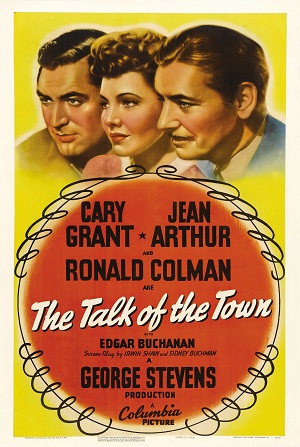
The fourth film on my DVR was the 1942 film, The Talk of the Town. The Talk of The Town originally aired on TCM on March 20th and I recorded it because it was a best picture nominee. As some of our regular readers undoubtedly know, it’s long been a goal of mine to watch and review every single film nominated for Oscar’s top prize.
The Talk of The Town is an odd little hybrid of comedy, melodrama, and a civics lecture. Michael Lightcap (Ronald Colman) is a brilliant attorney and legal professor. He’s been shortlisted for the Supreme Court and he’s also a widely read author. In fact, he’s even rented a house for the summer, so that he may work on a book. The owner of the house — teacher Nora Shelley (Jean Arthur) — will also be acting as his secretary.
As well-read as Prof. Lightcap may be, he’s also rather stuffy and out-of-touch with what’s going on outside of the world of academia. He knows how the law should work but he has little understanding of how the law actually does work. Fortunately, he gets a lesson in reality when he arrives at the house and eventually meets the gardener, Joseph (Cary Grant). Joseph turns out to be surprisingly intelligent and very passionate about politics. Lightcap and Joseph have many debates about whether or not the American legal system actually protects the working man.
What Lightcap doesn’t know is that Joseph is actually Leopold Dilg. Leopold is a labor activist, the type who you always see in old documentaries, standing on a street corner and preaching about unions. Leopold is also a fugitive. He was accused of setting fire to a mill, a fire that apparently led to the death of the foreman. Despite the fact that he loudly proclaimed his innocence, Leopold was arrested and prosecutors announced that they would seek the death penalty. Convinced that he would never get a fair trial, Leopold escaped from jail and fled to Nora’s house.
Nora and Leopold went to school together. They love each other, even though circumstances — mostly his political activism — conspired to keep them apart. When Lightcap moves into the house, Nora and Leopold’s attorney, Sam (Edgar Buchanan), hope that they can convince him to take on Leopold’s case. However, they also have to not only convince Leopold to reveal his true identity but also convince Lightcap to put his supreme court appointment at risk by defending a politically unpopular defendant. Their solution is to trick Lightcap into falling in love with Nora and then convince him to take on the case for her.
However, Nora soons finds herself falling in love with Lightcap for real. Who will she choose in the end? Cary Grant or Ronald Colman? Today, it seems like a pretty easy decision but apparently, in 1942, Columbia Pictures actually shot two different endings for the movie.
The Talk of The Town is an odd little movie. For the most part, it’s a drama. But it also has plenty of comedic elements, mostly dealing with the attempts to keep Leopold’s identity a secret. In the end, it’s a little bit too preachy to really work as either a drama or a comedy. That said, I still liked The Talk Of The Town because it made a strong case for the importance of due process, which is a concept that a lot of people take for granted.
(At the same time, The Talk of the Town was made in 1942 so you never have any doubt that Lightcap’s belief in the American legal system will eventually be vindicated. With America having just entered World War II, 1942 was not a time for cynicism. If Talk of the Town has been made in the 30s, it probably would have been a very different movie.)
Probably the best thing about Talk of the Town is the cast. It may not be a great film but, when you’ve got Cary Grant and Jean Arthur in a scene together, it almost doesn’t matter.
The Talk of the Town was nominated for best picture but it lost to Mrs. Miniver.
These are the type of questions that I found myself considering as I watched the 36th film in Mill Creek’s Fabulous Forties box set, 1941’s Penny Serenade.
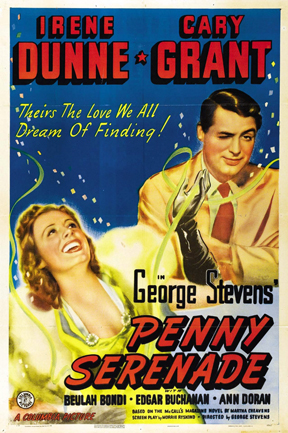
Penny Serenade opens with Julie (Irene Dunne) announcing that she’s planning on leaving her husband, Roger (Cary Grant). Fortunately, before Julie goes through with her plan, she listens to a song called You Were Meant For Me. Perhaps not coincidentally, the song is included on an album called The Story Of A Happy Marriage. As she stares at the spinning vinyl, Julie starts to have flashbacks!
No, not flashbacks of the LSD kind. (Though, interestingly enough, Cary Grant was reportedly a big fan of LSD…) Instead, she has flashbacks of her marriage to Roger. We see how she first met Roger while she was working in a music store. Roger stopped by the store to tell her that a record was skipping and it was love at first sight. However, Roger had no interest in getting married. Or, at the least, he didn’t until Julie opened up a fortune cookie and read the fortune: “You get your wish — a baby!”
Julie continues to stare at the spinning record and we discover that eventually, she and Roger did get married. Julie did get pregnant but, as the result of an earthquake, she lost the baby. (Curse you, fortune cookie! CURSE YOU!) Meanwhile, Roger took over a small town newspaper and revealed himself to have absolutely no idea how to handle money.
Because of the earthquake, Julie will never be able to have a child. (DAMN YOU, FORTUNE COOKIE! DAMN YOU FOR YOUR LIES!) However, they can still adopt! She writes to Miss Oliver (Beulah Bondi), the head of the local orphanage. Julie demands to be given a baby with “blue eyes and curly hair.” Fortunately, Miss Oliver apparently has a surplus of curly-haired, blue-eyed babies but she’s still reluctant to approve the adoption. After all, Julie is such a terrible housekeeper! However, she is impressed by how much both Julie and Roger want a baby so Miss Oliver puts aside her concerns and allows them to have a baby for two years.
At the end of the two years, Roger and Julie have to go to an adoption hearing. Unfortunately, the paper has gone out of business, the family has absolutely no money, and the fortune cookie has stopped giving advice. Fortunately, Roger is Cary Grant and who can say no to Cary Grant? Roger promises the judge that he’ll always love and take care of the baby…
But that’s not all! The movie is not over yet. And even as Roger makes his plea, we can’t help but think about the fact that this movie is being told in flashback and that present day Julie is still planning on leaving Roger. Now, I’m not going to spoil the movie by going into why or revealing what happens in the end. I’ll just say that it involves more tragedy and more melodrama. In fact, it includes so much tragedy and so much melodrama, that it starts to get a little exhausting. How much bad stuff can happen to Cary Grant!?
And the record just keeps spinning…because what goes up must come down, spinning wheel got to go round…
Over the course of his long career, Cary Grant only received two Oscar nominations. Penny Serenade was his first nomination and, as a fan of Cary Grant’s comedies, it saddens me to say that Cary’s nominated performance really wasn’t that good. Watching this film, you can tell that Cary felt that this was his chance to prove himself as a dramatic actor and, as a result, he acts the Hell out of every scene. Of course, Cary’s undying popularity comes from the fact that he rarely seemed to be acting. His charm was in how natural he was. In Penny Serenade, he never seems natural. He’s trying too hard and it’s just odd to see Cary Grant trying too hard.
If you want to see Cary Grant at his best, check out The Awful Truth. Or maybe The Philadelphia Story. Those are two great films that prove that Cary Grant was a great actor. Even a rare misfire of a performance can’t change that fact.
Until next time…
Ride a painted pony, let the spinnin’ wheel spin. … Ride a painted pony, let the spinnin’ wheel turn.
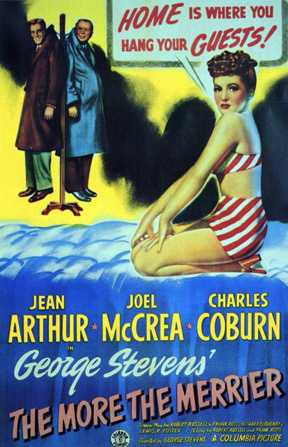
After I finished with Watch On The Rhine, I decided to watch another film from 1943. Like Watch On The Rhine, The More The Merrier is a film about life during wartime and it takes place in Washington, D.C. However, that’s all that they have in common. Whereas Watch On The Rhine was a serious and somber affair, The More The Merrier is thoroughly delightful little comedy.
The More The Merrier opens with a retired millionaire named Benjamin Dingle (Charles Coburn) arriving in Washington D.C. He’s been asked to serve as an adviser for a commission that has been tasked with solving America’s housing shortage. (This was apparently a very real concern during World War II.) However, as soon as Dingle arrives, he finds directly effected by the problem that he’s supposed to be solving. His hotel room won’t be available for two days and he has no where to stay. After a quick look through the newspaper, Ben finds an ad for a roommate.
When he arrives at the apartment, he discovers a long line of men waiting outside. They’re all in the same situation as him and are hoping that Connie Milligan (Jean Arthur) will select him for her roommate. However, Connie picks Ben, largely because he’s old and rich and she won’t have to worry about him hitting on her on like most guys nor does she have to worry about him borrowing her clothes or getting jealous of her, like she would have to with a female roommate. Connie is engaged to a boring but well-paid bureaucrat named Charles Pendergrast (Richard Gaines). She doesn’t really love Pendergrast (and he has an annoying habit of shushing her) but, after growing up poor because her mother married for love, Connie is determined to not to make the same mistake.
Ben and Connie struggle, at first, to adjust to each other’s habits. Connie keeps to an exact schedule and claims to not have any use for frivolity. Ben is the exact opposite. The early scenes of them trying (and, of course, failing) to stay out of each other’s way are hilarious, with both Coburn and Arthur giving brilliant comedic performances. (I’m jealous of how wonderfully Jean Arthur could express exasperation.) Connie’s apartment is already small and it gets even smaller once she sublets half of it to Benjamin Dingle.
However, things are about to get even more crowded. One day, while out exploring Washington, Ben runs into Joe Carter (Joel McCrea), a sergeant who has a few days before he’s scheduled to be shipped overseas and who has no place to stay. Generously, Ben agrees to sublet half of his half of the apartment to Joe. Of course, Ben does this without telling Connie.
When, after another hilarious and artfully done sequence of the three new roommates wandering around the apartment and just barely missing each other, Connie discovers what Ben has done, she orders both Ben and Joe to leave the apartment. Ben agrees to do so, if she gives him back his security deposit. Unfortunately, Connie already spent that money on a hat…
So, they’re stuck together. Connie is attracted to Joe and Joe to Connie but Connie is also determined to marry Pendergrast. (When Joe scornfully says that he bets Pendergrast combs his hair “every hour on the hour,” Connie snaps back, “Mr. Pendergrast has no hair!”) Fortunately, Ben — being older and wiser — can see that Joe and Connie are perfect for each other and he starts doing everything he can to bring the two together.
As Ben says more than once, “Damn the torpedoes! Full speed ahead!”
Jean Arthur is one of my favorite actresses of Hollywood’s Golden Age. She had this perfect “no bullshit” attitude, mixed with an unexpected vulnerability. In The More The Merrier, she’s just as credible when she’s ordering Ben and Joe to leave as when she’s breaking into tears after she catches Ben reading her diary. In the role of Ben, Charles Coburn is warm, kind, and wonderfully eccentric. (When Joe asks him what does for a living, Ben cheerfully replies, “I’m a well-to-do retired millionaire. How ’bout you?”) And then you have Joel McCrea, in the role of the “cute but dumb” Joe Carter. He’s not really that dumb but he certainly is cute. Wisely, McCrea never tries to be funny. Instead, he gets most of his laughs just by reacting to all of the craziness going on around him.
Briskly directed by George Stevens, The More The Merrier features a snappy script from Frank Ross, who was married to Jean Arthur. It’s full of hilarious lines but, at the same time, there’s an undercurrent of melancholy to it as well. Hanging, like a shadow over all of the comedy and the romance, is the fact that Joe is soon going to be shipped overseas. Even while you laugh, you’re very aware that there’s a chance he might not be coming back. That reality brings an unexpected depth to the film’s otherwise cheerful love story.
The More The Merrier was nominated for best picture but it lost to Casablanca. However, Charles Coburn did win the Oscar for best supporting actor.
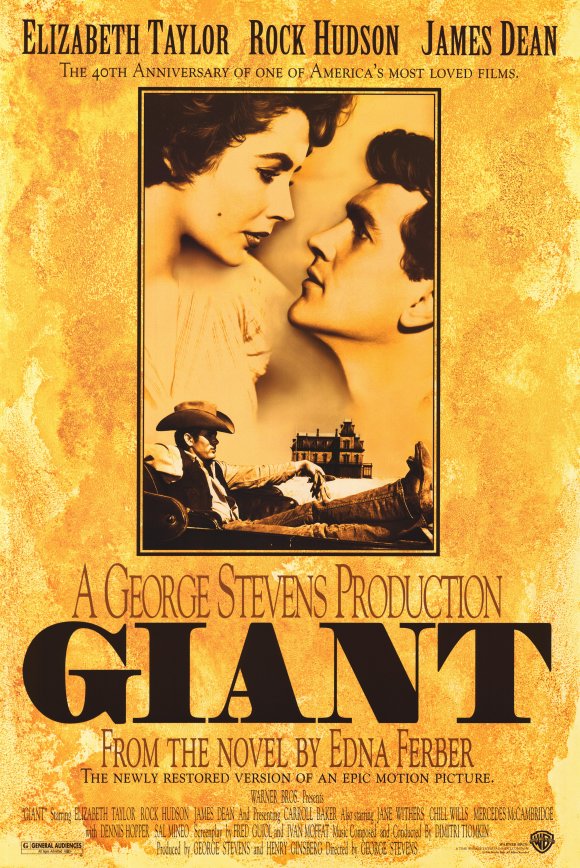
Let’s continue to embrace the melodrama by taking a look at the 1956 best picture nominee, Giant.
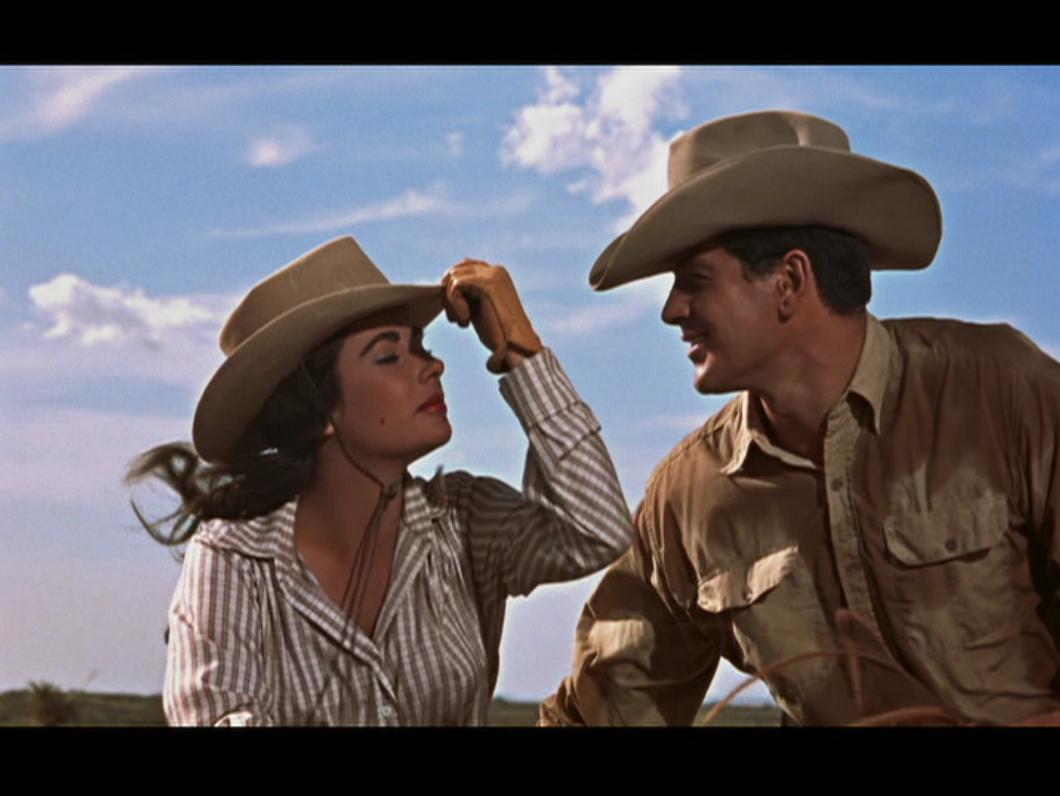
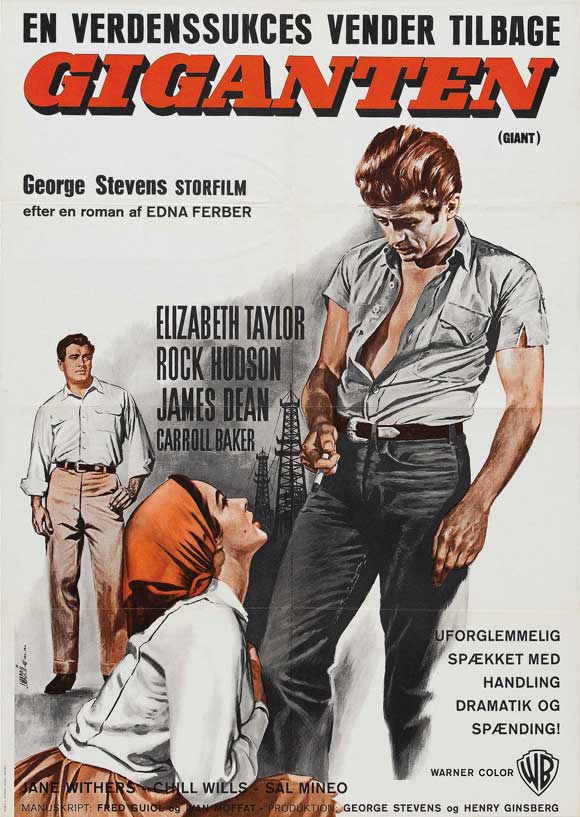
Giant is a film about my home state of Texas. Texas rancher Bick Benedict (Rock Hudson) goes to Maryland to buy a horse and ends up returning to Texas with a bride, socialite Lesley Lynnton (Elizabeth Taylor). At first, Lesley struggles to adapt to the harsh and hot Texas landscape. Bick’s sister, Luz (Mercedes McCambridge) takes an instant dislike to Lesley and Bick is annoyed by Lesley’s concern over the living conditions of the Mexicans that work on Bick’s ranch. It sometimes seems like the only person who appreciates Lesley is Jett Rink (James Dean), an ambitious ranch hand who secretly loves her and who is planning on becoming a rich man. That’s exactly what happens when oil is found on the land around Bick’s ranch. While Bick stubbornly clings to the past, oilman Jett represents both the future of Texas and the nation. Meanwhile, Bick and Lesley’s son (played by a very young Dennis Hopper) challenges his father’s casual bigotry when he falls in love with a Mexican girl.
Giant is appropriately named because it is a huge film. Clocking in at 201 minutes, Giant tells a story that spans several decades and features a big cast that is full of familiar faces, all struggling for their chance to somehow stand out from everyone else around them. Even the film’s wonderful panoramic shots of the empty Texas landscape only serve to remind us of how big the entire film is. To a certain extent, the size of Giant‘s production is to be understood. In the 1950s, Hollywood was having to compete with television and they did this by trying to make every film into a major event. You watch a movie like Giant and you practically hear the old Hollywood moguls shouting at America, “See!? You can’t get that on your precious TV, can you!?”
For those of us watching Giant today, the length is both a blessing and a curse. It’s a curse because the movie really is too damn long. The opening scenes drag and many of them really do feel superfluous. It’s hard not to feel that the real story doesn’t really start until about 90 minutes into the movie. And once the story really does get started, there’s still way too much of it for it all to be crammed into one sitting. Oddly enough, you end up feeling as if this extremely long film is still not telling you everything that you need to know. If Giant were made today, it would probably be a two-part movie on either HBO or Lifetime and it would definitely feature a lot more sex.
However, to be honest, one of the reasons that I did enjoy Giant was because it was as big as it was. I mean, the film is about Texas so of course it should be a little excessive! Everything’s bigger in Texas and that includes our movies. Add to that, Giant may be too long but it uses that length to deals with issues that are still relevant today — oil, immigration, and racial prejudice. Rock Hudson may not have been a great actor but he is at least convincing as he transitions from bigotry to tolerance.
But really, when it comes to Giant, most people are only interested in James Dean. And they definitely should be because Dean gives a great and compelling performance here. Dean brings all of the emotional intensity of the method to material that one would not naturally associate with method acting and the end result is amazing to watch. Giant was released after Dean had been killed in that infamous car wreck. I can only imagine what it must have been like to be sitting in a theater in 1956 and to see this compelling and charismatic actor towering above the world on the big screen while aware, all the time, that his life had already been cut short and he would never been seen in another film.
Even better, Dean’s new style of acting clashes perfectly with Hudson’s old style of acting, making the conflict between Bick and Jett feel all the more real and intense. Much as Bick represents old Texas and Jett represents the new Texas, Hudon and Dean represented the two sides of Hollywood: the celebrity and the artist. Needless to say, Dean wins the battle but, surprisingly, Hudson occasionally manages to hold his own.
I can’t necessarily say that Giant is an essential film. A lot of people are going to be bored by the excessive length. But if you’re a fan of James Dean or if you’re from Texas, Giant is a film that you need to see at least once.
As part of my mission to see every film ever nominated for best picture, I watched George Stevens’ A Place In The Sun this weekend. A Place in the Sun was released in 1951. It was a front-runner for best picture but in an upset, it lost to An American In Paris. (Another best picture loser that year: A Streetcar Named Desire.)
Montgomery Clift plays George Eastman, a poor man with a religious fanatic mother and a wealthy uncle. Looking to make his fortune (i.e., to find his “place in the sun), George gets a job working in his uncle’s factory and quickly starts a romance with one of his co-workers, the shy and insecure Alice (Shelley Winters). However, even as he and Alice settle down to a life of dreary romantic bliss, George discovers that the Eastman name also allows him to mingle with (if never truly belong to) high society. He meets the rich (and shallow) Angela Vickers (played by Elizabeth Taylor) and soon, he’s also romancing her. Neither Angela or Alice is aware of the other’s existence and for a while, George has the best of both the world he desires and the world in which he actually belongs. Eventually, George decides that he wants to marry Angela and become a part of her world. However, there’s a problem. Alice is pregnant and demanding that George marry her or else. The increasingly desperate George quickly decides that there’s only one way to get Alice out of his life…
A Place in the Sun was based very loosely on Theodore Dreiser’s 1925 novel, An American Tragedy. While the movie remains (more or less) faithful to the novel’s plot, director Stevens jettisons most of Dreiser’s heavy-handed Marxism and instead concentrates on the more melodramatic elements of the story. The end result is a glorious soap opera that is occasionally a bit tacky and heavy-handed but always watchable and entertaining.
Stevens is helped by the three lead performances. As Angela, a stunningly beautiful Elizabeth Taylor manages to be both calculating and clueless, seductive and innocent. As her counterpart, Shelley Winters gives a really brave performance as Alice. The film is structured that its impossible not to feel sorry for Alice. The genius of Winters performance is that she (and director Stevens) allowed Alice to become a real, flawed human being as opposed to just a symbol of victimization. However, the film is truly dominated by Montgomery Clift. Clift is in just about every scene and his own rather fragile persona translates wonderfully in the role of George. Was Montgomery Clift ever as handsome as he was in A Place In The Sun? He gives a perfect performance as the type of guy that every girl has known, the guy that we fell in love with not because of who he was but who we thought he could be. These are the guys who always end up breaking our hearts, they’re the ones who we still can’t help but think about years later, always wondering “why?”
Unlike a lot of older films, A Place in the Sun remains remarkably watchable and relevent today. Perhaps its most famous scene involves a capsized rowboat and oh my God, that scene freaked me out so much. Admittedly, a lot of that had to do with the fact that I have this morbid fear of drowning (and, like one of the characters in this film, I can’t swim) but director Stevens also does a great job building up the scene’s suspense. He makes brilliant use of sound especially, in much the same way that Francis Ford Coppola would later use that roaring train in The Godfather. Seriously, I watched that scene with my hands literally over my eyes, just taking an occasional peek until it was all over.
One last note — there’s an actor in this film who plays a detective. You’ll see him if you play the trailer at the top of the post. His big line is “You’re under arrest.” I have no idea who this actor was but he had one of the most authentic and memorable faces that I’ve ever seen in a movie, regardless of when the movie was made. He had the type of presence that reminded me why I love character actors.