Horror Review: Horror Express (dir. Eugenio Martin)


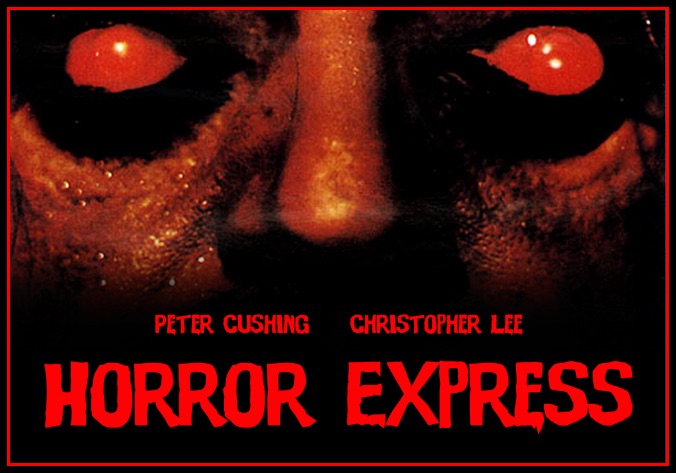
There was one film I saw when I was very young that absolutely terrified me, and even now, decades later, it still has the power to unsettle me and rob me of sleep. That film is Horror Express, a 1972 Spanish-British horror/science fiction hybrid directed by Eugenio Martín. It brought together two titans of gothic horror cinema, Christopher Lee and Peter Cushing—icons of the Hammer Films era—while also featuring Telly Savalas in a sadistic, scene-stealing turn as a volatile Cossack captain.

When Horror Express was released, the horror genre was at a fascinating crossroads. The gothic traditions popularized by Hammer Studios throughout the 1960s were beginning to fade, overtaken by the grittier, bloodier styles of filmmakers like Herschell Gordon Lewis and George A. Romero. By 1968, Romero’s Night of the Living Dead had already shifted the genre toward a darker, more nihilistic tone, paving the way for the grislier excesses that would dominate the 1970s. Martín’s film stood out precisely because it clung to the elegance and atmosphere of Hammer’s gothic aesthetic while incorporating moments of shocking violence and morbid detail. It occupied an unusual in-between space: refined in look and tone yet unnerving in its thematic brutality. Its blend of period atmosphere, science fiction paranoia, and restrained gore made it a fascinating transitional work in horror history.

The premise is simple but chilling. Aboard the Trans-Siberian Express, a British anthropologist (Christopher Lee’s Professor Saxton) transports a recently unearthed specimen—an ape-like, fossilized creature. His colleague, Peter Cushing’s Dr. Wells, becomes reluctantly entangled in the unfolding mystery. Predictably, the specimen is not what it seems; it revives and begins unleashing a series of violent attacks on the passengers. Soon it is revealed to harbor a far more terrifying, alien intelligence capable of killing and inhabiting its victims. This leads to one of the film’s most haunting sequences: the white-eyed, zombie-like corpses, drained of memories and humanity, shambling through the train corridors under the entity’s control. At eight years old, these images struck me as some of the most horrifying I had ever seen, and even today their uncanny blend of gothic atmosphere and science fiction body horror still lingers.

Viewed in retrospect, Horror Express bears a striking resemblance to John W. Campbell’s novella Who Goes There?—the basis for Howard Hawks’ The Thing from Another World and John Carpenter’s The Thing in 1982. Like those stories, it is steeped in paranoia, playing with the idea of an alien intelligence that can absorb knowledge and animate the dead. While it never attains the precision of Carpenter’s later masterpiece, it foreshadows that same blend of claustrophobia, distrust, and escalating dread.

What makes Horror Express unforgettable is its restraint. Rather than leaning on gore, it generates fear through suggestion, atmosphere, and disturbing imagery. The snowy isolation of the Trans-Siberian route reinforces the cold sterility of its alien invader, while the confined train cars become a claustrophobic prison of escalating terror. Over time, the film has slipped into the public domain, making it widely available on streaming platforms and budget DVDs. Though often overlooked in surveys of 1970s horror, it deserves recognition as one of the last great gothic horror films before the torch passed to Craven, Carpenter, and Hooper.

For me, Horror Express remains not just a childhood scare but a cinematic touchstone: a rare piece of science fiction horror bridging two eras, one that manages to terrify without relying on excess gore. It disturbed me at age eight, and even now, watching the blank-eyed corpses lurch through the dim train cars still triggers that same visceral shiver.

International Horror: The Case of the Bloody Iris (dir by Giuliano Carnimeo)


Luna, a blonde wearing a miniskirt, walks down a city street. She goes to a high-rise apartment building and is buzzed in. She doesn’t live in the building but someone who is expecting her does. She gets on an elevator, one that is full of people. One person in the elevator obviously notices when she enters. Eventually, everyone gets off the elevator, except for Luna and that one person. As the elevator approaches the top floor, Luna is suddenly stabbed to death. The murderer flees. When the elevator reaches the top floor, three residents discover Luna’s dead body….

And none of them seem to care!

Professor Isaacs (George Riguad) stares at the body, unconcerned. Miss Moss (Maria Tedeschi) makes a few judgmental comments about the victim. Mizar (Carla Brait) does, at least, scream when she finds the dead body but, ultimately, she’s more worried about how she’s going to get downstairs so that she can get to her job as a stripper/performance artist in a sleazy club.

Yes, we’ve entered giallo territory! The Italian giallo films are known for their brutal murders, stylish visuals, convoluted plots, and their black-gloved killers. However, what I always find to be most disturbing about them is that it’s rare that anyone really cares about all of the murders or the victims. Instead, giallo films are often full of bystanders who, at the most, get mildly annoyed at the idea of their day being interrupted by someone else’s murder. The typical giallo takes place in a heartless world, one where even the most grotesque scenes are often viewed with a disturbing nonchalance. That’s certainly the case with the opening of the 1972 Italian film, The Case of the Bloody Iris.

The rest of the film centers on Jennifer Langsbury (Edwige Fenech) and Marilyn (Paola Quattrini), two models who have recently been hired to star in a series of print ads for the building. They also live in the building, which would seem convenient if not for the fact that there’s also a killer on the loose who is only targeting young, single women. Even without the murders occurrin around her, Jennifer is struggling a bit getting adjusted to the world. Before becoming a model, she was a member of hippie sex cult and the cult’s leader, Adam (Ben Carra), has a bad habit of randomly showing up and demanding that she return to him. However, Jennifer is far more interested in Andrea Anitnori (giallo mainstay George Hilton), the handsome architect who built the building and who has an obsessive phobia about blood, which is going to be a bit of a problem because a lot of blood is about to be spilt.

Got all that?

The Case of the Bloody Iris is a typical, if entertaining, giallo, which means there’s a lot of sex, a lot of blood, a lot of bizarre suspects, and a few incredibly incompetent police detectives. It’s also pretty damn enjoyable, even if it doesn’t exactly break a lot of new ground as far as the genre is concerned. While director Giuliano Carnimeo never matches the visual heights of an Argento, a Bava, a Martino, or even a Lenzi, he still does a good job keeping the action moving and he shows just enough of a flair for capturing stylistic violence to make his film worthy of the genre. While the mystery itself doesn’t always make a lot of sense (which is actually to be expected when it comes to the giallo genra), The Case of the Bloody Iris features Edwige Fenech and George Hilton, two mainstays of the genre, at their best and (even though dubbed) most charismatic. It’s an enjoyable little thriller, one that’s worth the 90 minutes that it takes to watch it.

Italian Horror Showcase: A Lizard In A Woman’s Skin (dir by Lucio Fulci)


The 1971 film A Lizard In A Woman’s Skin is a story of greed, love, lust, repressed desires, bloody murder, and two rather hateful hippies.  It’s a surreal tale that manages to combine LSD, politics, therapy, and a good old-fashioned whodunit.  It’s a film that clearly a product of the late 60s and the early 70s and yet, it’s also a film that is so shamelessly sordid and wonderfully strange that it feels timeless.

And not surprisingly, it was directed by Lucio Fulci.

Over the course of his career, Lucio Fulci was credited with directing 56 films and one television miniseries.  Though we tend to primarily think of Fulci as being a horror director, he actually worked in every genre.  He directed peplums.  He was responsible for some of the best and most violent spaghetti westerns ever made.  He even directed comedies and an adaptation of Jack London’s White Fang!

Still, it is for his horror films that Fulci is best-remembered and his non-compromising and frequently surreal style was perfect for the genre.  Though 1979’s Zombi 2 is frequently cited as Fulci’s first excursion into the horror genre, he had actually dabbled in it before with a set of stylish and violent giallo films that he directed in the early 70s.

For example, A Lizard In A Woman’s Skin deals with a horrific crime and features some of Fulci’s most striking and disturbing images.  The film deals with Carol Hammond (Florida Bolkan), who is the daughter of a politician (Leo Genn) and the wife of a wealthy attorney (Jean Sorel).  Carol is haunted by bizarre dreams involving her decadent neighbor, Julia Durer (Anita Strindberg).  In her latest dream, Carol not only has a sexual encounter with Julia but also stabs her to death immediately afterward!  It’s only after Julia’s dead that Carol realizes that she’s being watched by two hippies, who appear to be amused by the whole thing.

After telling her therapist about the dream, Carol learns that Julia Durer has indeed been murdered.  In fact, she was stabbed in exactly the same way that Carol saw in her dream!  Was it just a dream or did Carol really murder of Julia?  Or did someone find out about her dream (which she recorded in her journal) and then murder Julia in order to frame her?  But who would want to do that?  Could it be maybe her weaselly husband, who is having an affair with his secretary?  Or maybe someone looking to embarrass her father?

And what about the two hippies?  It turns out that they’re real and they have a story of their own tell….

The mystery at the heart of A Lizard In A Woman’s Skin is a convoluted one and while the film’s plot did hold my interest, this film is less about the story and more about the way that Fulci tells it.  Dealing with hippies, visions, LSD, and a potentially unstable protagonist gave Fulci whatever excuse he needed to turn Lizard In A Woman’s Skin into a surrealistic carnival ride of psychedelic images and sexually-charged dream sequences.  From Carol’s nightmares to the scene where an intruder chases Carol through a sanitarium, A Lizard In A Woman’s Skin is full of strange images that are designed to keep the viewer just as off-balance as Carol.  The film’s most shocking scene — which involves Carol coming across four dogs being used in a medical experiment — actually led to Fulci and special effects artist Carlo Rambaldi being taken to court and forced to prove that the dogs in the scene weren’t real.  (Fortunately, Rambaldi brought his dog props to court with him.)  It’s a shamelessly sordid film, one from which you will not be able to divert your eyes.

Florinda Bolkan gives a great and sympathetic performance was Carol while Antia Strindberg is properly decadent as Julia.  Penny Brown and Mike Kennedy plays perhaps the most hateful and callous hippies of all time and Kennedy especially makes a strong impression.  Trust Lucio Fulci to make a film where the hippies are just as frightening as the zombies who populated his later work!

A Lizard in A Woman’s Skin is a classic giallo and one of Fulci’s best.

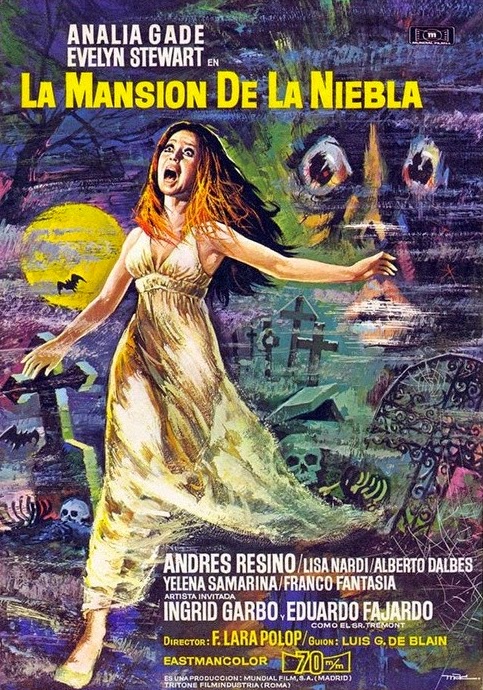
The Daily Horror Grindhouse: Murder Mansion (dir by Francisco Lara Polop)


Maniac Mansion Title

1972’s Murder Mansion (which is also known as Maniac Mansion) is an enjoyable Italian/Spanish co-production.  It’s been included in a few dozen Mill Creek box sets and it’s usually advertised as being a zombie film.  While I don’t want to give too much away about the film’s twisty plot, I do feel obligated to let our readers know that it is most definitely NOT a zombie film.  Instead, it’s an old-fashioned gothic giallo.

Murder Mansion opens with various people separately traveling across the countryside.  A few minutes is devoted to allowing us to get to know them and we quickly discover that they are all familiar giallo types.  There’s the cold businessman, the lecherous man with the beard and the driving gloves, and, of course, the free-spirited young lovers who have just met.  There’s also the emotionally unstable, Elsa (Analia Gade).

When a huge fog rolls in, Elsa is the first of the travelers to find herself stranded outside of a foreboding mansion.  She thinks she sees two shadowy figures in the fog — a woman and a hulking man dressed like a chauffeur — pursuing her.  As she runs through the fog, she runs into the young lovers, who are also similarly stranded.  They decide to seek refuge inside the mansion and … guess what?  It turns out that all the other travelers have decided to seek refuge there as well!

Well, it turns out that the mansion is looked after by a housekeeper named Martha (Ida Galli, a.k.a. Evelin Stewart).  Martha explains that the former owner of the mansion was killed years ago in an automobile accident, along with her chauffeur.  (Hmmm….)  Martha also goes on to explain that the village around the mansion is deserted because the villagers became convinced that the woman and her chauffeur were vampires.  Martha then invites everyone to spend the night.

As everyone prepares to turn in for the night, they can’t help but notice a few strange things.  First off, why is every bedroom decorated with a disturbing painting?  And why does the painting of the former, now deceased, owner of the house look so much like Martha?

As you probably already guessed, a mysterious figure soon starts to prowl around the house, killing the travelers one-by-one.  Meanwhile, Elsa continues to have her nervous breakdown and soon starts to have flashbacks to some unspeakable acts that were committed by her father…

Murder Mansion is an enjoyable little giallo, one that is full of creepy atmosphere, twisty plot developments, and memorably strange characters.  It’s actually a lot of fun to watch as our heroes creep around the mansion and try to put together all of the clues.  (It made me want to go out and solve mysteries!)  As far as blood, gore, and nudity are concerned, Murder Mansion is actually remarkably tame by the standards of Italian (and, for that matter, Spanish) thrillers, which makes it an appropriate introduction to the genre for people who may not have previously seen a lot of giallo films.

(Trust me.  I tried to introduce my aunt to giallo by showing her Mario Bava’s Bay of Blood and she made me stop the movie after the double impalement.  If I had been smart, I would have started with Murder Mansion and then worked my way up.)

All in all, Murder Mansion is a lot of fun and great Halloween treat!