18 Days of Paranoia #17: Walk East On Beacon! (dir by Alfred L. Werker)


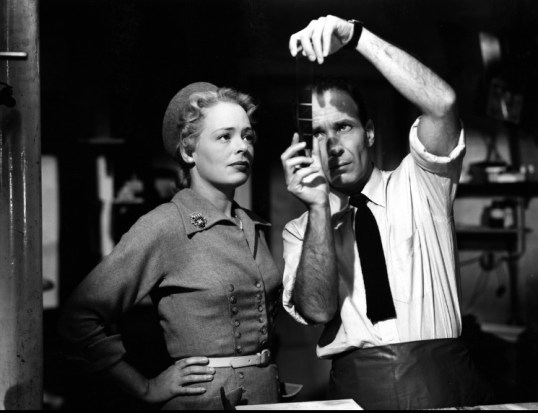
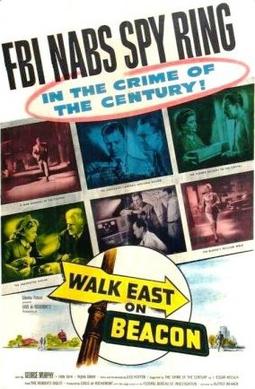
From 1952 comes Walk East On Beacon, a mix of spy thriller and film noir that highlights the efforts of the FBI to expose and take down a communist sleeper cell working right in the United States of America!  (Cue the dramatic music.)

One need only check out the opening credits to see what type of film Walk East On Beacon is going to be.  We’re told early on that the film was “suggested” by a Reader’s Digest article that was written by none other than the director of the FBI, J. Edgar Hoover. The title of that article was “The Crime of the Century: The Case of A-Bomb Spies” and it dealt with the FBI investigation that led to the arrest, conviction, and controversial execution of two Russian spies, Julius and Ethel Rosenberg.  I haven’t read the article but judging by the fact that it was written by Hoover and published in Reader’s Digest, I think it’s fairly safe to guess that it wasn’t particularly concerned with things like protecting the First Amendment, civil rights, or the freedom to hold any ideological belief regardless of how unpopular it may be with the general public.  (Of course, I would be remiss if I didn’t also point out that most historians now agree that, despite what many on the Left claimed over the decades, the Rosenbergs were indeed guilty of being spies and they played a very central role in the Russians discovering the secret to making atomic bombs.)

In the film, George Murphy plays an FBI agent named Jim Belden.  According to J. Hoberman’s book, An Army of Phantoms, the FBI specifically requested that Murphy be cast in the lead role because Murphy was an outspoken anti-communist.  (Murphy would also later be elected to the U.S. Senate.)  Project Falcon, a super-secret U.S. program, has been infiltrated by spies and Belden has been assigned to track down and capture their ringleader.  He does this by using a number of techniques that were probably considered pretty high tech back in 1952, stuff like hidden cameras and secret microphones.  He even brings in a group of lip readers to watch silent footage of two possible spies speaking so that they can tell him what the spies are talking about.  You don’t have to worry about a thing with Jim Belden on the case!

As for the members of the spy ring, they’re a mixed bunch.  Some of them are just bad people who have betrayed their country just because it’s the evil thing to do.  Others are people who idealistically joined the Communist Party years ago because they wanted to help their fellow man and, instead, they’ve now found themselves forced to spy against their country.  Prof. Albert Kafer (Finlay Currie) doesn’t want to betray America but he’s been told that his son will be executed if he doesn’t cooperate.  Kafer goes to the FBI.

As you can probably guess, this is not a particularly subtle film.  The communists are all evil and the FBI is doing its best to protect the loyal citizens of America and, if you’re going to question the legality or the ethics of their methods …. well, why don’t you just move to Russia and tell Stalin about it, okay!?  Interestingly enough, the film is shot like a film noir, with an emphasis on shadows and dark streets and desperate men trying to escape their fate.  But it has none of the moral ambiguity that one usually expects to find in a film noir.  Instead, it presents a thoroughly black-and-white view of the world.  All of the communists are either neurotic or cruelly evil while the FBI is professional, bland, and rather humorless.  There’s really only one moment — where a blackmailed spy admits to his wife that he’s been trapped into betraying his country — where the film seems to come to life.  Otherwise, this is a rather dry film, one that even comes with officious voice over narration.

While the film may not work as a thriller, it is somewhat fascinating as a historical document.  The film was shot on location in Boston and, while I realize this may just be the history nerd in me talking, it’s still somewhat interesting to see what an major American city looked like in 1952.  (It looks remarkably clean.)  As well, the film really delves into the minutia of stuff that today seems mundane but which probably took audiences by surprise in 1952, stuff like wiretapping, drop points, and how even a condolence card could be used to send a secret message.  If nothing else, the film’s portrait of a world where anyone — from a cab driver to an atomic scientist — could be a spy certainly provides a interesting snapshot of 1950s paranoia.
Other Entries In The 18 Days Of Paranoia:

  1. The Flight That Disappeared
  2. The Humanity Bureau
  3. The Private Files of J. Edgar Hoover
  4. The Falcon and the Snowman
  5. New World Order
  6. Scandal Sheet
  7. Cuban Rebel Girls
  8. The French Connection II
  9. Blunt: The Fourth Man 
  10. The Quiller Memorandum
  11. Betrayed
  12. Best Seller
  13. They Call Me Mister Tibbs
  14. The Organization
  15. Marie: A True Story
  16. Lost Girls

The Fabulous Forties #34: This Is The Army (dir by Michael Curtiz)


Titapos

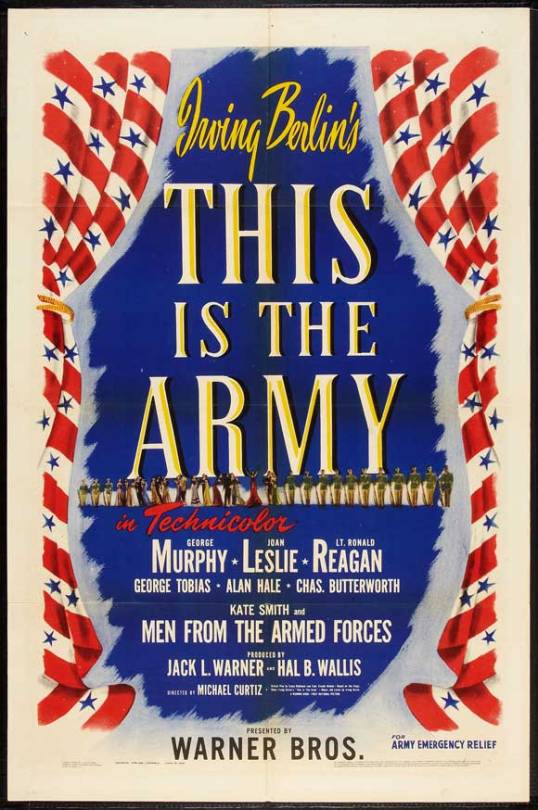
The 34th film in Mill Creek’s Fabulous Forties box set is the 1943 musical, This is The Army.

This Is The Army is based on a Broadway musical that was specifically conceived and written by Irving Berlin as a way to boost wartime morale.  The show, which was a collection of patriotic songs and comedic skits, was performed by members of the U.S. Army.  The film version starts with dancer Jerry Jones (George Murphy) being drafted at the start of World War I and putting together an all-army revue called Yip Yip Yaphank.  (Interestingly enough, this was also the name of a real-life show that Irving Berlin put together during World War I.)  The show is a big hit and, when the soldiers in the cast receive their orders to head to France, they literally march off the stage and out the theater.  It’s actually a pretty rousing scene but it’s almost immediately followed by a very sad one, in which we learn that only three members of the cast survived the war.  Jerry Jones is shot in the leg and when he returns home, the former dancer now walks with a cane.

Twenty-five years later, another world war has broken out.  Jerry’s son, Johnny (Ronald Reagan), has joined the army.  Johnny is ordered to put together another revue, in the style of Yip Yip Yaphank.  At first, Johnny is reluctant but orders are orders.  Soon, Johnny and the cast of This Is The Army are touring the U.S. and even performing in front of President Roosevelt (played by Jack Young, though, from a historical perspective, wouldn’t it be neat if President Roosevelt had appeared as himself in a film with Ronald Reagan?).  Along the way, Eileen (Joan Leslie) tries to convince Johnny to marry her even though Johnny wants to wait until the war is over.

It’s really not much of a plot but then again, the film is about showcasing the musical performances.  The soldiers sing.  The soldiers dance.  The soldiers tell jokes and imitate people who were famous in 1943.  There are several scenes that attempt to wring laughs from soldiers dressed up like women.  What’s interesting is that, at a time when the army was still segregated, the performances in This Is The Army feature both white and black soldiers.  Irving Berlin apparently demanded that black soldiers be allowed to appear in both the stage show and the film and, as a result, the unit that performed This Is The Army was, for a time, the only integrated unit in the U.S. Army.

Of course, that makes it even odder that there’s an extended sequence in which white soldiers perform while wearing blackface and standing on a set that’s been designed to resemble a pre-Civil War plantation.  It’s a scene that pops out of nowhere and then it keeps going and going and going and I could only stare at the screen in shocked horror as it played out.  It’s an odd contradiction that the same Irving Berlin who demanded that black soldiers be honored on stage and screen was also apparently the same Irving Berlin was put a minstrel show sketch into the middle of This Is The Army. 

Interestingly enough, George Murphy later retired from acting and was elected to the U.S. Senate in 1964.  Murphy’s success inspired his co-star, Ronald Reagan, to run for governor.  If Murphy had never been a senator, Reagan would probably never have been a president.  Both Reagan and Murphy give likable performances in This Is The Army and it’s easy to see how that likability, while it may not have often translated into great acting, did eventually lead to political success.

This Is The Army is a time capsule film, one that is mostly interesting as a view into the psyche of 1940s America.  The humor is often corny and the storyline is predictable but there’s also a very sad subtext to the film.  Since both the film and the stage show were performed by actual enlisted men, you watch with the knowledge that some of the men singing and joking on stage won’t return from the war.  Often times, during the performances, we see random people in the audience crying as they realize the same thing.  Even in an otherwise light-hearted film, the sobering realities of life during wartime are right beneath the surface.

Lisa Marie Reviews The Oscar Nominees: Battleground (dir by William Wellman)


I love February.

Why?  Well, first off, we all know that February is the most romantic month of the year.  February is Valentine’s Day, romantic movies, flowers, lingerie, and chocolate.  February is also the month when, in a lead up to the Oscars, TCM devotes a good deal of its programming to showing Oscar nominees of the past.

As I’ve mentioned in the past, one of my dreams is to watch and review every single film that has ever been nominated for best picture. Now, realistically, I’ll never be able to accomplish this goal because the 1929 Best Picture nominee The Patriot is currently a lost film.  But, even if it does mean that I’ll only be able to see 510 out of the 511 nominated films, it’s still a dream that I’m pursuing and, with the help of TCM and the month of February, it’s a dream that’ll come true.

Take, for instance, Battleground.  This 1949 Best Picture nominee (it lost All The King’s Men) recently aired on TCM.  I’m not exactly a fan of war films but, since it was a best picture nominee, I still made sure to DVR and watch it.

Set during the final days of World War II, Battleground follows one platoon of soldiers as they fight and attempt to survive the Battle of the Bulge.  The platoon is made up of the type of characters that we usually expect to find in a WWII film but, fortunately, they’re played by an ensemble of likable actors who all bring their familiar characters to life.  There’s Jim Layton (Marshall Thompson), the newest member of the platoon who nobody wants to run the risk of getting close to.  There’s Holley (Van Johnson), the cheerful soldier who is unexpectedly thrust into a position of leadership that he might not be right for.  Roderiques (Ricardo Montalban) is from Los Angeles and is amazed by the sight of snow.  “Pops” Stazak (George Murphy) is the type of older soldier who you would totally expect to be nicknamed “Pops.”  Bettis (Richard Jaeckel) is scared of combat.  Kippton (Douglas Fowley) spends nearly the entire film looking for his lost teeth.  And finally, of course, there’s the hard-boiled but warm-hearted Sgt. Kinnie (James Whitmore).

In some ways, Battleground is a very conventional film and it’s easy to wonder how it ended up getting nominated for best film of the year.  (Among the eligible films that were not nominated: The Bicycle Thief, Champion, The Fountainhead,  On The Town, Sands of Iwo Jima, She Wore A Yellow Ribbon, They Live By Night, and White Heat.)  However, the film’s nomination makes a bit more sense when you consider that it was released just four years after the end of World War II.  It was a film that appealed both to the veterans who were able to relate to the film’s story and to the patriotic spirit of a country that had just defeated the greatest evil of the 20th Century.

Battleground did not exactly make me a fan of war movies but it’s still a well-made and effective film. As opposed to a lot of other war films, Battleground never makes war look like fun.  For the most part, the emphasis is less on strategy and combat and more on the soldiers who are simply trying to survive from day-to-day.  The end result is a film that serves as a moving tribute to the soldiers who fought in World War II.