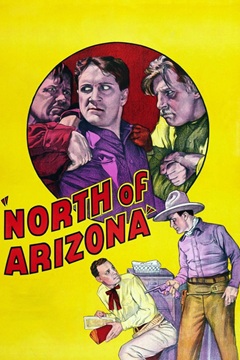
North of Arizona (1935, directed by Harry S. Webb)


Newly hired ranch foreman Jack Loomis (Jack Perrin) comes to the aid of two Indians who were nearly swindled out of their land during a card game.  The Indians inform Jack that his new boss, George Tully (Al Bridge), is actually a crook and the ranch is just a front for his criminal activities.  When Jack says he doesn’t want to be a part of Tully’s schemes, Tully and his men frame Jack for a robbery.

After you watch enough of these Poverty Row westerns, you start to get the feeling that anyone in the 30s could walk into a studio and star in a B-western.  Jack Perrin was a World War I veteran who had the right look to be the star of several silent films but once the sound era came along, his deficiencies as an actor became very apparent.  He could ride a horse and throw a punch without looking too foolish but his flat line delivery made him one of the least interesting of the B-western stars.  That’s the case here, where Perrin is a boring hero and the entire plot hinges on the villain making one really big and really stupid mistake.  John Wayne could have pulled this movie off but Jack Perrin was lost.

Jack Perrin’s career as a star ended just a few years after this film but not because he was a bad actor.  Instead, Perrin filed a lawsuit after a studio failed to pay him for starring in one of their films.  From 1937 until he retirement in 1960, Perrin was reduced to playing minor roles for which he often went uncredited.  Hollywood could handle a bad actor but not an actor who expected to be paid for his work.
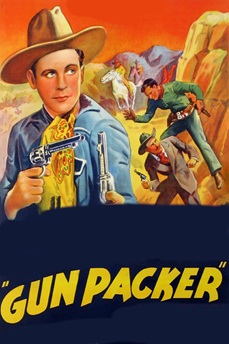
Gun Packer (1938, directed by Wallace Fox)


Someone is holding up stages and making off with a fortune of gold bullion.  The government decides to send in a gun packer.  Jack Denton (Jack Randall), the son of a legendary lawman, is sent to investigate, along with his sidekick Pinkie (Ray Turner) and Rusty the Wonder Horse.  Jack goes undercover, telling an elderly ex-con (Barlowe Borland) that he’s a former partner of his, which leads Jack to the leader of the robbers, Chance Moore (Charles King).

There are a lot of familiar faces in this western.  Not only does Charles King play yet another villain but Glenn Strange shows up in his customary role as the town sheriff.  Lloyd Ingraham, Forrest Taylor, Victor Adamson, George Hazel, Dave O’Brien, and Tex Palmer all have roles.  It’s interesting that the same actors showed up in these movies and almost always seemed to be playing the same roles.  The only thing that changed was the hero.  In this case, it’s Jack Randall, who may not have been a great actor but who was a believable western hero.  His sidekick here is Ray Turner, a black actor who began his career during the silent era and who had a long career in the westerns.  While Turner plays a subordinate character, the role still avoids a lot (though not all) of the demeaning racial stereotypes that were very common in most films from the 1930s.  Jack treats Pinky with respect and they’re clearly friends outside of work.  That may not sound like a lot but it was a big deal for a 1938 Poverty Row western.

The real hero here is Rusty the Wonder Horse.  Rusty’s best scene?  Jack, needing to climb a mountain, calls for Rusty to drop his lariat.  Jack grabs the rope and Rusty pulls him up.  Rusty truly earns the right to be called a wonder horse.

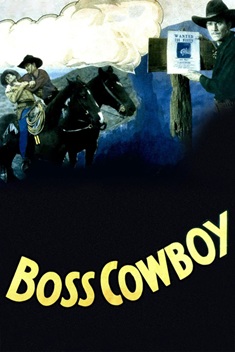
Boss Cowboy (1934, directed by Victor Adamson)


Boss Cowboy takes place in the 30s but it’s very much a western.  One car shows up and telephone poles dot the countryside but almost everyone in the movie rides a horse.  The Nolans and the Rosses are two ranching families.  Both families are losing cattle.  Nolan foreman Dick Taylor (Buddy Roosevelt) suspects that the culprit is the Ross foreman, Jack Kearns (George Cheseboro) and he’s right.  Kearns is ripping off both families.  Complicating Taylor’s effort to stop Kearns are his romantic feelings towards Mary Ross (Frances Morris), who is visiting from “back east.”  Sally Nolan (Fay McKenzie) is also visiting and running joke is her handing off her small dog to a ranch hand named Slim (Alan Holbrook).

No apparent relation to either Teddy or FDR, Buddy Roosevelt was a respected stunt man who tried his hand at starring in a few westerns,  Unfortunately, Buddy Roosevelt wasn’t much of an actor, which is painfully apparent while watching him in Boss Cowboy.  He’s fine when he’s riding a horse and pulling a gun but when he has to speak, it’s difficult to watch.  As bad as Buddy Roosevelt’s acting was, he was not the worst actor in Boss Cowboy.  That honor was split between Frances Morris and Fay McKenzie.  Boss Cowboy is pretty dull.  Every scene drags and there are plenty of awkward silences while the cast tries to remember their lines.

Though he wasn’t much of an actor, Buddy Roosevelt remained in a demand as a stunt man throughout the 40s.  In the 50s and 60s, he was kept busy playing townsmen in shows like The Life and Legend of Wyatt Earp.  In 1962, he made his final film appearance in The Man Who Shot Liberty Valance.  He then retired to Colorado, where he did at age of 75 in 1973.  In all, his Hollywood career spanned 46 years, from 1916 to 1962.


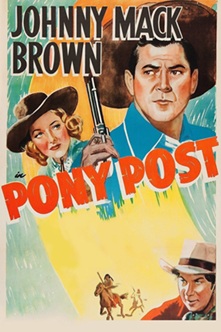
Pony Post (1940, directed by Ray Taylor)


In the days of the Old West, Griff Atkins (Stanley Blystone) manages a Pony Express station but, because of his gambling debts, he actually encourages the Indians and the outlaw Richard brothers (John Rockwell and Ray Teal) to attack the Pony Express riders and steal their horses.  Major Goodwin (Tom Chatterton) tries to put a stop to all this by firing Griff and putting Cal Sheridan (Johnny Mack Brown) in charge.  Griff and the Richard brothers continue their outlaw ways and eventually, the head of one of the relay stations is killed in one of their raids.  While the dead man’s daughter, Norma (Nell O’Day), investigates the murder, Cal works to bring peace the line and falls in love with Goodwin’s daughter, Alice (Dorothy Short).  Meanwhile, aspiring Pony Express rider Shorty (Fuzzy Knight) tries to invent a trampoline system that will help him to mount a horse.

No matter how bad things get in the west, you can always count on Johnny Mack Brown to bring some order and to get it done in less than an hour.  Johnny Mack Brown was always a good hero and that’s the case here.  Eventually this film has all of the horse riding and tough fighting that fans of the genre expect from these westerns but, for a short movie (it only runs for 59 minutes), it still seems to take a while for it to really get going.  The first half of the movie is more about Fuzzy Knight singing songs and trying to become a rider than it is about anything else.  I usually enjoy Fuzzy’s antics but, like the B-western themselves, they are definitely an acquired taste for most viewers.

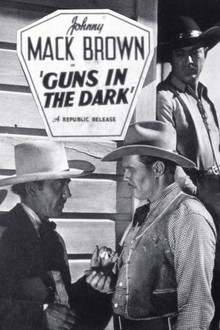
Guns In The Dark (1937, directed by Sam Newfield)


In Mexico, two American cowboys, Johnny Darrel (Johnny Mack Brown) and Dick Martin (Julian Madison) join a poker game to try to win some money and help out their buddy, Oscar (Sid Saylor).  When they discover that cantina owner Manuel Mendez (Ted Adams) has rigged the game, a fight breaks out.  The lights turn off.  In the darkness, several guns are fired.  When the lights come back up, Dick is dead.  Mendez convinces Johnny that he accidentally shot his friend in the fight.  Guilt-stricken, Johnny tosses aside his guns and returns to Texas.

Johnny has sworn that he will never shoot another gun but when he’s hired to work at a ranch owned by Joan Williams (Claire Rochelle), he finds himself in the middle of a range war between Joan and Brace Stevens (Dick Curtis), with Mendez also making an unwelcome return to Johnny’s life.  Even after Johnny discovers the truth about what happened that night at the cantina, he doesn’t pick up a gun.  Instead, Johnny fights the bad guys with lassos and plates.

Guns In The Dark is only 54 minutes long and it features actors who will be familiar to any fan of the old B-westerns.  Sidekcick Sid Saylor’s stuttering schtick gets old quickly but Johnny Mack Brown is as likable as always in Guns In The Dark and he comes across as being an authentic cowboy even when he’s not carrying a gun  Given that this film features even more horse chases than the typical Johnny Mack Brown b-western, it’s good that Brown is so convincing.  What isn’t convincing is how stupid Johnny Darrel is required to be in order for him to fall for Mendez’s lie in the first place.  I appreciated the change of pace from Brown just using a gun to stop the bad guys but I wish the reason behind it had been more convincing.  This isn’t one of Johnny Mack Brown’s more memorable westerns though, as always, it’s easy to see why he was one of the early stars of the genre.