12 Trailers In Case of the Rapture, Part Two


Hi there!  It’s Saturday morning — are you still with us?  If you’re not, don’t worry.  You have all day to get raptured.  Until then, here’s the second part of this weekend’s edition of Lisa Marie’s Favorite Grindhouse and Exploitation Trailers.

(And if you haven’t read part one, it’s right here.)

Anyway, let’s waste no more time because who knows how long we’ve got left.

7) Requiem for a Vampire (1971)

Seeing as this could very well be the last things that I ever post or that you ever read pre-Rapture, there’s no way I can’t start things out without including this trailer for Jean Rollin’s unique, twisted, and very French vampire fairy tale, Requiem for a Vampire.  One thing to note here is that when this film was released in the U.S., the American distributor felt the need to emphasize that the two girls were virgins and even went so far as to retitle the film Caged Virgins.  However, the original French print of this film makes no reference to whether or not the girls are virgins and, despite all that happens to them in the film, the girls themselves are never presented as being helpless.  Whenever I feel the need to explain the difference between American culture and French culture, this is one of the examples I always cite.

8 ) Kenner (1969)

Jim Brown is Kenner!  And that’s about all I really know about this film.  Well, that and small bundles of heroin are worth millions…

9) The Three Dimensions of Greta (1973)

I was recently reading about 3-D Sex and Zen: Extreme Ecstasy, a movie from Hong Kong that is apparently setting box office records because it’s being advertised as the first 3-D pornographic film.  And, as the linked article shows, a lot of people are reporting that claim as fact.  And they’re wrong.  3-D Sex and Zen might be the first recent 3-D porn film but it’s hardly the first.  There was a spate of 3-D porn films in the mid-70s and one of my favorite trailers (which I can’t post here because 1) it’s too explict and 2) I can’t remember the title of the film) features a stereotypical, curly-haired, guy with a mustache type of porno actor going, “Soon, my giant schlong with be hanging right over the head of that redhead in the 3rd seat in the backrow.”  And of course, I was all like, “Oh my God, can he see me through the screen!?”   Anyway, the 3 Dimensions of Greta was a part of this wave.  This is another one of those trailers that will probably be yanked off YouTube in a few more days (assuming there isn’t a Rapture first).

(By the way, why were so many porno films made about girls named Greta?  I mean, was that name a turn-on?  Were the films of the 70s exclusively made by guys named Hansel?  Seriously, boys are weird.)

10) The Violent Professionals (1973)

They’re violent alright!  Before the Italian exploitation industry devoted itself to cannibals and zombies, they devoted themselves to ripping off The French Connection and The Godfather.  This film from Sergio Martino actually features Don Barzini himself, Richard Conte.

11) Wonderwall (1968)

If I didn’t tell you this film was from 1968, you’d guess it just from watching the trailer.  The soundtrack was done by George Harrison.  Though this film was certainly not designed to be an exploitation film in the way most of the other films featured here were, it definitely is one.

12) The Beyond (1981)

Can you believe I went this long without featuring the trailer for Lucio Fulci’s best known (after Zombi 2) film?  Well, I love Fulci, I love this film, and I was waiting for the right occasion to feature this trailer.  And the end of the possible end of the world seemed like the right time.  Anyway, this is one of those love it or hate it films (and I know that one of our regular readers is not a huge fan of this film but I love him anyway).  At his best, director Lucio Fulci made some of the most visually stunning and dramatically incoherent films ever and never was that more apparent than with the Beyond.  Out of the film’s cast, Catriona MacColl plays one of the few strong women to ever appear in a Fulci film while David Warbeck (a personal fave of mine) is the perfect hero.  My favorite performance in the film (and a lot of this has to do with the fact that she co-starred in one of my favorite movies ever, Beyond the Darkness) is given by Cinzia Monreale, who plays the blind Emily.

And so there you go.  If you do get raptured later today, thank you for reading.  It’s been a pleasure telling you about the films I love and hopefully, someday, we’ll all meet in the beyond.

And if, as I suspect, there is no rapture today, I look forward to sharing even more.

Ciao!

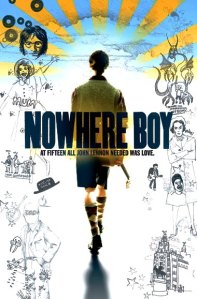
A Quickie From Lisa Marie: Nowhere Boy (Directed by Sam Taylor-Wood)


At first glance, Sam Taylor-Wood’s Nowhere Man sounds just a little bit too cutesy.  The movie, which covers the youth of John Lennon, starts with the death of John’s Uncle George, covers both his attempts to reconcile with his mother Julia (portrayed here as being bipolar) and his troubles relationship with the aunt who actually raised him, details how John came to form his own band (The Quarrymen) and first met Paul McCartney and George Harrison, and ends with John preparing to leave for Germany.  Yet the movie works surprisingly well and, by the end, is actually quite touching regardless of whether you idolize John Lennon or if you think Imagine is one of the most overrated songs of all time.  By refusing to indulge in any easy sentimentality about either John Lennon or the iconic figure he would eventually become (the word “Beatles” is never uttered at any point in the film), Taylor-Wood crafts a touching coming-of-age story about an alienated teenager trying to find peace with his dysfunctional existence.  The fact that the teen is going to grow up to be the John Lennon is secondary to the plot.

The film works mostly because of the cast.  The young John Lennon is played by Aaron Johnson who, earlier this year, was the lead in Kick-Ass.  I have to admit that I didn’t care much for Johnson in Kick-Ass.  His performance seemed generic and bland and he was overshadowed by Nicolas Cage, Chloe Grace Moretz, Mark Strong, Christopher Mintz-Plasse, and just about everyone else in the movie.  Here, however, Johnson gives a strong, sympathetic performance as a character who often comes across as being neither.  He both manages to capture the young Lennon’s sensitivity as well as his anger and cocky arrogance. 

However, the movie truly belongs to the two actresses playing Lennon’s aunt and mother, Kristen Scott Thomas and Anne-Marie Duff.  Scott Thomas has an especially difficult job as her character is far less flamboyant and, at first sight, a lot less interesting as Duff’s.  However, as the film progresses, Scott Thomas starts to subtly reveal the dry humor that lies underneath her character’s serious expression.  As for Duff, she dominates the film as surely as Julia dominated her son’s life.  Duff doesn’t resort to any of the easy (and insulting) clichés that are usually used to represent bipolar disorder on film.  Instead, she captures both the exhilarating high of being manic along with the constant fear of the depressive episode that we always know is destined to follow.  It’s a spot-on performance that elevates this film above the standard coming-of-age story.

Wisely, neither the director nor her actors ever get caught up in the fact that their film is about the John Lennon.  There’s no portentous foreshadowing or awkwardly staged moments designed to specifically make you go, “Hey, that’s John Lennon!”  Even the first time that Lennon meets Paul McCartney and, later, George Harrison is handled in a casual, off-hand manner.  Taylor-Wood has enough faith in her audience to believe that we’ll be able to understand the importance of John being introduced to a younger guitar player named Paul without bashing us over the head with the fact that this is the Paul McCartney.  As such, while you’re always aware that this is a movie about John Lennon, you can also see the movie as simply being the story of an alienated teenager who finds salvation through music.