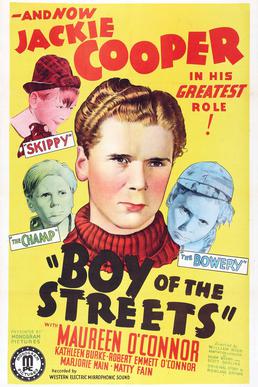
Welcome to New York City, circa 1937!
It’s a place where the extremely wealthy carefully avoid the districts dominated by the extremely poor, like the Bowery. In the Bowery, families live in tenements and worried mothers can only cry as they watch their sons join street gangs and their daughters settle for a life of abuse and loss. Sure, there’s a few do-gooders. Occasionally, there’s a cop who is convinced that no boy is a lost cause. Sometimes, you’ll run into a doctor who is determined to provide adequate medical care to the inhabitants of the Bowery. In fact, you might even see a rich person who is determined to spread about some charity. But, for the most pat, life in the Bowery is just one hopeless day after another.
14 year-old Chuck Brennan (Jackie Cooper) lives in the Bowery. He’s got a gang of boys who will do anything that he tells them to do and, despite the fact that Chuck is obviously smarter than almost everyone else around him, he has no interest in being a role model or decent citizen or anything else of that matter. Chuck lives in a shabby apartment with his mother (Marjorie Main) and his father (Guy Usher). Chuck looks up to his father who apparently knows important people and is often out of town on “business.” However, when Chuck discovers that his father is actually a low-level hood who works for the local political machine, Chuck is not only disillusioned but also inspired to go find some gangsters to team up with himself.
The system says that Chuck is a hopeless case but not everyone agree. Officer Rourke (Robert Emmett O’Connor) thinks that there’s hope for Chuck, he just needs something or someone to straighten him out. (Like maybe a stint in the Navy….) And then there’s Nora (Maureen O’Connor), the sweet Irish girl who lives in Chuck’s building and who is often heard singing to her deathly ill mother.
In the end, it’s all up to Chuck. Will he pursue a life of crime or the life of an honest man? Will he be a man like his father or will he end the cycle of crime and desperation?
Boy of the Streets is a low-budget, black-and-white film from 1937. It was produced by Monogram Pictures and, much like Dead End (which came out the same year and featured a superficially similar storyline), it’s a film that mixes social commentary with a bit of gangster action. The film’s low-budget doesn’t do it any favors and there’s nothing particularly surprising to be found in the film’s plot but child actor Jackie Cooper is convincingly cocky as the swaggering Chuck and Marjorie Main does a good job as his anguished mother. (Interestingly, Main also played Humphrey Bogart’s mother in Dead End.)
Boy of the Streets is a good example of a film that I never would have seen if not for TCM. (I recorded it off of TCM way back in June.) That’s one reason why I’ll always be thankful for TCM. At a time when so many people seem to be determined to destroy history, TCM is celebrating it.
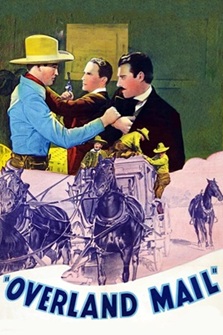 Jack Mason (Jack Randall) has the most important job on the frontier. He delivers the mail. After he’s chased by the members of the local Indian tribe, he learns that an uprising is imminent because a young brave has been murdered and the tribe blames the citizens of a nearby town. Of course, the murder was actually committed by a gang of counterfeiters led by saloon owner Pollini (Tristram Coffin). Pollini is not only a counterfeiter but he also lies to sweet Mary Martin (Jean Joyce), telling her that he’s hiring her to be a waitress when he’s actually looking for a dance hall girl. Jack has to bring Pollini to justice before a full scale war breaks out.
 Through the Shattered Lens