14 Days of Paranoia #1: Fast Money (dir by Alex Wright)


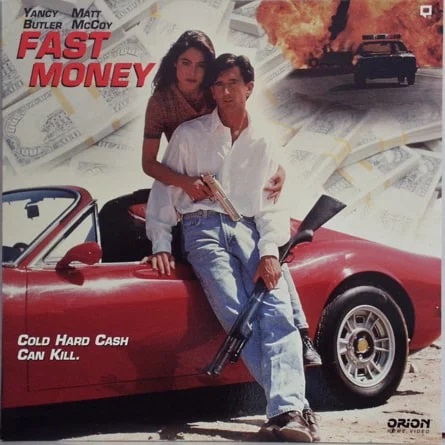
First released in 1996, Fast Money opens with Francesca March (Yancy Butler) stealing a car.

This is what Francesca does for a living.  She steals cars and she’s good at it.  She’s the type of who can look in any trashcan and find something that she can use to pick a lock.  She’s master at hot-wiring a car.  I personally have no idea how to hot-wire a car but, judging from the movies that I’ve seen, it appears to be the easiest thing in the world to do.  Francesca doesn’t just steal cars for the money.  She sincerely enjoys doing it, to the extent that it’s a compulsion for her.  If she sees a car, she has to steal it.

This has not made her popular with the LAPD.  In fact, an entire taskforce has been set up to stop her.  Realizing that she has to get out of town, she rushes to the airport.  It’s there that she runs into Jack Martin (Matt McCoy), a nerdy journalist who is working on a story that could take down a powerful U.S. Senator.  Jack is looking to catch a flight to Reno.  For reasons that aren’t particularly clear, Francesca rushes up to Jack and pretends to be his wife and the recently widowed Jack goes along with it.

Further complicating matters is that Francesca impulsively decides to seal one last car and the one that she picks just happens to have 3 million dollars in mob money and a bunch of counterfeit printing plates in the trunk.  The evil Sir Stewart (Jacob Witkin) wants his money back and he sends Regy (Trevor Goddard) and corrupt detective Lt. Diego (John Ashton) to track down Francesca and Jack.

Soon, Francesca and Jack are desperately trying reach the Mexican border while dodging corrupt cops, FBI agents, and mobsters.  It leads to a lot of car chases, explosions, helicopters, and shoot-outs.  (The otherwise meek Jack turns out to be a surprising good shot.  Neither he nor Francesca freaks out after he shoots multiple people, which is the sort of thing that I would probably freak out about.)  Francesca and Jack also find themselves falling in love but wondering just how much they can trust each other.  Stolen money does that to people.

Fast Money is a cheerfully dumb but entertainingly fast-paced movie, one in which the chase never stops long enough for the viewer to have too much time to try to figure out why the ultracool Francesa would be willing risk her freedom for a relationship with someone as whiny as Jack.  Yancy Butler plays Francesca as being so confident and so fearless that it’s hard not to admire her but there’s also no way that she seems like she would ever have much use for someone as meek and repressed as Jack, regardless of how deadly his aim might be.  One gets the feeling that the only thing keeping this couple together is the adrenaline rush of being hunted.  If Jack and Francesca do make it to safety, their relationship will probably be over by the end of the week.

Though Fast Money is ultimately a fun but somewhat generic direct-to-video action film, I appreciated the film’s vision of a world where everyone from the mob to the police to the FBI were basically working together to track down one career criminal and one innocent man.  When even the usually likable John Ashton is trying to murder you in a cheap motel, you know you have reached the other side of the looking glass.  Jack learns what Francesca has always understood, which is that one should be suspicious of authority.  Though it may not have been the film’s intent, Fast Money‘s ultimate message becomes, “Trust no one but yourself.”
Radical Jack (1999, directed by James Allen Bradley)


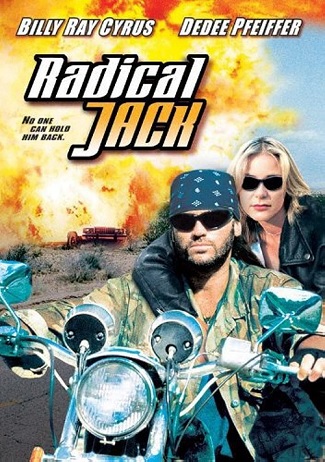
Billy Ray Cyrus is Jack, a tough-as-nails former CIA agent who is still traumatized by his actions during Desert Storm and the murder of his wife by the international terrorist, Riotti (Benny Nieves).

Stop laughing.

I’ll admit that the idea of Billy Ray Cyrus, the most mild and unthreatening of mullet-headed country music stars, playing a CIA burnout who has killed countless men may sound like something to laugh about but … forget it, I’ve got nothing.  Laugh all you want because it is ridiculous casting and, throughout the film, Billy Ray looks increasingly uncomfortable with the character’s R-rated antics.  Sometimes, you have to do what you have to do, though.  When this movie was made, it’d been seven years since Achy Breaky Heart and even one-hit wonders need to pay the bills.  In 1999, reinventing Billy Ray Cyrus as a second-tier action star probably seemed like a good idea.  Billy Ray may not be the most convincing CIA agent but he’s still more likable than Steven Seagal.

Billy Ray is sent undercover to a small town in Vermont.  Somehow, by working as a bouncer at the local roadhouse, Billy Ray Cyrus is supposed to find a way to expose two local arms dealers, Lloyd (George “Buck” Flower) and Lloyd’s good for nothing son, Rolland (Noah Blake).  Lloyd and Rolland are selling weapons to Riotti so this is personal for Billy Ray.  But Billy Ray is also romancing Rolland’s ex-girlfriend, Kate (Deedee Pfeiffer) so it is personal for Rolland too.

As both an action hero and a film, Radical Jack isn’t all that radical and Billy Ray Cyrus never looks comfortable in any of the action scenes or the scenes where he makes out with Deedee Pfieffer but there are still plenty of explosions, fights, and chase scenes.  Though she doesn’t have much romantic chemistry with Billy Ray, Deedee Pfieffer gives the best performance in the film, playing Kate as someone who knows that she deserves better than what life has given her.  Radical Jack was produced by the same people who did Time Chasers and fans of that film will be happy to visit the exact same landing strip and hangar that was featured so heavily in that sci-fi epic.  There’s also a twist at the end, which you’ll see coming from miles away and Billy Ray does something unexpectedly cruel with a hand grenade.  Radical Jack did not make an action star out of Billy Ray Cyrus but, two years later, he showed an unexpected talent for comedy with his small role in Mulholland Drive.  Seven years after playing a burned-out CIA assassin, Bill Ray Cyrus found new fame as Miley Cyrus’s father and Radical Jack would never ride again.

October Positivity: Early Warning (dir by David R. Elliott)


First released in 1981, Early Warning opens with a shot of a crowded, polluted city.  On the soundtrack, we hear the voices of newscasters.  The world is tottering on the brink of war.  Gas prices are skyrocketing.  Inflation is rising.  People are losing their jobs and their homes and many of them are having to skip meals in order to have enough food to last through the week.  Riots are breaking out across America.  Crime is running rampant.  The rich are getting richer.  The poor are getting poorer.  The President is a doddering old fool who sounds incapable of bringing America together.

Wow, that all certainly sounds familiar!  It’s tempting to say that Early Warning predicted the state of the world in 2022.  However, the truth of the matter is that the movie was made at the tail end of the Carter years and, as we all know, history tends to repeat itself.

Early Warning makes the argument that all of the problems in the world are due to the …. are you ready for this? …. One World Foundation.  (The One World Foundation could have picked a less obviously evil name.)  Led by Alexander Stonefield (Joe Chapman), The One World Foundation manipulates humanity by raising prices, destroying cities, and causing natural disasters.  They have a plan to start a nuclear war, by encouraging countries to invade one another and then supplying nuclear weapons to both sides.  They’ve decided that the best way to control humanity is to assign everyone a number and to…. okay, well, you know where this is going, don’t you?  Yes, this is one of those movies.  Before Left Behind, there was Early Warning!

The One World Foundation may be able to manipulate the world but their security sucks because a reporter manages to sneak into their headquarters and record a meeting where Stonefield explains, in exacting detail, everything that he’s planning on doing.  (You have to wonder why Stonefield even felt the need to have that meeting.)  The reporter is caught by a group of silly-looking guards who all wear white knee socks and tap shoes.  He’s killed but not before he put the recording in a mail box.  That’s putting a lot of trust in the U.S. Postal Service but whatever.

Another journalist, Sam Jensen (Christopher Wynne), teams up with a religious activist named Jenny Marshall (Delana Michaels) and soon, they’re doing their own investigation.  It turns out that the One World Foundation is going to have yet another meeting, this one at a hotel in the middle of the desert.  While Sam and Jenny try to uncover the truth, they fall in love but, unfortunately, Sam’s not a believer.  Can this be fixed before Sam is gunned down by a mysterious, helicopter-riding assassin known as The Cobra?

Early Warning is a bit of an odd film.  Jenny is often inappropriately cheerful, even when she’s got guards in knee socks trying to kill her.  Sam is a remarkably whiny hero.  There’s a strange sequence in which Sam and Jenny stumble across a survivalist compound in the middle of the desert and one of the survivalists is played by none other than George “Buck” Flower.  But perhaps the strangest thing about the movie just how low-rent and incompetent the One World Foundation is.  For an organization that can drive countries to war and wipe out someone’s savings just by pushing one button, One World has a remarkably difficult time tracking down two people.

(Of course, that’s always been my issue with most conspiracy theories.  It’s hard for me to buy that a group could be competent enough to control the world while also being too incompetent to properly cover up their activity.)

Early Warning is an early example of an evangelical end-of-the-world thriller.  One gets the feeling that the filmmakers were probably inspired by the then-recent success of The Omen films.  The budget was obviously low but that often works to the film’s advantage.  The grainy images feel appropriate for a movie about paranoia.  What doesn’t work to the film’s advantage are the stilted performances and a screenplay that can never decide whether it wants to primarily thrill the audience or primarily preach at them.  Still, to me, it’s interesting as an early example of a cinematic genre that, even if it doesn’t get much publicity, is still going strong.  It’s also interesting to see that, in 1981, people were just as quick to say the world was ending as they are in 2022.  The world appears to have been ending for a while now.

The TSL’s Grindhouse: Blood Games (dir by Tanya Rosenberg)


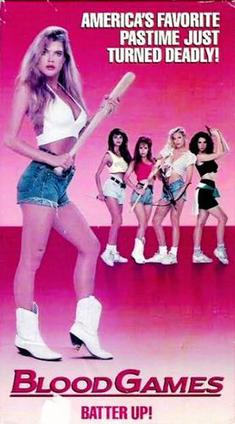
First released in 1990, Blood Games opens with a birthday celebration gone terribly wrong.

Somewhere in the rural South (at least, I assume it’s meant to be the South if just because of the big Confederate flag that appears in one scene), Roy Collins (Gregory Cummings) is celebrating his birthday.  Roy’s father, Mino (Ken Carpenter), has invited Babe and the Ball Girls, a women’s softball team, to come to town to play an exhibition game against Roy and the local boys.  When Babe (Laura Albert) and her team not only beat but also thoroughly humiliate the hometown team, Mino doesn’t take it well.  He yells at Roy and Roy and his idiot friend, Holt (Don Dowe), decide to get revenge.  After Roy is killed while trying to assault one of the girls, Mino gathers all of the rednecks together and declares, “I WANT JUSTICE!”  Everyone in town grabs a shotgun, jumps in a pickup truck, and heads off in pursuit of the Babe and the Ball Girls tour bus.

It shouldn’t come as a surprise to anyone that the bus itself breaks down in the middle of the woods and the team is forced to hike to safety while being pursued by Mino, Holt, and all of the rest of the shotgun toting locals.  It turns out that Mino is a deadly shot with a crossbow and Holt, at times, seems to be close to indestructible.  However, it also turns out that Babe and the Ball Girls are far tougher than any of the men expected.  The film reaches its bloody conclusion at a deserted farm, complete with a dramatically-scored flashback montage that reminds us of everyone whose life was lost during Roy’s birthday weekend.

Just to state the obvious, Blood Games is just as exploitive as it sounds.  This is the type of film where, early on, the action stops so the camera can linger on Babe and the Ball Girls in the locker room after they win their game.  (George “Buck” Flower shows up as the redneck who inevitably ends up peeking in at them.)  The team’s uniforms were probably popular with the film’s target audience but short shorts and crop tops don’t really seem practical for a game that would involve sliding through the dirt and the weeds on the way to home plate and, as a Southern girl who spent many a summer in the country while growing up, I cringed a bit when I thought about all the bugs that were probably in the grass and the dirt, waiting for a chance to hop onto a bare leg.  (It didn’t help that the game was apparently just being played in some random field.)

And yet, as exploitive as many viewers will undoubtedly find Blood Games to be, the film definitely works.  The rednecks are so loathsome and they overreact so severely to losing one game to a team of girls that it’s impossible not to cheer when Babe and the Ball Girls turn the tables on their pursuers.  “Batter up!” the film’s trailer announces and it is true that the Ball Girls use the same teamwork that won them the game to survive in the wilderness.  At the same time, they also use baseball bats, ropes, guns, and anything else they can get their hands on.

The acting is a bit inconsistent, though Don Dowe and Ken Carpenter are both well-cast as the main villains.  Dowe plays Holt as being someone who knows that he’s in over his head but who is too weak-willed to go against the mob.  The fact that he’s weak makes him all the more dangerous because a weak man will do anything to try to convince others that he’s strong.  Carpenter, meanwhile, is chillingly evil as Mino, who quickly goes from mourning his son to taking a sadistic pleasure out of hunting down human beings.  The film’s real strength is to be found in Tanya Rosenberg’s direction.  Along with keeping hte movie moving at a fairly steady pace, Rosenberg also captures the atmosphere of being lost in the country in the summer.  Watching the film, you can literally feel the heat rising from the ground and hear the cicadas in the distance.

Incidentally, I convinced my sister to watch this film with me because I assumed it was a baseball movie.  However, as Erin quickly pointed out to me, it instead turned out to be a softball movie.  I have no idea what exactly the difference is between baseball and softball but Erin assures me that there is one.  Well, no matter!  Whether it was softball or baseball, Babe and the Ball Girls did a good job striking out the hometown boys.

Batter up!