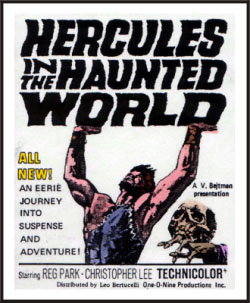
Hercules In The Haunted World (1961, directed by Mario Bava)


Returning home from his latest adventure, Hercules (Reg Park) and his sidekick, Theseus (George Ardisson), are shocked to find their home city has fallen victim to a plague that puts its victims in a trance-like state.  The woman that Hercules loves, Deianira (Leonara Ruffo), is one of the victims and, since she was also the city’s queen, the sinister Lico (Christopher Lee) is ruling in her place.

Hercules consults with the oracle, Medea (Gaia Germani).  Medea says that the plague can only be lifted by the Stone of Forgetfulness, which can only be found in the land of the dead, Hades.  Hercules and Theseus set out for Hades but before they can enter the realm of the dead, they have to perform a quest to defeat a rock monster and retrieve a magic apple from a giant tree.  Nothing is simple in ancient Greece.

The best of all the Hercules films, Hercules in the Haunted World may not have had Steve Reeves in the lead role but it did have Mario Bava behind the camera.  Bava shows what a clever director can achieve just through creative lighting, colorful mists, and detailed set design.  The film has all of the mythological monsters and toga-clad action that you expect from a Hercules film but it also has atmosphere, bleeding plants made from the souls of the dead, zombies, and Christopher Lee.  Lee may not be playing a vampire here but he still finds an excuse to drink blood in an attempt to achieve immortality.

Reg Park was a Brit who was inspired to become a bodybuilder after watching Steve Reeves in a competition.  When Reeves left the role of Hercules, Park was cast in his place.  Park only made a total of five peplum films and he was even worse at expressing emotion than Steve Reeves.  Park did have the physique necessary to play Hercules and that was really all that was needed.  Though Park tired of acting, he would still go on to mentor another bodybuilder who was inspired by Steve Reeves and would play Hercules in a film, Arnold Schwarzenegger.
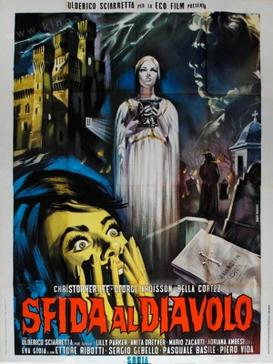
Horror Film Review: Challenge the Devil (dir by Giuseppe Vegezzi)


Oh, where to start with the 1963 Italian film?

A criminal named Carlo lands in Italy and soon finds himself being pursued a group of gangsters.  An extended shoot-out leads to Carlo being serious wounded.  Carlo stumbles into a church, where he is met by a monk who used to be an friend of his.  Carlo explains that he has been blackmailing a Beirut crime lord and now the crime lord’s men are after him.  Unfortunately, Carlo gave all the evidence to an exotic dancer and now he needs the evidence back but, obviously, he can’t show his face in the streets.  The monk goes to a nightclub and, after watching several different cabaret acts that have nothing to do with the rest of the film, he finally gets a chance to talk to the dancer.  The dancer is also an old friend of his but hasn’t seen him since he became a monk and she demands to know what led to this development in his life.  The monk tells her the story of his past, in return for her giving him the evidence.

In the distant past, the monk was a part of a motorcycle gang led by wannabe gangster Gian (Mario Polletin) and a failed poet, Gugo (Giorgio Ardisson).  One day, Gian, Gugo, the future monk, and their respective girlfriends decided to break into an apparently deserted castle, where they decided to have a wild party.  Of course, to them, a wild party meant playing the bongos and drinking wine.  However, it turned out that the castle wasn’t totally deserted.  There was an old man (Christopher Lee) living in the castle and the old man explained that the love of his life had died years before and that her body was somewhere in the castle.  If Gugo and the gang found her body and brought her to the old man so that he could give her a decent burial before his own death, the old man would give them the castle.  The greedy and drunken gang agreed but they soon discovered that the castle was full of secrets and the old man was not quite who he claimed….

Challenge The Devil is a thoroughly disjointed film, one with a plot that is almost impossible to follow.  Some of that is because of the film’s troubled production history.  Originally, the film was titled Katarsis and it was simply about the gang coming across the castle and meeting Christopher Lee.  However, after the film was shot, the production company went out of business and the film’s new owner decided to re-edit the film and tack on the scenes involving Carlo, the dancer, and the monk.  None of the new scenes fit with the style of the old scenes and, indeed, all of the nonsense with Carlo and the dancer means that the film’s main story doesn’t even get started until after about 20 minutes of filler.  Of course, it should be noted that even the original version of the film doesn’t look like it was that good.  This was director Giuseppe Vegezzi’s only feature film and he shows very little natural ability when it comes to framing shots or creating atmosphere.

But what about Christopher Lee, you may be asking.  He’s fine.  I mean, Christopher Lee is imposing and his physical presence is so strong that he even makes an impression in a bad film.  But Lee only gets a few minutes of screen time.  For his part, Lee said that this was one of the film that he did for the money and he never actually saw the finished product.  I don’t blame him.  This one is for Lee completists only.

Italian Horror Showcase: The Long Hair of Death (dir by Antonio Margheriti)


http://www.youtube.com/watch?v=3lUV-TMeJ1I

This 1964 Italian horror film takes place in a feudal village in the 15th century.  It’s a time of fear, corruption, and ignorance, which is a dangerous combination.  The village is ruled over by the corrupt Count Humboldt (Giulliano Raffaelli).  With his villagers panicking about every day problems like poor crops, banditry, and disease, the Count understand that the best thing to do is just blame it all on a witch.  Of course, it doesn’t do much good to blame a witch unless you also burn her and that’s exactly what the count decides to do Adele Karnstein.  When Adele’s daughter, Helen (Barbara Steele), goes to the castle to make an appeal for her mother’s life, the Count responds by raping her and then tossing her over the edge of a cliff.

Adele’s other daughter, Lisabeth (Halina Zalewska), is adopted by the Count and grows up in his castle.  Eventually she is married off to the count’s evil and greedy nephew, Kurt (George Ardisson).  Knowing fully well what Kurt’s family did to her mother and her sister, Lisabeth is not all happy about the arrangement but what can she do?  She has absolutely no one to help her.

And then, one night, lightning strikes Helen’s grave.  Not only does the grave fly open but Helen is now suddenly walking around the village and heading for the castle.  Except, of course, she is now calling herself Mary.  When Mary arrives at the castle, Kurt is immediately taken with her, so much so that he starts to plot the murder of Lisabeth.  However, is it possible that this is all a part of Mary’s plan?

Meanwhile, the black plague has once again struck the village and again, the villagers are starting to demand a sacrifice….

Obviously, the main reason to see The Long Hair of Death is for Barbara Steele’s performance in the dual roles of Helen and Mary.  In the early 60, Steele appeared in several Italian gothics and she almost inevitably always seemed to play a character who, after being unjustly killed by a member of the upper class, returned from the dead to get revenge.  (This was a template that was set down by her best-known Italian film, Mario Bava’s Black Sunday.)  While I’ve read that it’s a role that Steele got tired of playing, that doesn’t change the fact that she was very good at it.  Steele’s characters always returned to punish the men who had previously used and abused her, which is one reason why her performances remain popular to this day.

That’s certainly the case with The Long Hair of Death, in which the entire film is basically leading up to Kurt being punished for both his sins and the sins of his uncle.  George Ardisson gives a wonderful performance as Kurt, effortlessly going from arrogant and lecherous to terrified and helpless without missing a beat.  Director Antonio Margheriti plays up the story’s gothic atmosphere, giving the film an occasionally dream-like feel.  He emphasizes not just the villainy of the Humboldts but also the superstition of the villagers, making clear that evil cannot prosper without ignorance.

The Long Hair of Death is hardly perfect.  The middle part of the film drags and the low-budget is occasionally a hindrance.  (The village often looks like it’s made out of cardboard.)  But the film comes alive whenever Barbara Steele is on-screen and the ending is a brilliantly macabre.  Lovers of Italian gothic horror will find much to appreciate about The Long Hair of Death.

Horror On The Lens: Hercules In The Haunted World (dir by Mario Bava)


Herculesinthehauntedworld

In many ways, 2014 was the year of Hercules.  Or, at the very least, it could have been the year of Hercules.  Neither one of the two Hercules film released this year exactly managed to set the American box office on fire.  Of the two, The Legend of Hercules was memorable largely for being forgettable while the Dwayne Johnson-starring Hercules was far better than any film directed by Brett Ratner has any right to be.

Neither one of them, however, can really hold a candle to the 1961 film, Hercules In The Haunted World.  In this Italian film, Hercules (Reg Park) discovers that his lover Princess Deianira has gone insane so he goes to Hades in order to get the Stone of Forgetfulness, so he can use it to cure her.  The story’s really not that important.  What is important is that this visually stunning film was the first color film to be directed by Mario Bava and that the film’s villain is played by Christopher Lee.

Enjoy!