Doctor Who — Destiny of the Daleks, City of Death, The Creature From The Pit, Nightmare of Eden, Horns of Nimon, Shada


Remember when I was writing about classic Doctor Who for Halloween?  Let’s get back to that with a look at the 17th season of the original series.  This season is a controversial one.  It featured some of the show’s worst serials but also one of its best.  Today, it’s remembered for introducing Lalla Ward as the second Romana and for featuring Douglas Adams as the script editor.

One frequent complaint about this season is that, under Adams’s influence, the season featured more comedy than before and it sometimes felt more like a version of Hitchhiker’s than Doctor Who.  There’s some truth to that but Adams’s influence also made Season 17 into a season unlike any other.  Many of Adams’s ideas didn’t work but he did give us City of Death.

Destiny of the Daleks (1979, directed by Kim Grieve)

Destiny of the Daleks will always have a place in my heart because it opens with Romana regenerating into Lalla Ward.  I will admit right now that, as a kid watching Doctor Who on PBS, I had a huge crush on Lalla Ward.  So did Tom Baker.  He ended up marrying Ward, though the marriage did not last for long.  The relationship between Baker and Ward often seemed to reflected in the relationship between The Doctor and Ward’s Romana.  Long before the Doctor Who reboot had people buzzing about the Doctor and Rose, fans of the original series knew that the Doctor and Romana were in love.

Destiny of the Daleks opens with Lalla Ward’s Romana cheerfully informing the Doctor that she’s decided to regenerate because she was bored and she’s decided to look like Princess Astra.  The Doctor points out that Princess Astra is a real person and Romana can’t just take on her appearance.  Romana then tries out several other appearances before The Doctor tells her to go with Astra.  This goes against everything that the show had established about Time Lords and regeneration but at least we end up with Lalla Ward as Romana.

It’s too bad that the rest of the serial itself isn’t that interesting, even if it does feature the first appearance by the Daleks since Genesis of the Daleks.  Davros returns as well, though he’s now more or less just another generic villain.  The Daleks have a new enemy, a group of robots called the Movellans.  The war between the Daleks and the Movellans are at a standstill because both are governed by logic.  That goes against everything we know about the Daleks.

This was Terry Nation’s final script for Doctor Who.  Reportedly, he was angered when Douglas Adams extensively rewrote the script.  Nation moved to America and later created the original MacGyver.

City of Death (1979, directed by Michael Hayes)

City of Death is a Doctor Who classic.  Romana and the Doctor visit modern-day Paris and the BBC found the money to allow the production to shoot on location.  The Doctor and Romana walk around Paris, hand-in-hand.  Count Scarlioni (Julian Glover) is actually an alien who wants to steal the Mona Lisa so that he can use it to fund his time travel experiments.  Countess Sacrlioni (Catherine Schell) is a classic femme fatale.  An American private investigator named Duggan (Tom Chabdon) wears a trench coat and solves problems by punching first and asking questions later.  John Cleese and Eleanor Bron appears as museum patrons who think the TARDIS is a work of modern art.  Douglas Adams later reworked bits of his script into Dirk Gentley’s Holistic Detective Agency.

Even people who cannot stand the rest of season 17 will agree that City of Death is one of the best of Tom Baker’s serials.  City of Death balances humor and drama and it features an excellent villain in the form of Julian Glover.  Tom Baker and Lalla Ward are at their best, the story is genuinely interesting, and — much like Jago and Lightfoot from The Talons of Weng-Chiang — Duggan deserved his own spin-off.

The Creature From The Pit (1979, directed by Christopher Barry)

This serial features the season’s first appearance by K-9, who is now voiced by David Brierley.  Though this serial was third to be aired, it was the first to be filmed.

It’s not much of a serial.  The TARDIS materializes on yet another feudal planet where Lady Adastra (Myra Frances) rules through fear.  Lady Adastra’s critics are thrown in the pit, which is said to be home to a great monster.  Instead, it’s home to a gentle blob that was sent to the planet as an ambassador.  The Doctor helps the blob gets its freedom while Romana and K-9 are briefly detained by a group of bandits.  Whatever potential the story had is short-circuited by the very unconvincing monster.

Nightmare of Eden (1979, directed by Alan Bromley and Graham Williams)

Two ships materialize in the same location and end up locked together.  Then the TARDIS materializes and the Doctor offers to find a way to unlock the two ships.  One of the ships is a luxury space liner and the passengers are soon being menaced by clawed monsters that look like stuntmen in rubber suits.  The other ship is a trade ship that the Doctor comes to suspect is involved in a drug-running operation.

Once again, the monsters were not at all convincing but the Doctor investigating the interstellar drug traffic was at least something different.  Much like City of Death, Nightmare of Eden, with its luxury spaceliner, had a few moments of satire that worked.  Unlike City of Death, the supporting characters were not that interesting and Tom Baker himself just seemed to be going through the motions.  Nightmare of Eden was better than a lot of Season 17 but it still ultimately comes across as being rather muddled.

The Horns of Nimon (1979 — 1980, directed by Kenny McBain)

The Horns of Nimon, is it terrible or is it great?  Some defend it because of its allusions to Greek mythology, its deliberate humor, and the over-the-top performance of Graham Crowden as Soldeed, the leader of the Skonnan Empire.  Others, like me, point out the turgid pacing, the bad creature effects, and the fact that the majority of the serial is just people walking around.  Based on the myth of the minotaur, The Horns of Nimon looks and feels cheap.  Crowden splits his pants at one point and I guess there was no time to stitch them back up.  The whole thing is just too slapdash.

Shada (2018, directed by Pennant Roberts and Charles Norton)

For decades, Shada was the Holy Grail of Doctor Who.  The final serial of the 17th century, Shada was in the process of filming when the BBC’s technicians went on strike.  With 50% of the serial filmed, production was suspended and eventually canceled.

Afterwards, Shada developed a legendary reputation.  It was often described as being a potential masterpiece, despite the fact that Season 17 was not one of Doctor Who‘s best.  Footage of the Doctor and Romana visiting Cambridge was widely released and even used in The Five Doctors.  The footage itself did look good but that was because it was mostly just Tom Baker and Lalla Ward relaxing and trading funny quips.  There was very little of the actual plot to be found in those scenes.

Finally, in 2017, Shada aired.  Animation was used for the unfilmed sequences and a white-haired Tom Baker even returned to shoot some new linking scenes.  Shada was finally broadcast in the U.S.  And, it wasn’t bad.  It may not have been the masterpiece that so many assumed it would be but it was certainly an improvement on The Creature From The Pit, Nightmare on Eden, and the Horns of Nimon.  

The Doctor and Romana travel to Cambridge to help out another timelord, Prof. Chronitis (Denis Carey).  After Chronitis is apparently killed, The Doctor and Romana discover that space criminal Skagra (Christopher Neame) is seeking a Time Lord named Salyavin who is somewhere on the prison planet, Shada.  Things get muddled once the Doctor actually travels to Shada but the Cambridge scenes are a definite highlight of the serial, a very British diversion for a very British show.  Much as with City of Death, the best moments are the ones where Tom Baker and Lalla Ward just get to play off of each other without having to deal with any sort of intergalactic menace.  Also, as with City of Death, Douglas Adams would borrows bits and pieces of Shada for Dirk Gentley’s Holistic Detective Agency.

Shada may not have been a masterpiece but it would have been a decent end for the seventeenth season.


Horror On The Lens: Tales From The Crypt (dir by Freddie Francis)


For today’s Horror on the Lens, we have 1972’s Tales From The Crypt, a British anthology film which features The Crypt Keeper (Ralph Richardson) informing five strangers of how they will die.  This classic, all-star film was based on stories that originally appeared in the Tales From The Crypt comic book.

In general, I’m not a huge fan of anthology films but Tales From The Crypt is an exception to that role.  It’s an entertaining collection of macabre stories and the cast is to die for …. maybe literally!

This Amicus-produced movie is probably best remembered for the segment in which Joan Collins is menaced by an evil Santa but the whole thing is good.

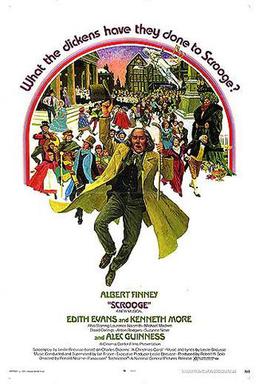
A Christmas Film Review: Scrooge (dir by Ronald Neame)


There have been many good film versions of the Charles Dickens novella, A Christmas Carol.  Several of them could even be called classics.  Everyone from Bill Murray to James Earl Jones to Tori Spelling to Fredric March has taken a turn at playing a version of the famous miser who, after being visited by three ghosts on Christmas Eve, changes his ways and becomes the most generous man in London.  This holiday season, I watched quite a few old TV shows and I was somewhat surprised to discover just how many sitcoms have featured an episode where one of the characters has A Christmas Carol-like experience.

Though actually, I shouldn’t have been surprised.  A Christmas Carol is a universal tale and it’s one that continues to be appealing 174 years after it was originally written.  You don’t have to be rich, British, greedy, or even a man to relate to what Ebenezer Scrooge goes through.  We’ve all be haunted by the past.  We’ve all wondered what we’re missing out on in the present.  And we all fear how we’ll be remembered in the future.  In fact, I would say that A Christmas Carol is probably as close to perfect you can get.  The only problem is that Bob Cratchit’s son is named Tiny Tim and any work of fiction that features a character named Tiny has to be docked a few points.

With all that said, my favorite film version of A Christmas Carol is the 1970 musical, Scrooge.

http://www.youtube.com/watch?v=g7xb1uSDxZ4

Scrooge sticks to the original details of the story.  Ebenezer Scrooge is played by Albert Finney.  (Finney was only 34 when he made Scrooge but was made up so that he looked closer to 120.)  The men, women, and spirits in Scrooge’s life are all played by a collection of distinguished British thespians.  Edith Evans is the stately Ghost of Christmas Past.  Kenneth More is the Ghost of Christmas Present, a decadent figure who drinks wine and travels around with two frightening-looking children.  Alec Guinness is a heavily chained Jacob Marley and he plays the role with just the right combination of sarcasm and concern.  (“No one else wanted to come,” Marley says when he greets Scrooge at the entrance of Hell.)  An actor named Paddy Stone is credited as playing the silent and shrouded Ghost of Christmas Future.  Let me just say that the Ghost of Christmas Future always scares me to death whenever I watch Scrooge.  I imagine little children in the 70s were traumatized by his skeletal visage.

What sets Scrooge apart is that it has singing and dancing!  That’s right, this is a musical version of A Christmas Carol, featuring songs composed by Leslie Bricusse.  Now, the overall quality of the songs is open to debate.  There’s 11 of them and really, only three of the songs are particularly memorable.  (Those songs are: I Like Life, I Hate People, and the Oscar-nominated Thank You Very Much.)  But, honestly, who cares?  The cast performs them with so much energy and enthusiasm that it’s impossible not to get swept up in it all.

(Admittedly, Albert Finney doesn’t really sing.  He just kinda growls the lyrics.  But that’s appropriate for the character of Scrooge.)

Scrooge is an outstanding production of a timeless tale.  It came on TV at least four different times this holiday season and I watched each time.  And I’ll do the same next year!

And as Tiny Tim, who did not die, said, “A Merry Christmas to all!  God Bless us, everyone!”

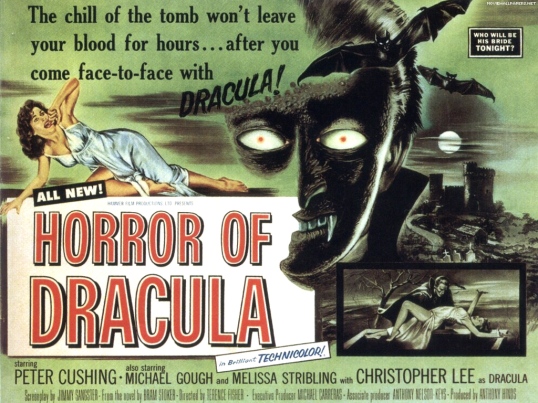
Horror Film Review Repost: The Horror of Dracula (dir by Terrence Fisher)


(As some of our longtime readers might remember, I originally posted this review on October 11th, 2013.  I’m going to be posting reviews of all of the Hammer Dracula films today so I figured I would start things off by reposting my thoughts on the very first of them, 1958’s Horror of Dracula.  Add to that, I happen to really like this review!)

horrorofdracula

Of all the monsters who have appeared in horror cinema, Count Dracula is perhaps the most iconic.  Reportedly, Dracula first appeared on film in 1920, in a silent Russian film that is now considered to be lost.  In 1921, he would appear in a Hungarian film called Dracula’s Death and in 1922, he would be renamed Count Orlok for the German masterpiece Nosferatu.  Indeed, by the time Bela Lugosi gave his famous performance in Tod Browning’s Dracula, the count had been appearing in films for at least 11 years.  In nearly 100 years of filmmaking, a countless number of actors have brought Dracula to life.

We could spend hours debating who was the best Dracula and certainly, there are some worthy contenders.  Bela Lugosi brought a continental sophistication to the role, while John Carradine was properly intimidating and theatrical.  Udo Kier, Gary Oldman, Thomas Kretschmann, Leslie Neilsen, Zandor Vorkov, and Frank Langella have all played the prince of darkness, to varying degrees of success.

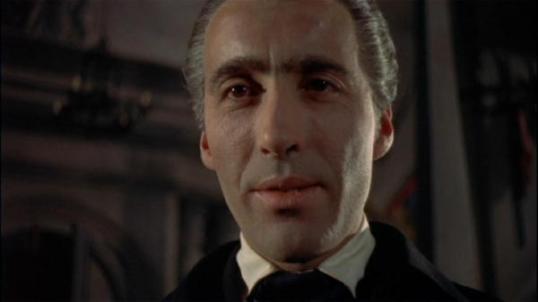
Yet for me, as worthy as any of those actors may be, there is only one true Dracula and he was played by Christopher Lee.

Lee famously played Dracula in seven movies for Hammer Films and, though he has often complained about the quality of these films (especially the later ones, which tended to mix Dracula with hippies), they were largely responsible for making Christopher Lee into the iconic figure that he remains today.  It’s also largely due to Lee’s performance that horror fans like me continue to discover and appreciate the films of Hammer today.

As played by Christopher Lee, Dracula was pure evil.  Lee’s Dracula had no use for self-pity and one can only imagine what his reaction would have been if he had ever run into the self-torturing vampires of Twilight.  Lee’s Dracula had no use for doubt or regret.  Instead, he was a determined animal who was driven by a singular lust for blood.

And yet, at the same time, Lee brought an intelligence to the role that was often lacking in previous performances.  Lee’s Dracula may have been an animal but he was a cunning animal.  Whereas it’s easy for me to imagine escaping from the clutches of Bela Lugosi, I know that if Lee’s Dracula wanted me then he would have me.  There’s no escape from Lee’s Dracula.  He’s too quick, determined, and intelligent.

Christopher Lee Is Dracula

His animal nature made Lee’s Dracula frightening but it was his cunning and determination that made him dangerous and, ultimately, even sexy.  (While I’ve read that audiences in 1931 swooned over Bela Lugosi, whatever sex  appeal he may have had is lost on modern viewers like me.)  It has often been argued that Bram Stoker meant for Dracula to be a symbol of all the desires that were repressed by Victorian society.   That’s certainly true when it comes to Christopher Lee’s carnal and viscous portrayal of the character.

Of the seven Dracula films that Christopher Lee made for Hammer Films, the first remains the best.  Released in 1958 and known as Dracula in the UK and the Horror of Dracula in the US,  it revitalized the horror genre and helped to make stars of both Christopher Lee and Peter Cushing.  Especially when compared to some of the sequels that Hammer subsequently produced, it remains one of the best Dracula films ever made.

Horror of Dracula

The film is a very loose adaptation of Stoker’s original novel.  Jonathan Harker comes to Dracula’s castle in Romania.  Though posing as a librarian, Harker has actually come to the castle to drive a stake through the heart of both Dracula and his vampire bride.  However, no sooner has Harker staked the bride than he’s overpowered and bitten by Dracula.  Significantly, all of this occurs within the first 10 minutes of the film.  As opposed to certain other Dracula films, Horror of Dracula gets straight to the point.  And why shouldn’t it?  After all, anyone watching the film already knows that Dracula’s a vampire so why waste time trying to convince us otherwise?  We don’t watch Dracula for the familiar story as much as we watch to discover how different filmmakers will choose to tell that story.

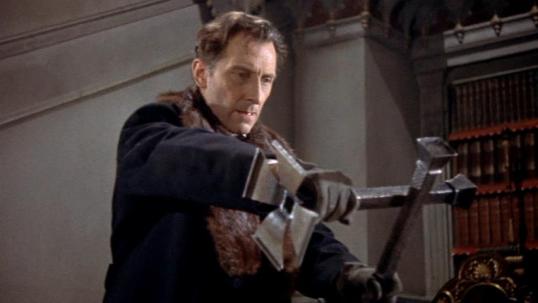
When Harker’s colleague, Prof. Van Helsing (played with the perfect amount of intensity by Peter Cushing) shows up at the castle, he discovers that Harker is now a vampire and that Dracula is nowhere to be found.

Dracula, needless to say, is out for revenge.  He stalks Harker’s fiancee Lucy, as well as Lucy’s brother Arthur Holmwood (Michael Gough) and his wife Mina (Melissa Stribling).  Much as in Stoker’s original novel, Lucy is eventually turned into a vampire and it’s up to Van Helsing and Arthur to stop both her and her new master.

(Of course, in Stoker’s original novel, Harker is not turned into a vampire and instead marries Mina while the aristocratic Arthur is one of Lucy’s three suitors.  However, I have to say that I always thought the literary Harker was a bit on the dull side and that Arthur was always my favorite character so I’m happy that he gets to be the hero here.)

If I had to pick one film to epitomize everything that I love about the Hammer brand of horror, it would be Horror of Dracula.  As directed by Terrence Fisher, the film moves at an exciting, non-stop pace while the traditionally lush cinematography is almost bombastically colorful.  Cushing and Lee, who were the best of friends off screen, make for formidable opponents, with Cushing embodying good just as effective as Lee embodied evil.  Though it’s been over 50 years since Horror of Dracula was originally released, the film remains effective and, not coincidentally, a lot of fun.

Peter Cushing as Dr. Van Helsing

Quite simply put, this is a film that, for so many reasons, remains a true pleasure to watch.

One final note — I often find myself lamenting that I was born several decades too late and I realize just how true that is whenever I watch a film like Horror of Dracula.  Seriously, I would have loved to have been a Hammer girl, showing off my cleavage and getting hypnotized by Christopher Lee.

Seriously, what more could you want?