Late Night Retro Television Review: Pacific Blue 2.17 “Runaway”


Welcome to Late Night Retro Television Reviews, a feature where we review some of our favorite and least favorite shows of the past! On Tuesdays, I will be reviewing Pacific Blue, a cop show that aired from 1996 to 2000 on the USA Network!  It’s currently streaming everywhere, though I’m watching it on Tubi.
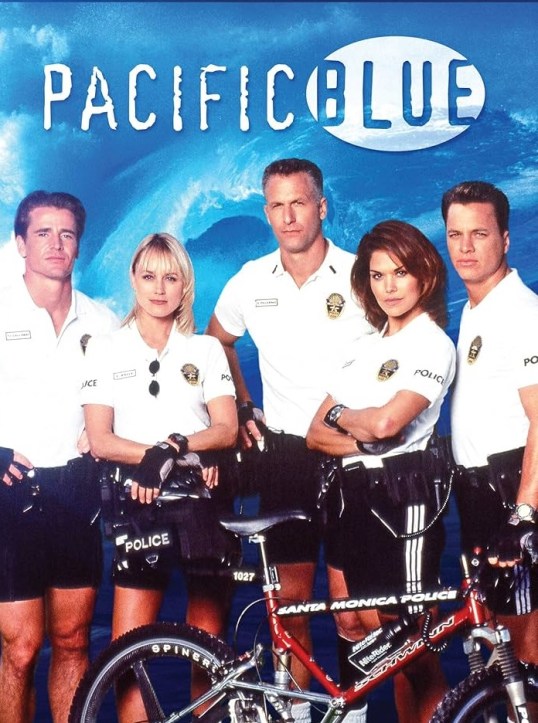
It’s time for more bicycle action.

Episode 2.17 “Runaway”

(Dir by Charles Siebert, originally aired on January 19th, 1997)

A teenage girl  (Boti Bliss) is missing on the boardwalk.  Maggie Garrity (Justina Vail), who runs the local shelter, is looking for her.  When she asks the bike patrol for help, TC is dismissive up until he looks up from his paperwork and sees Maggie.  I’ve noticed that this is a patten with the bike patrol.  It’s rare that they do anything until they see it will involve hanging out with an attractive members of the opposite sex.

TC recruits Chris to help him put up flyers.  Chris rolls her eyes because, seriously, why should a member of law enforcement be concerned with a teenage girl who has been abducted by a pimp (Gene Lythgow) and his psycho girlfriend (Ami Dolenz)?  Personally, I would dread working for Chris because she never stops complaining.  It says a lot about this show that the we’re nearly done with the second season and Chris still doesn’t have a personality beyond being whiny.

TC falls for Maggie but Maggie’s a nun!  After they manage to rescue the missing girl, TC asks Maggie if maybe she could stop being a nun for a new nights so that they could go out on a date.  Maggie says that it doesn’t work like that.  What I find interesting is that TC has no problem casually asking Maggie to give up her vows just because he wants to date her.  Hey, TC — this is why you’re single!

Meanwhile, Palermo has new expensive bicycle.  What a dork.  When the bike gets stolen, Victor has to find it.  Palermo sure is mad about his missing bike.  What a loser.

This show is not growing on me.

Horror Movie Review: When A Stranger Calls Back (dir by Fred Walton)


The 1993 film, When A Stranger Calls Back, opens with the recreation of an urban legend.

A teenager babysitter named Julia Jenz (Jill Schoelen) arrives at a big suburban house for a routine baby-sitting gig.  The two children are already asleep in bed.  All Julia has to do is sent in the living room and do her homework until the parents return from their party.  Julia settles in.  She gets one mysterious phone call but hangs up.

Then, someone knocks on the door.

The man on the other side of the door explains that his car has broken down and he asks if he can come inside to call his auto club.  (This is one of those films that could have only worked in the age of landline phones.)  Julia doesn’t want to let the man into the house but the man is insistent that he needs Julia’s help.  Finally, Julia says that she’ll call the auto club for him but, when she goes to the phone, she finds that the line is dead.  Rather than tell the man the truth, Julia lies to him and says that she called the auto club.  The man thanks Julia and says that he’s returning to his car.

(What is an auto club?)

Eventually, the man returns, knocking on the door and asking if Julia really called the auto club.  Julia continues to lie, even as the man becomes increasingly belligerent.  What Julia doesn’t know but soon discovers is that the man is not outside talking to her but he’s actually inside of the house.  And he’s abducted the children!

The opening scene, which of course harkens back to the original When A Stranger Calls, is a genuinely well-done and suspenseful sequence.  Again, much like as if with the first film, the opening of When A Stranger Calls Back is so strong that the rest of the film can’t really keep up.

When A Stranger Calls Back is indeed a sequel to When A Stranger Calls, which means that, after Julia’s terrifying night of babysitting, the film jumps forward five years.  The children are never found and the man who knocked on the door is never identified.  Julia is now a college student but she’s still traumatized by the night and has a difficult time trusting anyone.  When she starts to suspect that someone has been in her apartment, she turns to Jill Johnson (Carol Kane), who is a counselor at the college and also the protagonist from When A Stranger Calls.  Jill helps Julie out, teaching her how to shoot a gun and also calling in the man who killed her stalker, John Clifford (Charles Durning).  Clifford figures out that Julia’s stalker is probably a ventriloquist.  Personally, I think the film made a huge mistake by making the stalker a ventriloquist instead of the ventriloquist’s dummy.

Despite strong performances from Carol Kane, Charles Durning, and Jill Schoelen, When A Stranger Calls Back suffers from the same problem as When A Stranger Calls.  After a scary and effective opening sequence, the rest of the film just feels like a letdown.  The killer in When A Stranger Calls Back is not quite as wimpy as the phlegmatic British guy from the first When A Stranger Calls but still, how intimidated can you be by a ventriloquist?  An even bigger problem is that When A Stranger Calls Back cheats at the end, suddenly revealing that a character who we had every reason to believe to be dead is actually alive.  It feels a bit as cop out on the part of the film, an attempt to slap an improbable happy ending on a film that would otherwise be pretty dark.

These films make me happy that I was never responsible enough to be a babysitter.