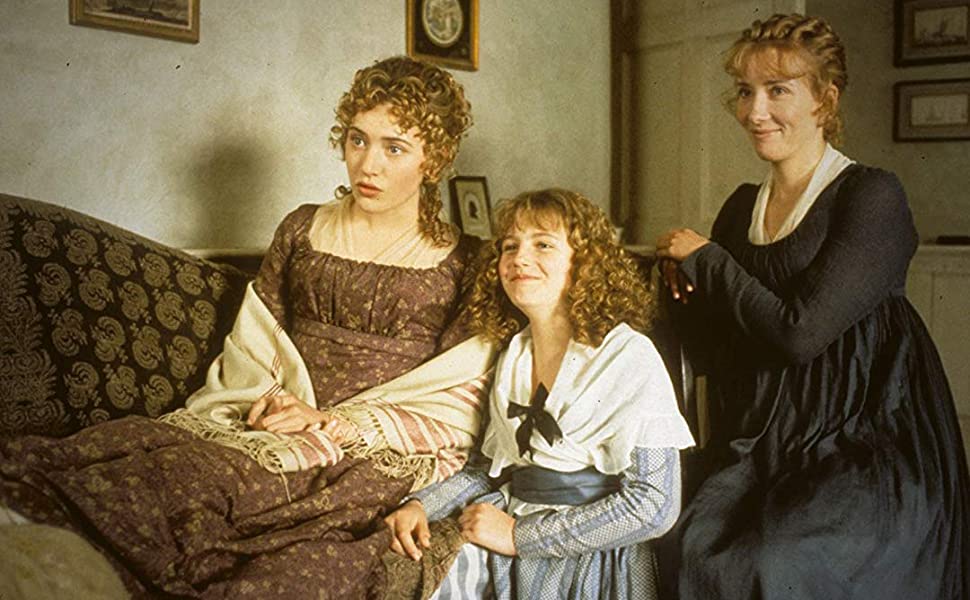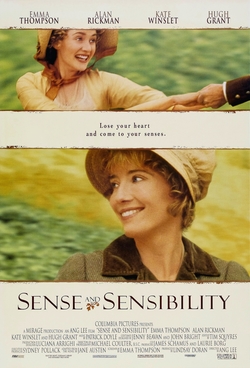
SENSE AND SENSIBILITY – 1995 was a banner year for Jane Austen and cinematic romance. This is one of my favorite scenes!


I may write mostly about the film exploits of actors like Charles Bronson, Rutger Hauer, James Woods, Clint Eastwood, and Chow Yun-Fat, but there’s no doubt that I’m a sucker for a good romance. And my very favorite romantic films are based on the works of Jane Austen. I’ve watched the 1995 TV mini-series version of PRIDE AND PREJUDICE starring Colin Firth and Jennifer Ehle at least ten times in my life. It’s just so good. My favorite Austen “book-turned-film” just may be the 1995 version of PERSUASION starring Amanda Root and Ciaran Hinds. I’ve probably watched it at least twenty times in my life. I love to watch these movies when I need a pick me up, or when I need to relax. They have hard won “happy endings” and they always leave me with a tear in my eye.

Well, it’s obvious that 1995 was an amazing year for Jane Austen adaptations, because the year also featured the release of Ang Lee’s SENSE AND SENSIBILITY starring an incredible cast that included Emma Thompson, Kate Winslet, Hugh Grant and Alan Rickman. Emma Thompson would even win an Oscar for the screenplay that she adapted for the screen. If it was up to me, she would have also won an Oscar for her performance in this scene alone, and I still get happy tears every time I watch it. *(SPOILER ALERT)* If you’ve never seen the film, and you don’t want to see how it ends, do not watch this clip. However, if you love the movie, and the scene, as much as I do, enjoy. Happy Valentine’s Day, my friends!

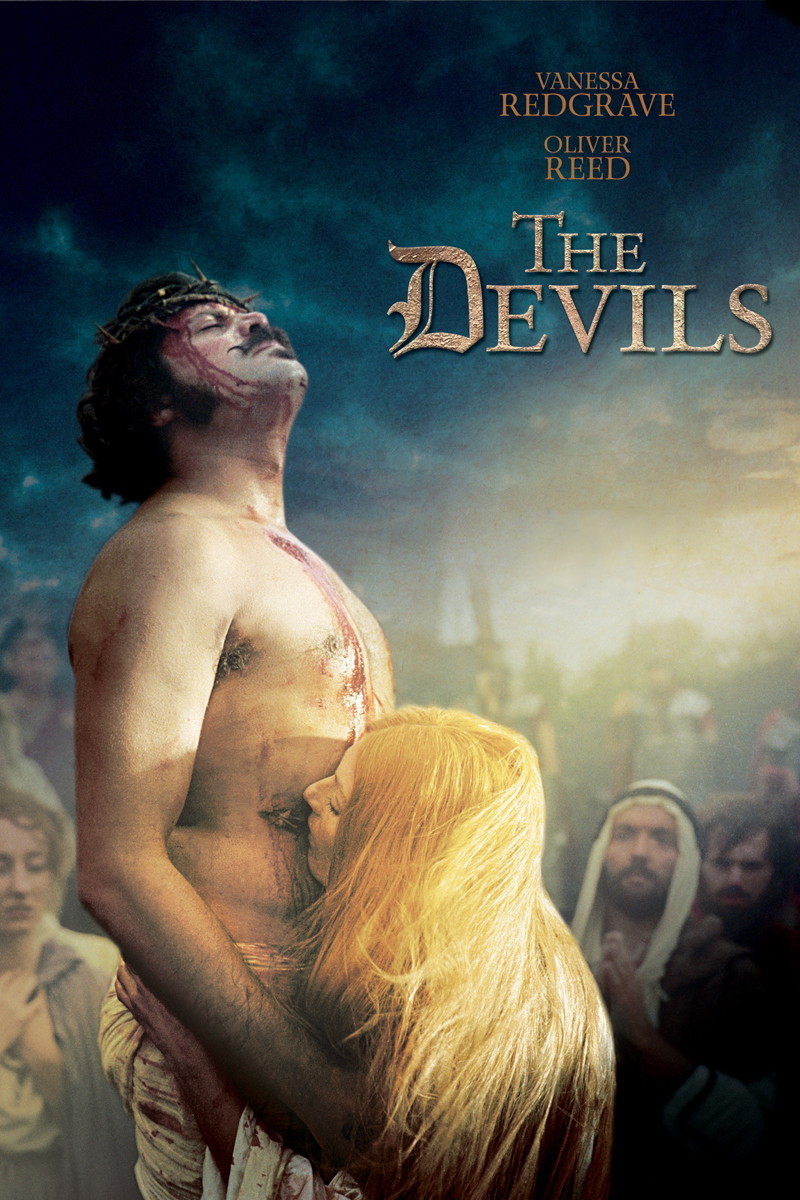
Horror Film Review: The Devils (dir by Ken Russell)


In 17th Century France, Louis XIII (Graham Armitage) may be king but it’s the devious Cardinal Richelieu (Christopher Logue) who holds the power. Richelieu has convinced that king that every walled city in France should have its walls blown up, the better to keep track of what’s actually happening within the city. Unfortunately, for Richelieu, Louis XIII promised the Governor of Louden that he would never harm any structure in the city, leaving its walls untouchable. While Louis XIII concentrates on throwing outdoor parties where murdering protestant is the main source of entertainment, Richelieu searches for an excuse to destroy the walls of Loudon.

Along with being frustrated by the fact that Loudon retains its walls, Richelieu is also upset that the unofficial leader of the city is Ubrain Grandier (Oliver Reed), a decadent priest who has not only criticized the discipline of clerical celibacy but who has also publicly opposed the Cardinal’s efforts to increase his own political power. Grandier has made it clear that, as long as he’s in control, the walls of Loudon will never came down and the people of Loudon, fearful of the plague that is ravaging the world outside of the walls, support him.

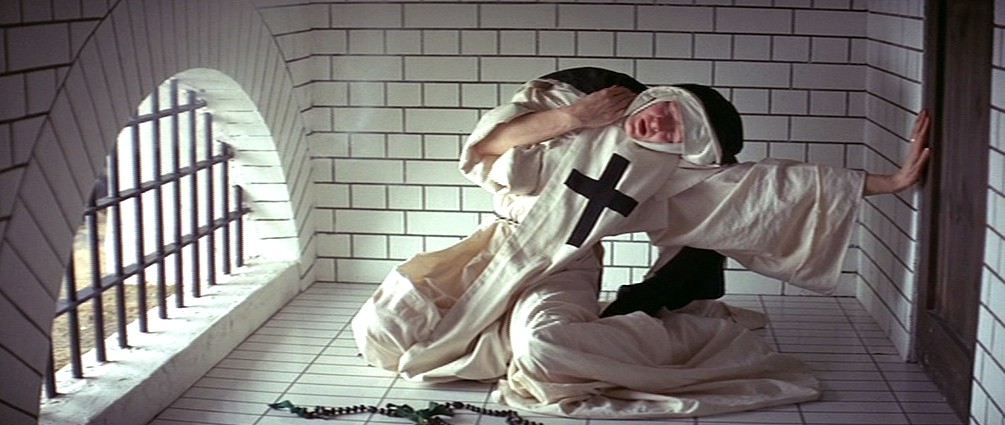
Among Grandier’s many admirers is Sister Jeanne des Agnes (Vanessa Redgrave), a hunchback who is also the abbess of the local convent. Having become sexually obsessed with Grandier, Agnes requests that he become the confessor of the convent. When Grandier refuses, it sets off a chain reaction that eventually leads to Grandier being accused of worshipping the Devil and “bewitching” Sister Agnes and several other nuns. With the arrival of Father Barre (Michael Gothard), a fanatical witch hunter, the city of Loudon descends into darkness and decadence.

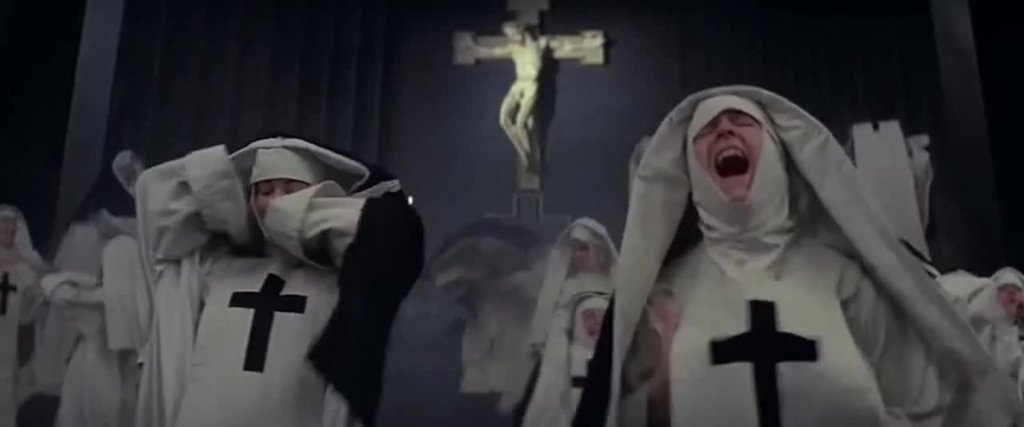
Directed by the infamous (and, let’s just admit it, brilliant) Ken Russell and first released in 1971, The Devils is not an easy film to see. When the film was originally released in Britain, it was controversial for its uncompromising depiction of 17th century torture and its combination of religion and sexual imagery. (This, of course, was a recurring theme in almost all of Russell’s work.) The British censors demanded a few minor cuts before agreeing to approve the film for release. While the British censors focused on the scenes of violence, Warner Bros. also removed several sexually explicit scenes, the most infamous of which was a sequence in which a group of naked nuns sexually defiled a statue of Christ. Also removed was a scene of a priest masturbating while watching the nuns and finally, a scene in which Sister Jeanne masturbated with a charred femur bone. Russell was not happy with the changes and, needless to say, he was even more upset when Warner Bros. removed an additional three minutes before releasing the film in the United States.

In the U.S., The Devils was even more controversial than it had been in the United Kingdom and, while many critics praised it as being a powerful attack on hypocrisy, others described it as merely being pornographic. Despite the cuts that were made, the American version of The Devils was slapped with an X rating and Warner Bros. attempted to distance itself from the controversy that had developed around the film. As of this writing, The Devils has never been given a proper Region 1 DVD or Blu-ray release. It’s rare that ever shows up on any streaming platforms. Even YouTube has only a handful of scenes. If you want to watch The Devils in America, you’re going to have to track down a VCR player and watch it on VHS. And, even then, you’ll only be seeing the version that was cut for the U.S.

Will Ken Russell’s original, uncut version ever be seen in America? It’s a question that many film students have asked themselves. In 2002, a 117-minute edition of The Devils played in London, featuring some of the footage that was cut from the film’s original release. However, that version is still considered to be incomplete and it’s certainly not available here in the United States. The Devils does occasionally show up on Shudder, which is how I saw it earlier this year. Of course, the Shudder version was the cut American version, which Russell repeatedly disowned.

Watching the film, I could understand Russell’s anger. It wasn’t just that scenes had been cut out of the film. It was that the scenes were often edited out with such a lack of finesse that it made the film seem disjointed. Russell was a director known for his hallucinatory and deliberately over-the-top style. When the film abruptly cuts away from showing us its most shocking images, it feels antethical to everything that Russell was about as a filmmaker. On the one hand, it’s easy to say, “Who cares if a scene of Vanessa Redgrave masturbating with a charred femur bone has been removed from the film? Who wants to see that?” But if you watch The Devils, it becomes apparent that it’s not about what would be pleasant to see. Indeed, in many ways, The Devils is meant as a deliberate attack on the senses, one in which shocking imagery is used to awaken the audience from their complacency. As such, the controversy about how the film was cut is not about what’s acceptable. Instead, it’s about the fact that Russell has created a world where it somehow makes total sense that Sister Jeanne would pick up the femur and make use of it. By editing the scene so that it abruptly ends with Jeanne merely looking at the bone, Warner Bros. forced The Devils to not be true to itself.

And yet, despite all of that, The Devils remains a powerful and disturbing film, a hallucinatory collection of nightmarish images and haunting scenes. The excessive stylization that was Ken Russell’s trademark is perfect for this story of an entire community caught up in a frenzy of paranoia and repression. Though a period film (and based on a true story), Russell’s Loudon resembles an alien landscape, an almost expressionistic city of pristine walls and dirty streets. Vanessa Redgrave’s twisted nun stalks through the film like an ominous spirit, both wanting and hating Grandier at the same time. When the “possessions” begin, the possessed finally have the excuse to do what they truly want and to live just as wantonly as the men who previously controlled their lives. Because they’ve come to believe that they’re no longer responsible for their own actions, they can indulge in every depravity. But with Louis XIII casually murdering protestants for sport at his estate and Richelieu manipulating church policy to his own ends, the film asks why the people’s actions are more worthy of condemnation than the actions of the people who rule them.

The Devils has reputation for being blasphemous. It is, of course, nothing of the sort. After I watched the film, I did a little research and I was not surprised to discover that Ken Russell was a practicing Catholic because only a Catholic could make a film that both celebrated what the Church could be while also condemning it for so often falling short. While Richelieu represents the people who use religion as a vehicle for their own drive for power and Sister Jeanne and the witch-hunter Father Barre represents the fanatics who use church doctrine to justify their own madness, it is the sinner Father Grandier who represents what the Church should be. It is Grandier who is ultimately forced to put his own life at risk to protect the people of Loudon.

Is The Devils are horror film? Some would probably argue with my claim that it is. They would probably claim that it’s a historical drama with a heavy political subtext, However, for me, the imagery itself is disturbing enough to justify calling The Devils a horror film. The possessed of Loudon eventually prove themselves to be as mad as any of the infected people from George Romero’s The Crazies and the torture that Grandier suffers is frightening specifically because it’s all based on fact. There really was a town named Loudon that had walls. There really was a priest named Grandier who was accused of practicing witchcraft and who suffered the most vile torture as a result.. The Devils is a film about people driven made by a combination of repression and fanaticsm. It’s a horror film because it’s true and, needless to say, the madness that possessed Loudon didn’t die out in the 17th Century. It’s continued into the present day.

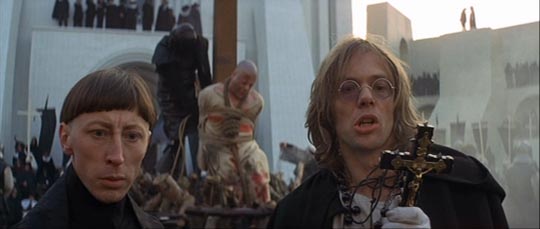
Oliver Reed may seem like an odd choice to play a priest but he gives one of his best performances as the charismatic but foolishly cocky Grandier. Vanessa Redgrave is frightening as the disturbed Sister Jeanne and British actor Murray Melvin is alternatively sympathetic and pathetic as a priest who comes to believe in Grandier’s innocence. For me, though, the film is stolen by Michael Gothard, who plays the fanatical witch hunter, Father Barre. With his long hair and his glasses, Father Barre bears a definite resemblance to John Lennon and the film portrays him as being the 17th century equivalent of a rock star, an arrogant and sensual man who encourages people to indulge in their most secret desires so that he can then declare them to be possessed and in need of an exorcism. Gothard had a magnetic screen presence, allowing him to steal scenes from even formidable talents like Oliver Reed and Vanessa Redgrave. Gothard would go on to play the silent assassin in the James Bond film, For Your Eyes Only and was, again, memorably threatening. Sadly, Gothard took his own life in 1992.

Someday, perhaps the full unedited version of The Devils will be available. Until then, even the edited version retains its power to shock, disturb, and make you think. Today, more than ever, its portrait of hypocrisy and mass madness feels relevant. The modern age is still ruled by hysteria and paranoia and our leaders are still looking for any excuse to take down any walls that might protect us from having to submit to their will. How different is Sister Jeanne from the people who are currently hurling accusations on social media? How different is Father Barre from the the people who were are currently told have all the answers? We may no longer burn people at the stake but we’ve found new ways to silence voices of dissent. The film may have been set in 17th Century France and first released in 1971 but Ken Russell’s masterpiece is all about the modern age. The Devils in not an easy film to watch or find but it is more than worth the effort to track down.


Lisa Reviews An Oscar Nominee: Sense and Sensibility (dir by Ang Lee)


Sense_and_sensibility

I just finished watching the 1995 best picture nominee Sense and Sensibility on TCM and, despite the fact that I’ve watched it several times in the past, I’m glad that I took time to rewatch it.  Sense and Sensibility is one of those very special films that you should rewatch every few months just to be reminded of how good it is.  There’s no CGI in Sense and Sensibility.  Instead, there’s just some very good writing, some excellent performances, and some lushly wonderful images of the English countryside, courtesy of director Ang Lee.  It’s a deliberately paced film, one that proves the virtue of a subtle touch.

The film tells the story of the Dashwoods.  As Mr. Dashwood (Tom Wilkinson) dies, he tells his son by his first wife, John (James Fleet), to take care of his second wife (Gemma Jones) and their three daughters, Elinor (Emma Thompson), Marianne (Kate Winslet), and Margaret (Emilie Francois).  Naturally enough, John does the exact opposite and soon the Dashwood sisters are forced to leave their large estate and fend for themselves.

The film centers on the practical Elinor and the passionate Marianne.  Elinor meets and falls in love with Edward (a surprisingly restrained Hugh Grant), an aspiring clergyman who is also John’s brother-in-law.  Edward comes from a wealthy family but will be disinherited if he marries someone who has neither money nor social prominence.  Marianne, meanwhile, has fallen in love with John Willoughby (Greg Wise), who is handsome, dashing, rich, and a bit of a cad.  (Cad is such a cool word.  People should start using it more.)  Marianne is so in love with the unworthy Willoughby that she misses the fact that the kindly Col. Brandon (Alan Rickman) has also fallen in love with her.

Sense and Sensibility is based on a Jane Austen novel and, in its very British way, it’s a wonderfully romantic film.  Tonight, when viewed in the shadow of the recent passing of Alan Rickman, the scenes featuring Col. Brandon were even more poignant than usual.  His love for Marianne is perhaps the most pure and selfless love to be found in the entire film.  There’s a scene where Col. Brandon is speaking to Elinor and Marianne, inviting them to his estate.  Marianne ignores him until Brandon mentions that Willoughby is also inspected.  Suddenly, Marianne looks up and smiles and Alan Rickman allows just a hint of pain to enter his voice.  It’s a masterful performance.

But really, the reason why I love this film is because it’s about sisters. I am the youngest of four sisters and, whenever I see this film, it’s hard for me not to see the Bowman sisters in the Dashwood sisters.  There is so much about Marianne that I relate to, from her passionate pursuit of “true love” to her artistic sensibility to her somewhat dangerous habit of wandering around in the middle of thunderstorm.  You never doubt for a second that Emma Thompson and Kate Winslet could be related and this film always makes me appreciate my own sisters.

Sense and Sensibility was nominated for Best Picture of 1995 but it lost to a film that is its total opposite, Mel Gibson’s Braveheart.

The Daily Grindhouse: The Devils (dir. by Ken Russell)


With Michael Reeves’ Witchfinder General having found some notoriety for it’s graphic depictions of the witchfinding and inquisition of suspected witches and sorcerers in ravaged England during it’s English Civil War during the 17th-century the world of film, especially the grindhouse and exploitation cinema of the day, founded a new subgenre of horror (folk horror) and also one in the niche world of exploitation. Nunsploitation would be ushered in during the late 60’s and right through the 1970’s of grindhouse cinema with films like Reeves and another which many thought was influenced heavily by the Vincent Price-starred production.

Ken Russell’s The Devils has had a recent rethinking as a film that was less exploitation and more of an arthouse film of the early 70’s which many called one of the more influential films of it’s era. No matter what recent thought on the film might have labeled Russell’s film I always thought it was one of the finer examples of nunsploitation cinema which has of late become more in tune with fetishic pornography than straight-out exploitation horror.

The film starred Oliver Reed and Vanessa Redgrave and was set in 17th-century France during the reign of King Louis XIII and the rise of his Catholic advisor in Cardinal Richelieu. Just like Reeves’ film, The Devils was based on the true historical account of the French priest Urbain Grandier of Loudon who was accused of witchcraft and subsequently executed because of these accusations.

Russell, who has mentioned that he got nothing from Reeves’ film as inspiration and actually hated the Witchfinder General, would take the graphic scenes of torture and sadism of Reeves’ film and ramp it up to the next level. He wouldn’t just include even more graphic scenes of sadistic violence in his own film, but add scenes of sex and perversion (even for the type of film it was The Devils pushed the boundaries of decency of the era) which would see Russell’s film banned from many areas in the UK. The film even split the critics of the day with some calling the film awful and debased while some would nominate the film and it’s director for prestigious film circle and festival awards.

The Devils would be heavily censored in its native UK and even in the US upon it’s release. As time went by the film began to garner new accolades as more open-minded critics began to look at Russell’s film under a new light. While more and more critics of todaycontinue to heap artistic and creative accolades upon this film that it’s begun to shed it’s exploitation roots I still believe that at it’s heart The Devils was and is still nunsploitation at it’s best.