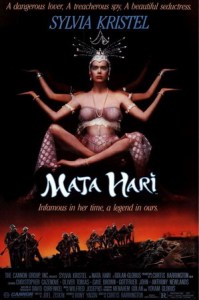
Europe, during World War I. The beautiful dancer, Mata Hari (Sylvia Kristel), is in love with two different soldiers, one German and one French. (The soldiers, played by Olivier Tobias and Christopher Cazenove, are also friends though they are now on opposite sides of the Great War.) Forced into the world of decadent, high class espionage by Frau Doktor (Gaye Brown), Mata Hari sleeps with everyone, shares information with both the Germans and the French, and tries to prevent more people from dying. Just as in history, Mata Hari ultimately has to face a firing squad but not before taking part in threesomes, voyeurism, and a topless sword fight.
The original Emmanuelle in a Cannon Film based on the life of the famed seductress Mata Hari? It sounds like it should be great but Mata Hari is mostly dull. I’ve read that Mata Hari was heavily edited before it was released in the United States so maybe that explains why the film is so choppy and nearly impossible to follow. I was never sure who Mata Hari was spying for and, after a while, I no longer cared. Sylvia Kristel is frequently naked, which explains why Mata Hari was once a Skinemax staple, but Kirstel later wrote that she was addicted to both cocaine and alcohol while making Mata Hari and maybe that partially explains why she seems to be so mentally checked out through the entire film. I don’t blame her. I checked out too.
One final note: About that topless sword fight, it sounds cooler than it actually is.
It may seem strange, at first, that I am including the 1971 best picture nominee, A Clockwork Orange, in a series of Back to School reviews. Certainly, Stanley Kubrick’s iconic adaptation of Anthony Burgess’s novel is not usually described as being a film about juvenile delinquency but that’s exactly what it is.
Many viewers tend to forget that Alex (played by Malcolm McDowell, who was nearly 30 at the time) and his three droogs are all meant to be teenagers. (Only Michael Tarn, who played Pete, was actually a teenager at the time the film was shot. Warren “Dim” Clarke and James “Georgie” Marcus were both in their late 20s.) There’s even a lengthy scene in which Alex is interrogated by a social worker, P.R. Deltoid (Aubrey Morris). Viewers are usually so surprised when Deltoid suddenly grabs Alex’s crotch that they forget that the whole reason Deltoid even came to the flat was to find out why Alex had been skipping school. (“Pain in my gulliver,” was Alex’s oft-quoted excuse.)
So, make no mistake about it. Among other things, A Clockwork Orange is a film about both the problem of juvenile delinquency and the continuing debate concerning what the authorities should do about it. Stylistic and philosophical differences aside, A Clockwork Orange comes from the same cinematic family tree that’s given us everything from Rebel Without A Cause to Bully to Spring Breakers.
Of course, that’s not all that A Clockwork Orange is about. It’s a Kubrick film, which means that there’s several different layers to work through and multiple interpretations for what we see on-screen. For those who may not be familiar with the film, it takes place in a recognizable but futuristic England. (One of my favorite theories is that A Clockwork Orange was about what was happening on Earth while David Bowman was becoming the starchild in 2001: A Space Odyssey.) It’s a violent world, one where there appears to be significantly fewer people around than in the past. The streets are deserted and bombed out. Occasionally, when Alex returns to his home, he passes a mural of idealized working men creating a new world. This rather banal work of Socialist realism has been defaced by obscene drawings and mocking graffiti.
Teenage Alex spends his nights hanging out with his friends (or, as he calls them, droogs), Pete, Georgie, and Dim. They drink at the Korova Milk Bar and wear obscenely oversized codpieces, signifying this society’s obsession with outsized masculinity. When they speak (and when Alex narrates the film), they do so in a rhyming slang called Nadsat. Under Alex’s sociopathic leadership, they spend their nights raping women, beating the homeless, and fighting with other gangs. When Alex is not with his droogs, he enjoys lying around the house and listening to Beethoven (or “Ludwig Van” as he calls him).
After being betrayed by his droogs (who have tired of Alex’s cockiness), Alex ends up imprisoned for murder. However, Alex is offered an early release if he’s willing to take part in the Ludovico Treatment. For two weeks, Alex is drugged and forced to watch violent and sexual films while the music of Beethoven plays in the background. As a result of the treatment, Alex grows physically ill at the thought of both violence and sex but he can also no longer listen to Beethoven. Arguably, as a result of being cursed of his anti-social tendencies, he has lost the only non-destructive thing that he enjoyed.
Over the objections of the prison chaplain (who argues that robbing Alex of his free will is not the same as rehabilitating him), Alex is sent back into the real world and he quickly discovers that he now has no place in it. His parents have rented his room out to a boarder who is now more of a son to them than Alex ever was. The streets are full of men who were previously tormented by Alex and who now wants revenge. In perhaps the film’s most brilliant moment, Alex discovers that his former droogs are now members of the police force. Though they may now be wearing uniforms, Dim and Georgie are still as destructive and dangerous as Alex once was. The difference is that Alex was caught and cured whereas Dim and Georgie discovered they could do just as much damage as authority figures as they did as juvenile delinquents.
In fact, the only people who now care about Alex are the political dissidents who hope to use Alex to discredit the government. However, the dissidents aren’t particularly worried about Alex’s well-being either. He’s just a prop to be used for their own ambitions. Even worse, for Alex, is the fact that one of the dissidents is Mr. Alexander (Patrick Magee), a writer who lost both his ability to walk and his wife to an earlier assault committed by Alex…
(Interestingly enough, Mr. Alexander’s boyguard is played by David Prowse, who later become the ultimate symbol of government oppression when he was cast as Darth Vader in Star Wars.)
A Clockwork Orange is a brilliant film but it’s one about which I have very mixed feelings. On the one hand, you can’t deny the power of the film’s imagery. How many times has just the opening shot — of McDowell staring at us while wearing one fake eyelash — been imitated on TV and in other movies? How much of the film’s dialogue — from “pain in my gulliver” to “the old in-out” — has lived on long past the movie? Regardless of how many times I’ve seen A Clockwork Orange, the film’s electronic score (from Wendy Carlos) never ceases to amaze me. Finally, it’s a film that argues that free will is so important that even a sociopath like Alex must be allowed to have it and that, as the chaplain argues, true goodness comes from within and cannot be manufactured or regulated by a government agency. (It’s also a film that suggests that the government would be just as quick to use the Ludovico Treatment not just on the evil Alexes on the world but on anyone who dared to dissent from the party line.) As I’m something of a “Freedom of Choice” absolutist, that’s a message to which I responded.
(At the same time, A Clockwork Orange does not argue that Alex’s actions should be free of consequences. If anything, the film’s message seems to be that things would have been better for literally everyone if the government had just left Alex in jail, as opposed to trying to “fix” what was wrong with him.)
And yet, I have mixed feelings about A Clockwork Orange. I guess my main issue is that the film doesn’t always play fair. Malcolm McDowell is allowed to give a charismatic and well-rounded performance as Alex but nearly everyone else in the film is directed and written as a one-dimensional caricature. Whereas Anthony Burgess’s novel emphasized the very real damage that Alex did to his victims, the film tends to surround Alex with comedic grotesqueries. By both making Alex the only fully developed character in the entire film and then casting the energetic and charismatic Malcolm McDowell in the role, the film seems, at times, to come dangerously close to letting Alex off the hook for his worst crimes. It also leaves the film open to the oft-repeated charge of glamorizing sex and violence. (According to Roger Lewis’s biography of the author, that was Anthony Burgess’s opinion of the film.) For the record, I don’t think A Clockwork Orange is an immoral film but I understand why some people disagree.
For that reason, A Clockwork Orange remains a controversial film. In fact, I’m somewhat surprised that this subversive and deliberately confrontational film was nominated for best picture. It was only the 2nd (and last) X-rated film to receive a best picture nomination. Though it lost to The French Connection, A Clockwork Orange continues to be a powerful and controversial film to this day. Perhaps the biggest indication of A Clockwork Orange‘s success is that it’s still being debated 45 years after it was first released.
 Europe, during World War I. The beautiful dancer, Mata Hari (Sylvia Kristel), is in love with two different soldiers, one German and one French. (The soldiers, played by Olivier Tobias and Christopher Cazenove, are also friends though they are now on opposite sides of the Great War.) Forced into the world of decadent, high class espionage by Frau Doktor (Gaye Brown), Mata Hari sleeps with everyone, shares information with both the Germans and the French, and tries to prevent more people from dying. Just as in history, Mata Hari ultimately has to face a firing squad but not before taking part in threesomes, voyeurism, and a topless sword fight.
 Through the Shattered Lens