Lisa Marie Reviews An Oscar Nominee: The Banshees of Inisherin (dir by Martin McDonagh)


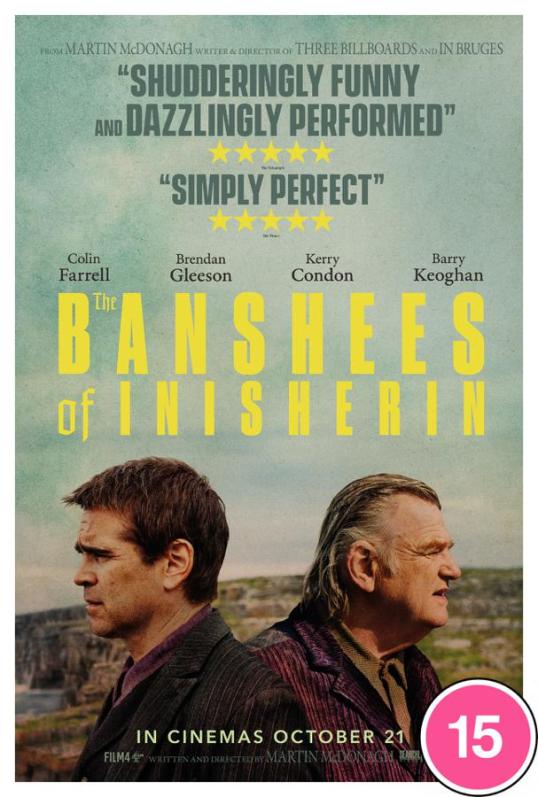
2022’s The Banshees of Inisherin takes place in 1923, near the end of the Irish Civil War.

On the fiction isle of Inisherin, the inhabitants are safe from the the fighting happening on the main land.  Occasionally, they can hear the gunfire and the explosions coming from Ireland but, for the most part, they’re content to go about their lives the same as they always have.  A few do dream of changing their routine.  Young Dominic Kearney (Barry Keoghan) has a crush on Siobhán Súilleabháin (Kerry Condon), who herself occasionally entertains the idea of leaving Inisherin and seeking something better.  But, for the most part, everyone is happy with doing the same thing over and over again.  They know exactly when they will see each other.  They know where everyone will be at any given moment of time.  They know that Colm Doherty (Brendan Gleeson) will be playing his fiddle at the pub or sitting in his cottage with his dog.  They know that every morning, he will have a drink with his best friend (and Siobhan’s brother), Padraic (Colin Farrell).

Except, one day, Colm abruptly tells Padraic that he no longer wants to be his friend.

Padraic has a difficult time understanding what Colm could possibly mean.  He and Colm have always been friends.  How can Colm suddenly no longer be his friend?  Making things even more frustrating is that Colm refuses to explain what, if anything, Padraic has actually done to make Colm no longer want to be his friend.  The closest thing to an explanation that Padraic gets is that Colm finds Padraic to be boring.  Colm, who composes music and, at the very least, seems to spend a good deal of time in contemplation, is tired of Padraic’s jokes and his simple ambitions.  He’s even tired of hearing about Padraic’s pet donkey, Jenny.  In order to show how sincere he is in his desire to no longer speak to Padraic, Colm says that he will chop off one of his fingers every time that Padraic speaks to him.  Padaic, who loves to talk and really doesn’t have anyone other than Colm and his sister to talk to, is shocked when fingers start to show up at his home.  It only escalates from there.

It’s a darkly funny movie, which is no surprise considering that it was written and directed by Martin McDonagh.  If anyone can make you smile while discussing mutilating himself, it’s Brendan Gleeson.  At heart, though, The Banshees of Inisherin is a deadly serious film with the characters of Colm and Padraic obviously meant to represent more than just two friends who are no longer speaking.  Colm, in his desire to have something more to his life than just his boring life in Inisherin, chops off his fingers and leaves you wondering how he will be able to play the fiddle that he loves so much.  It seems counter-productive but once Colm says he’s going to do it, he has no choice but to follow through.  The simple-minded but achingly sincere Padraic goes from simply being emotionally wounded to being vengeful over Colm’s rejection.  It’s easy to see that Colm originally ended the friendship because he was depressed and feeling as if he had wasted his entire life on Inisherin.  Unfortunately, by the time Colm and Padraic come to understand this very common emotion, they’re both too far gone to turn back.  While Colm and Padraic go from being friends to sworn enemies, Dominic attempts to be more assertive and Siobhan dreams of perhaps the same thing that motivates Colm, an escape from Inisherin.

The Banshees of Inisherin is a well-acted and thought-provoking film, one that mixes serious of heart-rendering drama with scenes of dark comedy.  Brendan Gleeson, Colin Farrell, Barry Keoghan, and Kerry Condon were all Oscar-nominated for their work here.  It’s hard to believe that this was Gleeson’s first nomination.  (Gleeson lost Supporting Actor to Ke Huy Quan for Everything Everywhere All At Once.  I would argue that Gleeson should have been nominated for Best Actor and that he deserved the Oscar over The Whale‘s Brendan Fraser.)  Farrell and Gleeson are believable as both lifelong friends and sudden enemies.  Farrell delivers his lines with such earnest conviction that he actually brought tears to my eyes.

Despite having received 9 nominations, The Banshees of Inisherin didn’t win in any of its categories, not even for Best Original Screenplay.  The Banshees of Inisherin lost Best Picture to Everything Everywhere All At Once, a true Oscar injustice.
Film Review: Michael Collins (dir by Neil Jordan)


Released in 1996, Michael Collins tells the story of the early 20th century struggle of Ireland to gain independence from Britain.

Liam Neeson stars as Michael “Mick” Collins, the revolutionary leader who perfected the use of guerilla warfare against the British and then, in the greatest of ironies, found himself fighting some of his former allies during the Irish Civil War.  Aidan Quinn plays Mick’s friend and fellow revolutionary, Harry Boland.  Both Harry and Mick fall in love with Kitty Kiernan (Julia Roberts).  Stephen Rea shows up as Ned Broy, a member of the Dublin police department who is inspired by Mick’s words to become a double agent.  Charles Dance has a cameo as the fearsome Soames, a British intelligence agent who is sent to Ireland to violently put down the Irish insurgency.  Finally, Alan Rickman plays Eamon de Valera, who goes from being one of Mick’s strongest allies to being one of his fiercest rivals.  The film follows Collins from the Easter Rising of 1916 to his eventual assassination in 1922, providing a look at the history of Ireland that is as much directed towards those outside of Ireland as those on the inside.

When watching Michael Collins, it helps to have a working knowledge of Irish history.  Otherwise, it can occasionally be a bit difficult to keep track of who is angry with who at any particular point in time.  Of course, it should be noted that the movie itself is not exactly historically accurate.  In the film, the gentle and likable Ned Broy becomes a victim of British bloodlust.  In real life, Ned Broy outlived Michael Collins by several decades and died peacefully at the age of 84.  For that matter, the film presents Eamon de Valera as being coldly Machiavellian and it suggests that de Valera was jealous of Mick’s popularity.  Though both Rickman and director Neil Jordan later said it wasn’t intentional, the film also seems to suggest that de Valera played a role in Collins’s assassination.  While Eamon de Valera remains a controversial figure for many reasons (including his neutrality during World War II), Jordan has said that he feels de Valera was not necessarily treated fairly in Michael Collins and indeed, de Valera — who plays as big a role in the founding of the Irish republic as anyone — is portrayed as often being ineffectual and unwilling to truly put himself at risk to fight the British.  De Valera’s relationship with Collins was undoubtedly more complex than portrayed in this film but, when one makes a movie for an international audience, nuance is often the first thing that’s abandoned.

Seen today, 29 years after it was released, Michael Collins is an impressively made film that has a few inescapable flaws.  It’s gorgeous to look at, full of moody shots of dark Dublin streets.  The violence is often shocking and Jordan doesn’t shy away from considering the moral implications of Collins’s guerilla warfare.  Michael Collins doesn’t make the mistake of blindly celebrating violence, which would be a valuable lesson for the world’s current crop of self-styled revolutionaries if they were only willing to hear it.  Having gotten used to seeing Liam Neeson cast in one generic action film after another, it was interesting to watch Michael Collins and see what a good actor he truly could be.  Even in 1996, He was perhaps a few years too old to playing a man who was only 31 when he died but Neeson still plays the role with a ferocious charisma that makes him believable as a leader.  His scenes with Aidan Quinn have a joie de vivre that brings out the both in best actors.  Alan Rickman is memorably sinister as Eamon de Valera and Stephen Rea’s gentle style makes Ned Broy into a truly tragic figure.  That said, the very American Julia Roberts feels miscast as Kitty Kiernan.  One gets the feeling that she was cast solely for her box office appeal.  Every film, the feeling goes, needs  a love story and those love stories need to be between people with familiar faces and Roberts is such a familiar face that her every appearance in the film feels like a distraction from the story being told.  That said, the film captures the excitement and danger of being in the middle of history-making events.  It’s a historical epic that’s never boring and manages to hold the viewer’s interest.

Michael Collins is ultimately a flawed but entertaining look at the early days of the Irish republic.

Embracing the Melodrama Part II #122: Calvary (dir by John Michael McDonagh)


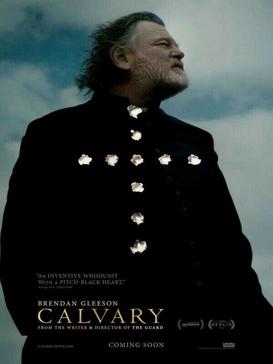
Calvary_movieposterCalvary was probably the best movie of 2014 that you did not see in a theater.  I missed seeing it during its brief theatrical run in the States.  If I had seen it when it was originally released, my list of the best films of 2014 would have been far different.  Calvary is an amazing film that takes a serious and intelligent look at issues of faith, morality, guilt, and absolution.  It is one of the best films about Catholicism that I’ve ever seen.

The film, which was written and directed by John Michael McDonagh (who previously gave us The Guard), tells the story of an Irish priest, Father James (Brendan Gleeson).  During confession, an unseen parishoner tells James about the horrific sexual abuse that he suffered as a child.  The parishoner explains that the priest who abused him has since died so the parishoner plans to get his revenge on the Catholic Church by killing James.  He tells James to meet him on the beach next Sunday.  He also informs James that his death will mean more because James is a “good man.”

The rest of the film follows James over the course of what could be the last week of his life and we watch as James struggles to fulfill his priestly duties in a world that seems to be moving further and further away from the Church.  While everyone seems to come to him with their problems and their questions, few people seem to share James’s faith and James is often left to wonder whether he’s doing any good at all.

For instance, when he confronts the local butcher (Chris O’Dowd) for beating his wife, the butcher refuses to admit that he did anything wrong.  When he goes to prison and talks to a serial killer (Freddie Joyce) who wants forgiveness, James replies that he can’t be forgiven because he feels no guilt.  The local millionaire (Dylan Moran) offers to donate money to the church but also confesses that he made his money through illegal means.  A local doctor, a hedonistic, cocaine-snorting atheist played by Aiden Gillen, takes perverse pleasure in taunting James for caring about death.  When James attempts to talk to a local girl, the girl’s father accuses him of being a pedophile.  When the local church catches on fire, nobody in the village seems to care.  And finally, one night, James returns home to discover that someone has murdered his beloved dog.

And yet, there are good moments as well.  James prays with a woman (Marie-Josee Croze) who has just lost her husband.  James gets chance to bond with his emotionally unstable daughter, Fiona (Kelly Reilly).  James successfully counsels a troubled young man (Killian Scott) and befriends an American writer (M. Emmett Walsh).

And, as Sunday approaches, James is forced to decide whether to leave his parish or to go to the beach.

Calvary is a great film, one that consistently takes you by surprise and forces you to think.  In many ways, James serves as a stand-in for the entire Catholic Church.  He’s made mistakes, he’s been battered, and he struggles with doubt.  And yet, at the same time, he is still capable of doing so much good.  Calvary is one of the best Catholic films ever made.

And it also features Brendan Gleeson’s best performance to date.  That is truly saying something because Brendan Gleeson is one of our greatest actors.  Gleeson is onscreen for every minute of Calvary and his emotional and, at times, warmly humorous performance is an amazing thing to behold.  When we first see James, he’s a weary and burned-out man.  Over the course of the week (and the film), he goes from being frightened to angry to sad to eventually achieving a state of grace.

It’s a great performance in a great film.

You may have missed Calvary in 2014.

Don’t miss it again.