Lisa Reviews An Oscar Nominee: For Whom The Bell Tolls (dir by Sam Wood)


For_whom_movieposter

After I watched The Pride of the Yankees, it was time to watch For Whom The Bell Tolls on TCM.  Based on the classic novel by Ernest Hemingway, the film version of For Whom The Bell Tolls was released in 1943 and, when I first started watching it, I was a little bit worried.

For, you see, For Whom The Bell Tolls is an extremely long film.  It’s a film that takes its time.  It’s also a very talky film and I have to admit that one reason I was worried was because the movie started at 11:30 and it was scheduled to last until 2:15 a.m.  Oh my God, I wondered, as the film started to slowly play out before me, am I going to end up dozing off before this is finished?

Well, I need not have worried.  Yes, For Whom The Bell Tolls does take a while to get started but it all pays off in the end.  By the time the film concludes, you realize why it had to take its time and why we had to spend so much time listening to these characters talk about what they did in the past, why they’re doing what they’re doing in the present, and what they’re hoping for in the future.

Not that all of the characters have a future.  At the start of the film, Robert Jordan (Gary Cooper) gets his palm read by Pilar (Katina Paxinou).  Pilar refuses to tell him what she saw in his future but it’s not difficult to guess.  Robert is on a suicide mission and everyone knows it.  Even when he falls in love with the beautiful Maria (Ingrid Bergman), he does so with the knowledge that he’ll be dead in just a few days.

Robert is an idealistic American who, as the film opens, is in Spain.  It’s the 1930s and Spain is embroiled in a civil war between fascists and guerrillas … well, if you’ve read Hemingway’s novel, you know that the guerrillas are communists.  But this is a Hollywood film so, for the most part, we don’t hear much about ideology.  But, then again, audiences in 1943 undoubtedly remembered the Spanish Civil War and understood that the guerrillas were fighting the forces of Gen. Francisco Franco.  And, for audiences today, all that matters it that the guerrillas are trying to overthrow a government.  Seriously, who doesn’t want to see the government overthrown?

(Full disclosure:  My grandmother on my mother’s side came to this country from Spain and frequently insisted that Franco had not been that bad.  At the time, not knowing one way or the other, I usually just smiled and nodded.)

Robert is fighting on the side of the guerrillas.  In four days, a major offensive is going to be launched against the fascists and, in order to keep fascist forces from pursuing the guerrillas, Robert has been assigned to blow up a mountain bridge.  Robert knows that he won’t survive this mission and, as he waits to die, he camps out with a small guerrilla band that is led by Pablo (Akim Tamiroff).  At first, Pablo refuses to take part in a mission that he considers to be futile but he is overruled by his strong-willed wife, Pilar (Katina Paxinou).

Among Pablo’s group is the beautiful Maria (Ingrid Bergman), a young woman whose family was killed by the fascist forces.  Robert and Maria fall in love, even as Robert prepares for his eventual death.

And then, finally, after two hours of screen time, Robert and the guerrillas head for that bridge and suddenly, we understand why the film took its time to reach this point.  By the time Robert reaches the bridge, we’ve come to know and care about both him and the other guerrillas.  And, as a result, we care about whether or not they survive.  When the fascists launch their own counter attack, every death counts.  We feel the loss of every casualty and we understand what they’re dying for.  After two hours of talk, For Whom The Bell Tolls ends with a genuinely exciting and even moving action sequence.  It all leads up to a final shot that will blow you away in more ways than one.

From Whom The Bell Tolls is a film that will reward those with the patience to stick with it and I’m glad that I turned out to be one of those people.  It was nominated for Best Picture of 1943 but lost to another film about an anti-fascist who fought in Spain, Casablanca.
Lisa Reviews An Oscar Nominee: The Pride of the Yankees (dir by Sam Wood)


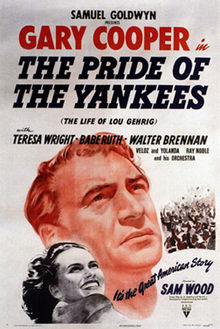
220px-The_Pride_Of_The_Yankees_1942

“People all say that I’ve had a bad break. But today … today, I consider myself the luckiest man on the face of the Earth.”

— Lou Gehrig (Gary Cooper) at the end of The Pride of the Yankees (1943)

After airing Foreign Correspondent earlier tonight, TCM followed up by showing the 1943 best picture nominee, The Pride of the Yankees.  Knowing that Pride of the Yankees was going to be a baseball film and that I know next to nothing about baseball, I recruited my sister, the Dazzling Erin, to watch the movie with me.  Erin loves baseball and I knew that she would be able to explain anything that went over my head.

Well, I absolutely loved watching this movie with my sister but it turns out that The Pride of the Yankees isn’t really much of a baseball movie.  True, it’s about a real life baseball player.  Several actual players appeared as themselves.  About 85% of the film’s dialogue deals with baseball and probably about 70% of the film features characters playing some form of the game.  But the film never goes into any great detail about baseball or how it’s played.  There’s no talk of strategy or rules or deeper meaning or anything else.  Going into the film, I knew that baseball was a game that involved throwing, swinging bats, and running.  And it turns out that was all that I needed to know.

The Pride of the Yankees is less about baseball and more about celebrity.  It’s a biopic of Lou Gehrig, who today is best known for his battle with ALS, a disease that is also known as Lou Gehrig’s disease.  Lou Gehrig died on June 2, 1941 and The Pride of the Yankees was released just a year later.  Watching the film, it’s obvious that Gehrig was a beloved figure, the type of celebrity who, if he were alive today, would probably be the center of stories like, “Lou Gehrig Did Something This Weekend And It Was Perfect.”  Watching the film, it easy to imagine how traumatic it must have been for the nation when a beloved athlete like Lou Gehrig died at the age of 37.

As a result, The Pride of the Yankees is less a biopic and more a case for canonization.  From the minute that the film’s Lou Gehrig appears on-screen, he is presented as being the type of saintly athlete who, by promising to hit two home runs in one game, inspires a crippled child to walk.  Lou is modest, kind, unpretentious, and never gets angry.  Over the course of the film, he takes care of his mother, displays a worthy work ethic, and marries Eleanor.  He and Eleanor have a perfect marriage without a single argument or a hint of trouble, except for the fact that Lou sometimes gets so busy playing baseball with the local children that he’s late coming home.  There’s not a hint of sadness in their life, until Lou suddenly gets sick.

And really, it should not work.  If ever there’s ever been a film that should be painfully out-of-place in our more cynical times, it would be The Pride of the Yankees.  However, the film still works because Lou is played by Gary Cooper and Eleanor is played by Teresa Wright.  These two excellent performers bring their considerable talents to making overly sentimental scenes feel credible.  Gary Cooper was 40 years old when he made The Pride of the Yankees and there’s a few scenes — especially the ones where Lou is supposed to be a student at Columbia University — where Cooper is clearly too old for the role.  But, for the most part, Gary Cooper did a great job as Lou Gehrig.  Cooper is especially memorable when Lou first starts to show signs of being ill.  Watching Lou struggle to swing a bat, I was reminded of a horse struggling to stand on an injured leg.  It was almost painfully poignant.

The Pride of the Yankees was nominated for 11 Academy Awards, including best picture.  However, it lost to another sentimental film that featured Teresa Wright, Mrs. Miniver.

Embracing the Melodrama, Part II: Wings (dir by William Wellman)


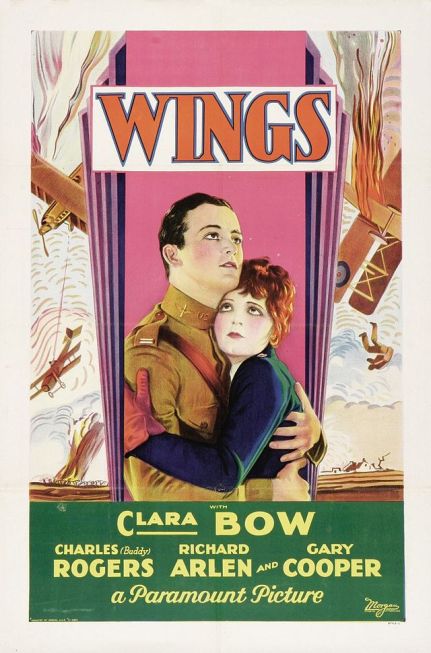
Wings

As I mentioned in my previous review, Sunrise may have won the 1927 Oscar for Unique and Artistic Production but the official winner of the first Academy Award for Best Picture was the silent World War I romantic melodrama, Wings.  Wings is one of those films that doesn’t seem to get much respect from contemporary critics, many of whom are quick to dismiss the film as being corny and clichéd.  It’s not unusual to see Wings cited as being the first example of the Academy honoring the wrong film.

Wings tells the story of David Armstrong (Richard Arlen) and Jack Powell (Charles “Buddy” Rogers), who both live in the same small town and who are both in love with the pretty but self-centered Sylvia (Jobyna Ralston).  Sylvia, meanwhile, is in love with the wealthy David but, when Jack asks for a picture of her, she gives him one that she had been planning to eventually give to David.  Meanwhile, Mary (Clara Bow), who is literally the girl next door, pines for Jack.

When World War I breaks out, both Jack and David join the Air Force.  At first they’re rivals but, under the pressure of combat and the threat of constant death, they become friends.  When David flies, he has a tiny teddy bear to bring him luck.  Jack, meanwhile, has Sylvia’s picture.  Meanwhile, their tentmate — Cadet White (Gary Cooper) — insists that he doesn’t need any good luck charms and promptly suffers the consequences for upsetting God.

Meanwhile, Mary has joined the war effort and is driving an ambulance around Europe.  Will Mary ever be able to convince Jack that they belong together?  Will David ever catch the legendary German pilot, Kessler?  Perhaps most importantly, will this new bromance be able to survive both war and the charms of Clara Bow?  And finally, will anyone be surprised when all of this leads to a tragic conclusion with an ironic twist?

Wings has got such a bad reputation and is so frequently dismissed as being the first case of the Academy picking spectacle over quality that I was actually shocked when I watched it and discovered that Wings is actually a pretty good movie.  Yes, it is totally predictable.  Every possible war film cliche can be found in Wings.  (From the minute that handsome and confident Gary Cooper announced that he didn’t need any lucky charms, I knew he was doomed.)  And yes, the film does run long and it does feature a totally out-of-place subplot involving a character played by someone named El Brendel (who was apparently a popular comedian at the time).  This is all true but, still, Wings works when taken on its own terms.

Here’s the thing with Wings: the aerial footage is still impressive (all the more so for being filmed without the benefit of CGI) and both Charles “Buddy” Rogers and Richard Arlen are handsome and appealing in a 1927 silent film sort of way.  In fact, the entire film is appealing in a 1927 silent film sort of way.  This is a time capsule, one that shows what films were like in the 20s and, as a result of the combat scenes, also provides a hint of what lay in the future for the film industry.  Most importantly, Wings features Clara Bow, who has been my silent film girl crush ever since I first saw It.  Whether she’s attempting to flirt with the clueless Rogers or hiding underneath her ambulance and shouting curses at the Germans flying above her, Clara brings a lot of life to every scene in which she appears.

If you’re a film historian, Wings is one of those films that you simply have to see and, fortunately for you, it’s actually better than you may have been led to think.

It’s currently available on Netflix.

http://www.youtube.com/watch?v=EqOqXj2biG0


Shattered Politics #7: Meet John Doe (dir by Frank Capra)


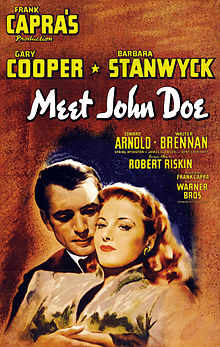
Meet John Doe

I cannot stand the phrase “pay it forward.”

The idea is that somebody does something nice for you and then they say, “Pay it forward” and suddenly, you are magically required to go out and do something nice for someone else.  For one thing, I hate the obligation of it all.  I have this fear that as soon as I finally get finished paying it forward, some stranger is going to hand me a Coke and say, “Pay it forward,” and suddenly I’ll have to do it all over again!  And really, honestly, I shouldn’t have to pay it forward just because someone  gives me a Coke.  If you’re going to tell me to pay it forward, at least give me a car or a Victoria’s Secret gift card or something.

Ultimately, “pay it forward” is something that people say to make themselves feel good but it’s actually a pretty shallow concept.

The same thing can be said about John Doeism, the philosophy that rests at the center of the 1941 film Meet John Doe, our latest entry in Shattered Politics.  John Doeism is a grassroots political movement that is based around the slogan, “Be a Better Neighbor.”  Much like “Pay it forward,” “Be a better neighbor” sounds good and it’s easy to say but its main appeal is that it doesn’t require that much thought.  If anything, it sounds like the first step on the road to serfdom…

That said, I still like the film.

Meet John Doe opens with lay-offs at a major metropolitan newspaper.  (These lay-offs are signified by a handsome young man who points at people and then runs his finger across his throat.)  Among those laid off is columnist Ann Mitchell (Barbara Stanwyck).  However, before Ann is officially let go, she is told to write one final column.  Understandably angry over her treatment, Ann responds by making something up.  She writes and prints a fake letter from a man calling himself “John Doe.”  John Doe explains that he’s unemployed and that he will be committing suicide on Christmas Eve.

Well, quicker than you can say twitter death hoax, everyone in the entire country reads John Doe’s letter and demands to know who he is.  The newspaper’s editor, Henry Connell (James Gleason), rehires Ann and puts her in charge of finding the real John Doe.

When numerous unemployed and homeless men start to show up at the newspaper, claiming to be the real John Doe, little do they realize that they are, in fact, auditioning.  Ann finally decides that Joe Willoughby (Gary Cooper) has what it takes to be the public face of John Doe.  Not only does he have a compelling personal story (he’s a former baseball player whose career was ended by an arm injury) but he looks and sounds like Gary Cooper.

(And, as I typed that last sentence, it suddenly occurred to me that Meet John Doe managed to predict American Idol…)

Joe is soon a celebrity, reading speeches that have been written for him by Ann and encouraging people across the nation to be a better neighbor.  And Ann is falling in love with Joe.  However, Joe is not comfortable with his new role.  For one thing, he doesn’t like being a hero for telling a lie.  Secondly, he knows that rival newsmen are eager to expose him as being a fraud.  And finally, there’s a sinister publisher named D.B. Norton (played by Edward Arnold, who previously played corrupt Boss Taylor in Mr. Smith Goes To Washington) who is eager to be President of the United States.  He wants to turn John Doeism into a fascist political movement and, unless Joe endorses him, he’ll reveal that Joe’s a fraud…

Meet John Doe was Frank Capra’s follow-up to Mr. Smith Goes To Washington.  It features many of the same themes as Mr. Smith, with the main difference being that Meet John Doe is a lot more preachy.  Whereas Mr. Smith saved its big speech for the end, Meet John Doe has several big speeches spread throughout its running time.  (There’s also a scene where a guy named Bert tells the story of how he was inspired by John Doe and, I swear, it literally goes on forever.)

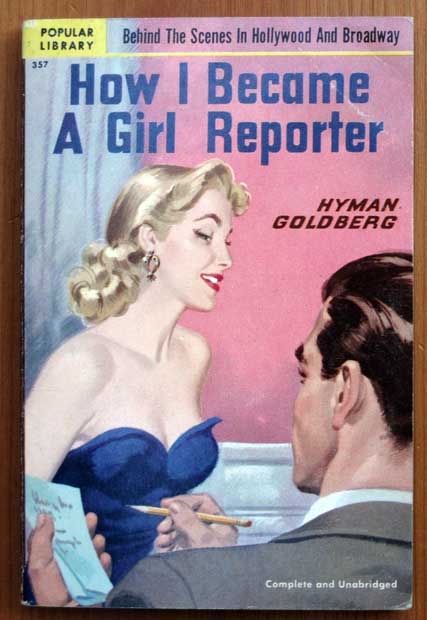
So, no, Meet John Doe is definitely no Mr. Smith Goes Go To Washington but I still liked it, mostly because of the chemistry between Gary Cooper and Barbara Stanwyck.  I wanted to be Barbara Stanwyck’s character.  Seriously, watching a film like Meet John Doe, leaves me convinced that I was born several decades too late.  If I had been born in 1918, I could have been a quick-witted, cynical, and secretly romantic intrepid girl reporter at a major metropolitan newspaper.

Girl Reporter

Even better, I would never have to worry about ever being told to “pay it forward.”