14 Days of Paranoia #3: The Lincoln Conspiracy (dir by James L. Conway)


When it comes to conspiracy theories involving presidential assassinations, the theories surrounding JFK may get all the attention but it’s the theories surrounding the death of Abraham Lincoln are usually far more plausible.

Unless, of course, it’s the theories that are pushed in the 1977 docudrama, The Lincoln Conspiracy.

A mix of documentary-style narration and really cheap-looking historical reenactments, The Lincoln Conspiracy essentially indicts almost everyone who was alive in 1865 as being a part of either the conspiracy or the subsequent cover-up.  Really, it’s remarkable how many historical figures are implicated in this film.

With the Civil War coming to a close, President Lincoln (John Anderson) hopes to pursue a generous reconstruction policy for the former Confederate States.  Secretary of War Edwin Stanton (Robert Middleton), Senator Ben Wade (Dick Callinan), and a host of other are all opposed to this plan, both because they want vengeance and they also want to make as much money as possible off of the Southern cotton fields.  They come up with a plan to impeach Lincoln but, in order to draw up the articles, they have to make sure that Lincoln is not seen for a few days.  When Col. Lafayette Baker (John Dehner) discovers that an actor named John Wilkes Booth (Bradford Dillman) is planning on kidnapping Lincoln, Stanton and his conspirators decide to give Booth their unofficial support.  However, when the plan changes at the last minute and Stanton decides that it would actually be a bad idea to kidnap Lincoln, an angry Booth decides to just kill Lincoln, Andrew Johnson, and William Seward.

Booth succeeds in shooting Lincoln and making his escape.  The other members of Booth’s group all fail in their assignments.  Andrew Johnson becomes president.  Though grievously wounded, William Seward survives.  Booth flees to Canada and …. oh, you thought Booth died?  No, that was just a look alike who was shot by a bizarre soldier named Boston Corbett.  By allowing everyone to believe that Booth was killed, Stanton is able to cover up any role he and his allies played in inspiring the assassination.  Unfortunately, Col. Baker keeps a diary and it seems like he might be planning on revealing the truth but he dies mysteriously before he can.

(And, to give the film some credit, Col. Baker’s sudden death at 41 was an odd one.  And, though it’s not really explored in the film, Boston Corbett, the man who shoot Booth, really was a weirdo who was described by contemporaries as being a religious fanatic who castrated himself and claimed to hear the voice of God.)

It’s a big conspiracy theory that is presented in The Lincoln Conspiracy.  In fact, it’s a bit too big to really be taken seriously.  The film pretty much accuses everyone in Washington of having a part in the assassination.  The film itself has the cheap look of a community theater production and the use of Dr. Samuel Mudd as a narrator only adds to the film’s silliness.  If you’re a fan of gigantic and thoroughly implausible conspiracy theories, as I am, the film is entertaining in its way.  If nothing else, Bradford Dillman certainly looks like how most people probably imagine John Wilkes Booth to have looked.  Otherwise, The Lincoln Conspiracy is far-fetched and not at all realistic, which is why I assume that a lot of people in 1977 probably believed every word of it.

Previous entries in 2025’s 14 Days Of Paranoia:
  1. The Fourth Wall (1969)
  2. Extreme Justice (1993)

Life is a Beach #4: Spring Break (dir by Sean S. Cunningham)


I think I may have made a mistake.  When I started reviewing beach films, I did so because it’s currently spring break for thousands of college students across the country and, right now, they’re all probably having a good time on the beach.  Unfortunately, what I didn’t consider was that watching and reviewing these films would make me start to wish that I was currently there with them.

Don’t get me wrong.  It’s not that I want to go hang out on the beach and party and flirt and get high and live for the moment and … well, no, actually, that’s exactly what I wish I was doing right now.  None of the beach films that I’ve watched so far have been good exactly but they do all get at a larger truth.

We all need some sort of spring break.

That’s certainly the theme of the 1983 comedy, Spring Break.

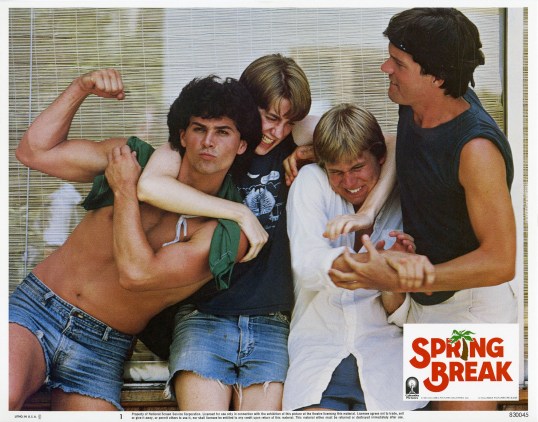
The heroes of Spring Break

The heroes of Spring Break

Perhaps the most surprising thing about Spring Break is that, unlike Malibu Beach and The Beach Girls, it was not produced by Crown International Pictures.  It certainly feels like a Crown International movie.  The film is a largely plotless collection of scenes, all of which take place over the course of spring break in Ft. Lauderdale.  It starts out as a comedy and then gets strangely dramatic towards the end.  It features a lot of nudity for male viewers but luckily, it has two hot guys for me so it all works out in the end.

Two nerdy students, Nelson (David Knell) and Adam (Perry Lang) go down to Florida for spring break.  Nelson does this despite the fact that he had promised that he would spend spring break working on his politically ambitious stepfather’s campaign.  When Nelson and Adam’s picture ends up in the paper, Nelson’s stepfather (Donald Symington) sends his operatives down to Florida to basically kidnap Nelson and drag him home.  Along the way, the stepfather also somehow gets involved in a plot to take over the motel where Nelson and Adam are staying.

Uhmmm…what?

Yes, it doesn’t make much sense but then again, the plot is never that important in these type of films.  What is important is that the motel is overbooked and, as a result, Nelson and Adam find themselves roommates with two hot guys from New York, Stu (Paul Land) and O.T. (Steve Bassett).

One thing that I did like about this movie is that it didn’t waste any time pretending that Stu and O.T. wouldn’t become best friends with Nelson and Adam.  Instead, the four of them start bonding as soon as they meet and they were all best friends within the first 15 minutes of the film.  Yay for another successful bromance!  But seriously, it is kind of sweet.

And it’s also fortunate because, once Nelson is kidnapped and held prisoner on a boat by his stepfather, who better to rescue him than two guys from Brooklyn?

Yes, it’s all pretty stupid but, as far as teen sex comedies from the early 80s are concerned, this is one of the better of them.  At the very least, Knell and Lang are both likeable and Land and Bassett are both hot and that really is about the best that you can hope from a film like this.  Add to that — and this is a theme that I seem to keep returning to as far as these beach films are concerned — Spring Break is a time capsule.  Though Spring Break was released before I was born, I feel like, having seen it, that I now have some firsthand experience of what it was like to be alive in 1983.

So 80s....

So 80s….

As I mentioned at the start of this review, Spring Break feels like a Crown International Picture but, actually, it was released by Columbia Pictures.  And it was directed by Sean S. Cunningham, who is probably best known for directing the original Friday the 13th!  Harry Manfredini even provided the music for both films.  That said, the fun-loving teenagers of Spring Break come to a much happier end than the ones at Camp Crystal Lake.