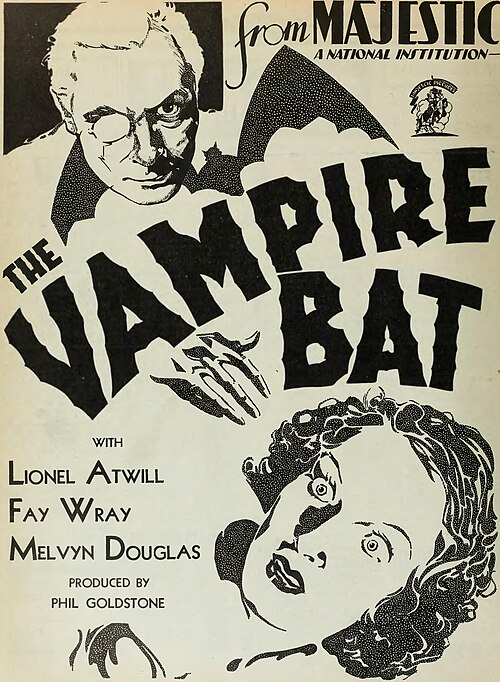
Horror Film Review: The Vampire Bat (dir by Frank R. Strayer)


In 1933’s The Vampire Bat, people are dying in a small German village, victims of blood loss.  A woman named Martha Mueller (Rita Carlisle) was recently attacked by a bat, leading to rumors of a vampire.  When the local town eccentric, a twitchy man named Hermann Glieb (Dwight Frye), argues that bats are actually harmless and admits that he likes bats because they are “soft” and “nice,” people start to suspect that he might be the vampire.  Another man named Kringen (George E. Stone) claims that he was attacked by a vampire and insinuates that it was Glieb.  Glieb may seems like a strange man who likes to collect bats but could he be something even more sinister?

Two town leaders have opposite feelings about the claim that a vampire is attacking the town.  Karl Brettschneider (Melvyn Douglas) is the local police inspector and he deals with facts.  He doesn’t believe in superstition and he initially scoffs at the idea that a vampire is attacking the village.  Meanwhile, Dr. Otto von Niemann (Lionel Atwill) is the town’s doctor.  He’s been treating the victims of the bat attacks and he’s even be letting some of his patients live at his home.  Everyone knows that Dr. von Neimann is a kindly man of science.  Karl is even dating Ruth (Fay Wray), one of Otto’s boarders.  But is the doctor as benevolent as everyone assumes?

When answering that question, consider these four facts:

  1.  Dr. von Neimann is the one who encouraged Kringen to spread stories about a vampire haunting the town, despite the fact that Kringen himself said that he didn’t want to start a panic.
  2. Dr. van Niemann is played by Lionel Atwill.
  3. Glieb is played by Dwight Frye.
  4. Karl is played by Melvyn Douglas.

Indeed, for horror fans, the casting of Lionel Atwill gives the game away.  Lionel Atwill appeared in a number of horror films and it was rare that he wasn’t cast as the villain.  (One of his non-villainous role was as the one-armed Inspector Krogh in The Son of Frankenstein.)  From the minute the viewer sees Atwill, he seem to give off sinister vibes and it’s not really a surprise when he turns out to be less than trustworthy.

As for Dwight Frye, horror fans love him for playing a number of unhinged weirdos, like Renfield in the Lugosi-version of Dracula and the torch-bearing servant in Karloff’s Frankenstein.  Frye was good at playing twitchy types but one thing that all of Frye’s characters had in common is that they were pretty much destined to be victims.  Even when Frye played an unlikeable character,  like in Frankenstein, it was obvious that he was going to end up getting killed at the hands of the Monster.

Finally, Melvyn Douglas was the epitome of propriety in every film in which he appeared.  If Douglas thinks that there is something more going on than just a vampire attacking people, there probably is.  And since we know Douglas can’t be the main bad guy, that pretty much just leaves Lionel Atwill.

The Vampire Bat is a short and enjoyable B-movie that puts an interesting spin on the typical vampire legend.  Though the budget may be low, the cast of Atwill, Douglas, Frye, and Wray can’t be beat and all of them give fully committed performances.  Dwight Frye, in particular, gives one of his best performance as the unfortunate Glieb.  As always, Lionel Atwill makes for an entertaining villain.  At its best, The Vampire Bat comments on the power of hysteria.  Convinced that there is a vampire in their midst, the town goes mad and it directs its anger towards those who are seen as being on the outside, men like Glieb.

The Vampire Bat is more than worthy of your Halloween viewing.
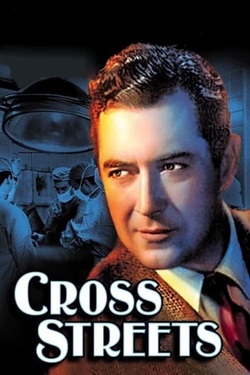
Cross Streets (1934, directed by Frank R. Strayer)


Having graduated from medical school, Dr. Adam Blythe (Johnny Mack Brown) is finally ready to marry his glamorous fiancée, Ann (Claire Windsor).  However, when Ann learns that Adam is going to have to spend years as an lowly paid resident, she ditches him and instead marries Dr. Jerry Clement (Niles Welch).  Blythe, heartbroken, becomes an alcoholic and, after a disastrous operation that leaves a patient dead, Blythe ends up on skid row.  Twenty years later, Blythe is spotted by his old friend Mort (Kenneth Thomson).  A self-made millionaire who dropped out of college, Mort takes Blythe to their 20-year reunion and talks him up as a brilliant surgeon.  When Blythe is pressured into performing a delicate piece of surgery, he is offered a position as the head of the college’s new research wing.  Blythe, meanwhile, meets and falls in love with June (Anita Louise), a young woman who reminds him of Ann.  It turns out that the resemblance is not a coincidence because June is Ann’s daughter!  Ann wants Blythe back and, when she discovers that Blythe is in love with June, she threatens to tell everyone that Blythe is actually June’s father!  All of the secrets and lies lead to the type of  sudden and tragic ending that only a pre-code film could get away with.

Cross Streets is a 65-minute soap opera that features Johnny Mack Brown in a non-western role.  Brown gives a likable performance but he’s less convincing when he has to be bitter.  One reason why Brown was such a successful B-western star is that he always came across as if he had never had a moment of self-doubt in his entire life.  Dr. Adam Blythe is all about self-doubt so he feels miscast in the role.  Claire Windsor is more convincing as the vampish Ann.  The movie has its slow spots and the plot requires a healthy suspension of disbelief but the ending still packs a punch.

Cross Streets is not easy to find but there is a not-great upload available on YouTube.

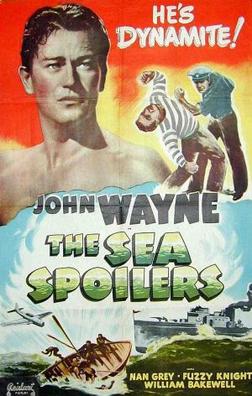
The Sea Spoilers (1936, directed by Frank R. Strayer)


Bob Randall (John Wayne) is a coast guard boatswain, headquartered in Alaska where he and the members of his crew battle evil seal poachers like oily Phil Morgan (Russell Hicks).  When Randall returns to port after his latest patrol, he has to deal with two disappointments.  First off, he is passed over for a promotion to commanding officer, even though everyone knows that he deserves it.  Instead, the promotion goes Lt. Commander Mays (William Blakewell), the son of a commander (George Irving).  Mays doesn’t even want the job.  He’s scared of the water and he’d rather fly airplane as a part of the Coast Guard’s aviation force.  Bob is disappointed but he’s a professional and he’s going to support Mays.  Secondly, Bob’s girlfriend (Nan Grey) witnesses a murder and is kidnapped by Phil Morgan.  Bob and his sidekick (dependable western mainstay Fuzzy Knight) go undercover as fisherman to try to find her.

The Sea Spoilers was the first of six B-movies that John Wayne did for Universal.  Wayne, who had been stuck in the B’s for a while, was trying to prove that he was more than just a singing cowboy so, in this one, he plays a tough and ready sailor.  Wayne is convincing in the role, even if the movie is really just a western set in what was then modern day Alaska.  Though only 30, Wayne shows the no-nonsense professionalism that would become his trademark once he became one of the world’s biggest movie stars.  Unlike some of Wayne’s early films, it’s possible to see the icon that John Wayne would eventually become while watching him here.  The Sea Spoilers is only 66 minutes long but fans of the Duke should enjoy it.

Finally, The Sea Spoilers was written by George Waggner.  Waggner would later go on to direct the original Wolf Man.