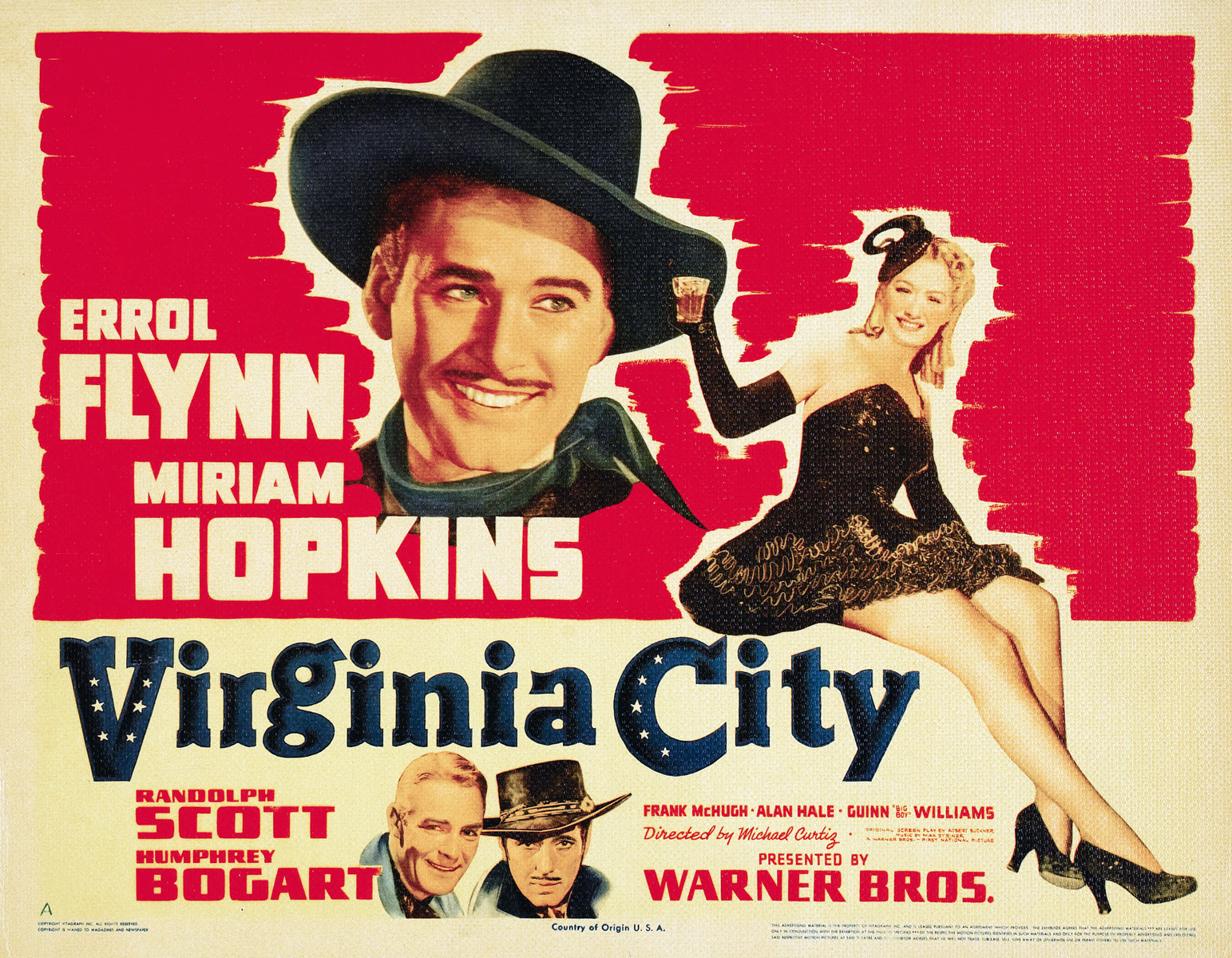
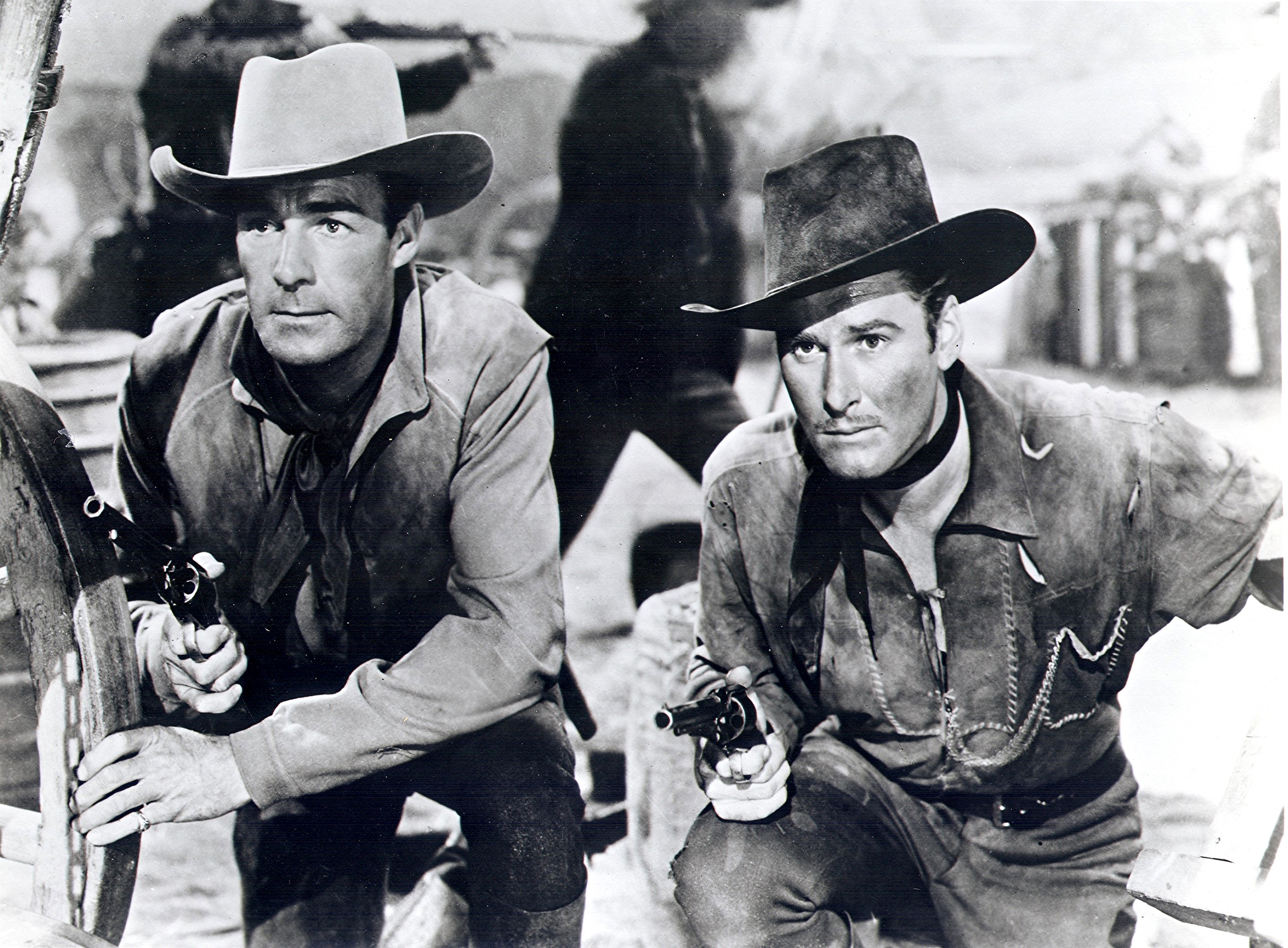
VIRGINIA CITY is a big, sprawling Western, filled with action, humor, and star quality. It’s the kind of movie they used to show around these parts every afternoon at 4 O’clock on DIALING FOR DOLLARS (George Allen was the local host), helping to spark my interest in classic films past, a flame which still burns bright today, two hours of pure entertainment, with square-jawed Errol Flynn going against square-jawed Randolph Scott backed by a Civil War setting and yet another sweepingly epic Max Steiner score.
We’re told “only the characters are fictional… The story is true” as we watch Union Captain Kerry Bradford (Flynn) and his two buddies Moose and Marblehead (Errol’s frequent co-stars/offscreen drinking compadres Alan Hale Sr and Guinn ‘Big Boy’ Williams) attempt to tunnel their way out of Libby Prison, aka ‘The Devil’s Warehouse’, when they’re caught by commanding Captain Vance Irby (Scott). He tells them Confederate troops…
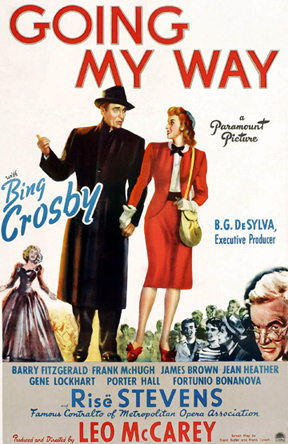
Last night, continuing my effort to watch 38 movies in 10 days (and, for the record, I have 7 days left as of today), I watched the 1944 musical-comedy-drama Going My Way.
Going My Way tells the episodic story of Father Chuck O’Malley (Bing Crosby), a priest from St. Louis who is assigned to take charge of a struggling parish in New York City. O’Malley is meant to replace Father Fitzgibbon (Barry Fitzgerald), a stubbornly old-fashioned priest who is struggling to keep up with a changing world. Though O’Malley is to take charge of the parish’s affairs, Fitzgibbon is to remain the pastor. However, the compassionate O’Malley doesn’t tell Fitzgibbon about the arrangement and allows Fitzgibbon to believe that O’Malley is only meant to be his assistant.
It’s obvious from the start that Fitzgibbon and O’Malley have differing approaches. Fitzgibbon is a traditionalist. O’Malley, on the other hand, is a priest who sings. He’s a priest who understands that the best way to prevent the local teens from forming a street gang is to convince them to start a choir instead. When it appears that 18 year-old Carol (Jean Heather) is “living in sin,” it is the nonjudgmental O’Malley who convinces her to marry her boyfriend.
And, slowly but surely, Fitzgibbon and O’Malley start to appreciate each other. O’Malley is even able to convince Fitzgibbon to play a round of golf with him, while Fitzgibbon tells O’Malley about his love for his mother in Ireland.
What’s interesting is that we learn very little about O’Malley’s past. In many ways, he’s like a 1940s super hero or maybe a less violent and far more ethical version of one of Clint Eastwood’s western heroes. He shows up suddenly, he fixes things, and then he moves on. Instead of a cape or a poncho, he wears a collar.
(And, of course, he doesn’t kill anyone. Actually, that’s probably a lousy analogy but I decided I’d give it a try anyway…)
At one point, O’Malley does run into an opera singer named Genevieve Linden (Rise Stevens). He and Genevieve (whose real name is Jenny) talk briefly about their past and it becomes obvious that they once had a romantic relationship. We don’t learn the exact details but it does bring some unexpected melancholy to an otherwise cheerful film. It reminds us of what O’Malley gave up to become a priest.
Fortunately, Genevieve is more than happy to help out with O’Malley’s choir, even arranging for them to meet with a record executive (William Frawley). The executive doesn’t have much interest in religious music but then he hears Bing O’Malley sing Swinging On A Star.
It’s a bit strange to watch Going My Way today because it is a film that has not a hint of cynicism. There’s no way that a contemporary, mainstream film would ever portray a priest as positively as Father O’Malley is portrayed in this film. Indeed, it says something about the world that we live in that I instinctively cringed a little whenever O’Malley was working with the choir, largely because films like Doubt and Spotlight have encouraged me to view any film scene featuring a priest and an pre-teen boy with suspicion. O’Malley is the ideal priest, the type of priest that those of us who were raised Catholic wish that we could have known when we were young and impressionable. Bing Crosby does a pretty good job of playing him, too. Watching Going My Way felt like stepping into a time machine and going to a simpler and more innocent time.
In the end, Going My Way is a slight but watchable film. It doesn’t add up too much but, at the same time, it’s always likable. Though the film may be about a priest, the emphasis is less on religion and more on kindness, charity, and community. Going My Way was a huge success at the box office and even won the Oscar for best picture.
Personally, I would have given the Oscar to Double Indemnity but Going My Way is still a likable movie.
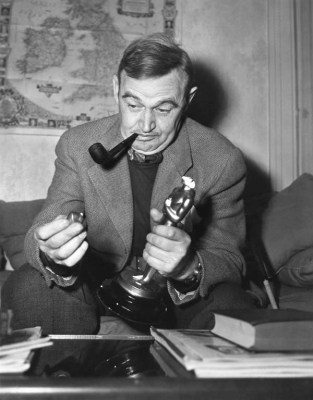
Speaking of likable, the Academy was so impressed with Barry Fitzgerald’s performance that they actually nominated it twice! He got so many votes in both categories that Fitzgerald ended up nominated for both Best Actor and Best Supporting Actor. Subsequently, the Academy changed the rules and decreed that a performance could only be nominated in one category. As for Fitzgerald, he won the Oscar for best supporting actor. He later broke the Oscar while practicing his golf swing.
Barry and Oscar
(Don’t worry. The Academy sent him a replacement.)
Last night, after I finished watching My Sweet Audrina, I decided to watch one more film off of the DVR. Seeing as how I had already watched a coming-of-age drama, a classic war film, and a Lifetime melodrama, I decided that my final film of the night would be 1938’s Four Daughters. According to the plot description, it was the story of four musically talented sisters and their father. It sounded nice and undemanding.
I recorded Four Daughters off of TCM, where it was shown as a part of the 31 Days of Oscar. When it originally aired, I was warned about it by some of my fellow Oscar fanatics. They all told me that it was an okay movie but it was nothing special. “Don’t let the best picture nomination fool you!” they all said. And, it’s true that the Four Daughters is one of the more forgotten best picture nominees. Go check out the list of external reviews on the imdb and you’ll see that only a handful of reviews have been posted for Four Daughters.
But you know what? I liked Four Daughters. Yes, when compared to some of the other films that have been nominated for best picture, Four Daughters may seem rather slight. Just compare it to some of the other films that were nominated for best picture of 1938: Grand Illusion, The Adventures of Robin Hood, Jezebel, and the winner, You Can’t Take It With You. Interestingly enough, Michael Curtiz directed both The Adventures of Robin Hood and Four Daughters. Curtiz was nominated for directing Four Daughters, though Robin Hood is certainly the better regarded film.
And yet, with all that in mind, Four Daughters is still a perfectly charming and rather sweet movie. Adam Lemp (Claude Rains) is a musician who loves classic music. He has four daughters, all of whom are musically talented. The oldest, Emma, is played by Gale Page while the other three daughters are played the Lane Sisters, who were apparently a very popular singing act in the 30s. Lola Lane plays Thea Lemp, Rosemary Lane plays Kay Lemp, and the youngest daughter, Ann, is played by Priscilla Lane.
While the film was obviously designed to capitalize on the popularity of the Lane Sisters, it’s not all just music and performing. The Lemps also own a boarding house, which is frequently visited by potential suitors. While Kay Lemp struggles with whether or not to accept a music scholarship and leave home, Emma is pursued by Ernest (Dick Foran) and Thea is courted by Ben (Frank McHugh), a wealthy older man.
And then there’s Ann, the youngest daughter and the one to whom I most related. Despite saying that she never wants to marry, Ann finds herself being pursued by two men. One of them is a composer named Felix Deitz (Jeffrey Lynn). The other is Felix’s best friend, Mickey (John Garfield).
John Garfield was one of the first Method actors to make the transition from stage to screen. (It’s generally argued that, in the beginning, Paul Muni begat John Garfield who begat Montgomery Clift who begat Marlon Brando who begat Robert De Niro who begat Leonardo DiCaprio.) Four Daughters was one of his first major roles and it also provided him with his first Oscar nomination. It’s interesting to contrast Garfield’s brooding and internalized performance with the somewhat more bland actors who play the other suitors. He grounds Four Daughters, giving the film a necessary jolt of reality.
However, I have to admit that my main reason for liking Four Daughters is a personal one. I am the youngest of four sisters and there was so much about Four Daughters that I related to. (I saw a lot of myself in Ann Lemp.) From the opening scenes of the sisters fighting and laughing at the same time to the countless scenes of the sisters supporting each other, Four Daughters gets it right. The film may have been made in 1938 but sisterhood is eternal.
In the end, I glad that I took the time to record and watch Four Daughters. It’s a sweet movie, one that will be enjoyed by sisters everywhere.
Down here in Dallas, we have a county commissioner named John Wiley Price. Even if you don’t live in Texas, you might have heard about him. A few years ago, Price stormed out of a commissioners meeting while shouting, “All of you are white! Go the Hell!” It was a popular YouTube video for a while and attracted all of the usual type of comments that you see online. It even made the national news.
Nobody down here in Dallas was surprised by Price’s outburst. To us, that was just John Wiley being John Wiley. For that matter, nobody was particularly surprised when it was reported that he was being investigated by the FBI. Everyone always took it for granted that John Wiley Price was taking bribes and receiving kickbacks. That’s just the way that things are done down here in Dallas, by politicians both white and black. (Of course, most of the white politicians who do it don’t get publicly investigated by the FBI.)
Now, if you ask the majority of people in Dallas county what they think about John Wiley Price and they’ll probably say something negative. I’ll admit that I would probably be among them. But the thing is — John Wiley Price’s constituents love him. John Wiley Price was first elected to the commissioner’s court before I was even born and, as long as he’s on the ballot, he will be reelected. Even if Price is convicted on corruption charges, he will still be reelected.
I can still remember the night that it was announced that John Wiley Price was on the verge of being arrested by the FBI. All across his district, emergency meetings were held in churches and ministers stood behind the pulpit and, while the TV cameras rolled, they called upon everyone to pray for John Wiley Price. In Price’s district, he’s known as “our man downtown,” the idea being that John Wiley Price is standing up to the rich and white Dallas establishment and, if he makes some money for himself in the process, so be it. As long as he’s doing right for the people who elected him, who cares how he does it?
And, as much as we may want to judge the John Wiley Prices of the world, the fact that of the matter is that he’s a part of a long American political tradition. That political tradition is also the driving force behind today’s final entry in Shattered Politics.
First released in 1958 and directed by John Ford, The Last Hurrah tells the story of Frank Skeffington (Spencer Tracy), the mayor of an unnamed city in New England that’s obviously meant to be Boston. Skeffington is the flamboyant head of a large and powerful (but, as the film makes clear, aging) Irish-American political machine. He’s preparing to run for his fifth term for mayor, a campaign that he says will be his last.
Whether Frank Skeffington is a good mayor or not depends on who you ask. The poor and the disenfranchised love him. Skeffington, after all, is the son of Irish immigrants. He was born poor. His mother worked as a maid and was even fired by a member of the wealthy and influential Force family. They know that Skeffington has had to cut corners and that he’s gone out of his way to reward his cronies but they also know that Skeffington is on their side. Though the phrase is never used in the film, Skeffington is “their man downtown.”
Meanwhile, the wealthy and the upper class see Frank Skeffington as being a crook, a man who has run a corrupt administration and who uses class warfare to keep the city divided against itself and to make himself and his cronies rich. Newspaper editor Amos Force (John Carradine) has thrown his considerable influence between Skeffington’s opponent, a wealthy but dull man named Kevin McCluskey.
Reporter Adam Caulfield (Jeffrey Hunter) is in an interesting position. On the one hand, he is Skeffington’s nephew. On the other hand, as a journalist, he works for Amos Force. Skeffington invites Adam to follow and record his final campaign for posterity.
It’s interesting to compare The Last Hurrah to films like The Boss or All The King’s Men. Whereas those two films came down squarely on the sides of the reformers, The Last Hurrah is firmly on the side of Frank Skeffington. It presents Skeffington as being a sentimental figure, the type of old-fashioned, populist politician who won office by going out and meeting the people face-to-face and personally giving them a reason to vote for him. As Skeffington himself points out, he’s the type of politician that will soon be made obsolete by television and modern campaigning.
And it’s impossible not to enjoy The Last Hurrah‘s refusal to pass judgment on its lead character. It helps, of course, that Spencer Tracy plays Skeffington with a twinkle in his eye while all of his opponents are played by villainous and aristocratic character actors like John Carradine and Basil Rathbone. Yes, the film says, Skeffington may have been corrupt but at least he wasn’t boring!
Finally, I enjoyed the film because all of the “good” guys were Irish Catholic and all of the bad guys most definitely were not.
So, with that last hurrah, we conclude Shattered Politics for today. We’ll be back tomorrow, when we’ll start to get into the 1960s.



 Through the Shattered Lens