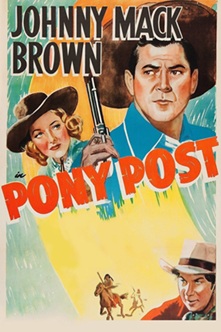
Pony Post (1940, directed by Ray Taylor)


In the days of the Old West, Griff Atkins (Stanley Blystone) manages a Pony Express station but, because of his gambling debts, he actually encourages the Indians and the outlaw Richard brothers (John Rockwell and Ray Teal) to attack the Pony Express riders and steal their horses.  Major Goodwin (Tom Chatterton) tries to put a stop to all this by firing Griff and putting Cal Sheridan (Johnny Mack Brown) in charge.  Griff and the Richard brothers continue their outlaw ways and eventually, the head of one of the relay stations is killed in one of their raids.  While the dead man’s daughter, Norma (Nell O’Day), investigates the murder, Cal works to bring peace the line and falls in love with Goodwin’s daughter, Alice (Dorothy Short).  Meanwhile, aspiring Pony Express rider Shorty (Fuzzy Knight) tries to invent a trampoline system that will help him to mount a horse.

No matter how bad things get in the west, you can always count on Johnny Mack Brown to bring some order and to get it done in less than an hour.  Johnny Mack Brown was always a good hero and that’s the case here.  Eventually this film has all of the horse riding and tough fighting that fans of the genre expect from these westerns but, for a short movie (it only runs for 59 minutes), it still seems to take a while for it to really get going.  The first half of the movie is more about Fuzzy Knight singing songs and trying to become a rider than it is about anything else.  I usually enjoy Fuzzy’s antics but, like the B-western themselves, they are definitely an acquired taste for most viewers.

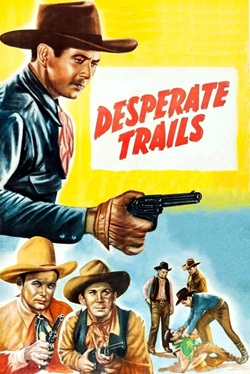
Desperate Trails (1939, directed by Albert Ray)


The frontier town of Denton has become lawless, plagued by murders, robberies, and cattle rustling.  The town’s sheriff (Russell Simpson) just cannot seem to bring peace to the streets.  That’s because the sheriff is secretly responsible for all the crime.  He’s working in cahoots with the town banker (Clarence Wilson) and he’s sets his sights on taking over a ranch owned by Frances Robinson.  As was so often the case with B-westerns, it all comes down to stealing someone else’s land.

The federal government sends Marshal Johnny Mack Brown to bring some order to the town.  Working undercover, Brown gets hired as Robinson’s ranch and he quickly chases off all of the bad ranchhands,  He brings his friend, singing cowboy Bob Baker, onboard to work as the ranch foreman.  With Fuzzy Knight providing comic relief, Brown sets out to thwart the next stagecoach robbery and to expose the evildoers of Denton.

This was the first western that Brown made with Universal Pictures.  Bob Baker, who had previously been the star of the studio’s B-westerns, was demoted to second lead and, eventually, he quit making films for Universal all together.  Unlike Baker, who was angry at being demoted, Fuzzy Knight was always happy to provide sidekick duty and would go on to co-star in all of Brown’s Universal westerns.  From the start, Brown and Knight had the chemistry that made them a good B-movie team.

Desperate Trails is a typical B-western but, as always, Brown elevates things with his performance.  From the minute that Brown rides into town, he screams authenticity.  He’s pretty tough in this film, which includes a scene where he coolly takes care of a gang of outlaws with just one rifle.  The best performance here comes from Russell Simpson, who gets angrier and angrier as the film goes on and all of his plans fall apart.

For fans of the B-western genre, Desperate Trails has a lot of entertainment to offer.

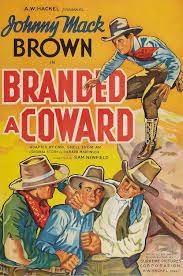
Branded A Coward (1935, directed by Sam Newfield)


When Johnny Hume was just a young boy, he witnessed his entire family being killed by a group of bandits led by the mysterious Cat.  Johnny grows up to be a trick-shot artist but, despite his skill with a gun, he can’t stand to point it at anyone or to be near any sort of gunfights.  When a fight breaks out in a saloon, he hides behind a bar and is labeled a coward.

Still, Johnny and his sidekick (Syd Saylor) somehow find the strength to run off a bunch of stagecoach robbers and save passenger Ethel Carson (Billie Seward).  Johnny is offered a chance to become the new town marshal.  Johnny, despite his fear of gunfights, accepts after he hears that the Cat is back in business.  Johnny wants revenge but the Cat turns out to be not who he was expecting.

Branded A Coward may be a zero-budget Poverty Row western but it’s actually has an interesting story and a good (if not entirely unexpected) twist towards the end.  Johnny Mack Brown was one of the better actors amongst the cowboys who starred in the westerns put out by PRC and directed by Sam Newfield.  Brown does a good job portraying Johnny’s fear and also his determination to get justice for his family.  Johnny proves he’s no coward but at what cost?

The plot here is a little darker than most of the westerns that were coming out at this time.  Every Poverty Row western featured a comic relief sidekick but this might be the only to feature the sidekick getting killed.  In the role of Oscar, Syd Saylor leaned very heavily on his fake stuttering shtick, to the extent that it actually got offensive.  I wasn’t sorry to see his character go.  Johnny Mack Brown didn’t need any help to get justice.

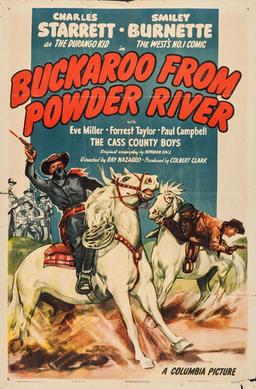
Buckaroo From Powder River (1947, directed by Ray Nazarro)


Pop Ryland (Forrest Taylor) is a frontier outlaw who makes law-breaking a family business.  With his two sons, Pop is planning on flooding the territory with counterfeit bonds.  His stepson, Tommy (Paul Campbell), doesn’t want anything to do with any criminal activity so Pop sends for McCall (Frank McCarroll), an assassin.  In a letter, Pop explains that he wants his stepson murdered.  When federal agent Steve Lacey (Charles Starrett) captures McCall, he finds the letter.  Steve heads into town and goes undercover, pretending to be McCall.  He also uses his other identity, the Durango Kid, to thwart Pop’s plans.

More than usual, this Durango Kid film leans more into the undercover aspect of Steve’s work.  What’s interesting is that, after Tommy fakes his own death, Tommy also disguises himself as the Durano Kid and keeps his stepfather from suspecting that Steve is actually a member of law enforcement.  It’s actually pretty clever, as far as these movies go, and it answers the question of why no one ever wonders why Steve and Durango are never in the same place at the same time.

Smiley Burnette shows up as Steve’s sidekick and he sings a few songs with the The Cass County Boys.  Along with Smiley’s antics, this film has all of the horse chases and gunfights that we expect from a Durango Kid movie.  Most of the usual stock company is present, including Ted Adams and Kermit Maynard.  As always, Charles Starrett looks authentic riding horse and handling a gun.  If you’re not into westerns, this film won’t convert you.  But, for fans of the genre, this is another entertaining outing for the Durango Kid,

Challenge of the Range (1949, directed by Ray Nazarro)


On the frontier, someone is raiding the homes of ranchers like Jim (Henry Hall) and Judy Barton (Paula Raymond).  The Homeowners Association summons Steve Roper (Charles Starrett) to bring a stop to the raids.  Everyone suspects that Cal Matson (Steve Darrell) and his son, Rob (Billy Halop), are behind  the raids but Steve, as the Durango Kid, discovers that a third party is trying to set everyone at war with each other for his own benefit.

The entry in the Durango Kid series was Charles Starrett’s 103rd western.  It’s not a particularly distinguished entry, relying heavily on stock footage.  I did find the idea of the film’s bad guy trying to manipulate the Bartons and the Matsons into destroying each other to be interesting but the movie doesn’t do much with it and the identity of main villain will be obvious to anyone who watches the film.  There is one good scene where Steve disarms three bad guys and then makes them walk all the way back to town without their boots on.  Steve doesn’t mess around.

Smiley Burnette provides the comic relief and a few songs.  This time, Smiley’s a dime store writer researching his next book.  Musically, he is accompanied by The Sunshine Boys.  103 movies in and Smiley still hasn’t figure out that Steve and Durango are one of a kind.

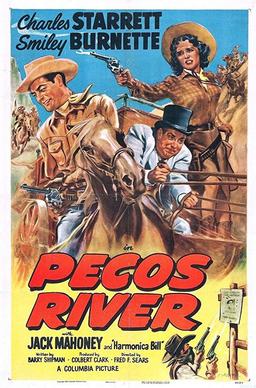
Pecos River (1951, directed by Fred F. Sears)


College student Jack Mahoney (Jock Mahoney) returns to his hometown on the frontier to pay a surprise visit to his father, Old Henry (Edgar Dearing).  Old Henry owns a local stagecoach line and is being targeted by outlaws.  When Jack reaches his father’s house, he discovers that someone has shot Henry in the back.  With the help of Steve Baldwin (Charles Starrett) and Betty Coulter (Anne James), two of Henry’s employees, Jack Mahoney tries to bring his father’s killers to justice.

Also helping is the masked Durango Kid, who tells Jack that Henry was an old friend of his.  Durango, who is never present at the same time as Steve for some reason, teaches Jack how to handle a gun.  When Steve is framed for murder, Durango works even harder to help bring the outlaws to justice.

This late Durango Kid entry has more of an edge that some of the other Durango films.  Both Durango and Jack are out for vengeance and their grim determination sets this one apart from some of Durango’s other, more jokey adventures.

Even with Durango in a serious mood, Smiley Burnette is around to provide some humor.  This time, Smiley is a traveling “specs specialist” who goes from town to town and sells people glasses.  (He also sings two songs while accompanied by Harmonica Bill.)  At the end of the movie, Smiley breaks the fourth wall, puts on a pair of glasses that he says allow him to see the future, and he lets us know whether or not Durango, Jack, and Betty are going to be safe.  Smiley says that he can see himself singing but he can’t hear the song because he only has the glasses.  “Looks like a good song, too.”

One final note: this movie actually features Jock Mahoney in two roles.  Not only does he play college student Jack Mahoney but he was also Charles Starrett’s stunt double in the movie’s action scenes.