Oh, 1919! What a year. The Great War had ended, leaving much of Europe devastated. American soldiers were coming home and, scarred by the horrors they had experienced, becoming members of a lost generation. The Spanish Flu was infecting millions, on the way to eventually wiping out 3% of the world’s population. It was a grim time so it’s no surprise that many chose to close their eyes and pretend like everything was fine. Only a few people were willing to look at the world and say, “There has to be something more.”
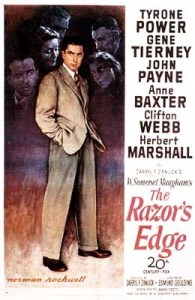
The 1946 film The Razor’s Edge tells the story of one such man. Before the war, Larry Darrell (Tyrone Power, Jr.) was like most of his friends back in Chicago. He was carefree. He was wealthy. He was engaged to marry the beautiful but self-centered Isabel (Gene Tierney). But then he went off to fight in World War I and the experience changed him. On the final day of the war, another soldier sacrificed his life to save Larry and Larry is now haunted by that man’s death. No longer sure about his place in the world, Larry announces that he’s rejecting his former life.
Of course, that’s an easy thing to do when you’re rich. Larry is lucky enough to have an inheritance that he can live off for a few years. All of his former friends think that Larry’s just struggling to adjust to being back home and they expect that he’ll get over it soon enough. Isabel’s uncle, Elliott (Clifton Webb), thinks that Larry’s acting like a total fool. For Larry’s part, he no longer cares what any of them think. He’s going to travel the world, seeking enlightenment.
While Larry’s searching, life goes on without him. Isabel ends up marrying one of Larry’s friends, Gray Maturin (John Payne). Larry’s best friend from childhood, Sophie (Anne Baxter), suffers a personal tragedy of her own and, when Larry next meets her, she’s living as a drunk on the streets of Paris. Larry keeps searching for the meaning of it all. He works in a coal mine. He discusses philosophy with a defrocked priest. Eventually, he ends up in the Himalayas, where he studies under a Holy Man (Cecil Humphreys).
It’s an intriguing idea and still a relevant one. Unfortunately, the movie doesn’t really work because Larry tends to come across as being a little bit full of himself. I could imagine someone like Henry Fonda working wonders with the role but Tyrone Power seems totally miscast as Larry. When you look at Power, you find it hard to believe that he’s ever had a bad day, much less a need to spend months hiding in the Himalayas. He comes across as the last person you would necessarily want to take spiritual advice from. The fact that Webb, Tierney, Payne, and Baxter are all perfectly cast only serves to enforce just how miscast Power is. It’s a well-intentioned film with nice production values but it’s never quite compelling.
The Razor’s Edge was based on a novel by W. Somerset Maugham. Interestingly, the film features Maugham as a character, played by Herbert Marshall. Even more interesting is the fact that the film was apparently remade in 1984, with Bill Murray cast as Larry Darrell. I’ve never seen the remake so I have no idea if Murray is an improvement on Power.
(Also, since I’ve been pretty critical of Power in this review, let me recommend Witness For The Prosecution, in which Power is much better cast.)
The Razor’s Edge was nominated for Best Picture but lost to another film about returning vets, The Best Years of Our Lives.
 Through the Shattered Lens