Gun Lords of Stirrup Basin (1937, directed by Sam Newfield)


On the frontier, crooked lawyer Gabe Bowdre (Karl Hackett) is trying to secure all of the local water rights for himself and that means running off both the homesteaders and the ranchers.  Bowdre and his men try to start a range war between the ranching Stocktown family and the homesteading Dawsons.  Meanwhile, Dan Stockton (Bob Steele) has fallen in love with Gail Dawson (Louise Stanley) and marries her mere minutes before someone shoots his father in the back.

Gun Lords of Stirrup Basin has all the common elements that usually come with a B-western.  I have lost track of how many times I have watched Karl Hackett play a crooked businessman who tries to start a range war to win either the water rights or the property deeds.  Bob Steele spent a good deal of his career beating up Karl Hackett on screen.

What sets Gun Lords of Stirrup Basin apart is the Romeo and Juliet angle.  While it’s predictable, the love story between Dan and Gail still adds more emotional depth than is usually found in these movies.  The scene where all of the ranchers glare daggers at Dan’s new wife is powerful.

Bob Steele’s as good a hero as usual and Karl Hackett is a dastardly villain.  Gun Lords of Stirrup Basin runs a little less than an hour, making it a good western for an afternoon break.

Billy The Kid In Texas (1940, directed by Sam Newfield)


Billy the Kid (Bob Steele) escapes from a Mexican prison (where he was being held on a trumped-up charge) and ends up in Corral City, Texas with his old friend, Fuzzy Jones (Al St. John).  This version of Billy the Kid may be an outlaw but he’s a really nice outlaw.  He holds up two men who had previously held up a express wagon but he turns over the loot after he and Fuzzy are appointed the new law in Corral City.  The bad outlaws don’t want Billy the Kid or anyone else as their new sheriff so they bring in a notorious gunslinger (Carleton Young) to help them keep the town under their control but it turns out that Billy and the gunslinger have a past that no one knew about.

Bob Steele played Billy the Kid in a series of films, until Buster Crabbe took over the role in 1942.  Steele was a convincing cowboy and a convincing gunman but he wasn’t a convincing kid.  Of course, this version of Billy the Kid didn’t have much in common with the real Billy the Kid.  The movie version of Billy the Kid got into a lot of trouble but it was usually due to a misunderstanding.

Billy the Kid In Texas is definitely a Poverty Row western.  It looks cheap and it was cheap but it did feature a good fight scene between Bob Steele and Charles King and the relationship between Billy the Kid and Carleton Young’s gunslinger also added some extra dimension to the otherwise predictable story.  This film is okay for western fans who aren’t sticklers for historical accuracy.


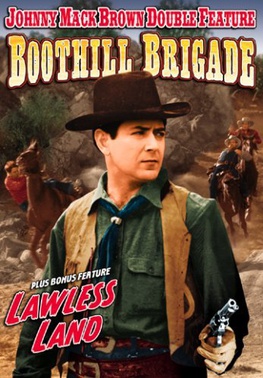
Boothill Brigade (1937, directed by Sam Newfield)


Rancher Jeff Reynolds (Frank LaRue) used to be one of the good guys on the frontier but he’s recently changed.  He fired all of his loyal ranch hands and instead hired a motely crew of outlaws.  He’s buying up land and evicting the squatters who have been living there.  About the only good thing he does is hire Lon Cardigan (Johnny Mack Brown) to be his new herd boss.  Lon is engaged to Reynolds’s daughter, Bobbie (Claire Rochelle).  With the help of Bobbie and comic relief cook Calico Haynes (Horace Murphy), Lon tries to figure out why Reynolds is now doing the bidding of the evil John Porter (Ed Cassidy).

The title is the most exciting thing about this movie, which is one of those old B-movies that puts the “creak” in creaky.  There’s surprisingly little gunplay but there is a lot of horse riding.  For a film that runs less than an hour, a surprising amount of it is just shots of people riding from one location to another.  The horses’ hooves sound impressive on the soundtrack but it’s not exactly exciting.  As always, Johnny Mack Brown is a convincing cowboy.  It’s a good thing he looks like he knows what he’s doing when he’s riding a horse!  The plot was standard B-western fluff.  Johnny Mack Brown appeared in a ton of westerns and almost all of them seemed to feature the same range war.  There are better Johnny Mack Brown movies out there.  This one is for completists only.

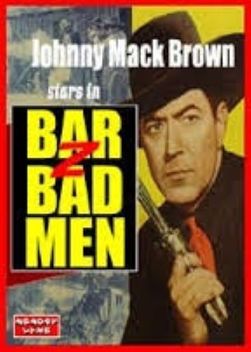
Bar-Z Bad Men (1937, directed by Sam Newfield)


After getting kicked out of town for shooting the place up during a night of friendly fun, cowboy Jim Waters (Johnny Mack Brown) drops in on his old friend, rancher Ed Parks (Jack Rothwell).  Ed has got a strange problem.  There are cattle rustlers about but instead of stealing Ed’s cattle, they’re adding cattle to Ed’s herd.  It’s an obvious scheme to try to create a feud between Ed and his neighbor, rancher Hamp Harvey (Frank LaRue).  Before Jim and Ed can solve the problem, Ed is gunned down.  Harvey is the number one suspect but Jim figures out the truth, that Harvey has been betrayed by one of his own employees and that all of this is a part of a scheme by Sig Bostell (Tom London) to take control of both ranches.

Bar-Z Bad Man is a B-western with a notably twisty plot as Bostell plays both sides against each other for his own benefit.  As usual, Johnny Mack Brown makes for a good and convincing western hero.  Whether he’s chasing someone on his horse or drawing his guns, Brown is always a convincing cowboy.  What makes this film interesting is that it opens with Johnny Mack Brown engaging in the type of behavior that most B-western heroes would never think of doing.  Shooting up the town and then getting exiled for his actions adds an element of redemption to Jim’s efforts to get to the bottom of Bostell’s schemes.  Or it would if Jim ever really seemed to feel bad about shooting the town up.  His excuse is that he was just having a good time.  Try to get away with that in the real old west, Jim!

Bar-Z Bad Men is a good B-western for those who like the genre.  The story is solid and Johnny Mack Brown is as convincing saving the west as he was shooting it up.


Gunning For Vengeance (1946, directed by Ray Nazarro)


Steve Landry (Charles Starrett) rides into another town and is once again named the new sheriff.  Luckily, Steve’s old friend Smiley Burnette is working as the town’s blacksmith.  Steve makes Smiley his deputy and then sets about trying to break up a gang of cattle rustlers.  When Steve learns that his jurisdiction does not extend beyond the city limits, he dons the disguise of his alter ego, The Durango Kid, to go after the outlaws.

Has Steve met his match in Belle (Phyllis Adair), the saloon owner who is the secret leader of the outlaws?  She notices that The Durango Kid’s boot tracks are the same as Steve’s boot tracks.  I’m surprised that no one has ever noticed that before.  Steve went through a lot of trouble to disguise himself as Durango but he never bothered to change his boots.

This entry in the Durango Kid series features a lot of Smiley Burnette so your enjoyment on the film will depend on how much tolerance you have for Smiley’s songs and his style of humor.  Each film featured Smiley being followed around by a different group of musicians.  In this one, Smiley is accompanied by The Trailsman.  When Smiley accidentally locks himself in a jail cell, the Trailsman stand on the other side of the bars and sing a song about how Smiley can’t get out of the cell.  Smiley does eventually get out but, later on, he’s knocked out cold during an attempted jail break.  Smiley’s not much of a help in this one.

This has all of the typical Durango Kid elements, including the stock footage of the stampeding cattle that appeared in nearly all of his films.  There’s another saloon fight and a gunfight towards the end.  Durango rides out of town alone, leaving Smiley behind, but we know they’ll soon be reunited in another adventure.

Law of the Canyon (1947, directed by Ray Nazarro)


When a gang of outlaws starts hijacking freight wagons and then ransoming them back to their owners, government agent Steve Langtry (Charles Starrett) is sent to investigate.  He both goes undercover as an inexperienced traveler and as the masked Durango Kid.  As always, he is accompanied by Smiley Burnette.  In this installment, Smiley tries to invent a machine that can find silver and he also sings a few songs.  His backing band, The Lone Star Cowboys, follow him everywhere that he goes but they don’t actually get involved in the action.

This is another Durango Kid movie, with all of the usual horse chases and shootouts.  The same action montage that started Phantom Valley also starts this movie.  As always, Charles Starrett is convincing when riding a horse or shooting a gun.

What sets this Durango Kid movie apart from the others is the main villain.  Dr. Middleton (played by a regular member of the Durango Kid stock company, Fred F. Sears) appears to be a kindly man who serves as a middleman between the citizens and the outlaws.  Actually, he is working with the outlaws and receives a commission of every ransom that he negotiates.  The reason he can get away with it is because he’s drugged the Sheriff (George Cheseboro)!  He attempts to drug Durango too but luckily, Smiley drinks the water instead.

While it won’t convert anyone who isn’t already a fan of the genre or the character, this is another entertaining outing for the Durango Kid.