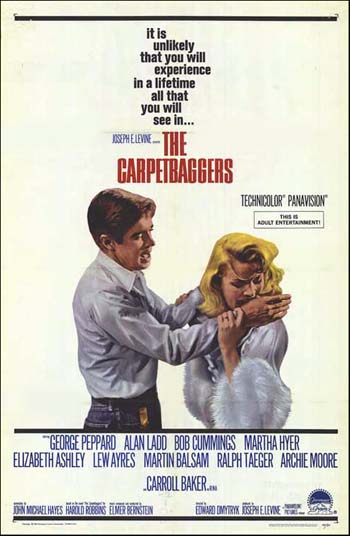
The 1960s was apparently a bad time for talented old school Hollywood filmmakers getting sucked into making big budget, excessively lengthy films. Joseph L. Mankiewicz spent most of his career making movies like All About Eve and then, in 1963, he ended up directing Cleopatra. Elia Kazan went from A Face In The Crowd to The Arrangement. John Huston went from Treasure of the Sierra Madre and The African Queen to directing not only The Bible but Reflections in a Golden Eye as well.
And then there’s Edward Dmytryk. Dmytryk may not be as highly regarded by modern critics as Mankiewicz and Huston but he still directed some of the best film noirs of the 1940s. His 1947 film Crossfire was nominated for best picture and probably should have won. In 1952, he directed one of the first true crime procedural films, The Sniper. His 1954 best picture nominee, The Caine Mutiny, featured one of Humphrey Bogart’s best and most unusual performances.
And yet, in 1964, he somehow found himself directing The Carpetbaggers.
The Carpetbaggers tells the story of Jonas Cord (George Peppard). Jonas is the son of the fabulously wealthy Jonas Cord, Sr. (Leif Erickson). At the start of the film, father and son do not get along. Senior resents that Junior is more interested in piloting airplanes than in learning the family business. Junior is angry that Senior has married Jonas’s ex-girlfriend, actress Rina Marlowe (Carroll Baker). In fact, as far as Jonas, Jr. is concerned, Nevada Smith (Alan Ladd) is more of a father to him than his actual father.
Nevada Smith is Jonas, Sr.’s best friend and occasional business partner. He’s a former cowboy who, we are told in a lengthy bit of exposition, is legendary for tracking down and killing the three men who killed his parents. (As we listen to Jonas, Jr. tell the entire lengthy story, we find ourselves thinking, “Okay, so why not make a movie out of that story?” Well, they did. Two years after the release of The Carpetbaggers, Steve McQueen starred in Nevada Smith.) Nevada’s also a film star whose career is in deep decline.
Speaking of deep decline, Jonas, Sr. ends up having a heart attack and dramatically dropping dead before he can get a chance to disinherit his son. Jonas, Jr. inherits the Cord fortune and the Cord business and proceed to spend the next two and a half hours abusing everyone who gets close to him. He even mistreats his loving and neurotic wife, Monica (Elizabeth Ashley, giving the only really memorable performance in the entire film).
Yes, there’s really no reason to have any sympathy at all for Jonas Cord, Jr. but the film insists that we should because he’s the main character and he’s played by the top-billed star. We’re also told that he’s a brilliant aviation engineer and I guess we’re supposed to admire him for being good at what does. We also discover that Jonas believes that his mother was insane and that she passed down her insanity to him. He fears that he’ll pass the crazy gene to any of children that he might have so that’s why he pushes everyone away. Just in case we don’t understand how big a deal this is to him, the camera zooms in for a closeup whenever Jonas is reminded of his mother.
(In the 60s, all mental instability was represented via zoom lens.)
However, Jonas isn’t just into airplanes! He also buys a movie studio, specifically because Rina Marlowe is under contract. Soon, Jonas is directing movies his way. Jonas also finds himself falling in love with another actress (Martha Hyer) so, of course, he starts treating her badly in an effort to push her away.
What can be done to save the tortured soul of Jonas Cord? Maybe he just need to get beaten up by Nevada Smith…
The Carpetbaggers was based on a novel by Harold Robbins. The novel was apparently quite a scandal when it was originally published. People read it and they wondered, “Who was based on who?” Well, if you’ve ever seen The Aviator, it’s not that difficult to figure out. Jonas Cord, eccentric movie mogul and obsessive pilot, was obviously meant to be Howard Hughes. Rina Marlowe was meant to be Jean Harlow, a fact that can be guessed just by looking at the last names. And I’m guessing that Nevada Smith was probably based on former President Warren G. Harding because … well, why not?
I suppose that, by the standards of 1964, the film version of The Carpetbaggers would have been considered risqué. For a modern audience, the main appeal of something like The Carpetbaggers is to see what was once considered to be shocking. The film is overlong, George Peppard doesn’t exactly figure out how to make Jonas into the compelling rogue that he needs to be, the clothes and the sets are a lot more interesting than any of the dialogue (but not interesting enough to carry a nearly 3 hour movie), and the film’s pacing is so off that some scenes seem to go on forever while others are way too short. But, as a cultural and historical artifact, The Carpetbaggers does hold some interest.
The Carpetbaggers was made at a time when Hollywood felt it was under attack from both television and European cinema. With a film like The Carpetbaggers, the studios were saying, “See!? Television will never be able to make a film this long and big! And those Europeans aren’t the only ones who can make a movie about sex!” Of course, as so often happened during this time, the studios failed to take into account that size and length don’t always equal quality (and ain’t that the truth?). As for the sex — well, we hear a lot more than we actually see. The Carpetbaggers is one of those films where everyone talks about sex, largely because showing sex wasn’t really an option. (And it should be noted that most of the sex talk is delivered in the language of euphemism.) As a result, The Carpetbaggers feels incredibly tame by today’s standards. As a result, your main reaction to The Carpetbaggers will probably be to marvel at what was considered daring and shocking 50 years ago.
(And before we get too cocky and quick to dismiss those who came before us, let’s consider how our current films will look to movie audiences five decades from now…)
As far as biopics of Howard Hughes are concerned, The Carpetbaggers in no Aviator. However, it is an occasionally interesting historical artifact.

 Through the Shattered Lens