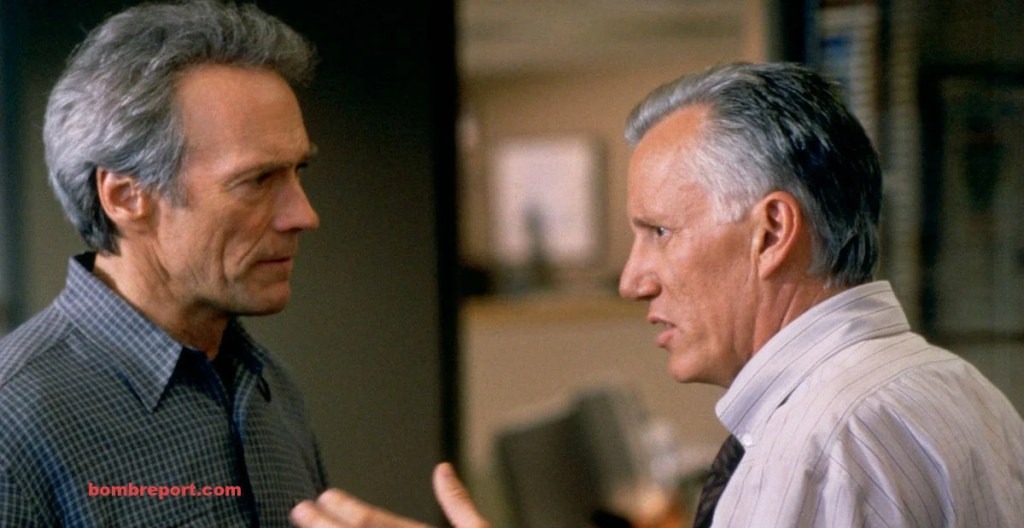
I review TRUE CRIME (1999) – starring Clint Eastwood and James Woods!


Here at The Shattered Lens, we’re celebrating Clint Eastwood’s birthday on May 31st. I decided to revisit his 1999 film, TRUE CRIME. 

Clint Eastwood directs and stars as ace journalist, Steve Everett, who also happens to be a bad friend, a terrible dad, and an even worse husband. Literally the only thing that he’s got going for him is his “nose,” his ability to sniff out a story where no one else can. Even that has begun to fail him, mostly due to his recents bouts with alcoholism, which he seems to somewhat have a handle on at the time of this story. When a young, beautiful colleague tragically passes away in an auto accident, Steve is given her previous assignment to cover the execution of convicted murderer Frank Beechum (Isaiah Washington). Not the kind to write a human interest “puff piece” like the Oakland Tribune is wanting, Everett begins digging into the past and pretty soon that nose of his starts telling him that Beechum is a victim of circumstantial evidence. Despite his editor Bob Findley’s (Denis Leary) objections, he’s able to convince his newspaper boss Alan Mann (James Woods) to let him dig deeper into the story. As he tries to juggle his myriad personal problems with his growing belief in Beechum’s innocence, Everett is also facing a clock that is ticking down to the midnight execution. Will he be able to find the crucial piece of evidence that will set Beechum free?

TRUE CRIME appears to be somewhat of a forgotten Clint Eastwood film. I saw it at the theater when it came out in 1999, but it was not financially successful, only bringing in $16 Million at the box office. Regardless of that, I still love the film. It’s certainly not perfect. It’s probably too long, Beechum is probably too angelic after being “born again,” and the resolution may be a little unrealistic, but I still enjoyed every second of it. One of the coolest things about Clint Eastwood is his willingness to play such flawed men on screen, yet we still love him. He’s great in this film! Anyone who’s read much of my work knows that my love of actor James Woods goes back to being in junior high and renting his movies BEST SELLER and COP. It’s such a treat seeing the legendary pair on screen together even if Woods’ role is sort of a glorified cameo. Woods is hilarious in his limited screen time. My last shout out is to Isaiah Washington as the innocent man who’s about to be put to death. After all these years and appeals, he’s accepted his fate, but the scene where he tells Everett his story and Everett tells him that he believes he’s innocent is so powerful. Add to that Washington’s scenes with his wife and daughter, and I was very much emotionally invested in this film. Washington’s performance was key to the film working, and he’s great!

Overall, TRUE CRIME is a film that takes its sweet time, but it ultimately tells a tense, engrossing story that ratchets up the tension to 10 prior to its last second resolution. I consider it very underrated and highly recommend it. I’ve included the trailer below:
Icarus File No. 20: Tough Guys Don’t Dance (dir by Norman Mailer)


The 1987 film, Tough Guys Don’t Dance, opens with Tim Madden (Ryan O’Neal) talking to his father, tough Dougy (Lawrence Tierney).  Dougy has stopped by Tim’s New England home to let Tim know that he has decided stop chemotherapy and accept his eventual death from cancer because, as Dougy puts it, “Tough guys don’t dance.”  The tone of Dougy’s voice is all we need to hear to know that, in his opinion, his son has spent way too much time dancing.

Tim is an ex-convict turned writer and, when we first see him, he’s obviously had a few rough nights.  He explains to Dougy that he woke up after a bender with his ex-girlfriend’s name tattooed on his arm, blood all over his jeep, and two heads dumped in his marijuana stash.  Tim says that he’s hopeful that he’s not the murderer but he can’t be sure.  He’s been drinking and doping too much.  He suffers from blackouts.  He’s not sure what happened.

The majority of the film is made up of flashbacks, detailing Tim’s affairs with a number of women and also his odd relationship with the town’s police chief, Luther Regency (Wings Hauser).  Luther is married to Tim’s ex-girlfriend, Madeleine (Isabella Rossellini), who long ago accompanied Tim on a trip to North Carolina where they hooked up with a fundamentalist preacher (Penn Jillette) and his then-wife, Patty Lariene (Debra Sundland).  (Tim found their personal ad while casually skimming the latest issue of Screw, as one does I suppose.)  Patty Lariene eventually ended up married to Tim, though she has recently left him.  As for Madeleine, she has never forgiven him for a car accident that they were involved in.  Is Tim capable of loving anyone?  Well, he does say, “Oh God, oh man,” repeatedly when he discovers that his wife has been having an affair.

Tim tries to solve the murders himself, finding that they involve not only him and Luther but also Tim’s old prep school friend, Wardley Meeks III (John Bedford Lloyd) and also some rather stupid drug dealers that Tim hangs out with.  The plot is almost ludicrously convoluted and it’s tempting to assume that the film is meant to be a parody of the noir genre but then you remember that the film is not only based on a Norman Mailer movie but that it was directed by Mailer himself.  Mailer, who was the type of public intellectual who we really don’t have anymore, was blessed with a brilliant mind and cursed with a lack of self-awareness.  There’s little doubt that we are meant to take this entire mess of a film very seriously.

And the film’s theme isn’t hard to pick up on.  By investigating the murders, Tim faces his own troubled past and finally comes to understand why tough guys, like his father, don’t hesitate to take action.  Tough guys don’t dance around what they want or need.  That’s a pretty common theme when it comes to Mailer.  Tim Madden is not quite an autobiographical character but he is, by the end of the story, meant to represent the type of hard-living intellectual that Mailer always presented himself as being.  Unfortunately, Ryan O’Neal wasn’t exactly an actor who projected a good deal of intelligence.  And, despite his lengthy criminal record off-screen, O’Neal’s screen presence was somewhat docile.  That served him well in films like Love Story and Barry Lyndon.  It serves him less well in a film like this.  It’s easy to imagine O’Neal’s Tim getting manipulated and, in those scenes where he’s supposed to be a chump, O’Neal is credible enough in the role.  It’s far more difficult to buy the idea of Tim actually doing something about it.

Indeed, it’s hard not to feel that co-star Wings Hauser would have been far more credible in the lead role.  But then, who would play Luther Regency?  Hauser gives such a wonderfully unhinged and out-there performance as Luther that it’s impossible to imagine anyone else in the role.  Maybe Hauser could have played both Tim and Luther.  Now that would have made for a classic film!

Tough Guys Don’t Dance is weird enough to be watchable.  The dialogue is both raunchy and thoroughly humorless, which makes it interesting to listen to, if nothing else.  The moments that are meant to be funny are so obvious (like casting noted atheist Penn Jillette as a fundamentalist) that it’s obvious that the moment that feel like clever satire were actually all a happy accident.  As far as Norman Mailer films go, this one is not as boring as Wild 90 but it also can’t match the unhinged lunacy of a frustrated Rip Torn spontaneously attacking Mailer with a hammer at the end of the unscripted Maidstone.  It’s a success d’estime.  Mailer flew too close to the sun but the crash into the ocean was oddly entertaining.

Previous Icarus Files:

  1. Cloud Atlas
  2. Maximum Overdrive
  3. Glass
  4. Captive State
  5. Mother!
  6. The Man Who Killed Don Quixote
  7. Last Days
  8. Plan 9 From Outer Space
  9. The Last Movie
  10. 88
  11. The Bonfire of the Vanities
  12. Birdemic
  13. Birdemic 2: The Resurrection 
  14. Last Exit To Brooklyn
  15. Glen or Glenda
  16. The Assassination of Trotsky
  17. Che!
  18. Brewster McCloud
  19. American Traitor: The Trial of Axis Sally

Lisa Reviews An Oscar Winner: Unforgiven (dir by Clint Eastwood)


The 1992 Best Picture winner, Unforgiven, begins as a story of frontier justice.

In Kansas, a young and cocky cowboy who calls himself the Schofield Kid (Jaimz Woolvett) rides up to an isolated hog farm.  He’s looking for Will Munny (Clint Eastwood), a notorious outlaw with a reputation for being a ruthless killer.  Instead, he just finds a broken down, elderly widower who is trying to raise two young children and who can barely even manage to climb on a horse.  Will Munny, the murderer, has become Will Munny the farmer.  He gave up his former life when he got married.

The Schofield Kid claims to be an experienced gunfighter who has killed a countless number of men.  He explains that a group of sex workers in Wyoming have put a $1,000 bounty on two men, Quick Mike (David Mucci) and his friend, Davey Bunting (Rob Campbell).  Quick Mike cut up one of the women when she laughed at how unimpressively endowed he was.  While Davey didn’t take part in the crime, he was present when it happened and he didn’t do anything to stop it.  The local sheriff, a man named Little Bill Daggett (Gene Hackman), had Davey give the woman’s employer several horses as compensation.  The Kid wants Munny to help him collect the bounty.

At first, Munny refuses to help the Kid.  But, when he realizes that he’s on the verge of losing his farm, Munny changes his mind.  He and his former partner, Ned Logan (Morgan Freeman), join with the Kid and the three of them head to Wyoming.  Along the way, they discover that the Kid is severely nearsighted and can hardly handle a pistol.

Meanwhile, in the town of Big Whiskey, Wyoming, Little Bill ruthlessly enforces the peace.  He’s a charismatic man who is building a house and bringing what many would consider to be civilization to the Old West. When we first meet Little Bill, he seems like a likable guy.  The town trusts him.  His deputies worship him.  He has a quick smile but he’s willing to stand his ground.  But it soon becomes apparent that, underneath that smile and friendly manner, Bill is a tyrant and a petty authoritarian who treats the town as his own personal kingdom.    Little Bill has a strict rule.  No one outside of law enforcement is allowed to carry a gun in his town.  When another bounty hunter, English Bob (Richard Harris), comes to town to kill the two cowboys, Little Bill humiliates him and sends him on his way but not before recruiting Bob’s traveling companion, writer W.W. Beauchamp (Saul Rubinek), to write Bill’s life story.  Bill’s not that much different from the outlaws that he claims to disdain.  Like them, Bill understands that value of publicity.

Unforgiven starts as a traditional western but it soon becomes something else all together.  As the Schofield Kid discovers, there’s a big difference between talking about killing a man and actually doing it.  Piece-by-piece, Unforgiven deconstructs the legends of the old west.  Gunfights are messy.  Gunfighters are not noble.  Davey Bunting is the only man in town to feel guilty about what happened but, because he’s included in the bounty, he still dies an agonizing death.  Quick Mike is killed not in the town square during a duel but while sitting in an outhouse.  Ned and Munny struggle with the prospect of going back to their old ways, with Munny having to return to drinking before he can once again become the fearsome killer that he was in the past.  And Little Bill, the man who says that he’s all about taming the west and bringing civilization to a lawless land, turns out to be just as ruthless a killer as the rest.  A lot of people are dead by the end of Unforgiven.  Some of them were truly bad.  Some of them were good.  Most of them were in the wrong place at the wrong time.  Everyone’s got it coming, to paraphrase Will Munny.

With its violent storyline, deliberate pacing, and its shots of the desolate yet beautiful western landscape, Clint Eastwood’s film feels like a natural continuation of the Spaghetti westerns that he made with Sergio Leone.  (Unforgiven is dedicated to both Leone and Don Seigel.)  Unforgiven was the first of Eastwood’s directorial efforts to be nominated for Best Picture and also the first to win.  It’s brutal meditation on violence and the truth behind the legends of the American frontier.  Eastwood gives one of his best and ultimately most frightening performances as Will Munny.  Gene Hackman won his second Oscar for playing Little Bill Daggett.

Unforgiven holds up well today.  Hackman’s Little Bill Dagget feels like the 19th century version of many of today’s politicians and unelected bureaucrats, authoritarians who claims that their only concern is the greater good but whose main interest is really just increasing their own power.  Unforgiven remains one Clint Eastwood’s best films and one of the best westerns ever made.  Leone would have been proud.

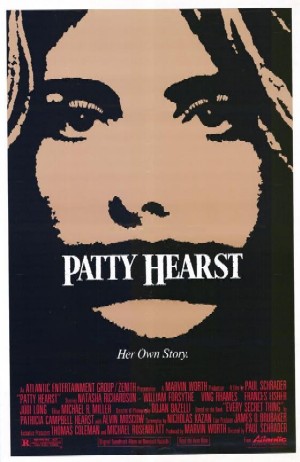
Film Review: Patty Hearst (dir by Paul Schrader)


The 1988 film, Patty Hearst, is based on a fascinating true story.

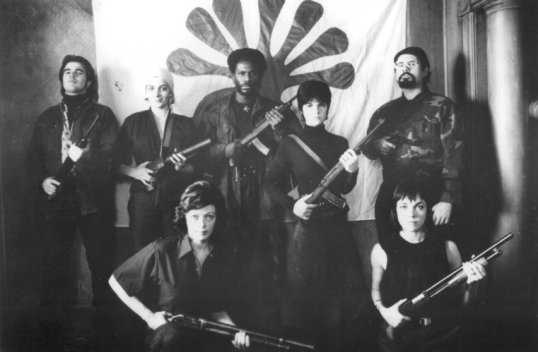
In 1974, newspaper heiress Patty Hearst was a 19 year-old student at Berkeley who was kidnapped from her apartment by a group of self-styled leftist revolutionaries known as the Symbionese Liberation Army (SLA).  The SLA was led by a charismatic escaped prisoner who called himself Field Marshal Cinque and who announced — via messages that Hearst read into a tape recorder — that Hearst was being held hostage in the name of social justice.  The police and FBI spent several months unsuccessfully searching for Hearst until one day, the SLA released an audio tape in which Hearst announced that she had now joined the SLA and would now be known as Tania.  Hearst was soon robbing banks and went from being a hostage to a wanted criminal.  When she was arrested in 1975, Hearst claimed to have been brainwashed by the SLA and people still debate whether she was a sincere revolutionary, a calculating criminal, or a victim.

(From what I’ve read about the Hearst kidnapping, I guess the modern day equivalent would be if Kendall Jenner disappeared and then resurfaced in Portland, setting cars on fire with Antifa.)

What can said for sure is that, after being arrested and convicted of bank robbery, Patty Hearst was sentenced to 7 years in prison.  Hearst served less than three years before her sentence was commuted by President Jimmy Carter.  Twenty years later, another President — Bill Clinton — gave her a full pardon.  Needless to say, the rest of the SLA did not receive a pardon or, for that matter, even a commutation.  The majority of them, including Field Marshal Cinque, died in a fiery explosion that came at the climax of a gun battle with police.  The rest were arrested, convicted, and ended up serving their full sentences.  Of course, while the majority of the SLA came from middle and upper middle class backgrounds, only one of them was the heir to a fortune.  When she was arrested, Patty may have given her career as being an “urban guerilla,” but ultimately, she was the granddaughter of William Randolph Hearst.

(Regardless of whether you believe Patty Hearst was brainwashed or not, it’s an undeniable fact that it’s easier to be a revolutionary when you know you won’t face any serious consequences if the revolution eventually fails.  If the members of the SLA were around today, they could just spend their time on twitter, retweeting John Fugelsang’s thoughts on Jesus.  But, in 1974, there was no twitter…)

Based on Every Secret Thing, Hearst’s own account of her kidnapping and subsequent life as a fugitive, Patty Hearst opens with the heiress (played by Natasha Richardson) being kidnapped and held prisoner by the SLA.  For the first fourth of the film, we see everything exclusively through Patty’s eyes.  She spends her days locked in a dark closet that’s so tiny that she can barely stand.  Whenever the door is opened, shafts a bright light flood both the closet and the screen, blinding not only Patty but the audience as well.  At first, Patty cannot even see the faces of the people who have kidnapped her.  All she knows are their voices.  Whenever that door opens, neither Patty nor the viewer knows whether she’s going to fed, berated, comforted, or raped.  All four of them happen to her, several times over the course of her time in that closet.  It’s harrowing to watch, all the more so because Natasha Richardson gives such an empathetic and bravely vulnerable performance as Patty.  When Patty is finally allowed to leave that closet, the audience is almost thankful as she is.  And, when Patty gets out of the closet, the look of the film changes as well.  It goes from being darkly lit to almost garishly colorful.  Patty’s entire world has changed.

The first part of the film is so powerful that it’s not surprising that the rest of Patty Hearst suffers by comparison.  Once Patty gets out of the closet and declares her allegiance to the revolution, she becomes a bit of a dead-eyed zombie and the focus naturally shifts to the rest of the SLA.  Ving Rhames gives a powerful performance as Cinque, the head of the SLA.  Cinque may be a passionate revolutionary but he also has a dangerous messianic streak.  Even worse, the film suggests, is Cinque’s lieutenant, Teko (William Forsythe).  Teko claims to be a revolutionary but ultimately reveals himself to be as much of a misogynist as those who he claims to oppose.  (Today, Teko would probably be one of those guys arguing that it’s okay for him to use the C word because he’s an “ally.”)  Whereas Cinque has no doubt about his revolutionary commitment, Teko always seem to be trying to prove something to everyone, especially himself.

Ultimately, Patty becomes almost a bystander to her own story.  For a time, she is the most famous bystander in the country.  Though the film is sympathetic to Patty, Natasha Richardson plays her with just a hint of ambiguity.  Ultimately, Patty comes across as someone desperately searching for an identity.  Since she is not sure who she ultimately is, it’s easy for Patty to become an “urban guerilla” and it’s just as easy for to her go back to being an heiress.  By the end of the film, it’s obvious that Patty is just as confused by her life as everyone else.

Patty Hearst was directed by Paul Schrader, who is best known for writing the scripts for such films as Taxi Driver and Rolling Thunder.  (Among Schrader’s other directorial credits: Blue Collar, Hardcore, American Gigolo, Cat People, and The Canyons.  Needless to say, he’s had an interesting career.)  In many ways, Patty Hearst is probably more relevant today than it was first released.  Considering that our culture is currently dominated by people pretending to be revolutionaries and celebrities famous solely for being famous, Patty Hearst feels rather prophetic.

Watching this film and experiencing Patty’s transformation from vapid heiress to brainwashed political activist to briefly notorious celebrity, I realized that we now live in a world of Patty Hearsts.