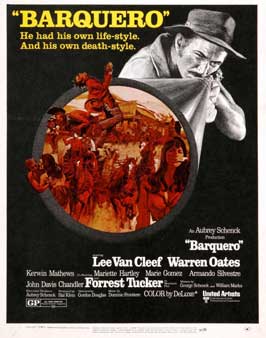
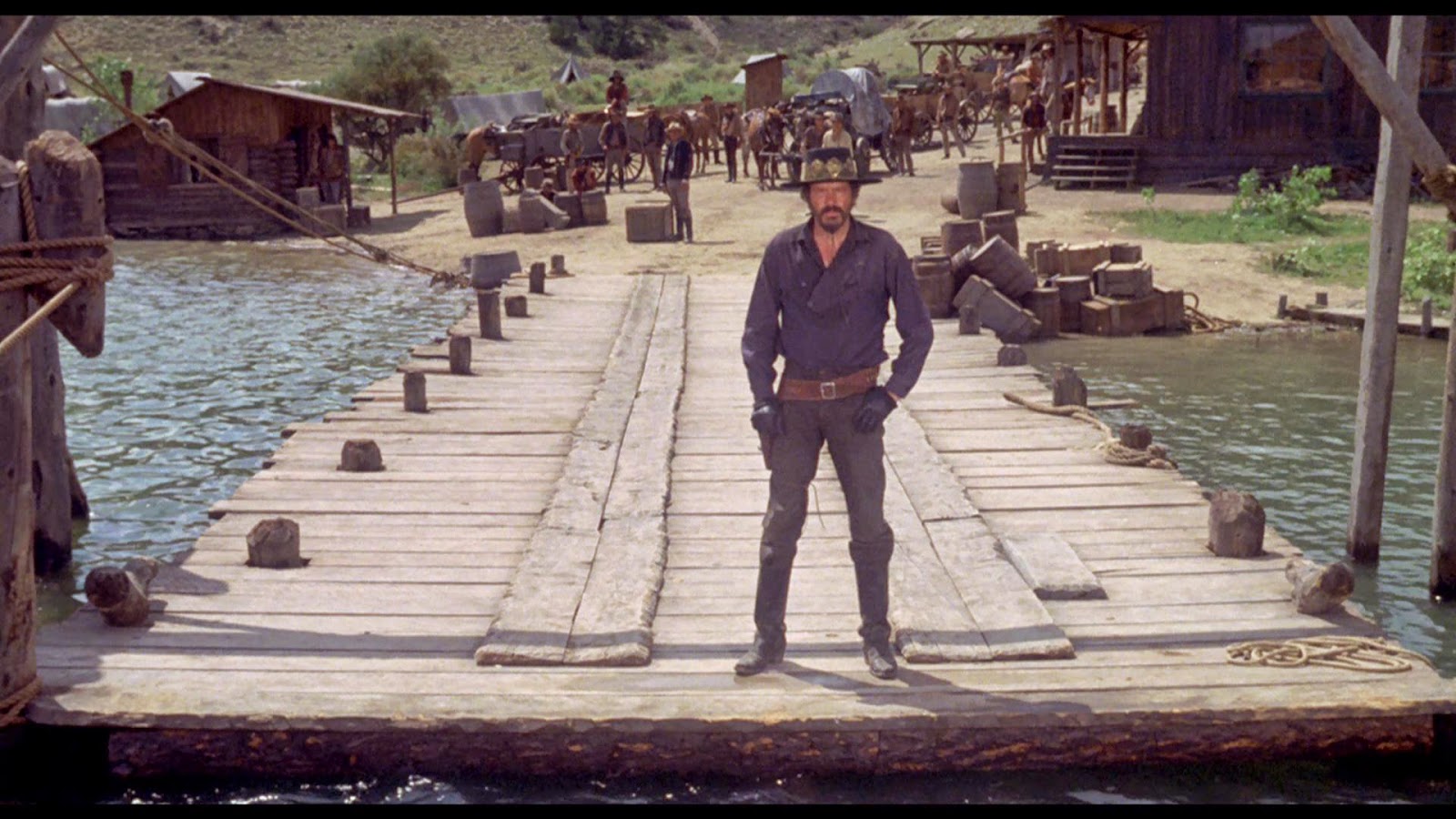
 Travis (Lee Van Cleef) is a former gunslinger who now makes his living taking settlers across a river on his small barge. When we first meet him, he is telling a child to shut up and stop bothering him while he is guiding the barge. He depends on the settlers on the other side of the river for his livelihood and they depend on him for transportation but he doesn’t like them and they don’t like him. Travis only cares about two people, his Mexican lover, Nola (Maria Gomez) and an eccentric hunter named Mountain Phil (Forrest Tucker).
After stealing a shipment of silver, outlaw Jake Remy (Warren Oates) and his army of mercenaries need to cross the river to escape into Mexico. To prevent anyone from following, they plan to destroy the barge afterward. However, Travis and Phil find out that Remy is on the way and take the barge to the other side of the river. When Jake and his gang arrive, a tense stand-off ensues, with the outlaws on one side of the river and Travis and the settlers trapped on the other.
Though Barquero was directed by the veteran American director Gordon Douglas (Douglas’s best known film is the 1950s giant ant film, Them!), it was heavily influenced by contemporary Spaghetti Westerns and Sam Peckinpah’s The Wild Bunch. This can be seen in both its graphic violence and in the casting of Lee Van Cleef and Warren Oates in the leading roles.
Travis was a perfect role for Van Cleef, a talented actor who was ignored by Hollywood until he found fame playing ruthless villains in European westerns. Surly and unsmiling, Travis may seem like an unlikely hero but, like many of the best Spaghetti westerns, there are no traditional good guys in Barquero. Travis is more interested in saving his boat than protecting the settlers. He is a hero of circumstance.
As Jake, Warren Oates is a great villain. In his very first scene, he and a prostitute watch as his gang massacre the citizens of a small town. When the prostitute asks if she can come with them, Jake calmly replies, “I don’t think so” and shoots her dead. Stuck on his side of the river, Jake smokes the local weed and starts to have violent hallucinations. Soon, he is shooting bullets into the river.
Also doing good work are Forest Tucker as Mountain Phil and Kerwin Mathews. Mathews, who is best remembered for starring in The 7th Voyage of Sinbad, plays the Marquette, a disgraced French nobleman who has started a second life as Jake Remy’s right-hand man.
Barquero starts with a bang but it struggles to keep up the momentum over its entire running time. The opening shoot out is exciting but things slow down almost too much during the stand-off at the river. It is an interesting but flawed western that deserves to be better known than it is and worth watching to see Lee Van Cleef and Warren Oates at their best.
 Through the Shattered Lens