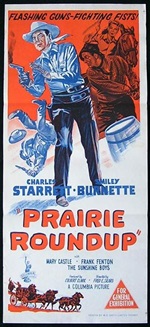
Steve Carson (Charles Starrett) is wanted for murdering the Durango Kid!
I know that sounds confusing because Steve Carson is the Durango Kid. The bandit that Carson shot was just disguised as the Durango Kid but actually, he was just a dim-witted outlaw who was set up by Buck Prescott (Frank Fenton), a rustler who was run out of Texas by Steve and who was trying to find a way to stop Steve from investigating his new scheme to cheat a bunch of ranchers in Santa Fe.
Steve is taken to jail but luckily, Smiley Burnette is around to help him break out. Smiley and Steve head to Santa Fe, where they get jobs working as cowhands at the Eaton Ranch and work to expose Prescott and his gang as being responsible for a series of stampedes. Smiley sings some songs and Steve resurrects the Durango Kid from the dead.
This was one of the later Durango Kid films. The range war plot is one that showed up in many Durango Kid films but Prairie Roundup adds something new to the formula but having Steve framed for murdering himself. Steve could prove his innocence by revealing that he’s actually the Durango Kid but Steve is determined to maintain his secret identity. I’ve seen several Durango Kid films and I still don’t really understand why Steve felt he needed a secret identity in the first place. But Prairie Roundup shows the extent to which he’ll go to keep it.
There’s plenty of fight and horse chases, more than enough to keep western fans happy. Smiley Burnette gets to throw some punches along with singing all of his usual songs. It’s also nice to see the lovely Mary Castle in the role of Toni Eaton, the daughter of one of the ranchers who has been targeted by Prescott. Featuring less stock footage than usual, Prairie Roundup is a worthy entry in the Durango Kid series.
Deputy Marshal Ed Garry (Jon Hall) is pursuing two bank robbers in Wyoming when he comes across a wounded man. Harley Masters (Wheaton Chambers) has been shot in the gut but his main concern is holding onto his hat. Ed takes Harley into town. They go into the local saloon, where Harley reveals a map hidden in his hat. He slips the map to Ed before an unseen gunman shoots him a second time. This time, Harley does not survive.
With the current sheriff “laid up,” Ed decides to stay in town and not only catch the bank robbers but also solve Harley’s murder. Ed soon finds himself in the middle of a conflict between two rival women (Frances Langford and Julie Bishop) who own ranches and stand to make a lot of money when the railroad comes through.
Deputy Marshal is one of the B-westerns that was produced by Robert Lippert and directed by William Berke in the 40s and 50s. This one is a step above the usual Lippert production because it combines a murder mystery with the standard western action and there are enough suspects to keep the story interesting. Jon Hall was best-known for appearing in exotic adventure films, often playing islanders. His career was in decline when he starred in Deputy Marshal but he makes for a surprisingly believable western hero. It helps that Hall was older than the typical B-western hero. His weathered looks make him convincing as an experienced lawman who understood the ways of the west.
Frances Langford, who plays the nicer of the two ranchers, was married to Jon Hall when she appeared in this film. She gets to sing two songs because this is a Lippert production and Robert Lippert believed that every western should open with a horse chase and should feature at least one song.
While it obviously never won any awards for originality, Deputy Marshal is a better-than-average B-western with an interesting mystery story and a convincing hero.
Well, not really. Wayne does play a cowboy named Singin’ Sandy Saunders in this early, pre-code Western but his voice was dubbed by someone who didn’t sound anything like Wayne. Wayne was only 25 when he starred in Riders of Destiny and this was six years before Stagecoach made him a star but he already had his famous way of speaking.
Riders of Destiny starts off with Singin’ Sandy riding through the west. When he comes across a wounded sheriff and then witnesses a stagecoach being robbed by Ms. Fay Denton (Cecilia Parker), he knows that he’s reached the town of Destiny. The town is under the control of a land developer named Kincaid (Forrest Taylor). Kincaid and his henchmen have been extorting the local citizens and stealing money from Fay and her father (George “Gabby” Hayes). After Singin’ Sandy reveals his skills with a gun, Kincaid offers him a position in his gang and if Sandy accepts, Kincaid will be unstoppable. Before Sandy’s mysterious appearance, the townspeople wrote to Washington to help and Washington has agreed to send down one of their best agents. Could that agent be traveling in disguise as a singing cowboy?
It’s always difficult for me to take a Singing Cowboy film seriously. (That’s especially true after watching Tim Blake Nelson in The Ballad of Buster Scruggs.) John Wayne is not an actor who was ever meant to be seen playing a guitar and singing a song, even if his voice was dubbed. But Riders of Destiny is not that bad of a programmer. If you can overlook the singing, the story is surprisingly mature and violent and Forrest Taylor is a good villain as the oily Kincaid. (With Kincaid demanding protection money and gunning down anyone who refuses to play it, he has more in common with the type of gangsters who were appearing in Warner Bros. crime films than with the typical western bad guy.) Cecilia Parker, who would eventually be best known for appearing in the wholesome Andy Hardy films, is sexy as Fay and, because this is a pre-code film, she gets away with robbing a stagecoach. With a running time of barely an hour, the action has to move quickly and there’s no need for any padding. Finally, even this early in his career, John Wayne was a perfect western hero, whether he was on his horse chasing the bad guys or walking down a dusty street, singing a song about how the “streets will run with blood” before drawing his guns.
Wayne would go on to play one more Singing Cowboy, in 1935’s The Lawless Range. Again, his voice was dubbed. He later said that he abandoned the Singing Cowboy genre because the children who saw the films would often approach him and ask him to sing one of the songs and they were always disappointed to learn that he couldn’t actually a sing a note. Of course, in 1939, John Ford would select Wayne to play The Ringo Kid in Stagecoach and Wayne would never have to sing again.
The 1944 film, Lady in the Death House, tells the tragic and faintly ridiculous story of Mary Kirk Logan (Jean Parker).
The daughter of a small-time criminal, Mary has spent most of her life trying to escape from her family’s legacy of crime. She’s even got a job, working at the same bank that her father once tried to rip off. Of course, at work, everyone knows her as Mary Kirk and they have no idea that her father was the infamous Tom Logan. If that information got out, Mary would lose her job and no longer be able to take care of herself or her younger sister, Suzy (Marcia Mae Jones).
One night, Mary is out on a date with a clumsy man who takes her out to a nightclub and manages to accidentally set Mary’s dress on fire. Luckily, Dr. Brad Braford (Douglas Fowley) is there, having a drink with his friend, the famous criminologist, Charles Finch (Lionel Atwill). Brad jumps into action, extinguishing the fire and saving Mary’s dress. It’s love at first sight.
There’s just one problem. Dr. Bradford is studying ways to bring the dead back to life and, in order to raise money for his research, he’s been working as the state’s executioner. When someone goes to the electric chair, Brad is the one who pulls the lever. Mary says that she can only marry Brad if he gives up his electrifying night job.
However, before Brad can turn in his letter of resignation, Mary is arrested for the murder of Willis Millen (Dick Curtis), a crook who once knew her father. Mary swears that she’s innocent but there are two eye witnesses who testify that they not only heard Mary and Willis fighting but that they also saw the shadow of someone hitting Willis over the head with a lamp. It doesn’t take long for the jury to reach a verdict:
I have to admit that, when this newspaper appeared on-screen, I was actually more curious about the “youth” who was arrested for stealing glitter off of campaign signs. However, for whatever reason, the film declines to follow up on that story. Instead, we watch as Mary goes to death row, with the knowledge that she is to die “at the hand of the man I love.”
However, there may still be hope! Charles thinks that Mary is innocent. Though there’s only 24 hours left before Brad is scheduled to execute Mary, Charles launches an investigation of his own. But even if Charles is able to find the evidence that exonerates Mary, will he be able to contact the governor in time? Or will Mary go to the chair?
Well, regardless of what happens, rest assured that this World War II-era film will end with an appeal for all movie goers to do the right thing and buy war bonds.
Lady in the Death House is an entertaining but fairly ludicrous little movie. I mean, realistically, having the executioner execute his own fiancée is a huge conflict of interest. It seems like they could have gotten a substitute executioner, if just for one night. But, if they did that, we wouldn’t get the melodramatic highlight of Mary announcing that she’s scheduled to be killed “by the hand of the man I love.”
Lady in the Death House provides a rare chance to see Lionel Atwill in a heroic role. The British actor played a countless number of mad scientists, killers, and Nazis before his premature death in 1946. (Atwill’s promising career was derailed in 1943, when he accused of hosting orgies at home and was subsequently convicted of perjury. That’s one reason why Atwill turned up in a “poverty row” feature like this one.) Atwill is convincing as Charles Finch. The same superior attitude that made him a good villain also makes him believable as the only person capable of figuring out who murdered Willis Millen.
Taking on its own terms, Lady in the Death House is a fun movie. If nothing else, it provides a lesson on how to get a message to the governor, even if no one’s quite sure where he is for the evening. That’s an important lesson to learn!
The 33rd film in Mill Creek’s Fabulous Forties box set was 1940’s Boys of the City.
As a classic film lover, I have to admit that I groaned a bit when the opening credits announced that Boys of the City starred “East Side Kids.” The East Side Kids were a group of actors who appeared in a number of B-movies from the 1930s through the 50s. Many of the actors started out as members of the Dead End Kids and a few more were members of a group known as The Little Tough Guys. In the 40s, they merged to become the East Side Kids and then eventually, once the East Side Kids started to hit their 30s, they became known as the Bowery Boys. Their movies started out as tough and gritty melodramas but, by the time they were known as the Bowery Boys, they were making cartoonish comedies. Occasionally, one of their films will show up on TCM. Their early serious films (Dead End, Angels With Dirty Faces) remain watchable but, from what little I’ve seen of them, their later comedies appear to be damn near unbearable.
Boys of the City finds the East Side Kids in transition. The kids still have an edge to them. They are definitely portrayed as being juvenile delinquents who are walking a thin line between either a short life of crime or a long life of poverty. But them film itself, while it may not be as cartoonish as the films that were to come in the future, is definitely a comedy.
Basically, the East Side Kids (Bobby Jordan, Leo Gorcey, Hal E. Chester, Frankie Burke, Sunshine Sammy, Donald Haines, David Gorcey, and Algy Williams) have been arrested for vandalism and are given a choice. They can either go to juvenile hall or they can spend the summer at a camp in upstate New York. Somewhat reluctantly (and hopefully remembering the unlucky fates of Humphrey Bogart in Dead End and James Cagney in Angels With Dirty Faces), the kids agree to go to the camp.
However, on the way to the camp, their car breaks down and they are forced to stay at the nearby home of a crooked judge (Forrest Taylor) until they can get the car repaired. The judge, however, is killed and it’s up to the East Side Kids to solve the murder! Was the judge killed by the gangsters that he was set to testify against? Was he killed by his niece (Inna Gest)? Or maybe it was his housekeeper, Agnes (Minerva Urecal, who appears to be parodying Judith Anderson’s performance in Rebecca)? Or was he murdered by Knuckles (Dave O’Brien), who the judge wrongly sentenced to die and who, following his vindication and release from prison, has become a guardian to the East Side Kids?
Who knows? Who cares? I certainly didn’t.
Clocking in at 68 minutes, Boys of the City is a typical 1940s second feature. Designed to keep audiences entertained without requiring them to think, Boys of the City moves quickly and adds up to nothing. I know that there are some classic film lovers who can tell the difference between the various East Side Kids (or Dead End Kids or Bowery Boys or whatever you want to call them) but they all pretty much blended together for me.
Not surprisingly for a film made in 1940, Boys of the City is full of casual racism. Sunshine Sammy plays an East Side Kid named Scruno. As soon as Scruno sees the cemetery next to the house, his eyes go wide and he says, “G-g-g-ghosts!” Apparently, that was very popular in the 40s but today, it’s impossible to watch without cringing.
Boys of the City has some interest as a time capsule but otherwise, it’s a film that is easily and happily forgotten about.
 Steve Carson (Charles Starrett) is wanted for murdering the Durango Kid!


 Through the Shattered Lens