Buckaroo From Powder River (1947, directed by Ray Nazarro)


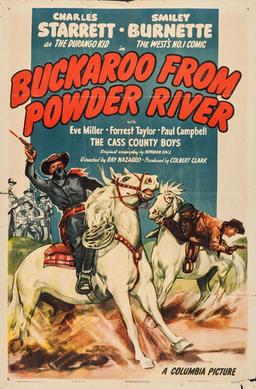
Pop Ryland (Forrest Taylor) is a frontier outlaw who makes law-breaking a family business.  With his two sons, Pop is planning on flooding the territory with counterfeit bonds.  His stepson, Tommy (Paul Campbell), doesn’t want anything to do with any criminal activity so Pop sends for McCall (Frank McCarroll), an assassin.  In a letter, Pop explains that he wants his stepson murdered.  When federal agent Steve Lacey (Charles Starrett) captures McCall, he finds the letter.  Steve heads into town and goes undercover, pretending to be McCall.  He also uses his other identity, the Durango Kid, to thwart Pop’s plans.

More than usual, this Durango Kid film leans more into the undercover aspect of Steve’s work.  What’s interesting is that, after Tommy fakes his own death, Tommy also disguises himself as the Durano Kid and keeps his stepfather from suspecting that Steve is actually a member of law enforcement.  It’s actually pretty clever, as far as these movies go, and it answers the question of why no one ever wonders why Steve and Durango are never in the same place at the same time.

Smiley Burnette shows up as Steve’s sidekick and he sings a few songs with the The Cass County Boys.  Along with Smiley’s antics, this film has all of the horse chases and gunfights that we expect from a Durango Kid movie.  Most of the usual stock company is present, including Ted Adams and Kermit Maynard.  As always, Charles Starrett looks authentic riding horse and handling a gun.  If you’re not into westerns, this film won’t convert you.  But, for fans of the genre, this is another entertaining outing for the Durango Kid,

The Lone Rider Rides On (1941, directed by Sam Newfield)


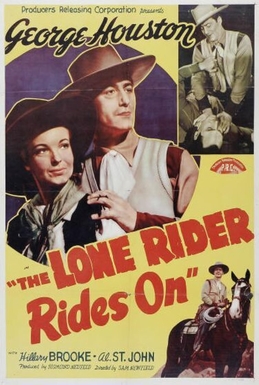
In the days of the wild west, Tom Cameron (George Houston) rides the range alone, seeking vengeance for the murder of his family.  They were killed when their wagon train was ambushed by the same outlaws who has previously sold them a plot of land.  Tom was a child at the time and he only remembers that the leader of the outlaws had a distinctive facial scar.  Tom Cameron is The Lone Rider.

No, not the Long Ranger.  The Lone Rider!  George Houston was an opera star who made for a surprisingly convincing gunslinger and the movie opens with him singing I Am The Lone Rider, just to make sure that it was understood that his vengeance-driven vigilante was a completely different character from that other vengeance-driven vigilante.  The Lone Rider is looking to avenge his family and, with the help of store keeper “Fuzzy” Jones (professional sidekick Al St. John), the Lone Rider does just that.  Though this is a standard B-western, the plot is a little more serious than most other B-movies.  This was the first of several Lone Rider movies and, despite the obviously low budget, there’s some emotional heft to its story.  Tom discovers that his brother (Lee Powell), who he thought had died in the attack, actually survived and joined up with the gang.  The story is about both Tom’s vengeance and his brother’s redemption.  Fans of the genre will enjoy the film’s classic western story and George Houston’s convincing performance as a gunslinger on a mission.

The Lone Rider would ride on for 16 more movies, the last one being released in 1944.  In 1942, George Houston was replaced in the lead role by Robert Livingston.  Houston went from starring in westerns to becoming one of Hollywood’s most respected vocal coaches.  (Howard Keel was one of his students.)  Shortly after the Lone Rider road for the last time, George Houston died while planning his musical comeback.  He had a heart attack and the police, thinking he was just intoxicated, tossed him in the drunk tank where he subsequently died.  He was only 48 years old.

Smoky Canyon (1952, directed by Fred Sears)


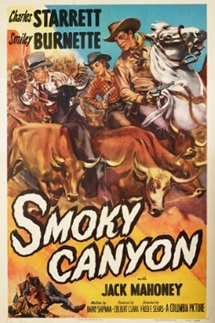
There’s a $2500 dollar reward out for the masked bandit known as the Durango Kid but little do the residents of Timber Rock know that the Kid is actually Steve Brent (Charles Starrett), a Treasury agent who puts on a mask whenever he needs to go undercover and discover what the bad guys are doing.

A range war has broken out between the sheep farmers led by Jack Mahoney (Jock Mahoney) and the cattlemen led by Carl Buckley (Tristram Coffin).  To broker a peace and discover which side is the most to blame, Brent works for the cattlemen while the Durango Kid sides with the sheepmen.  It turns out that Buckley’s to blame here.  He’s using the war to thin out his cattle so that an Eastern beef syndicate can keep prices high.  When Mahoney gets too close to the truth, he is framed for the murder of Mr. Woodstock and it’s up to the Durango Kid to prove that Mahoney is innocent.  Meanwhile, Carl wants to blow up an entire mountain so that it will really thin out his cattle herd.

This is a typical Durango Kid movie, entertaining if you like B-westerns and probably boring if they’re not your thing.  It has all the usual gunfights, horse chases, and dynamite explosions that are promised by every Durango Kid film.  Starrett was always one of the most convincing cowboys on screen, even if his use of the Durango Kid alter ego didn’t always make sense.  All the usual members of the Durango stock company show up, all playing different characters than they did in the previous Durango Kid film.  Mahoney gets to play one of the good guys for once and his spirited girlfriend is played by the lovely Dani Sue Nolan.  Smiley Burnett shows up to provide comic relief.  This time, he’s a singing tour guide.  He sings a song called It’s Got To Get Better.  Let’s hope so.

Renegade Girl (1946, directed by William Berke)


Missouri in 1864.  The Civil War is raging and the state is divided between those who support the Union and those secretly support the Confederate guerillas led by Willian Quantrill (Ray Corrigan).  The Union’s Major Baker (Jack Holt) is determined to track down rebel Bob Shelby (Jimmie Martin) and he enlists the Native American Chief Whitecloud (played by Chief Thundercloud) to help find him.  Whitecloud has a personal vendetta against the Shelby family and, when he finds Bob, he executes him in cold blood.  Bob’s sister, Jean Shelby (Ann Savage), is also a Confederate sympathizer and she seeks revenge.  Complicating things is that Jean has fallen in love with Union Captain Fred Raymond (Alan Curtis).

One of the many B-westerns produced by Robert L. Lippert and directed by William Berke, Renegade Girl packs a lot of plot into just 65 minutes.  The action is nonstop and fans of westerns will find all of the horse chases, gunfights, and threats of hanging that they could want.  The main thing that distinguishes Renegade Girl from other B-westerns is the fierce performance of Ann Savage as Jean Shelby, a woman who will not stop until she gets her revenge.  While the film’s portrayal of the Quantrill and Chief Whitecloud definitely goes against modern sensibilities, Ann Savage’s performance feels ahead of her time.  No one is going to stand in Jean Shelby’s way.

Chief Thundercloud’s real name was reportedly Victor Daniels, though his past is shrouded in mystery.  He claimed to be a Cherokee from Arizona, though he was listed as being Mexican on a marriage record that was filed before he started his film career.  As Chief Thundercloud, he was a mainstay in westerns from the 30s to the time of his death in 1955.  He was the first actor to play the Lone Ranger’s Tonto and he also played Geronimo in a 1939 Paramount film of the same name.  His final film role was a posthumous appearance in John Ford’s The Searchers.

Chip of the Flying U (1939, directed by Ralph Staub)


In this B-western, Johnny Mack Brown plays Chip Bennett, the foreman of the Flying U Ranch.  The ranch is owned by J.G. Whitmore (Forrest Taylor) and his daughter (Doris Weston), who has just returned from college and who has eyes for Dusty (Bob Baker), a singing ranchhand.

Ed Duncan (Anthony Warde) and his gang are in the arms smuggling business.  To make their business a success, they need access to the ranch, which sits on the shore of a lake.  Knowing that Chip would never let them take over, Duncan tries to frame Chip for a bank robbery and murder.  Chip responds by kidnapping two of Duncan’s men, leading to a final and explosive shootout.

Chip of the Flying U is a western that doesn’t seem to know what era it’s supposed to be taking place in.  Chip, Duncan, and all of the other ranch hands dress like they’re in the late 1800s.  Doris Weston dresses like she’s just stepped out of a 1930s photoshoot.  Duncan is trying to smuggle hand grenades, which were invented in 1908 but not commonly used until World War I.  The movie’s time period is all over the place but that was frequently the case with the B-westerns of the 30s.  Shot on studio backlots and for a very low budget, these films were not concerned with historical accuracy.  Instead, they were about shootouts and a few songs.  Chip of the Flying U offers up both, along with Fuzzy Knight as the comedic sidekick who turns out to be very good with a rifle.

With lots of horse chases and bloodless shoot-outs and not too much romance, this movie may seem creaky by today’s standards but probably thrilled the kids who caught while spending an afternoon at the movies in 1939.  Today, the appeal of movies like this is that the good guys are unquestionably good and the bad guys are unquestionably bad.  They remind us of a simpler time that may have never existed but we all hope it did.

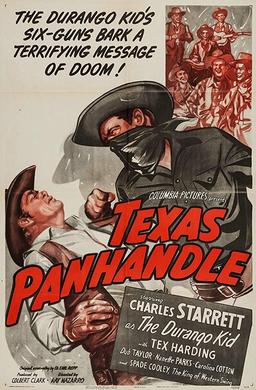
Texas Panhandle (1945, directed by Ray Nazarro)


Secret Service agent Steve Buckner (Charles Starrett) is told by his boss that his activities as the Durango Kid have led some in the Agency to suspect that Steve is himself an outlaw.  Even after Steve explains that he only takes on the Durango Kid identity when he needs to step outside of the law to protect innocent people, Steve is still suspended pending an investigation.

With nothing better to do, Steve rides off to the Texas panhandle, where he learns that outlaws have been robbing settlers and stealing government gold.  Working as the Durango Kid, Steve discovers that it’s not just outlaws that are targeting the new arrivals but it’s also the corrupt head of the local land office, Ace Gatlin (Forest Taylor).  Helping out Steve are settler Tex Harding and Cannonball (Dub Taylor), who works at the saloon and sings a few songs.

This is a standard Durango Kid film.  It has all the usual gunfights and horse chases but it doesn’t have Smiley Burnette.  Dub Taylor takes Smiley’s place as the comedic sidekick and, while Taylor isn’t bad, he’s still no Smiley Burnette.  Dub Taylor’s characters were usually more buffoonish than the clever helpers played by Smiley Burnette and, as a result, the Durango Kid movies with Taylor feel more juvenile than the ones with Smiley.  That’s the case here.

This installment is interesting because it reveals that Steve’s superiors knew about his Durango Kid side hustle and were as a confused about why he needed it as everyone else was.  Steve reveals he would rather lose his job than give up being Durango.  Luckily, at the end of the movie, he gets a telegram telling him that the investigation is over and he’s been reinstated with the Secret Service.  All’s well that ends well.

Lawless Empire (1945, directed by Vernon Keays)


For years, outlaws have controlled the frontier town of Dusty Gulch but now their power is threatened by the homesteaders who are moving into the area.  Led by the crusading Rev. Tex Harding, the homesteaders are being progress and reform to the frontier.

Duke (Ethan Laidlaw) and his gang have launched a campaign of intimidation against the new arrivals.  Luckily, the Durango Kid (Charles Starrett) rides into town to protect the homesteaders.  Duke’s boss, businessman Blaze Howard (John Calvert), decides that the town needs a sheriff to go after the Kid.  Blaze offers the job to newcomer Steve Ranson, not realizing that Steve is not only the Durango Kid but also the brother of the former sheriff, who was murdered by Blaze’s men.

Lawless Empire is one of the few Durango Kid films not to feature Smiley Burnette as Durango’s sidekick.  Instead, Durango rides into town with Bob Wills and his Texas Playboys and, while Willis does perform a song or two, there’s still considerable less singing than in the films that featured Burnette.  The role of comic relief is provided by Dub Taylor in the role of Cannonball.  Cannonball gets a job sweeping up Blaze’s saloon and he feeds whatever information he learns back to Durango.  When Blaze figures out what’s going on, he deliberately supplies Cannonball with bad information but it doesn’t make any difference.  The Durango Kid is always one step ahead of the bad guys.

Lawless Empire is a little more serious than the other Durango Kid films.  Steve is not only trying to clean up the town but he’s also seeking to avenge his brother so there’s not as much room for as much comedy as usual.  Lawless Empire does have all of the usual gunfights and horse chases and the film gets off to an exciting start with Durango making his first appearance with his gun already drawn so that he can disarm Duke and his men.  Even without Smiley around to help him out, Durango brings law to a lawless empire.


The Stranger From Ponca City (1947, directed by Derwin Abrahams)


After spending the past few years cleaning up the west, Steve Leary (Charles Starrett) rides into the town of Red Mound and says that he is ready to buy a ranch and settle down.  What Steve finds is an unfriendly town that is divided between law-abiding citizens on one side and cattle rustlers on the other.  The cattle rustlers want to prevent Steve from purchasing the old Atkins ranch and they’ll do anything to keep the deed from being signed over.  It’s a good thing that Steve also happens to be the legendary Durango Kid.

This is a standard entry in the Durango Kid series.  To me, it’s interesting to see that, even though Steve seems like he wants to settle down and live a peaceful, ranching life, he still can’t bring himself to give up his secret identity.  It is also interesting that Steve cannot escape Smiley Burnette.  This time, Smiley is the owner of Red Mound’s restaurant and he’s accompanied by Texas Jim Lewis and the Lone Star Cowboys.  It seems like Smiley sings even more than usual in this entry.

I liked the opening of The Stranger From Ponca City, in which Steve rides into town and all of the townspeople demand to know which side of Red Mound he supports.  Smiley even explains that food made on one side of the town cannot be taken to the other without it leading to violence.  After the opening sequence, The Stranger From Ponca City focuses on all of the usual horse chases and gunfights that showed up in all of the Durango Kid films.  Most of the Durango Kid stock company shows up as well.  Keep an eye out for Jock Mahoney, playing a bad guy with Kermit Maynard.

Director Derwin Abrahams keeps things moving, even if his direction is not up the level of the work of Durango’s usual directors, Ray Navarro and Fred F. Sears.  This isn’t the best of the Durango Kid films but fans of the genre should enjoy it.

Prairie Roundup (1951, directed by Fred F. Sears)


Steve Carson (Charles Starrett) is wanted for murdering the Durango Kid!

I know that sounds confusing because Steve Carson is the Durango Kid.  The bandit that Carson shot was just disguised as the Durango Kid but actually, he was just a dim-witted outlaw who was set up by Buck Prescott (Frank Fenton), a rustler who was run out of Texas by Steve and who was trying to find a way to stop Steve from investigating his new scheme to cheat a bunch of ranchers in Santa Fe.

Steve is taken to jail but luckily, Smiley Burnette is around to help him break out.  Smiley and Steve head to Santa Fe, where they get jobs working as cowhands at the Eaton Ranch and work to expose Prescott and his gang as being responsible for a series of stampedes.  Smiley sings some songs and Steve resurrects the Durango Kid from the dead.

This was one of the later Durango Kid films.  The range war plot is one that showed up in many Durango Kid films but Prairie Roundup adds something new to the formula but having Steve framed for murdering himself.  Steve could prove his innocence by revealing that he’s actually the Durango Kid but Steve is determined to maintain his secret identity.  I’ve seen several Durango Kid films and I still don’t really understand why Steve felt he needed a secret identity in the first place.  But Prairie Roundup shows the extent to which he’ll go to keep it.

There’s plenty of fight and horse chases, more than enough to keep western fans happy.  Smiley Burnette gets to throw some punches along with singing all of his usual songs.  It’s also nice to see the lovely Mary Castle in the role of Toni Eaton, the daughter of one of the ranchers who has been targeted by Prescott.  Featuring less stock footage than usual, Prairie Roundup is a worthy entry in the Durango Kid series.

Deputy Marshal (1948, directed by William Berke)


Deputy Marshal Ed Garry (Jon Hall) is pursuing two bank robbers in Wyoming when he comes across a wounded man.  Harley Masters (Wheaton Chambers) has been shot in the gut but his main concern is holding onto his hat.  Ed takes Harley into town.  They go into the local saloon, where Harley reveals a map hidden in his hat.  He slips the map to Ed before an unseen gunman shoots him a second time.  This time, Harley does not survive.

With the current sheriff “laid up,” Ed decides to stay in town and not only catch the bank robbers but also solve Harley’s murder.  Ed soon finds himself in the middle of a conflict between two rival women (Frances Langford and Julie Bishop) who own ranches and stand to make a lot of money when the railroad comes through.

Deputy Marshal is one of the B-westerns that was produced by Robert Lippert and directed by William Berke in the 40s and 50s.  This one is a step above the usual Lippert production because it combines a murder mystery with the standard western action and there are enough suspects to keep the story interesting.  Jon Hall was best-known for appearing in exotic adventure films, often playing islanders.  His career was in decline when he starred in Deputy Marshal but he makes for a surprisingly believable western hero.  It helps that Hall was older than the typical B-western hero.  His weathered looks make him convincing as an experienced lawman who understood the ways of the west.

Frances Langford, who plays the nicer of the two ranchers, was married to Jon Hall when she appeared in this film.  She gets to sing two songs because this is a Lippert production and Robert Lippert believed that every western should open with a horse chase and should feature at least one song.

While it obviously never won any awards for originality, Deputy Marshal is a better-than-average B-western with an interesting mystery story and a convincing hero.