Review: The Proposition (dir. by John Hillcoat)


When I first saw John Hillcoat’s film The Proposition I was literally shocked and dumbstruck with what I had just witnessed. As a long-time aficionado of the horror genre I could say that part of me has become desensitized to onscreen violence and nothing really shocks me. Even though I’ve seen films with more violence throughout its running time, The Proposition just had a heavy sense of despair, moral ambiguity, and a Miltonian feel throughout. The film felt like how it would be if one accepted an offer from one of the damned to stroll down to the Nine Circles of Hell. As much as I didn’t want to accept that offer the curiosity of what I might see won out. That’s how I was able to sit through the entirety of Hillcoat’s ultra-violent and nihilistic tale of lawless and amoral individuals in the untamed wilderness of 1880’s Australian Outback.

I must agree with several critics who have said The Proposition seemed to mirror another dark and violent tale. Hillcoat’s film shares so much the same themes and tone as Cormac McCarthy’s brutal novel, Blood Meridian, that one almost wondered if the film was adapted from McCarthy’s great novel. But similarities aside, Hillcoat and Nick Cave’s (director and writer respectively) film can clearly stand on its own two bloody legs.

The film begins with a bloody siege and shootout and we’re soon introduced to two of the three Burns’ brothers. We soon find out that both brothers, Charlie (played by Guy Pearce) and Mikey (played by Richard Wilson), are outlaws wanted for a multitude of heinous crimes with a recent one the senseless rape and murder of the Hopkins family. One Capt. Stanley (Ray Winstone) who acts as law in this particular area of the Outback also happens to be friends of the unfortunate Hopkins clan. When he finally apprehends the two brothers after the siege gives older brother Charlie a proposition. He’ll spare the younger brother’s life from the hangman’s noose if Charlie finds their older brother Arthur (played with Kurtz-like menace by Danny Huston) and kills the outlaw leader. The quest is set as Charlie accepts and sets out to find his elder brother. Whether Charlie will go through with killing his older brother Arthur is one thing the audience won’t find out until the final minutes of the film. Even though there’s no love-lost between Charlie and Arthur, there’s still the traditional bond of family that makes Charlie’s quest a complex one.

We realize early on that Charlie is very protective of his simpler, younger brother Mikey and would do anything to save his life. Guy Pearce does a great performance as the conflicted and brooding Charlie Burns. There’s a quiet intensity in Pearce’s performance. He’s pretty quiet through most of the film, but one could feel the palpable rage just roiling beneath his brooding countenance. Pearce’s Charlie is one who is only a trigger away from exploding into outright violence. Charlie is definitely a child and creation of the lawless Outback the film is set in.

Arthur Burns on the other hand comes in introduced as an almost warrior-poet (though in this story it would be more like a charismatic-sociopath) who would watch the sun set and spout poetry as easily as gun down an innocent or slice a man’s throat without missing beat. Danny Huston does a bravura performance as the charismatic and wholly amoral Arthur. His performance easily matches that of Pearce’s scene for scene. Another performance that I must point out as being very strong in the film is Ray Winstone as Capt. Stanley, the Ahab of the tale with his obsession to bring civilization to the lawless Outback and to bring Arthur Burns to ultimate justice even if it means dealing with the lesser evil that is Charlie Burns.

The Proposition will be talked about alot for its unflinching look at violence onscreen. Though there’s been films that have more violence per hour than Hillcoat’s film, but the extreme brutality of the killings, maimings and rape in The Proposition has such an air of realism to it that one cringes at every gunshot wound and knife slashing. Like Aronofsky’s Requiem for a Dream, this film’s scenes of violence makes one want to rush into the shower and cleanse off the dirt, grime and stink of the film. It’s in this unflinching and realistic portrayal of death and violence that the film shares alot with McCarthy’s Blood Meridian. The images are difficult to watch, but our curiosity makes us look through squinted eyes to see the full breadth of the violence. In time, just through the audiences acceptance of the oncreen violence do we soon become complicit in whats going on the screen.

It is a shame that The Proposition had such a limited release in the US. Even since it’s release on video it’s a film that still seems to be underappreciated. I think this film would’ve done as well as Eastwood’s Unforgiven in giving the audience a different, darker side of the Old West mythology (though its really the Australian Old West). John Hillcoat has crafted himself a brutal and nihilistic film that’s very hard to watch but also difficult to ignore. The Proposition is a film I highly recommend as it is the type of film that helps redefine a whole genre.
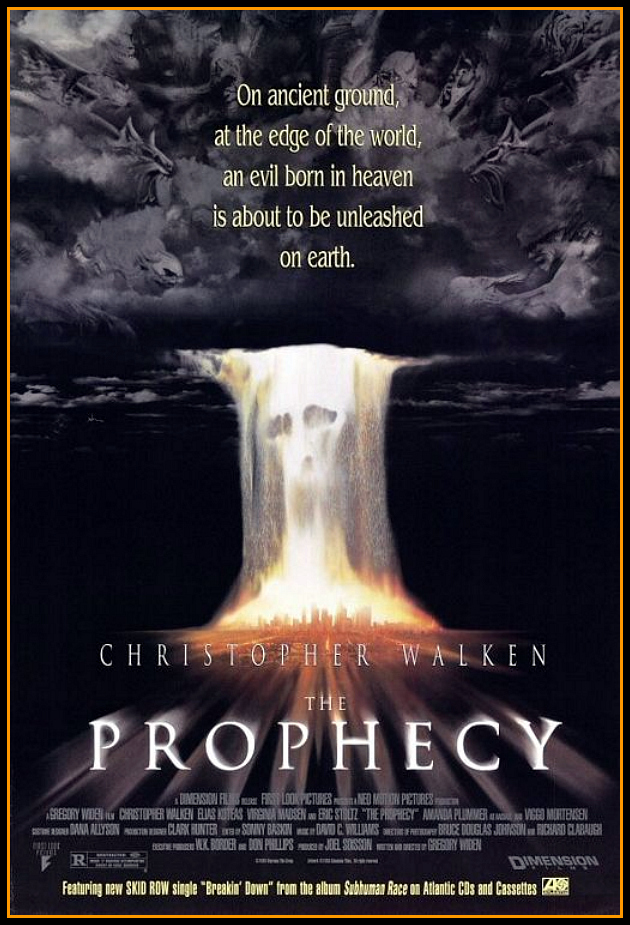
Film Review: The Prophecy (dir. by Gregory Widen)


I first found out about this little cult film starring the very awesome Christopher Walken around 1993 or so when I was at the local Waldenbooks (yes there used to be bookstores not named Barnes & Noble or Borders back in the day) looking at the latest issue of Fangoria. Inside the magazine they were doing a brief feature on an upcoming horror film tentatively called God’s Army. All I saw was that it was to star Christopher Walken and it had gore and angels in it. That alone peaked my interest and I was looking forward to seeing it in the theaters. Almost two years passed and nothing about it was ever heard again until I visited the video rental place near my house and saw a VHS tape (yeah, those big videocassette thingies) with the title of The Prophecy and starring Christopher Walken.

This was the film I was so hyped to seeing in the theaters. The title had changed from it’s earlier (and much cooler) one of God’s Army. It would seem that it’s film distributor had little to no faith in the box-office potential of the film and just delayed it’s release to the point that when it did come out no one knew about it barely anyone saw it. It was a real damn shame since filmmaker Gregory Widen made such a good film that was able to mash-up horror, angels and a detective story all in one without creating a mess of things.

The Prophecy was about the war in heaven we were never taught about in Sunday school. We all know about the war in heaven where Lucifer and the rebel angels who followed him tried to overthrow God. That didn’t go over so well for Lucifer and he and his band of fallen angels were cast out into Hell by God and his right-hand man the Archangel Michael. This film talks about the second war in heaven soon thereafter which no one outside those who wrote little-known apocryphal texts about it (and being apocryphal they never were included in the Bible). This war now had a new group of angels led by the Archangel Gabriel rebelling against God for choosing humans (talking monkeys as these new rebels called them) above all living creatures including the angels themselves for God’s love. This war was now in a state of stalemate after countless millenia, but a prophecy about a soul so dark and evil was to be the tipping point for either side. This particular soul was to be found on Earth and whoever acquires it would break the stalemate and finally bring this second war to an end.

With this in mind we have Walken as the Archangel Gabriel coming down to Earth to look for this soul so he can finally win the war for his side (which also means the end of mankind). It’s the angel Simon (played by Eric Stoltz) who comes down to stop him from getting this soul or, at the very least, hide it from Gabriel. With these two factions of angels vying to acquire this soul we have a Detective Thomas Daggett smack in the middle of the case investigating all the weird happenings and deaths surrounding the battle between these two factions. The dead bodies of angels begin to appear on morgue slabs looking like eyeless, hermaphroditic specimens and angelic script found in crime scenes brings Daggett back to his time studying to be a priest before images of angels warring amongst themselves breaks him down and he quits the seminary to become a cop instead.

It would come down to these three factions racing against time to acquire this dark soul.

The film is not as gory as it’s feature in Fangoria made it out to be, but it is quite violent and bloody that I understand why it got the horror label attached to it. It’s more a dark fantasy thriller more than horror. It’s rare in today’s film that we see angels portrayed as the bloodthirsty beings that the really are. The film even points out this oft-ignored detail of God’s messengers. Angels are always the ones God sends to punish or send a very serious message to his chosen beings that is Man. The Prophecy shows this aspect of angels in full light and how their attitudes about humanity might lead some of them to hate God for raising Man above even them.

Christopher Walker does a great job conveying Gabriel’s hate and contempt for humans. His Gabriel is like one of those pundits always on tv (both liberal and consevative) who are so into their sides’ message that they never see the other side as anything but the enemy. One could almost say that Walken’s Gabriel is like then apocalypse-hungry version of Glenn Beck and Keith Olbermann in one body. This is not to say that Walken goes over-the-top with his performance. In fact, he’s quite subdued in how he uses those many tics and voice mannerisms a whole cottage industry has grown around in.

Walken’s portrayal of Gabriel infuses what could’ve become a one-note villain with lots of layers and complexities that the rest of the cast were able to play off from. His character would be terrifying one moment then smoothly switch over to being funny and charming then back to terror. It’s due to his great performance that the other cast members like Stoltz as the weary, loyal angel Simon and Koteas as the fallen religious cop Daggett were able to bring their own performance to another level. This is quite a feat since the dialogue in the film was a mixed bag of horror cliches and interesting Biblical-speak about secret wars, apocryphal books and prophecies. The film even has a nice appearance of the first fallen angel himself and none other than Viggo Mortensen plays Lucifer.

The Prophecy does have a feeling that it was always one misstep away from becoming an awful film. This had happened with 2010’s Legion and did that film about angels and the apocalypse turn out to be a huge steaming pile of shit-turd. But while Dimension Film saw the film fall over on the side of bad for myself and those who have come to admire and love this cult classic the film stayed balance between good and bad. Widen’s film never went over to the side of becoming a truly great film, but it also never fell on the side that Legion ended up on. What Prophecy ended up becoming was a film that was almost grindhouse in nature, but even then it still looked too good with too many good performances to be given that label. The fact that it contains one of Christopher Walken’s best performances speaks well of a film that many critics during it’s early days had dismissed as just another bad horror film.

In the end, this film became just one of the many little-gems that got lost in film studio money politics. I definitely would recommend this cult film to people who haven’t seen it, but I would tell them to stop at just this film and not even go near the four sequels which came after it.