Horror Film Review: Festival of the Living Dead (dir by Jen and Sylvia Soska)


Opening with a montage of scenes from Night of the Living Dead mixed in with actual footage of civil unrest from the 60s, Festival of the Living Dead imagines a world where a zombie outbreak actually did occur in 1968.

Humanity survived.  All of the zombies were apparently put down by human hunters and the plague of the living dead was ended.  In order to commemorate the night of the living dead, a Festival of the Living Dead is held every year at the sight of the zombie outbreak.  Over the past 55 years, the Festival has become a high-priced event that can only be attended by people who are willing to spend a lot of money for the honor to stay in tents, listen to live music, and set fire to a giant wicker woman.  Essentially, the Festival of the Living Dead is Burning Man but instead of basing the festival of new age nonsense, the Festival is based on a zombie outbreak.

Unfortunately, those who attend the Festival have lost sight of what the party is supposed to be about.  Now, instead of celebrating the survival of humanity and paying honor to those who lost their lives (sometimes more than once in one night!), the people attending the Festival are just influencers who are hoping to go viral.  Early on in the film, Iris (Carmen Bicondova) point out how weird and tacky it is to have a festival celebrating an event where so many people died.

This year, the folks at the Festival of the Living Dead are going to be reminded about what the entire festival is supposed to be about!  When one vlogger films himself snorting what he claims to be a crushed meteorite, everyone assumes that he’s just another person looking for online fame.  But soon, he’s foaming at the mouth, throwing up, and then savagely attacking the festival staff.  Of course, those who have seen the original Night of the Living Dead will remember the much-ridiculed scene in which a news reporter is heard to speculate that the dead are coming back to life due to space dust that was brought back to Earth by NASA.  It turns out that reporter knew what he was talking about.  It’s not just a case of Hell no longer having room for the dead.  It’s the meteorites!

Ash (Ashley Moore) and her friends try to survive the Festival of the Living Dead, which turns out to not be an easy task.  Not only are zombies famous for being relentless in their pursuit of the living but the living are famous for reacting to living dead outbreaks in the dumbest ways possible.  Ash has one cool friend, that would be Iris.  Unfortunately, the rest of her friends are nowhere near as smart.  Fortunately, Ash has zombie hunting in her blood.  Though the film doesn’t specifically state it, it’s suggested that her grandfather was Ben, the hero of Night of the Living Dead.

Festival of the Living Dead is a loving homage to Night of the Living Dead and its sequels.  It’s undeniably derivative but it’s also made with so much love for the genre that it doesn’t matter that you’ll be able to guess who is going to live and who is going to die from the minute they first appear onscreen.  Ashley Moore, Carmen Bicondova, and Christian Rose (as the film’s bravest character) all give strong performances and the film’s central joke — which is that everyone at the Festival is either too stoned or too stupid to initially notice the zombie outbreak — is one that works because it’s rooted in fact.  Do you seriously think anyone at Burning Man would notice the living dead?
Horror Film Review: Tales of Terror (dir by Roger Corman)


Eh, anthology films.

I have to admit that I’ve never been a huge fan of anthology films.  Anthology films are almost always a bit uneven.  Some filmmakers are better suited to making short films than others and, as anyone who has ever sat through one can tell you, sitting through a boring short film is actually worse than having to watch a boring long film.  Too often, anthology films are just a collection of boring short films.  If you get lucky, there might be a good segment hidden amongst all of the bad segments.  But even so, that often means sitting through 30 minutes of bad filmmaking for 15 minutes of something that’s moderately entertaining.

1962’s Tales of Terror is an anthology horror film.  Directed by Roger Corman, the film is a part of his Poe cycle and features adaptations of three Poe short stories, Morella, The Black Cat, and The Facts In The Case of M. Valedemar.  While it definitely suffers from the flaws that afflict many anthology films, Tales of Terror is saved a bit by the presence of Vincent Price.  Price not only appears  in all three of the films but he also provides the narration that links each film.  As I mentioned when I reviewed The Premature Burial, one cannot underestimate the importance of Vincent Price and his unique style of acting when it comes to discussing Corman’s Poe adaptations.  With his dramatic flourishes and his theatrical style of speaking, Price was the perfect star for these films.  As an actor, he perfectly complimented Corman’s flamboyant and colorful direction.  It also helps that Price himself seems to be truly enjoying himself in all of these films.  His eccentricity brings the film’s to life.

As for the separate stories that make up Tales of Terror, things get off to a rather macabre start with Morella.  Leonora (Maggie Pierce) returns home to visit her father (Vincent Price), who is now a drunken wreck who continues to blame Leonora for the death of her mother, Morella (Leona Gage).  Morella died while giving birth to Leonora.  Leonora is shocked to discover that her father is keeping her mother’s decomposing body in the mansion.  Leonora, who is suffering from a terminal illness, tries to take care of her father.  However, Morella’s spirit remains in the house, leading this story to a rather depressing and unsettling ending.  This story was effectively done, playing out like a particularly morbid companion to The Fall Of The House of Usher.

The Black Cat is presented as a comedy, starring Peter Lorre as a man who becomes convinced that his wife is cheating on him with a snobby wine taster who is, of course, played by Vincent Price.  This overlong segment did not work for me and I have to admit that a lot of that is because I love cats, black cats in particular.  Beyond that, the humor is a bit too broad.  Corman could do comedy, as he showed with Little Shop of Horrors, but he seems to be trying a bit too hard here.

Finally, the third segment is The Facts In The Case of M. Valdemar, in which Vincent Price plays the title character.  The dying Valdemar employs a hypnotist (Basi Rathbone) to put him in a trance to help relieve his suffering.  However, the hypnotist hopes to marry Valdemar’s wife (Debra Paget) and, after putting Valdemar into a trance, he leaves the dying man there.  Valdemar, whose body starts to decay, cannot die.  But, once he becomes angry enough, he can still rise from his bed to seek revenge even as his body putrefies.  This segment was the best of the three, featuring Price’s best work in the film and also a wonderfully villainous turn from Basil Rathbone.  The makeup effects that were used to capture Valdemar’s decay remain effectively frightening today.

Tales of Terror is two good stories and one mediocre one, which is better than the usual anthology film.  Still, not surprisingly, the main reason watch is for the wonderful Vincent Price.

Horror on the Lens: Trilogy of Terror (dir by Dan Curtis)


For today’s horror on the Lens we have a made-for-TV movie that was produced and directed by Dan Curtis.

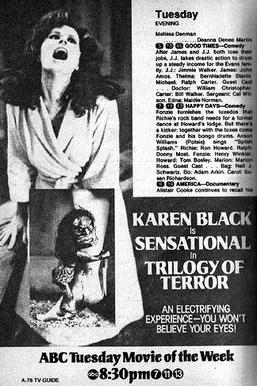
Trilogy of Terror, which aired in 1975, is an anthology film, featuring three segments that were each based on a short story from Richard Matheson.  What makes this particular film special is that each segment features Karen Black playing a radically different character from the previous segment.  The film really is a showcase for this underrated actress, though Black herself later said that the film ruined her career because it typecast her as a horror actress.

The third segment is the one that gets all the attention.  That’s the one with the killer doll.  I like all of the segments, though.  The first one is often considered to be the weakest but anyone who has ever been through a similar situation will appreciate it as tale of revenge.  The second segment has a playful vibe that I liked.  And yes, the third segment is genuinely frightening.

From 1975, here is Trilogy of Terror:

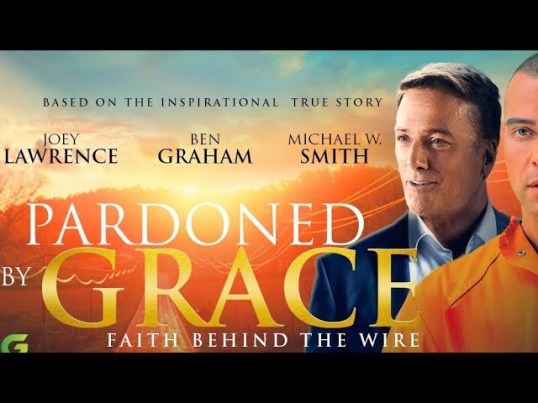
October Positivity: Pardoned By Grace (dir by Kevan Otto)


Wait, what’s this?

A sincere and heartfelt faith-based film that works largely due to a sensitive and likable performance from Joey Lawrence?

Well, stranger things have happened.

2022’s Pardoned By Grace tells the story of Scott Highberger (portrayed by Joey Lawrence).  Scott is a screw-up.  From the first time we see him until roughly until about an hour into this film, Scott is always doing something wrong.  He starts out the film as a small town drug addict and dealer and, throughout the course of Pardoned By Grace, he is consistently tempted to retuning to that lifestyle.  He’s someone who has spent his entire life being told that he’s never going to amount to anything and that he’s destined to be a failure so it kind of makes sense that he wouldn’t be worried too much about following the laws of conventional society.

The film follows Scott as he goes in and out of prison.  The warden, the guards, and even the other prisoners all know that Scott is capable of being more than just a convict but Scott himself cannot find the faith to keep from getting into trouble.  Whenever he’s released, he messes up and he’s sent back to jail.  At one point, he even gets a good job and he starts making a lot of money and that’s all it takes for him to start using cocaine again.

Finally, after having alienated every member of his family and committed one too many crimes, Scott finds himself in a church, where he listens to a sermon from Pastor Dave (Michael W. Smith).  Dave instinctively hires Scott to handle odd jobs at the church.  While Scott cleans up the place and stacks chair and tries to live an honest life, Dave makes plans for his prison ministry.  Scott is excited when he’s invited to take part in the ministry but then he learns that he won’t be allowed to enter any prisons to preach because he still has a years-old warrant out for his arrest.  Scott heads to Florida, where he turns himself into the police, even though he knows that, as a repeat offender, he is looking at a potential life sentence as a result.

Pardoned by Grace works surprisingly well.  Joey Lawrence is not exactly the first person who comes to mind when you think of an actor with tremendous dramatic range but he is still likable and earnest as Scott, a man who is determined to atone for his past mistakes and to take responsibility for his actions, even if it means losing his freedom.  If anything, Lawrence’s limited range actually makes him a good pick for Scott, who is initially portrayed as being someone who does whatever he feels has to be done in the moment with very little consideration given to what his actions could mean in the future.  As well, one doesn’t have to be religious to appreciate the film’s portrait of a justice system that is so obsessed with punishment that it’s forgotten that one of the purposes of prison is rehabilitation.  Scott is not someone who wants to be a criminal but it’s not prison that helps him to move on from his old ways.  Instead, it’s the faith of someone who is willing to give him a second chance.

Pardoned by Grace was surprisingly good.

A Blast From The Past: Final Curtain (dir by Edward D. Wood, Jr.)


1957’s Final Curtain is a short, 22-minute film in which a mysterious man (Duke Moore) wanders around a creepy and seemingly abandoned theater.  While Dudley Manlove (who played Eros the Alien in Plan Nine From Outer Space) provides narration, the man sees many strange things in the theater.  What is real and what is merely a hallucination?  Watch to find out!

Final Curtain was envisioned, by director Edward D. Wood, as being the pilot for a horror anthology series.  Though none of the networks were interested in buying Wood’s proposed series, Wood considered Final Curtain to be his finest film and it certainly is a bit more atmospheric than the typical Wood film.  The role of the mysterious man was written for Bela Lugosi but, after Lugosi passed away, Duke Moore was cast in the role instead.

From 1957, here is Final Curtain.

4 Shots From 4 Films: Special Dan Curtis Edition


4 (or more) Shots From 4 (or more) Films is just what it says it is, 4 (or more) shots from 4 (or more) of our favorite films. As opposed to the reviews and recaps that we usually post, 4 (or more) Shots From 4 (or more) Films lets the visuals do the talking.

Today’s edition of 4 Shots from 4 Films is dedicated to one of the most underrated horror directors around, Dan Curtis!

It’s time for….

4 Shots From 4 Dan Curtis Films

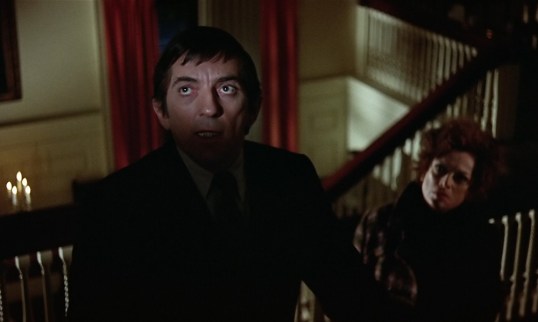
House of Dark Shadows (1970, dir by Dan Curtis, DP: Arthur Ornitz)

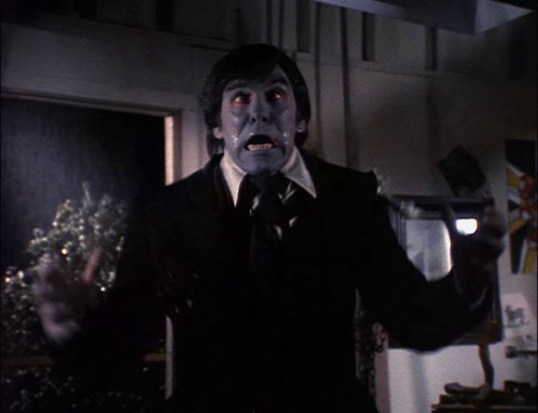
The Norliss Tapes (1973, dir by Dan Curtis, DP: Ben Colman)

Trilogy of Terror (1975, dir by Dan Curtis. DP: Paul Lohmann)

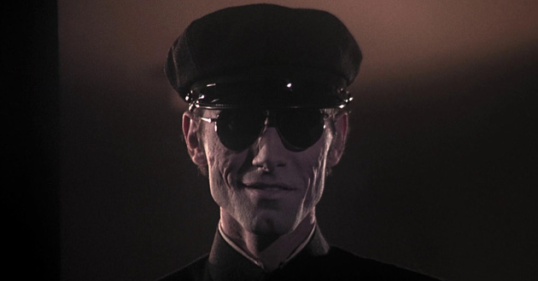
Burnt Offerings (1976, dir by Dan Curtis, DP: Jacques R. Marquette)

Horror on the Lens: The Norliss Tapes (dir by Dan Curtis)


The Norliss Tapes (1973, dir by Dan Curtis)

Today’s Horror on the Lens is The Norliss Tapes, a 1973 made-for-TV movie that was also a pilot for a television series that, unfortunately, was never put into production.

Reporter David Norliss (Roy Thinnes) has disappeared.  His friend and publisher, Stanford Evans (Don Porter), listens to the tapes that Norliss recorded before vanishing. (Stanford Evans, it must be said, is a great name for an editor.)  Each tape details yet another paranormal investigation.  (Presumably, had the series been picked up, each tape would have been a different episode.)  The first tape tells how Norliss investigated the mysterious death of an artist who apparently returned from the grave.

For a made-for-TV movie, The Norliss Tapes is pretty good.  It’s full of atmosphere and features a genuinely menaching yellow-eyed zombie monster. The film was directed by Dan Curtis, who was responsible for several made-for-TV horror films and who also created the deathless TV show, Dark Shadows. Curtis also directed a few feature films. Burnt Offerings, for instance, will be forever beloved for its scene of annoying little Lee Montgomery getting crushed by a chimney. If you ever get a chance to listen to the director’s commentary that Dan Curtis recorded for the Burnt Offerings DVD release, you must do so. Curtis comes across as the crankiest man on the planet and it’s actually kind of fascinating to listen to. His irritation when Karen Black keeps asking him if he knows the name of the actor who played the ghostly chauffeur is truly an amazing thing to here. (For the record, the actor’s name was Anthony James, he also had important supporting roles in two best picture winners — In The Heat of the Night and Unforgiven — and yes, he was one of the best things about Burnt Offerings. Karen Black knew what she was talking about.)

But back to The Norliss Tapes!

Admittedly, this is not the first Halloween in which I’ve shared The Norliss Tapes with our readers. Back in both 2015 and 2021, The Norliss Tapes was one of our “horrors on the lens.” Unfortunately, there’s only so many good quality, public domain horror films available on YouTube so, occasionally, a movie is going to show up more than once over the years. But, as long as it’s good film, who cares?

Enjoy The Norliss Tapes!

6 Ed Wood Trailers For Horrorthon


Since the 10th of October was the 100th anniversary of the birth of director Edward D. Wood, Jr., it seems appropriate to dedicate this week’s edition of Lisa Marie’s Favorite Grindhouse Trailers to him!

Below …. can you handle six trailers for six Ed Wood films!?

Watch, if you dare!

  1. Glen or Glenda (1953)

2. Jail Bait (1954)

3. Bride of the Monster (1955)

4. Plan 9 From Outer Space (1957)

5. The Sinister Urge (1960)

6. Meatcleaver Massacre (1977)

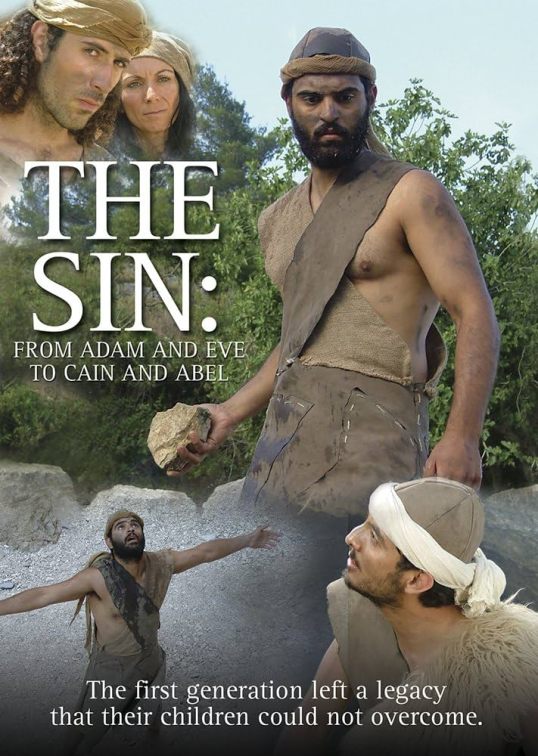
October Positivity: The Sin: From Adam and Eve to Cain and Abel (dir by Robert Savo)


2017’s The Sin tells a familiar story.

Shortly after creating the world and the first people, God allows Adam (Ayman Nahas) and Eve (Khawlah Hag-Debsy) to live in the Garden of Eden.  He only gives them one major rule to follow.  They can eat from any tree except for the Tree of Knowledge.  They’ve got all the food that they could possibly want, as long as they don’t break that one very simple rule.  Eve promptly breaks that rule, taking the advice of a serpent and eating an apple.  She then convinces Adam to do the same.  When God asks Adam whether or not he ate from the tree, he lies.  Then he tries to put all the blame on Eve.  God responds by kicking them out of the Garden and cursing them to suffer on Earth.

Adam and Eve wander the Earth, arguing nonstop about who is to blame.  Finally, they stop arguing long enough for Eve to get pregnant.  In the film, they are depicted as having two sons, Cain (Shredi Jabarin) and Abel (Nahed Bashir).  Abel is the gentle sheep herder.  Cain is the farmer who sees everything as a competition.  When God prefers Abel’s offering of a lamb to Cain’s offering of some nuts and berries, Cain murders his brother and then lies about it.

And, needless to say, everything’s been going downhill ever since.

This is a short film, barely clocking in at 50 minutes.  It tells the story faithfully enough, though it leaves out Seth and Adam and Eve’s other children.  (Perhaps that’s to avoid discussing the possibility that Cain and Seth ended up marrying their own sisters.  I mean, they had to populate the Earth somehow)  The main problem with the film is the acting.  The actors playing Adam and Eve both come across as being rather goofy and the scenes of them arguing about who is to blame feel more like petulant nagging than an actual discussion about who is to blame for bringing sin into the world.  As for Cain and Abel, Abel is kind of wimpy while Cain comes across as being the worst dumbass teenager ever.  The scene were Cain start to shout “competition” over and over again made me smile a bit too much, considering that I knew this was going to lead to the first murder.

On the plus side, the film refrains from putting all the blame on Eve.  While Eve may have been the first to bite into the forbidden fruit, Adam made his choice and then he not only lied about it but tried to put all the blame on Eve.  If anything, this film suggests that Adam was punished less for what he did and more because he refused to accept responsibility for his actions.  By that same token, Cain’s murder was bad but his refusal to take responsibility for his actions showed that he was beyond redemption.

As a final note, let me just say that it’s always amazing to me the odd and obscure things that you can find on Tubi if you just spend a few minutes scrolling through your list of recommendations.

Horror Scenes I Love: Sherlock Holmes vs Jack the Ripper in Murder By Decree


Though I may not agree with the film’s conclusions, Bob Clark’s 1979 film Murder By Decree is still the best of the Jack the Ripper films.

This scene, featuring the final battle between Sherlock Holmes (Christopher Plummer) and the Ripper, is not only full of fog-shrouded atmosphere but it also features one of the most savage portrayals of Jack the Ripper.