Film Review: La Dolce Vita (dir by Federico Fellini)


The great director Federico Fellini was born, on this day, 125 years ago.

He was born in Rimini.  That’s in Northern Italy.  (The Italian side of my family comes from Southern Italy and yes, there is a difference.)  Fellini was 19 years old when he enrolled in law school but records, which were admittedly spotty at the time, seem to indicate that he never attended a single class.  Instead, Fellini found work as a writer, working first as a journalist and then a screenwriter.  (He was one of the many credited for writing the screenplay for Rome, Open City.)  He began his directing career as a neorealist in the 50s but soon crafted his own unique style, one which openly mixed humor with drama and fantasy with earthiness.  Fellini established himself as one of the world’s best directors, a filmmaker who made art films that not only entertained but also provoked thought.  Fellini was a director who embraced life’s contradictions as well as being a strong anti-authoritarian who rarely commented on politics but did make known his distaste for communism.  He was also one of Mario Bava’s best friends.

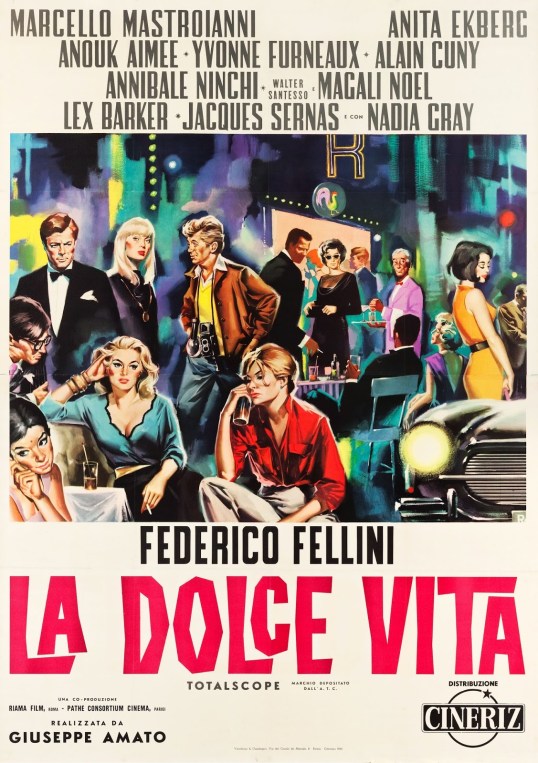
My favorite Fellini film is 1960’s La Dolce Vita.

Ah, to be rich, decadent, and jaded in Rome in the early 60s!  Or maybe not.  Sometimes, being jaded is not as much fun as it seems.

La Dolce Vita is largely remembered for the scene in which actress Sylvia (Anita Ekberg) and journalist Marcello (Marcello Mastroianni) wade into Rome’s Trevi Fountain.  While that it is a great and sensual scene and justifiably famous (and, in fact, the film’s poster was originally a shot of Ekberg in the fountain despite the fact that the scene is only a small part of a 3-hour movie), it’s often overlooked that the scene itself does not have a happy ending.  When Marcello and Sylvia return to Sylvia’s hotel, Sylvia is slapped by her loutish boyfriend (played by Lex Barker).  Marcello, meanwhile, has a fiancée named Emma (Yvonne Furneaux) who is recovering from a recent overdose.  Even though Marcello swears that he loves Emma and that he would do anything for her, he is still compulsively unfaithful.

When we first meet Marcello, he’s in a news helicopter, watching as a statue of Jesus is flown over Rome.  However, Marcello is distracted by the sight of a group of women sunbathing on a nearby rooftop and he tries to get their phone numbers before returning to following the statue.  That pretty much sets the tone for most of what we see of Marcello over the course of La Dolce Vita.  He’s searching for the profound and transcendent but he frequently gets distracted by his own more earthy desires.

The film follows Marcello as he encounters different people in Rome and the surrounding area.  Some of them are rich and some of them are poor.  All of them are looking for something but none of them seem to be quite sure what it is.  A possible sighting of the Madonna brings a crowd of people to the outskirts of Rome, where everyone asks for something but the end result is only chaos.  A meeting with an intellectual friend of Marcello seems to offer a solution to Marcello’s ennui until a tragedy reveals that his friend was even more lost than Marcello.  (The film’s sudden tragic turn took me very much by surprise when I first saw it, despite the fact that countless filmmakers have imitated the moment since.)  A possibly important conversation on a beach is made unintelligible by the crashing waves and, instead of providing enlightenment, it ends with a shrugs and an enigmatic smile.  There’s a definite strain melancholy running through the film though there’s also a certain joi de vivre to many of Marcello’s adventures.  Marcello is torn between seeking transcendence and seeking pleasure.  Fellini shows us that both are equally important.  It’s left to use to decide whether the pleasure is worth the heartache and vice versa.

La Dolce Vita is visually stunning portrait of life in Rome at a very particular cultural moment.  Marcello Mastroianni is the epitome of decadent cool in the lead role but he’s also a good enough actor to let us see that Marcello is never quite as proud of himself or as happt with his life as everyone assumes he is.  La Dolce Vita may be about a specific cultural moment but, as a film, it is timeless.

Scenes That I Love: Terence Stamp Goes For A Drive in Fellini’s Toby Dammit


The great Italian director, Federico Fellini, was born 104 years ago today.

Today’s scene that I love comes from Toby Dammit, Fellini’s contribution to the 1968 anthology film, Spirits of the Dead.  In this scene, a narcissistic actor (Terence Stamp) goes for a very fast drive through a very haunted Rome.


Scenes That I Love: The Final Scene of Federico Fellini’s La Dolce Vita


100 years ago today, the great Federico Fellini was born in Rimini, Italy.  It seems appropriate that today’s scene of the day should come from my favorite Fellini film, 1960’s La Dolce Vita.

In this scene, which occurs at the end of the film, jaded journalist Marcello Rubini (Marcello Mastroianni) finds himself hung over on the beach, watching as a group of people pulls a dead sea serpent out of the ocean.  The serpent appears to be a giant squid of some sort.  Myself, I’ve always felt that it was the equivalent of the Biblical Leviathan and maybe the fish that swallowed Jonah.  Regardless of the fish’s history, it’s now dead but, as Marcello points out, its eyes continue to stare.  The people on the beach are less interested in what the fish is and instead more concerned with what they can do with the carcass.

Marcello looks away from them and sees a young woman named Paola (Valeria Ciangottini) standing at the other end of the beach, calling out and motioning to him.  Marcello attempts to hear what Paola is saying but he cannot hear her words over the sounds of the ocean.  For once, Marcello, the journalist and the high society insider, does not know what is being said.  Finally, Marcello walks away with another woman, leaving Paola’s message a mystery.

What was Paola saying?  Perhaps, in the end, that’s not as important as what we think she may have been saying.  (Sofia Coppola later played a sort of homage to this ending with the final scene of Lost In Translation.)  Marcello missed the message but the good life — La Dolce Vita — continues.

https://www.youtube.com/watch?v=pIkFea5aO1g

Short Horror Film Review: Spirits of the Dead — Toby Dammit (dir by Federico Fellini)


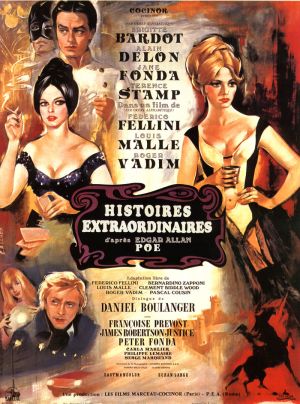
Directed by Federico Fellini, Toby Dammit was the third and final part of the 1968 anthology movie, Spirits of the Dead.

All three parts of Spirits of the Dead were based on a short story by Edgar Allan Poe.  Toby Dammit was based on Never Bet The Devil Your Head.  It seems appropriate that Fellini was the only director to rename his adaptation.  While Toby Dammit may be based on Poe’s story, it’s definitely Fellini’s film.

Terrence Stamp plays Toby Dammit, a former Shakespearean actor turned dissolute film star.  As is quickly established, Toby is an alcoholic.  As we watch him stumble through this film, alternatively bitter and flamboyant, we’re reminded of the stories of other British thespians who were legendary drinkers: Oliver Reed, Trevor Howard, David Hemmings, Peter O’Toole, and others.  With his Shakespearean background, it’s tempting to assume that Toby is meant to be a stand-in for Richard Burton but he actually bears a greater resemblance to Richard Harris.

(If you’re wondering how I came to be an expert on British alcoholics, might I recommend a short but informative book called Hellraisers: The Life and Inebriated Times of Richard Burton, Richard Harris, Peter O’Toole & Oliver Reed.  It was written by Robert Sellers and it makes for very interesting reading.  Especially the parts about Oliver Reed.)

Toby has come to Rome, to work on a film.  He doesn’t seem to be quite sure what the film is about or what role he’ll be playing.  (Judging from what the people around him say, it appears to be a biblical epic and Toby will be playing Jesus.)  While Toby floats through the city in an alcoholic haze, sycophants and fans surround him.  While he sits in the back set of a limo, a fortune teller looks at his palm and gets a worried look on her face.  Toby doesn’t care.  He just wants to get the Ferrari that the film’s producers promised him.

The only thing that worries Toby is the little girl that he keeps seeing out of the corner of his eye.  She bounces a white ball and whenever Toby sees her, a truly evil smile cross her face.  Interestingly, Fellini always frames the girl so that, like Toby, we only seem to be seeing her out of the corner of our eye.  Is she real or is she a figment of Toby’s alcohol-addled brain?  And what are we to make of the fact that Toby’s normally noise-filled world goes silent whenever he sees the girl?
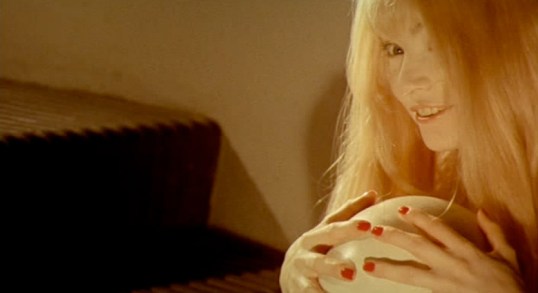
On a talk show, Toby is asked how he visualizes the devil.  He says that he doesn’t see the devil as being a demon with horns or an old man.  (Interestingly enough, that’s how Poe portrayed the Devil in the original short story.)  Instead, he sees the devil as being a little girl with a ball.

However, Toby can’t spend too much time worrying about the little girl.  He just got his Ferrari…

Toby Dammit is the only unqualified success among the three short films that make up Spirits of the Dead.  I think it helps that, unlike Roger Vadim and Louis Malle, Fellini updated Poe’s story to the 20th Century and set it in the international film world.  If Malle and Vadim both seemed detached from their segments, Fellini knew the world that he was depicting.  I imagine he certainly was acquainted with plenty of actors who were just like the brilliant but self-destructive Toby Dammit.

The images of frequently dream-like.  Everything is filmed slightly off-center, mirroring Toby’s hazy view of existence.  When he sits in his limo, the world outside looks like the ruins of some sort of apocalyptic hellscape.  When he is on a talk show or at an awards show, Toby still seems to be isolated from all of the adoring people around him.  The few times that he does talk to other people, he does so without looking at them.  In fact, the only person who seems to truly capture Toby’s attention is that little girl with the ball.

Speaking of which, it seems obvious that Toby Dammit was meant to be a bit of an homage to Fellini’s friend and fellow director, Mario Bava.  Not only is the film’s color scheme very Bavaesque but that little girl will look familiar to anyone who has ever seen Kill, Baby, Kill.

Valerio Valeri in Mario Bava’s Kill, Baby, Kill
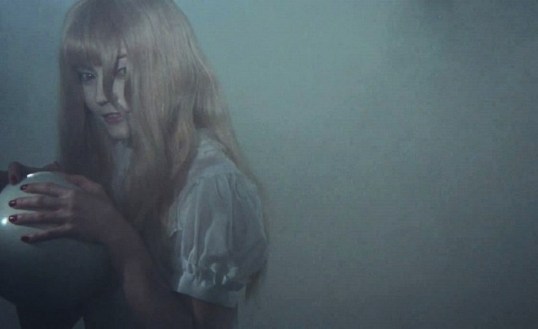
Marina Yaru in Federico Fellini’s Toby Dammit

Toby Dammit is definitely the best part of Spirits of the Dead.  It’s a true Italian horror classic.
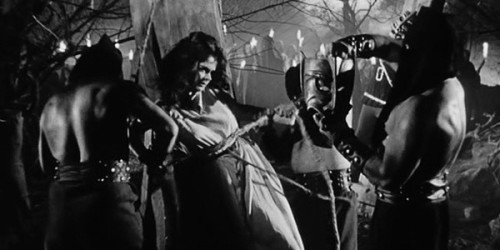
4 Shots From 4 Films: Black Sunday, 8 1/2, I maniaci, Caged Heat


4 Shots From 4 Films is just what it says it is, 4 shots from 4 of our favorite films. As opposed to the reviews and recaps that we usually post, 4 Shots From 4 Films is all about letting the visuals do the talking.

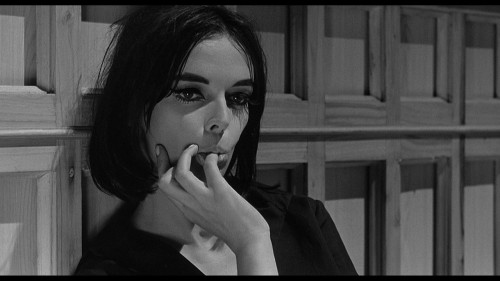
Happy birthday to the wonderful and iconic actress, Barbara Steele!

4 Shots From 4 Films

Black Sunday (1960, dir by Mario Bava)

Black Sunday (1960, dir by Mario Bava)

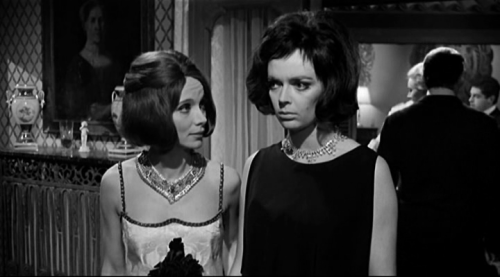
8  1/2 (1963, dir by Federico Fellini)

8 1/2 (1963, dir by Federico Fellini)

I maniaci (1964, dir by Lucio Fulci)

I maniaci (1964, dir by Lucio Fulci)

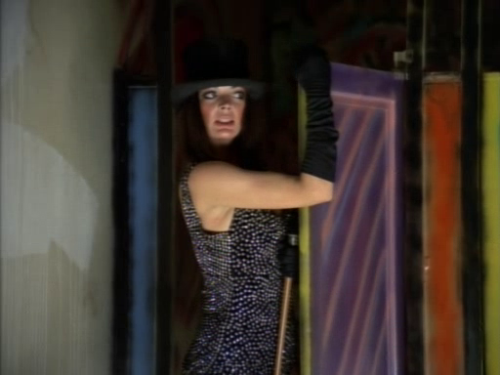
Caged Heat (1974, dir by Jonathan Demme)

Caged Heat (1974, dir by Jonathan Demme)


Scenes That I Love: Anita Ekberg and Marcello Mastroianni In The Trevi Fountain


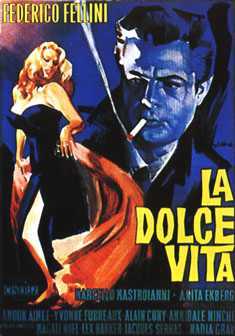
La_Dolce_Vita_(1960_film)_coverart

Anita Ekberg, RIP

This famous and iconic scene is taken from Federico Fellini’s 1960 film, La Dolce Vita.  The film follows tabloid journalist Marcello (Marcello Mastroianni) over the course of 7 days and 7 nights.  He spends the 2nd day pursuing a famous actress named Sylvia (Anita Ekberg).  As the day comes to an end, he finds Anita wading into the Trevi Fountain.

As famous and celebrated as this scene is, it’s often forgotten that it ultimately ends with Sylvia being slapped by her loutish boyfriend, Robert (Lex Barker).  That slap is not included in the video below but that’s okay.  For today, at least, let’s allow Sylvia her happiness.

http://www.youtube.com/watch?v=T4kZjU7zGbU

Dino De Laurentiis, R.I.P.


I read earlier that film producer Dino De Laurentiis died on Wednesday.  He was 91 years old and he either produced or helped to finance over a 150 movies.  He started his career with Federico Fellini and went on to produce two of the iconic pop art films of the 60s, Roger Vadim’s Barbarella and Mario Bava’s Danger: Diabolik.  Then in the 70s he went through the most infamous stage of his career when he produced several overblown “event” films like the 1976 remake of King Kong.  However, even while De Laurentiis was devoting his time and effort to critically reviled attempts at spectacle, he was also supporting the visions of independent directors like David Lynch.  In the 21st Century, De Laurentiis was probably best known for producing the Hannibal Lecter films.

De Laurentiis, born in Naples, was a Southern Italian and, not surprisingly, was one of those legendary, larger-than-life moguls who built his career walking on the thin line between the Mainstream and the Grindhouse.  Hollywood is run by people who try to be De Laurentiis but De Laurentiis was the real thing. 

Dino De Laurentiis, R.I.P.

(On a personal note, De Laurentiis produced one of my favorite films of all time, Bound.  And I’m a fourth-Southern Italian myself.  Southern Italians are the best.)