Afraid of the Dark (1991, directed by Mark Peploe)


Lucas (Ben Keyworth) is an 11-year-old boy who lives in London and who enjoys watching the neighborhood through his telescope.  Because Lucas’s mother is blind, Lucas is concerned that there is a serial killer who is going around and attacking blind women.  Lucas is determined to help his father (James Fox), an inspector with Scotland Yard, capture the killer.  Lucas starts to sneak out of the house, visiting cemeteries and spying on the same blind women that the killer is stalking.  Investigating on his own, Lucas discovers who the killer might be.

Or does he?

Outside of the imaginary world where he spends most of his time, Lucas is a shy boy and his father is not a detective but instead a florist.  While Lucas’s mother actually is blind, Lucas himself is starting to lose his eyesight as well.  Lucas is scheduled to undergo an experimental surgery.  He’s due to go under the knife, just as surely as the victims of the serial killer that he thinks he’s hunting.  Meanwhile, his mother is pregnant and the increasingly unstable Lucas is both obsessed with his older stepsister and jealous of all the attention that his new baby sister is already getting.

Afraid of the Dark is a British psychological thriller that deserves to be better known.  Intelligently written and directed Mark Peploe, it’s both a poignant and a frightening look at a child who, due to being forced to deal with something that few others can understand, has retreated so far into his own imaginary world (where he can be the hero) that he can no longer tell what is real and what isn’t.  Lucas is both frightening and sympathetic and the movie will keep viewers guessing as to what is real and what isn’t.  James Fox and Fanny Ardant are perfectly cast as Lucas’s parents and David Thewlis, Paul McGann, and Robert Stephens all make an impression as the men who Lucas investigates in his search for the serial killer.  Tense, intelligent, and surprising, Afraid of the Dark is a film that is worth discovering.
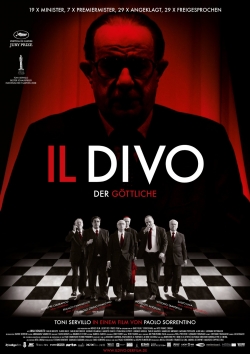
The International Lens: Il Divo (dir by Paolo Sorrentino)


Earlier tonight, as I watched the 2008 Italian film, Il Divo, it occurred to me that political corruption really is an international language.

The film is heavily stylized biopic of Giulio Andreotti.  Andreotti (who died five years after the release of this film) is nearly unknown figure in the United States but, in Italy, he spent several decades as a member of the country’s political elite.  He was a controversial figure, a man who served several terms as prime minister and was later appointed senator for life but who was also accused of being politically corrupt and affiliated with some of the worst elements of the Mafia.  People who threatened to investigate Andreotti or who could have contributed to his downfall had a habit of ending up dead.  No sooner has Il Divo begun then we’re treated to a lengthy montage of Andreotti’s associates getting killed in various ways.  Some are gunned down.  One is found hanging underneath a bridge.  One is in an exploding car.  The film also opens with a title card that informs us that, over the course of Andreotti’s long career, he was rumored to be one of the leading members of the P2, a masonic lodge that counted among its members some of the most powerful men in Italy.  P2 is one of those organizations that conspiracy theorists love to obsess upon.

Directed by Paolo Sorrentino, Il Divo is an Italian film that deals with the life of a prominent Italian political figure and, needless to say, it was made for an Italian audience.  For an American viewer like me, it was often impossible not to get confused as I tried to keep up with who was working with who and who had just been killed.  In short, this film was made to be viewed by people who already know who Guilo Andreotti was and who are familiar with the details of his long career.  It was not made for someone like me who is still struggling to wrap her mind around the fact that Italy has both a prime minister and a president.

But, in the end, it really didn’t matter if I occasionally struggled to follow every twist and turn of Andreotti’s career.  Il Divo may technically by a biopic of Giulio Andreotti but, on a larger scale, it’s about how power corrupts and the banality of evil.  Those are universal themes and you certainly do not have to be any particular nationality to be familiar with the fact that people who dedicate their lives to accumulating political power often turn out to be, at the very least, willing to cut some ethical corners.  I may not have always understood every detail of Il Divo‘s story but I did understand exactly what the film was ultimately about.

As played by Toni Servillo, Andreotti does not come across as being  particularly charismatic politician.  With his hunched back and his bat-like ears, Andreotti almost seems like a caricature of a corrupt leader.  In the film, one immediately sees that Andreotti hasn’t held onto his power because he’s particularly loved by the people.  Instead, he’s held onto power by being smarter than those who would try to defeat him.  No matter how determined his enemies may be, Andreotti is always just a little bit more ruthless.  Andreotti succeeds because he’s willing to do what he has to do to succeed and he’s willing to ally himself with people who have a stake in his continued success.  While the film never comes out and says that Andreotti was personally responsible for ordering the deaths of any of his enemies, it does suggest that he purposefully surrounded himself with men who would do anything to keep Andreotti in power, if just to protect their own fiefdoms of corruption.

There’s an early scene in Il Divo where Andreotti’s allies all arrives for a meeting with the prime minister.  Most of them are politicians.  One of them is a cardinal.  Another is simply identified as being a “businessman.”  They pull up in their expensive cars and then we watch as they walk across the screen in slow motion, arrogantly confident in the fact that they’re above any and all legal or ethical considerations.  They’re all wealthy men and they all seem to understand the importance of keeping Andreotti happy.  Carlo Buccirosso plays Paolo Cirino Pomicino, who was one of Andreotti’s chief allies.  Buccirosso plays Pomincino as being glibly hyperactive, a cheerfully corrupt ball of energy who seems to be having all of the fun that Andreotti denies himself.  Because Andreotti denies himself an interest in anything other than wielding and holding power, he is invulnerable to attack and prosecution but sometimes it’s hard not to wonder if he would have rather have been Pomincino, dancing at parties and sliding across tiled floors.

Indeed, Andreotti begins and ends Il Divo as an enigma.  How deeply involved is he in the murders occurring around him?  Is he ordering them or is he just turning a blind eye?  What makes Andeotti tick?  By the end of the film, his main motivation seems to be bitterness.  Death may be inevitable but he’s not going to go until everyone else goes first.  That is a motivation that many politicians across the world probably share.  Corruption is universal.

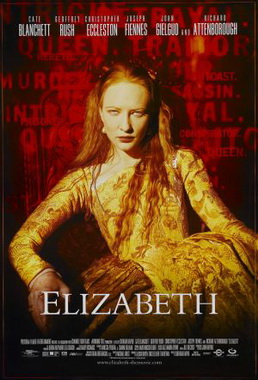
Embracing the Melodrama Part II #97: Elizabeth (dir by Shekhar Kapur)


Elizabeth_Poster“I am no man’s Elizabeth!”

— Queen Elizabeth I (Cate Blanchett) in Elizabeth (1998)

I have to admit that I always feel guilty about the fact that I love movies about British royal history.  After all, I have roots in Northern Ireland and I was raised Catholic.  If anything, I should refuse to watch films about British royalty on general principle.  I should be writing more reviews of films like Bloody Sunday.

But I can’t help myself.  Whether it’s because I enjoy looking at all of the costumes or I just have a thing for movies set in drafty old castles, I have a weakness for films about British royalty.  (And I will also admit that I sat through the entire royal wedding and I have a bit of a girlcrush on both Pippa and Kate Middleton.  As I said, I just can’t help myself.)

Of course, some of it definitely has to do with the fact that I’m an unapologetic history nerd.  I am fascinated with how people lived in the past.  And, of course, anyone who shares my obsession understands that, when it comes to history, there’s both the official story and the truth.  The official story is something that’s passed down over the centuries.  It’s what we learn in school.  The truth, however, is always far more obscure.  The truth is what historians piece together from what little gossipy evidence has managed to survive the passage of time.

We all know that the official story of Queen Elizabeth I is that she was England’s greatest Queen, she defeated the Spanish Armada, and she never married.  She was the “Virgin Queen,” forsaking love to serve her nation.  That’s the official story but is it the truth?

That’s the question at the heart of the 1998 Best Picture nominee Elizabeth.  Now, don’t get me wrong.  I’m not arguing that Elizabeth represents the truth.  Historically, the film is messy and full of speculation that is less based on evidence and more on the desire to keep things cinematic.  But still, Elizabeth is an interesting film specifically because it takes a historical figure and dares to suggest that she may have been human before she became an icon.

Cate Blanchett gives a great performance in the role of Elizabeth.  When we first meet her, she’s a somewhat silly girl who is less concerned with politics and religion and more concerned with her boyfriend, Robert Dudley (Joseph Fiennes).  Elizabeth is also the protestant half-sister of Catholic Queen Mary (Kathy Burke).  Mary is planning on ordering Elizabeth’s execution but dies of stomach cancer before she gets around to singing the order.

Suddenly, Elizabeth is Queen of England.  Young and insecure, she is, at first, manipulated by advisors like William Cecil (Richard Attenbrough), who pressures her to marry the cross-dressing Henry III (Vincent Cassel) of France.  Meanwhile, the Pope (John Gielgud) signs an order calling for Elizabeth’s death.  Catholic nobleman Thomas Howard (Christopher Eccleston) and mysterious priest John Ballard (Daniel Craig) conspire to assassinate Elizabeth.  With even Robert Dudley giving her reason to distrust him, Elizabeth discovers that her only ally is the enigmatic and ruthless “spymaster,” Francis Walsingham (Geoffrey Rush). It all ultimately ends in a sequence that basically transports the finale of The Godfather to the Elizabethan era.

I really should not like Elizabeth.  It’s undoubtedly an anti-Catholic film, though it’s nothing compared to the histrionic anti-Catholicism of its sequel, Elizabeth: The Golden Age.  But I can’t help myself, I enjoyed Elizabeth.  It was impossible for me not to relate to Cate Blanchett’s passionate performance.  (And there was just something so incredibly hot about the way Joseph Fiennes, with his intense eyes, would stare at her.)  When you ignore the film’s protestant bias and just concentrate on the performances and the gorgeous production design, you can’t help but love Elizabeth.